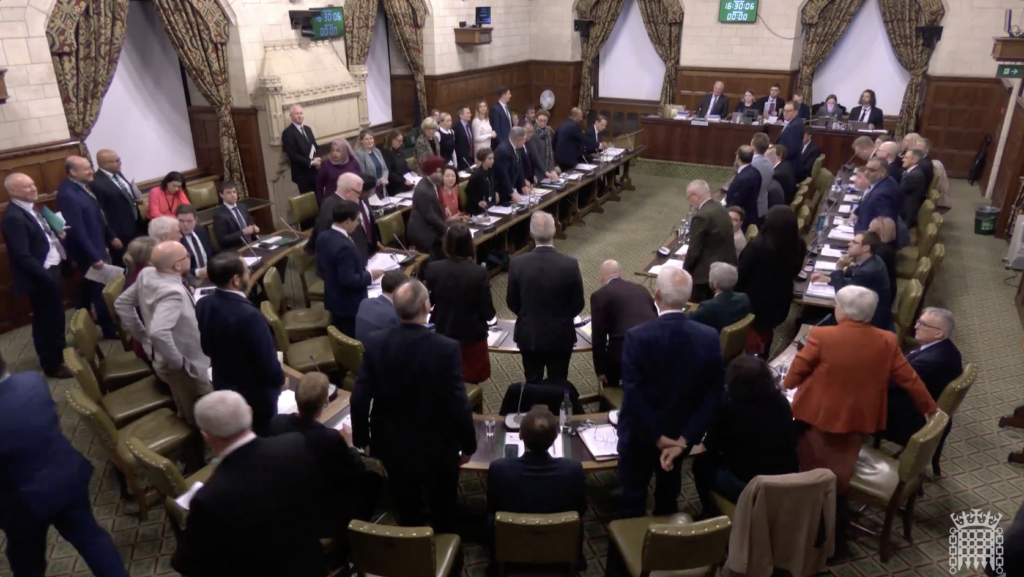
Westminster Hall acts as a second debating chamber for MPs.
The debates held in Westminster Hall are designed to give backbench MPs the opportunity to discuss topics that would not otherwise be heard in the main chamber. These include local constituency matters, the reports of select committees and public e-petitions.
Ministers cannot apply for Westminster Hall debates. Shadow ministers are not expected to apply. However, both a government minister from the relevant department and shadow minister deliver contributions towards the end of a debate.
This means Westminster Hall debates are a means by which backbench MPs can secure an on-the-record response to a particular local or national issue.
The chamber itself, also known as the Grand Committee Room, is located off the main Westminster Hall. Unlike the main chamber in the House of Commons, it has a U-shaped seating arrangement.
When did Westminster Hall debates start, and why?
Sittings in Westminster Hall were established in 1999 as part of a package of parliamentary reforms recommended by the House of Commons modernisation committee. The primary purpose was to significantly increase the time available for backbench-led debates.
This parallel chamber helps counterbalance the focus of the commons on core government business, such as passing legislation and major policy statements. It ensures that a wide range of other issues can be fully aired without extending sitting hours.
Until the end of the 2010 parliament, Westminster Hall debates took place on motions for the adjournment. Westminster Hall debates, which still hold similarities with adjournment debates (which take place in the commons chamber), now take place on a specific motion. The motion is phrased: “That the House has considered [a specific matter]”.
Types of Westminster Hall debate
A wide variety of debates are scheduled in Westminster Hall each week.
The majority of debates are on topics chosen by individual backbench MPs. Time slots, typically for 30, 60, or 90-minute debates, are allocated to MPs either through a regular ballot run by the Speaker’s Office (the ballot takes place on sitting Tuesdays), or by the independent commons backbench business committee. This latter body schedules debates on subjects that have significant cross-party support.
Another function of Westminster Hall is to debate the subject of parliamentary e-petitions. Any e-petition on the official Parliament website that reaches 100,000 signatures is considered for a debate. If granted, these debates are held in Westminster Hall, usually on a Monday afternoon.
Time is also regularly allocated for debates on the reports published by House of Commons select committees.
How Westminster Hall debates work
MPs can apply for a Westminster Hall debate electronically via their MemberHub portal or by filling in an application form.
The sponsoring MP opens the debate, after which other interested MPs then contribute. They begin by moving the motion, stating: “I beg to move that the House has considered [subject of debate]”. A government minister from the relevant department must provide a response at the end of the debate. Because debates take place on motions expressed in neutral terms no votes are taken.
Evaluation question
To what extent do Westminster Hall debates contribute to effective parliamentary scrutiny, and how significant is their practical impact?
Debates in Westminster Hall follow the same rules around language, relevance, forms of address, sub judice, dress and so forth as the commons chamber.
Debates in Westminster Hall are presided over by a member of the panel of chairs. The panel of chairs is made up of MPs chosen by the House of Commons speaker, typically at the beginning of every parliament, to chair public bill committees, other commons general committees, as well as Westminster Hall debates.
The chairman of the ways and means committee (the senior deputy speaker) supervises the arrangements for sittings in Westminster Hall, serving as chair of the panel of chairs.
Westminster Hall debates: timings
Sittings in Westminster Hall take place on four days each week:
- Mondays (4.30pm-7.30pm): e-petition debates scheduled by the petitions committee.
- Tuesdays (9.30am-11.30am and 2.30pm-5.30pm): debates secured by MPs through a ballot run by the Speaker’s Office. The backbench business committee may allocate the 90-minute Tuesday morning slot.
- Wednesdays (9.30am-11.30am and 2.30pm-5.30pm): debates secured by MPs through the ballot system.
- Thursdays (1.30pm-4.30pm): debates chosen by the backbench business committee or on select committee reports selected by the liaison committee, which receives roughly half of the available Thursday time.
If a division is called in the main chamber of the House of Commons, the Westminster Hall sitting is suspended. The lost time is added at the end.
Additional resources
- TheyWorkForYou – Recent Westminster Hall debates: https://www.theyworkforyou.com/whall/

