What is the law?
Since 1 March 2017, any driver caught using their mobile phone while driving is liable to six points on their licence and a £200 fine.
Prior to 2021, rules meant that drivers could only be prosecuted for “interactive communication” behind the wheel such as texting or talking on a handheld phone.
However, a new rule change brings the law in line with technological developments, meaning drivers can now be penalised for taking photos or changing a song on their Smart Phone. The new rules thtat came into effect in March 2022 were promoted in an £800,000 awareness campaign.
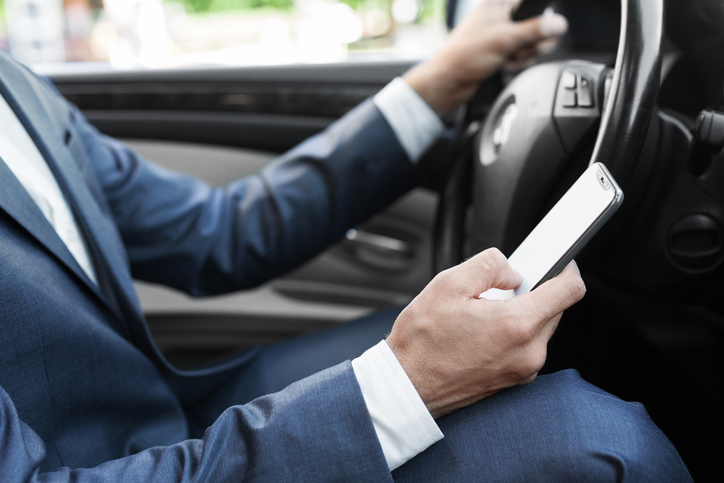


In 2021 it will become illegal to touch a mobile phone when drivingCurrent legislation states that no person shall drive a motor vehicle on a road while using a handheld mobile phone or a handheld device of a kind specified by the Act. As such it is normally still an offence to make calls during on-the-road stops, for example, at traffic lights or in traffic jams.
Although the use of a mobile phone is an offence in its own right, it can also be a contributory factor in relation to other offences such as careless and dangerous driving and, in the most serious cases where death occurs, causing death by careless or dangerous driving.
The regulations make exceptions for 999 and other emergency service calls, and for calls made in response to a “genuine emergency”. Drivers can also use their mobiles for contactless payments if a vehicle is stationary at a drive-thru takeaway.
Currently it is still legal for a driver to access their mobile phone through purely voice commands. However, drivers must always remain in proper control of their vehicle when doing so, otherwise they run the risk of committing other offences like driving without due care and attention.
A history of the law around driving and mobile phones
The Initial Rules – 2003
Regulations prohibiting the use of a hand held mobile phone or similar device when driving were introduced on 1st December 2003.
Prior to the introduction of the regulations, there were no specific controls governing the use of mobile phones while driving, although drivers could be prosecuted for driving without due care and attention.
It was widely felt that mobile phone use when driving increased the risk of accidents, and this was confirmed by the Stewart Report of 2000, which warned that the practice could have a detrimental effect on driving standards, and was reconfirmed by a 2003 assessment carried out by the Department for Transport’s road safety division.
In 2003, the Royal Society for the Prevention of Accidents claimed to have evidence that at least 20 road deaths since 1998 had involved mobile phone use, but the Society said that there were likely to have been many more, as the cause of accidents is not recorded.
Research by the Transport Research Laboratory in 2002 warned that drivers on mobiles had even worse reaction and stopping times than those under the influence of alcohol.
Pressure to act on the issue was spurred by the Government’s Road Safety Strategy, ‘Tomorrow’s Roads – Safer for Everyone’ which set a target for reducing the number of deaths and serious injuries on British roads by 40 per cent by 2010.
To make mobile phone calls legally while driving, a motorist must use a hands-free kit and have the handset held in a ‘cradle’. The regulations only apply to passengers where the passenger is a driving instructor, instructing a learner. Cyclists are not affected by the regulations. The use of two-way radios is exempt, but the Government maintained that using them, and mobiles with hands-free sets, was still distracting and may leave a driver liable for prosecution for driving without due care and attention.
Tougher penalties – 2007 – 2017
In February 2007, drivers caught using a mobile phone while driving faced a fine of £60 and three penalty points; The fine for drivers of goods vehicles, buses or coaches could reach £2,500.
Since 1 March 2017, any driver caught using their mobile phone while driving a car is liable to six points on their licence and a £200 fine.
Further tightening of definitions – 2021
Many road safety campaigners feel that the regulations do not go far enough because they are ambiguous about what a ‘device’ might be and do not ban calls with hands-free kits.
In 2018 figures from the Department of Transport, reported that drivers using mobile phones were responsible for 33 yearly deaths on Britain’s roads. At the same time, a report from the RAC claimed that 25% of drivers admitted to having used their mobile phone when driving during the last year.
In 2019, the Commons Transport Select Committee explored the dangers of hands-free phone use and recommended that the Government, “…explore options for extending the ban on driving while using a hand-held mobile phone or other device, to hands-free devices.”
Opponents of this potential change counter that mobile phones are no more distracting than many other driver activities that have no specific provisions made for them, such as talking to a passenger.
However, in 2021, the government has announced further measures to tighten the law on mobile phone use when driving, extending it to all uses of a mobile phone when at the wheel.
Controversies
Enforcement
The effectiveness of police enforcement relating to the use of mobile phones when driving has long been controversial. In the first week of the ban, Scottish police forces issued just 20 tickets, whilst English forces announced a two-month amnesty to allow drivers to “get used to” the measures.
With surveys showing that 25% of drivers still use their mobile phone when driving, and statistics that showing 33 people are still killed each year on the road in an accident where a driver has been using a mobile phone, road safety campaigners argue that the current regime, both in terms of public education and enforcement is not proving effective.
The ban is intrinsically difficult to enforce, as the offender must be caught in the act. In November 2016 the Department for Transport, acknowledged that “detection can be difficult as mobile phones can be used surreptitiously while driving”. It committed to providing “additional guidance or advice and consider new technology where it aids detection and ensure effective prosecution by the police”.
Technology recently developed by Norfolk County Council’s Road Safety team in partnership with vehicle sign technology firm Westcot is now able to detect whether a mobile phone is in use within a car. If a scanner senses a phone in use in a car, a symbol of a mobile with a line through it then flashes up on a road sign as drivers pass by.
Added dangers with smart phones
Rapid advances in technology in the form of smartphones have added a new dimension to the risks of using a mobile while driving.
The ‘RAC Report on Motoring 2011’ reported that a significant number of drivers in the 17-24 age group and a slightly lower number in the 25-44 age group admitted to accessing email, Facebook or other social networking sites and other apps while behind the wheel.
Further research published in March 2012, carried out by the Institute of Advanced Motorists and the Transport Research Laboratory, which assessed the effects on young drivers using smartphones to access Facebook, found that in every test their driving performance was adversely affected.
The researchers concluded that when compared with previous studies, this study showed that using smartphones for social networking when driving was more dangerous than drink -driving or being high on cannabis.
The Institute of Advanced Motorists called for government action to highlight the dangers of using smartphones behind the wheel and suggested that phone manufacturers and social network providers also had a key role to play in spreading the message.
Statistics
Evidence suggests that the use of a hand-held mobile phone whilst driving was a contributory factor in 21 fatal accidents (1%) and 84 serious accidents (0.5%) in 2014 and there is a strong indication that this was underreported […] recent surveys commissioned by DfT have found a persistent number of drivers that reportedly use a hand-held mobile phone. [Source, Department for Transport, 2016]
A campaign using unmarked Police Vehicles called Operation Tramline found evidence of ongoing widespread non-compliance with 109 of the 231 vehicles stopped were stopped for mobile phone offences. [Source, Department for Transport, 2016]
Official figures show that the number of Fixed Penalties issued in England and Wales for using a hand-held mobile phone while driving fell significantly, from a peak of 123,100 in 2011 to a low of 16,900 in 2015- [Source – Home Office: Fixed penalty notices issued by offence type, England and Wales, 2001 to 2015].
Using a smartphone for social networking slows reaction times by 37.6 per cent; texting slows reaction times by 37.4 per cent; hands-free mobile phone conversation slows reaction times by 26.5 per cent. By contrast, cannabis slows reaction times by 21 per cent, alcohol (above UK driving limit but below 100mg per 100ml of blood) slows reaction time by between six and 15 per cent; alcohol at the legal limit slows reaction times by 12.5 per cent. [Source: IAM – March 2012]
25% of drivers admit that they have used their phones whilst driving at some point in the last year. 25% of people admit to making or receiving a call when behind the wheel, 39% admit to making or receiving a call whilst the car is stopped but the engine is running. 19% of drivers have checked texts, emails or social media when driving (40% have done so with the stationery but with the engine running). 16% have actually posted on social media or sent texts or emails whilst driving (33% with the car idling). And 14% of drivers have taken photos whilst driving (22% with the car idling). RAC, 2018 Report on Motoring.
Quotes
“This research shows how incredibly dangerous using smartphones while driving is, yet unbelievably it is a relatively common practice….. It’s antisocial networking and it’s more dangerous than drink -driving and it must become just as socially unacceptable.” – Institute of Advanced Motoring, Chief Executive, Simon Best – March 2012
“I will do everything in my power to keep road users safe, which is why I am taking a zero-tolerance approach to those who decide to risk lives by using their phone behind the wheel. I’m ensuring anyone who chooses to break this vital law can face punishment for doing so, and we’ll continue our efforts to ensure our roads remain among the safest in the world”. Transport Secretary, Grant Shapps MP. March 2022.