What are Landfill Sites?
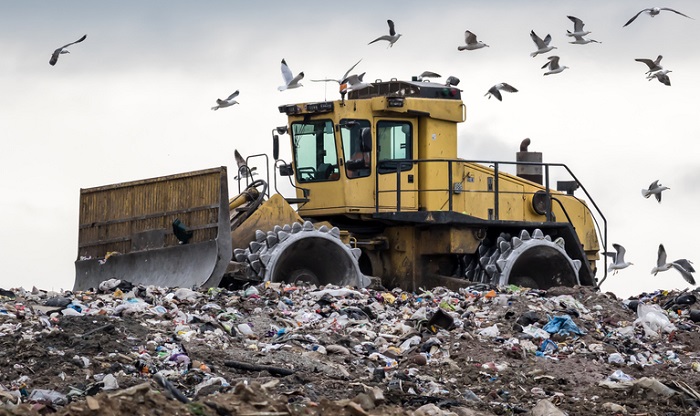
Landfill sites are solid waste disposal sites, where both active and inert waste is deposited and compacted, and then periodically covered over with a layer of soil. Their purpose is to minimise the volume of non-recyclable solid waste material, and store it with minimal danger to the public. Landfill sites must be licensed by the Government.
Once a landfill is full and stops taking waste, it is now capped and restored. This process is designed to avoid harmful effects from historic landfill sites. Plastic waste, in particular, that has been disposed in landfill, fails to degrade and can last for centuries. It not dealt with appropriately, it poses issues for animals who might get caught or ingest it, and for nearby habitats and rivers when chemicals leach from the plastic.
The after uses made of closed landfill sites include nature conservation, woodland, public amenity or agriculture. Closed and contained landfill sites are subject to long-term environmental monitoring and aftercare management.
The standard rate of landfill tax has increased twelve fold since it was first introduced in 1996.
The declining use of landfilling
Landfill as a means of waste disposal goes back to the dawn of civilisation, with archaeologists having discovered sites in the vicinity of the Minoan capital of Knossos on Crete dating back to 3,000 BC. What to do about waste then has long been a problem for governments. Historically landfill was the most commonly used approach for waste disposal in the United Kingdom.


However during the last quarter of century there has been a marked switch away from landfill waste. Although the introduction of the landfill tax has made a contribution in reducing the financial attractiveness of landfill, the decline in landfill has also been influenced by improvements in recycling systems and a change in public attitudes to recycling, alongside a separate growth in the energy for waste sector.
Although there are also substantial volumes of residual waste that are not recyclable or suitable for fuel use, and which appear likely to continue to need to be safely disposed of by landfill, landfill is now seen as the lowest rung within the waste hierarchy.
Within the waste system, the priority is on preventing the creation of waste in the first place, followed by preparing waste for reuse; to recycling and recovery, with disposal in landfill considered the worst, option.
In the contest of climate change, methane, and greenhouse gas emissions, there has also been concern about how landfill disposal creates landfill gas. Landfill gas occurs naturally as byproduct of the decomposition of organic matter in landfills. Landfill gas is composed evenly of methane gas (the primary component of natural gas), and carbon dioxide.
In the ten years between 2010 and 2020 there was a 72% reduction in the weight of local authority collected waste sent to landfill.
The amount of plastic waste going to landfill fell from 122,400 tonnes in 2012 to 53,400 tonnes in 2016.
The government has now set a waste management target under which the amount of municipal waste going to landfill would drop down to 10% by 2035, with the elimination of all food waste going to landfill by 2030. The government has also been keen to eliminate all biodegradable waste going to landfill by 2030.
The landfill tax
Landfill Tax is an environmental tax paid on top of normal landfill rates by any company, local authority or other organisation that wishes to dispose of waste in landfill. It is intended to encourage alternative means of waste disposal, such as recycling, by reflecting the environmental costs of landfill use more accurately in its price.
A landfill operator is responsible for the landfill tax – the costs are passed on to users as higher prices. Landfill Tax is collected from operators by HM Customs and Excise.
Landfill Tax operates at two rates: a standard rate for active waste (substances that either decay or contaminate land – which includes household waste); and a lower rate for inert materials.
Materials qualifying for the lower rate are listed in the Schedule to the Landfill Tax (Qualifying Material) Order 1996. They are generally rocks and soils, ceramics and concrete, unused minerals, furnace slags, ash and low-activity inorganic compounds and water. Calcium sulphate, calcium hydroxide and brine qualify only if they are disposed of in specific containers.
The Landfill Tax was first introduced by the Conservative government in 1996 as part of a strategy entitled ‘Making Waste Work’. The Government hailed it as “the UK’s first tax with an explicit environmental purpose”. The initial aim was to achieve a 25 per cent recycling rate for household waste.
Based on the weight of the waste deposited, the Landfill tax applies the polluter pays principle, incentivising the disposal of less waste through landfill and encouraging the recovery of more value from waste through recycling.
Initially introduced at the standard rate of £7 per tonne, the subsequent Labour government (1997-2010) and Coalition/Conservative government (2010-) have since set about increasing the rate of landfill tax considerably. In 2022 the standard rates for landfill tax were £98.60 per tonne for active waste and a lower rate of £3.15 per tonne for inactive waste. This was an increase from £96.70 per tonne and £3.10 per tonne in 2021.
Landfill tax revenues fell to £566 million in 2020/21 compared to £641 million in 2019/20.
Critics of landfill tax in the past have argued that it has spawned an increase in fly-tipping, the dumping of rubbish, and the use of unlicensed and illegal waste sites.
Supporters of the landfill tax point to the decline in landfill waste, to argue that the landfill tax has played a part in reducing the demand for landfill and driving beneficial changes in behavior.