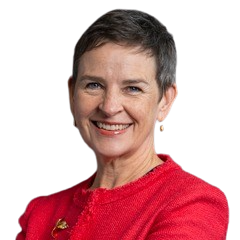
Mary Creagh is the Labour MP for Coventry East.
Creagh was first elected to parliament at the 2005 general election for the constituency of Wakefield. She lost her seat in parliament at the 2019 general election to Conservative Imran Khan.
Creagh returned to parliament at the 2024 general election.
In the 2024 general election for the Coventry East constituency, Creagh received 18,308 votes, representing 49.5% of the vote share. The Reform UK candidate, Iddrisu Sufyan, came second with 6,685 votes (18.1%), while the Conservative candidate, Sarah Lesadd, secured 6,240 votes (16.9%). Creagh was duly elected with a majority of 11,623.
The Coventry East constituency is located in the West Midlands within the city of Coventry.
The seat was re-established for the 2024 general election following boundary changes. It is primarily formed from the abolished Coventry North East constituency. The seat encompasses areas such as Foleshill, Longford, Wyken and Walsgrave on Sowe. The immediate predecessor MP for the area was Labour’s Colleen Fletcher.
Creagh was appointed Commander of the Order of the British Empire (CBE) in the 2021 Birthday Honours for parliamentary and political services.
Political Career
Creagh served as the parliamentary under-secretary of state for nature in the Department for Environment, Food and Rural Affairs from July 2024 to July 2026. She left government as part of the July 2026 reshuffle conducted by Andy Burnham upon his appointment as prime minister.
In her previous stint in parliament, Creagh held several frontbench positions. She was shadow secretary of state for international development (November 2014 – September 2015), shadow secretary of state for transport (October 2013 – November 2014) and shadow secretary of state for environment, food and rural affairs (October 2010 – October 2013).
Creagh was briefly an opposition whip and shadow minister for health following the 2010 general election.
Earlier in her parliamentary career, Creagh served as an assistant government whip (June 2009 – May 2010) and was parliamentary private secretary (PPS) to the chief secretary to the Treasury from 2007 to 2010. A PPS acts as an unpaid parliamentary assistant, providing a link between the senior frontbencher and backbench MPs. Creagh was also a PPS to Andy Burnham as secretary of state for culture, media and sport from 2006 to 2009.
Creagh stood as a candidate in the 2015 Labour leadership election. The election followed the resignation of Ed Miliband after the party’s defeat in the 2015 general election and was the first to be held under a “one member, one vote” system.
Creagh launched her campaign in an article for the Daily Mail, styled as a pitch to “Middle England”.
She wrote: “Our [2015 general election] campaign message focused almost exclusively on the NHS, an emotive issue for many of us, but in the end, not people’s main motivation for voting.”
She added: “People felt that Labour didn’t understand their aspiration to earn money and provide a better life for their family. People trust Labour to look after their schools, hospitals and council services. But they simply do not trust us to run the economy and make them better off. That must change.
“I am launching my bid to be the leader of the Labour Party. I want to earn back the trust that Middle England has lost in the Labour Party. We forgot the hard-learned lessons of our last three election victories; that to win elections a party needs to offer hope.”
Creagh withdrew from the contest on 12 June 2015 after securing only 10 nominations from the parliamentary Labour Party (PLP) – far short of the 35 required to reach the final ballot. She won the support of Labour MPs Sarah Champion, Jo Cox, Thangam Debbonaire and Stephen Kinnock among others.
Writing in the Guardian about her decision to stand aside, Creagh took a further swipe at Ed Miliband’s leadership. She said an “exchange in Manchester town hall crystallised for me that the leader’s office did not understand business and didn’t understand what business needed from government.”
Creagh stood down from the shadow frontbench upon Jeremy Corbyn’s election as leader.
Creagh chaired the environmental audit committee from February 2016 until November 2019. By virtue of this role, she served on the liaison committee across the same period.
In the 2019 general election, Creagh was defeated by the Conservative candidate, Imran Ahmad Khan, who won 21,283 votes (47.3%) and a majority of 3,358 over Creagh in second place.
In May 2022, Khan resigned as an MP following a criminal conviction for child sexual assault. The subsequent by-election was won by the Labour candidate, Simon Lightwood, with 13,166 votes (47.9%). The contest represented the first time Labour had captured a Conservative seat in 10 years.
Creagh delivered her maiden speech on 25 May 2005 during a debate on the queen’s speech.
In it, she said: “We must do more to help the working poor – those without children on low incomes who struggle each month to make ends meet. I met several people during the election campaign who wondered aloud whether they would be better off on benefit. I passionately believe that work must pay.”
She added: “As someone who has suffered severe hearing loss, I want to do more for disabled people. We must do more to help the disabled to keep their jobs and provide better advice when they are unable to work.
“I welcome the reform of incapacity benefit if it will allow those disabled people whom society has forgotten the dignity, comradeship and prosperity that work brings.”
Before her election to parliament, Creagh served as a Labour councillor on Islington London Borough Council from 1998 to 2005. During this time, she served as leader of the Labour Group for five years.
Political Views
Leadership elections and loyalty
Labour deputy leadership 2025: Creagh was one of 175 Labour MPs who nominated Bridget Phillipson for the party’s deputy leadership in September 2025. The election followed the resignation of Angela Rayner, who stepped down as deputy prime minister and deputy party leader after an investigation into her tax affairs. It marked the first time since 2007 that Labour had held a deputy leadership contest while in government.
Phillipson, the serving education secretary, was widely viewed as the candidate favoured by Downing Street and the party leadership. She secured 175 nominations from the Parliamentary Labour Party (PLP), comfortably exceeding the 80 required to reach the final ballot. She was ultimately defeated by Lucy Powell.
Corbyn loyalty list: In March 2016, Creagh was labelled as “hostile group” by the Corbyn leadership in a leaked list which categorised Labour MPs by their perceived loyalty. This label suggested the Corbyn leadership viewed Creagh as actively and openly antagonistic.
Labour leadership 2016: Creagh supported Angela Eagle for the party’s leadership in July 2016. The election was triggered by a challenge to Jeremy Corbyn following the EU referendum, which led to a wave of shadow cabinet resignations and a vote of no confidence supported by 172 MPs.
Eagle, the former shadow first secretary of state, was the first to formally launch a challenge against Corbyn. However, she withdrew from the race on 19 July after attracting fewer nominations than Owen Smith. Corbyn was ultimately re-elected with an increased mandate of 61.8% of the vote.
Creagh went on to support Smith’s candidacy. Smith, the former shadow work and pensions secretary, was ultimately defeated by Corbyn, who won with an increased mandate of 61.8% of the vote.
Labour leadership 2010: Creagh was one of 81 Labour MPs who nominated David Miliband for the party’s leadership in May 2010. The election followed the resignation of Gordon Brown, who stepped down as prime minister and Labour leader after the 2010 general election.
Miliband, the former foreign secretary, was seen as closely aligned with the New Labour project – a Blairite figure. He secured 81 nominations from the Parliamentary Labour Party (PLP), comfortably exceeding the 33 required to reach the final ballot, but was narrowly defeated by his brother, Ed Miliband, in the final round by 50.7% to 49.3%.
Factional identity and party tradition
Labour Movement for Europe: Creagh was endorsed by the Labour Movement for Europe (LME) in the 2024 general election. Founded in 1981, LME is a pro-European socialist society affiliated with the Labour Party. It campaigns for a close relationship between the United Kingdom and the European Union. The organisation refers to itself as the “home of the pro-Europeans in the Labour and trade union movement”.
Creagh has previously served as chair of LME.
Brexit and Europe
Brexit referendum: Creagh supported remain in the 2016 Brexit referendum, and therefore disagreed with a majority of her constituents, 62.8% of whom voted to Leave.
Article 50: In February 2017, Creagh voted against the European Union (Notification of Withdrawal) Bill. The legislation empowered the prime minister to notify the Council of the European Union of the UK’s intention to withdraw, formally triggering the process set out in Article 50 of the Treaty on European Union. MPs supported the bill by 498 votes to 114 at second reading. In voting against the bill, Creagh defied the party whip – one of 47 Labour MPs to do so.
People’s vote support (2019): Creagh signed a January 2019 statement by Labour MPs calling for a “people’s vote” or second referendum. The statement, signed by 71 Labour MPs, read: “Defeat of the Tory [Brexit] deal in a public vote would give us all a chance to campaign for the anti-austerity policies and a Labour government that deals with the true causes of the Brexit vote, and a reformed Europe that works for all people.”
Remain pledge: During the 2019 general election campaign, Creagh was one of 193 Labour candidates to sign the anti-Brexit “Remain pledge”, drawn up by the campaign group Remain Labour.
It stated: “Labour is committed to a confirmatory referendum, to give you the final say on Brexit. If elected as your Labour MP, I pledge to campaign to Remain in the EU.”
Welfare
Welfare vote (July 2025): Creagh voted in favour of the government’s flagship welfare bill at second reading. The vote came after ministers agreed to significant concessions to avoid defeat via a mass rebellion of Labour MPs on 1 July 2025.
Assisted dying
Creagh voted against the Terminally Ill Adults (End of Life) Bill, better known as the assisted dying bill, at both second reading (November 2024) and third reading (June 2025).
Social values and conscience issues
Same-sex marriage (2013): In February 2013, Creagh voted in favour of the Marriage (Same Sex Couples) Bill at its second reading. The landmark piece of legislation, which received its second reading by 400 votes to 175, legalised marriage for same-sex couples in England and Wales.
Foreign policy and security
Trident renewal (2016): Creagh voted in favour of a government motion calling for the renewal of the Trident nuclear deterrent system in July 2016. The motion, which was passed by 472 votes to 117, committed the UK to constructing a new fleet of submarines to carry the nation’s nuclear weapons. Labour was split over the issue with 140 of its 230 MPs going against leader Jeremy Corbyn and backing the motion.
Syria airstrikes (2015): Creagh voted in favour of a government motion to extend UK airstrikes against Isis from Iraq into Syria in December 2015. The motion, which was passed by 397 votes to 223 after a 10-hour debate in the House of Commons, authorised the RAF to conduct strikes against Isis targets in Syria.
Syria airstrikes (2013): Creagh voted against the government’s motion on the principle of military intervention in Syria in August 2013. The government motion was defeated by 285 votes to 272, a move which effectively ruled out UK participation in any US-led military strikes.
Before Politics
Born Mary Helen Creagh on 2 December 1967 in Coventry, Warwickshire, she attended Bishop Ullathorne Roman Catholic School.
She studied modern languages at Pembroke College, Oxford. She later earned a PhD in European studies at the London School of Economics (LSE).
Creagh worked in Brussels for four years, initially as an intern at the European Parliament and then for the European Youth Forum. She then took a job in academia, lecturing in entrepreneurship at the Cranfield School of Management. She also served for seven years as a trustee of the charity Rathbone.
After losing her seat in 2019, Creagh was appointed chief executive of Living Streets, a national charity for pedestrians.
Personal Life
Creagh’s parents were immigrants from Ireland. Her father was a car factory worker; her mother was a primary school teacher.
She married Adrian Pulham in 2001. They have two children, a son and a daughter.
Trivia
Creagh is fluent in French and Italian.
Creagh named her son Clement after Clement Attlee, the Labour prime minister from 1945 to 1951.
During her time as a councillor in Islington, she ran a campaign office for Jeremy Corbyn, the local MP.
Mary Creagh MP: ‘Andy Burnham is right – fixing care must come before assisted dying’
9 September 2026