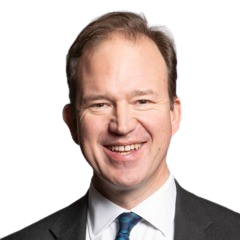
Jesse Norman is the Conservative MP for Hereford and South Herefordshire, having first been elected to parliament at the 2010 general election.
In the 2024 general election, Norman received 14,871 votes, representing 32.6% of the vote share. The Labour candidate, Joe Emmett, received 13,592 votes (29.8%), while the Reform UK candidate, Nigel Ely, secured 8,395 votes (18.4%). Norman was duly re-elected with a majority of 1,279 votes.
The Hereford and South Herefordshire constituency covers the southern part of the county, including the city of Hereford, the market town of Ross-on-Wye, and surrounding rural areas near the Welsh border. The SAS regimental base is located near Hereford within the constituency area.
The seat was created for the 2010 general election. The main predecessor seat, Hereford, was held by the Liberal Democrats from 1997 to 2010.
Political Career
Norman serves as shadow leader of the House of Commons on the Conservative frontbench appointed by Kemi Badenoch (since November 2024).
Norman is also a member of the House of Commons defence select committee (since December 2023) – the committee responsible for monitoring the expenditure, administration and policy of the Ministry of Defence (MOD) and its associated public bodies. The committee’s remit includes oversight of the British Armed Forces.
In addition, Norman is a member of the House of Commons modernisation committee (since November 2024). The modernisation committee is a cross-party committee of MPs that considers reforms to House of Commons procedures, standards, and working practices.
Prior to the 2024 general election, which saw the Conservatives ejected from government, Norman held a series of ministerial roles. He was minister of state at the Department for Transport from October 2022 until November 2023 under Rishi Sunak. He briefly served as minister of state at the Foreign, Commonwealth and Development Office (September – October 2022) under Liz Truss.
In June 2022, Norman publicly called for the prime minister, Boris Johnson, to be removed ahead of a Conservative “no-confidence” in his leadership. The vote was triggered by discontent within the parliamentary party following the “partygate” scandal and the publication of the Sue Gray report. While the prime minister ultimately won the vote, the scale of the rebellion against him, with 148 of his own MPs voting to remove him, severely weakened his authority and presaged his resignation the following month.
In a letter addressed to Johnson, Norman said that under Johnson’s leadership, the Conservatives have “a large majority but no long-term plan”.
He wrote: “Neither the Conservative Party nor this country can afford to squander the next two years adrift and distracted by endless debate about you and your leadership.
“For you to prolong this charade by remaining in office not only insults the electorate, and the thousands of people who support, volunteer, represent and campaign for our party; it makes a decisive change of government at the next election much more likely. That is potentially catastrophic for this country.
“For these reasons, and with great sadness, I am withdrawing my support for you as leader.”
Previously, Norman served as financial secretary to the Treasury (2019–2021), paymaster general (2019), minister of state at the Department for Transport (2018-2019), parliamentary under-secretary of state at the Department for Transport (2017-2018) and parliamentary under-secretary of state at the Department for Business, Energy and Industrial Strategy (2016-2017).
Norman chaired the House of Commons culture, media and sport select committee from June 2015 to July 2016. By virtue of this role, he sat on the liaison committee across the same period. Norman was also a member of the Treasury committee in the 2010-2015 parliament.
Norman reportedly acted as the rebel ringleader who orchestrated the Conservative rebellion against the coalition government’s proposals, spearheaded by the Liberal Democrats, to reform the House of Lords. On 10 July 2012, 91 Conservative backbenchers rebelled against the House of Lords Reform Bill – which would have provided for an upper chamber of 450 members (halved from 826), 80% of whom would be elected.
Speaking during the bill’s second reading debate, Norman called it an “interesting solution to an elective dictatorship to propose two elective dictatorships.”
During the division that followed, the prime minister, David Cameron, confronted Norman in the members’ lobby. In his 2019 memoir, For the Record, Cameron alleged that Norman had sent a message to Tory MPs giving the impression that he, as prime minister, now wanted the bill defeated.
Norman reportedly texted: “The PM desperately needs the bill to be knocked off. There is no manifesto commitment now that the programme motion has been withdrawn.”
Cameron recalled confronting Norman, admitting that his “even temper left me right there.”
Shortly after the vote, Norman described the proposed legislation as ”a dead duck”.
Norman delivered his maiden speech on 14 June 2010 during a debate on emerging economies.
In it, he said: “I know that every member of this House will join me in saying that it is the greatest honour of all to be chosen to sit in this august chamber; to have a share, however small, in the supreme sovereign authority in this country; and to walk in these hallowed halls and corridors, as so many extraordinary men and women have done before us.”
He added: “Now, the idea of revolution is never dear to a conservative, but even Edmund Burke would agree that we need a revolution in how we think about economics in government.
“Over the past two decades the British government have become steeped in a 1970s textbook caricature – a view in which markets are always efficient, prices reflect perfect information, and institutions are nowhere to be found. One would be tempted to call such a view neo-liberal, were we not in a time of coalition government…
“In policy terms, this textbook economics takes power away from local people. It encourages centralisation and top-down meddling…
“Politics is not a subset of economics, and economics is not a subset of the financial sector. GDP growth is important – goodness knows that is true now – but so are flexibility, resilience and, above all, entrepreneurship in our economy.”
Political Views
Leadership elections and loyalty
Tory leadership 2024: Norman supported Kemi Badenoch’s candidacy in the 2024 Conservative Party leadership election. The contest was triggered by the resignation of Rishi Sunak following the party’s defeat in the 2024 general election.
Badenoch, the then-shadow housing secretary, was seen as a leading figure on the party’s right wing. After finishing first in the final parliamentary ballot with 42 votes, she defeated Robert Jenrick in the membership vote with 53,806 votes (56.5%). Badenoch was declared Conservative leader on 2 November.
During the campaign, Norman criticised the speech Jenrick delivered to the Conservative Party’s annual conference in Birmingham.
He posted to social media: “I am very sorry to have to say it, but that speech of Robert Jenrick’s was lazy, mendacious, simplistic tripe.”
Both Norman and Jenrick were subsequently appointed to Badenoch’s first shadow cabinet.
Jenrick, upon defecting to Reform UK in January 2026, told the Spectator: “There were very few other people who in their hearts believed in the agenda that I wanted the Conservative party to pursue. And there were some people who actively disagreed.”
He added: “At least a third of Conservative MPs would feel more at home in the Lib Dems.”
Jenrick was reportedly speaking in reference to Norman.
Tory leadership 2022 (I): Norman supported Nadhim Zahawi’s candidacy in the Conservative Party’s July-September 2022 leadership election. The contest was triggered by the resignation of Boris Johnson following the mass exodus of more than 60 frontbenchers.
Zahawi had been appointed chancellor just days earlier following Rishi Sunak’s resignation. He was eliminated in the first parliamentary ballot on 13 July after receiving 25 votes – failing to reach the 30-vote threshold required to proceed.
Tory leadership 2022 (II): Norman supported Rishi Sunak’s candidacy in the Conservative Party’s October 2022 leadership election. The contest was triggered by the resignation of Liz Truss after just 45 days in office, following the financial and political tailspin triggered by her “mini-budget”.
Sunak, the former chancellor, had finished second to Truss in the previous contest. Unlike the summer contest, this election featured an expedited process requiring each candidate to secure at least 100 nominations from MPs to proceed. Sunak, having emerged as the clear frontrunner, was declared leader of the Conservative Party unopposed on 24 October.
Tory leadership 2016: Norman supported Theresa May for the party’s leadership in July 2016. The contest was triggered by the resignation of David Cameron following the UK’s vote to leave the European Union.
May, the then-home secretary, secured a commanding lead in the parliamentary stages, receiving 165 votes in the first ballot and 199 in the second. Following the withdrawal of her final rival, Andrea Leadsom, on 11 July, May was declared leader unopposed and was appointed prime minister two days later.
Factional identity and party tradition
Free Enterprise Group: Norman was a member of the Free Enterprise Group (FEG) of Conservative MPs – a parliamentary caucus, founded in 2011 by Liz Truss, that championed free-market, libertarian economic policies. The group, seen as a standard-bearer for the Thatcherite wing of the party, is most notable for the political ascent of its founding members. Key figures in the FEG included Truss, Kwasi Kwarteng, Priti Patel, Dominic Raab and Chris Skidmore. The 2012 book, Britannia Unchained, served as the group’s unofficial manifesto for radical free-market reform. It was effectively succeeded by the Free Market Forum, which was launched in 2021.
Brexit and Europe
Brexit referendum: Norman has never revealed how he voted in the 2016 Brexit referendum. A majority of his constituents, 60.4%, voted to Leave.
In a ConservativeHome article, published on 18 May 2016, Norman wrote: “I have taken a position on the current Brexit debate which is somewhat unusual among MPs.
“That is to be decided, but undeclared; to remain publicly neutral in order to assist wavering voters in my constituency and elsewhere to reach a decision in their own terms, with information and advice that are as impartial and independent as possible.
“A referendum is not an act of representative government, and I am not a minister, so my vote can properly be a private one. I am not being paid to exercise it, and of course it has exactly the same weight as any other.”
In a subsequent article for the Guardian, published on 31 May 2016, Norman argued that the debate would “fuel voter disillusionment and reduce public trust still further”.
He added: “If out wins, all bets are surely off. But if in triumphs, the risk is of years of internal party dispute, and political stasis.”
Article 50: In February 2017, Norman voted in favour of the European Union (Notification of Withdrawal) Bill. The legislation empowered the prime minister to notify the Council of the European Union of the UK’s intention to withdraw, formally triggering the process set out in Article 50 of the Treaty on European Union. MPs supported the bill by 498 votes to 114 at second reading.
Customs union vote (2025): In December 2025, Norman voted against the UK-EU Customs Union (Duty to Negotiate) Bill. The bill, introduced under the ten-minute rule procedure by Liberal Democrat Europe spokesperson Al Pinkerton, sought to mandate the government to enter into negotiations with the European Union to establish a bespoke customs union.
Assisted dying
Norman voted against the Terminally Ill Adults (End of Life) Bill, better known as the assisted dying bill, at both second reading (November 2024) and third reading (June 2025).
Social values and conscience issues
Abortion decriminalisation (2025): Norman voted against a backbench amendment to the Crime and Policing Bill that sought to decriminalise abortion in England and Wales in June 2025. The amendment, which was passed by a majority of 242 votes, removed women from the threat of prosecution for ending a pregnancy at any stage. As an issue of conscience, MPs were allowed to vote according to their personal beliefs.
Foreign policy and security
Trident renewal (2016): Norman voted in favour of a government motion calling for the renewal of the Trident nuclear deterrent system in July 2016. The motion, which was passed by 472 votes to 117, committed the UK to constructing a new fleet of submarines to carry the nation’s nuclear weapons.
Syria airstrikes (2015): Norman voted in favour of a government motion to extend UK airstrikes against Isis from Iraq into Syria in December 2015. The motion, which was passed by 397 votes to 223 after a ten-hour debate in the House of Commons, authorised the RAF to conduct strikes against Isis targets in Syria.
Before Politics
Born on 23 June 1962, Norman was educated at Eton College. He studied classics at Merton College, Oxford. He later obtained an MPhil and PhD in Philosophy from University College London (UCL).
From 1988 to 1991, he worked for and later ran an educational charity project distributing textbooks in Eastern Europe.
In his 2010 maiden speech, Norman stated: “Many years ago, I ran an educational charity giving away new medical textbooks throughout eastern Europe during and after the communist period.”
Norman then worked at Barclays bank from 1991 to 1997.
After leaving Barclays, Norman taught philosophy at UCL and later at Birkbeck, University of London, while pursuing his PhD and writing. He also served on the board of the Hay Festival of Literature and the Arts.
Norman is the author of books including Compassionate Conservatism (2006), The Big Society (2010), Edmund Burke: Politician, Philosopher, Prophet (2013), and Adam Smith: What He Thought, and Why it Matters (2018).
Personal Life
Norman married Kate Bingham in 1992. Bingham chaired the UK’s Vaccine Taskforce during the Covid-19 pandemic. They have three children, two sons and a daughter.
His father was Torquil Norman, founder of the Bluebird Toys company, which produced Polly Pocket, and the Roundhouse Trust.
Trivia
Norman’s interests include cycling, hill walking and playing jazz on the trumpet.
He was elected as a two-year fellow at All Souls College, Oxford in 2022.
He was Spectator Parliamentarian of the Year and The House Backbencher of the Year in 2012.
Jesse Norman has not written for Politics.co.uk.