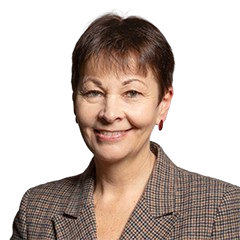
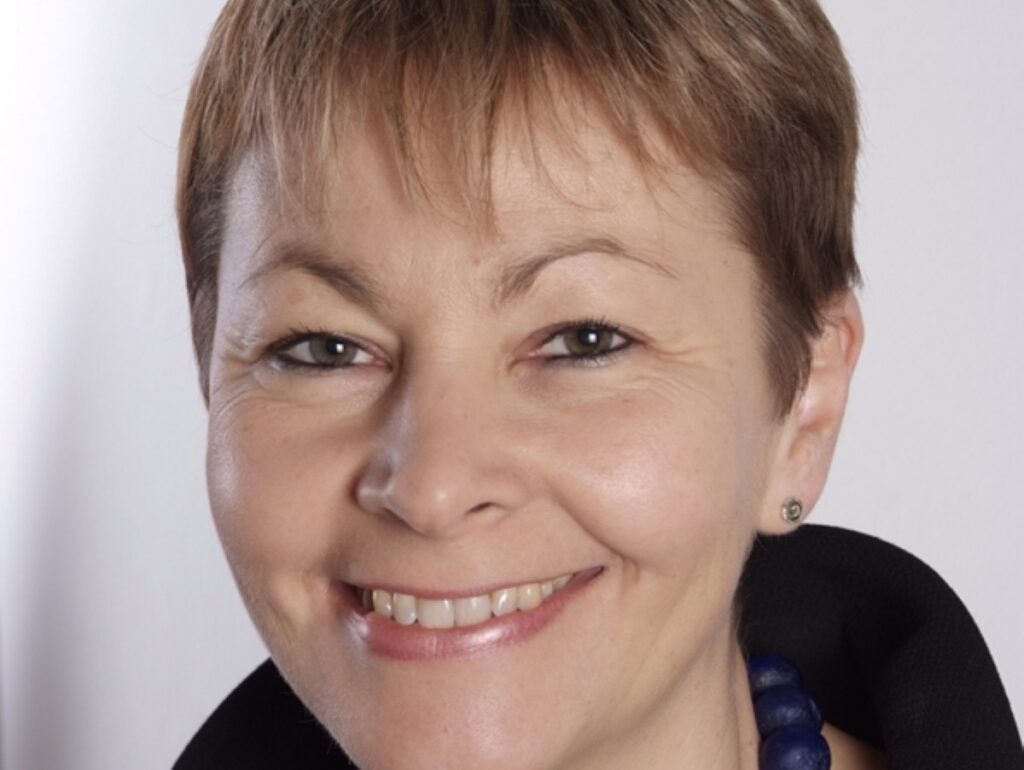
Caroline Lucas served as the Green Party MP for Brighton Pavilion from 2010 to 2024. She previously served as a member of the European Parliament (MEP) for South East England from 1999 to 2010.
Lucas’ election as the Green MP for Brighton Pavilion in 2010 was a watershed moment, marking the first time a Green Party candidate had been elected to the UK parliament.
Within the Green Party of England and Wales, Lucas held a series of senior positions. She served as leader (2008-2012), co-leader alongside Jonathan Bartley (2016-2018), and principal speaker (2003-2006 and 2007-2008).
In June 2023, Lucas announced she would stand down from parliament at the forthcoming general election.
At the 2024 general election, the Brighton Pavilion constituency was won by the Green Party candidate, Siân Berry, who secured 28,809 votes (55.0%) and a majority of 14,290.
Caroline Lucas: early political career and development (1986-2010)
Lucas joined the Green Party in 1986. She held internal party roles as national press officer (1987-89) and co-chair (1989-90).
In 1993, Lucas won a seat on Oxfordshire County Council, the Green Party’s second-ever council seat at the time. Her victory appeared to reflect the success of the party’s “Westminster through town halls” strategy.
Lucas was elected as one of the Green Party’s first MEPs in 1999, representing the South East England region.
In 2007, the Greens held an internal referendum on replacing its “principal speaker” model with a formal leader and deputy leader structure. (The proposed changes would allow for two co-leaders if a pair of candidates wanted to stand on a joint-ticket.) Previously, motions to introduce a formal leadership team had achieved a majority at Green conference, but fallen short of the necessary two-thirds majority for approving a constitutional change. In the event, 73% of members backed the creation of the leader and deputy leader positions – achieving the necessary two-third majority. On a turnout of 48.3%, 2,634 Green members voted in favour of the reforms, with 963 opposed.
Lucas, the female principal speaker of the party from 2003 to 2006, was among the supporters of the new model. She argued that the referendum offered the opportunity to “demonstrate that alternative models of leadership are possible – not top-down and authoritarian, but inspirational and persuasive.”
She added: “Given the scale and urgency of the Green message, we owe it to ourselves, and to the electorate, to make our Party as effective as we can – I believe that developing authentic leadership models is a major part of that process.”
In September 2008, Lucas was overwhelmingly elected as the first leader of the Green Party of England and Wales with 92.4% of the vote. The Greens achieved some success in the 2008 London mayoral election. The party’s candidate, Siân Berry, placed fourth with 77,347 votes (3.2%).
At the 2010 general election, Lucas was elected as the MP for Brighton Pavilion, securing a majority of 1,252. Lucas had been selected, not without controversy, to stand in Brighton over the party’s previous candidate, Keith Taylor, by a 55-45% margin. Upon Lucas’ selection, one member responded: “The Greens have blown it. Half of us wanted Keith – and now we’ve been landed with an over-ambitious outsider who has parachuted herself into our city. I thought the Greens were better than this.”
Lucas secured 31.3% of the vote in Brighton Pavilion, defeating the incumbent Labour MP, David Lepper, and overturning a notional Labour majority of over 5,000. Nationally, the Green Party’s vote share stood at 1.0% at the 2010 general election, having contested roughly 50% of the seats.
Caroline Lucas: parliamentary career (2010-2024)
Lucas’ 2010 victory marked the end of the party’s 37-year journey from a fringe movement formed in a Coventry pub to an elected force in the House of Commons. Upon meeting the former “hybrid” Plaid-Green MP, Cynog Dafis, in 2011, he graciously relinquished any claim to her title, declaring: “I was a kind of hybrid, so I don’t really count.”
Dafis added: “I am more than happy to say that Caroline Lucas is the first Green MP.”
In her maiden speech on 26 May 2010, during a debate on the environment, Lucas acknowledged an “additional responsibility… to speak not only as the new member of parliament for Brighton Pavilion, but also as the first representative of the Green Party to be elected to Westminster.”
She added: “The Green Party traces its origins back to 1973, and the issues highlighted in its first Manifesto for a Sustainable Society – including security of energy supply, tackling pollution, raising standards of welfare and striving for steady state economics – are even more urgent today.
“If our message had been heeded nearly 40 years ago, I like to think we would be much closer to the genuinely sustainable economy that we so urgently need, than we currently are today.
“We fielded 50 candidates in the 1979 general election as the Ecology Party, and began to win seats on local councils. Representation in the European Parliament and the London Assembly followed.
“Now, after nearly four decades of the kind of work on doorsteps and in council chambers which I am sure honourable members are all too familiar, we have more candidates and more members, and now our first MP.”
From 2010 to 2015, the Greens sought to capitalise on the disenchantment felt by Liberal Democrat voters at the party’s decision to enter into coalition with the Conservative Party. In the 2012 London mayoral election, the Green candidate, Jenny Jones, placed third on 4.5% of the vote, leapfrogging the Liberal Democrats who were reduced to fourth.
Under Lucas, the Greens moved beyond single-issue environmentalism towards a comprehensive left-wing platform. Lucas stepped down as Green leader in 2012 to focus on her parliamentary duties. She was succeeded by Natalie Bennett, an Australian-British journalist.
The Greens won 3.8% of the vote at the 2015 general election – the party’s highest ever national vote share. However, this surge in support translated into no additional seats. Lucas was re-elected in Brighton Pavilion with an increased majority of 7,967 over Labour, but the Greens failed to make breakthroughs elsewhere. The party contested 538 seats in 2015, a significant increase on 310 in 2010.
In 2016, after Bennett announced that she would not seek re-election as leader, Caroline Lucas returned to the leadership in a co-leadership arrangement with Jonathan Bartley. The Green Party campaigned for Remain in the 2016 referendum on Britain’s membership of the European Union (EU). The party struggled to make strides during Jeremy Corbyn’s tenure as leader of the Labour Party.
Under Lucas and Bartley’s co-leadership, the Greens stood in 457 seats in the 2017 general election, securing 1.6% of the overall vote. Lucas once again increased her majority in Brighton Pavilion (to 14,699).
Lucas stood down from the co-leadership in 2018 and was succeeded by Siân Berry, a member of the London Assembly and former mayoral candidate. Under Berry and Bartley’s co-leadership, the Greens achieved their best-ever local election result in 2019, doubling their number of council seats from 178 to 372.
The Green Party’s manifesto for the 2019 general election endorsed a “people’s vote” or second Brexit referendum. The party’s vote share rose modestly to 2.7%, but it once again failed to secure a second MP. Lucas’ majority in Brighton Pavilion increased to 19,940.
In June 2023, Lucas announced her decision not to seek re-election at the next general election. In a letter to her Brighton Pavilion constituents, she stated it had been the “privilege of my life to serve this extraordinary constituency and community”.
She wrote: “I have always been a different kind of politician – as those who witnessed my arrest, court case and acquittal over peaceful protest at the fracking site in Balcombe nearly 10 years ago will recall.
“And the truth is, as these threats to our precious planet become ever more urgent, I have struggled to spend the time I want on these accelerating crises.
“I have therefore decided not to stand again as your MP at the next election.”
What is Caroline Lucas doing now?
In her 2023 statement announcing her intention to stand down as an MP, Lucas said she had “struggled to spend the time I want on these accelerating [climate and ecological] crises.”
She added: “My determination to trying to make change is stronger than ever. I look forward to having the time to explore ever more imaginative and creative ways of helping to make a liveable future a reality. Watch this space!”
In November 2024, Lucas was unveiled as a co-president of European Movement UK alongside former Conservative MP Dominic Grieve.
Lucas published the book Another England: How to Reclaim Our National Story in 2024. In January 2025, she received an honorary Doctor of Laws degree from the University of Sussex.
During the momentous June 2026 Makerfield by-election campaign, Lucas urged her party to withdraw from the contest to avoid splitting the progressive vote. Lucas pointed to Labour candidate Andy Burnham’s support for electoral reform and proportional representation.
Political Views
The Greens are an environmentalist and progressive political party positioned on the left of British politics.
The party’s foundational ideological beliefs are set out in its official core values and “philosophical basis”. This latter document outlines the aims and beliefs of the party, providing the basis on which all its policies are agreed.
The opening to the Green Party’s philosophical basis states: “A system based on inequality and exploitation is threatening the future of the planet on which we depend, and encouraging reckless and environmentally damaging consumerism.
“A world based on cooperation and democracy would prioritise the many, not the few, and would not risk the planet’s future with environmental destruction and unsustainable consumption.”
In 2013, Lucas was arrested during an anti-fracking demonstration outside an exploratory drilling site in Balcombe, West Sussex. She argued at the time that exploiting new fossil fuel sources like shale gas undermined efforts to tackle climate change. She was later found not guilty of obstructing the public highway and public order offences related to the protest.
Lucas was a strong opponent of Brexit and was a co-founder of the official People’s Vote campaign. The 2019 Green manifesto described the party as “proudly pro-European” and said it was “unequivocally campaigning for Britain to Remain in the EU.”
Lucas has also expressed support for the introduction of a Universal Basic Income (UBI) and is a prominent proponent of electoral reform.
In 2015, Lucas endorsed Jeremy Corbyn’s campaign for the Labour leadership, writing in the Independent that she had “never felt so optimistic about a potential leader of the Labour Party”.
Brexit and Europe
Brexit referendum: Lucas supported Remain in the 2016 Brexit referendum, and therefore agreed with a majority of her constituents, 74.1% of whom also voted to Remain.
Article 50: In February 2017, Lucas voted against the European Union (Notification of Withdrawal) Bill. The legislation empowered the prime minister to notify the Council of the European Union of the UK’s intention to withdraw, formally triggering the process set out in Article 50 of the Treaty on European Union. MPs supported the bill by 498 votes to 114 at second reading.
Left-wing ‘people’s vote’: In March 2019, Lucas was among 20 signatories to a cross-party letter published in the Guardian that called for a second referendum and rubbished Brexit as a “massive assault” on working-class people.
The letter read:“We are campaigning to transform society, not for the status quo. We are against Brexit because it is a massive assault on working-class people, on the environment, on migrants and on the communities that the left aims to represent.”
Social values and conscience issues
Same-sex marriage (2013): In February 2013, Lucas voted in favour of the Marriage (Same Sex Couples) Bill at its second reading. The landmark piece of legislation, which received its second reading by 400 votes to 175, legalised marriage for same-sex couples in England and Wales.
Foreign policy and security
Trident renewal (2016): Lucas voted against a government motion calling for the renewal of the Trident nuclear deterrent system in July 2016. The motion, which was passed by 472 votes to 117, committed the UK to constructing a new fleet of submarines to carry the nation’s nuclear weapons. Labour was split over the issue with 140 of its 230 MPs going against leader Jeremy Corbyn and backing the motion.
Syria airstrikes (2013): Lucas voted against the government’s motion on the principle of military intervention in Syria in August 2013. The government motion was defeated by 285 votes to 272, a move which effectively ruled out UK participation in any US-led military strikes.
Palestine
Ceasefire vote (November 2023): Lucas voted for a Scottish National Party (SNP) amendment to the king’s speech in the House of Commons calling for an “immediate ceasefire” in the Israel-Hamas war. Labour had tabled a rival motion, making a more moderate appeal for a “humanitarian pause” in the conflict.
Palestinian recognition vote (2014): In October 2014, Lucas voted in favour of recognising Palestine as a state. The motion, passed by 274 votes to 12, called on the government to “recognise the state of Palestine alongside the state of Israel as a contribution to securing a negotiated two-state solution”.
Civil liberties
Covid passes vote (2021): Lucas was one of 126 MPs to vote against Covid passes in England in December 2021. The measure, introduced by Boris Johnson’s government, was carried by 369 votes to 126.
Before Politics
Caroline Patricia Lucas was born on 9 December 1960, in Malvern, Worcestershire. She attended Malvern Girls’ College and studied english literature at the University of Exeter, graduating with first-class honours. She also spent a year studying at the University of Kansas, gaining a diploma of journalism in 1984.
Lucas joined the Green Party in 1986 while studying for her PhD. She cited reading Jonathon Porritt’s book Seeing Green as a key influence, later describing it as “one of those books that completely change your life”.
Before her election as an MEP in 1999, Lucas worked for the charity Oxfam for 10 years.
Personal Life
Lucas is married to Richard Savage, who played cricket professionally for Warwickshire.
The couple have two adult sons.
Trivia
Lucas completed a PhD in English Literature at Exeter in 1989, with a thesis titled Writing for Women: The Example of Woman As Reader in Elizabethan Romance.





Caroline Lucas: ‘Extremists on the Right have hijacked Englishness — the Left must reclaim it’
23 April 2024