MPs back Article 50 bill by overwhelming majority
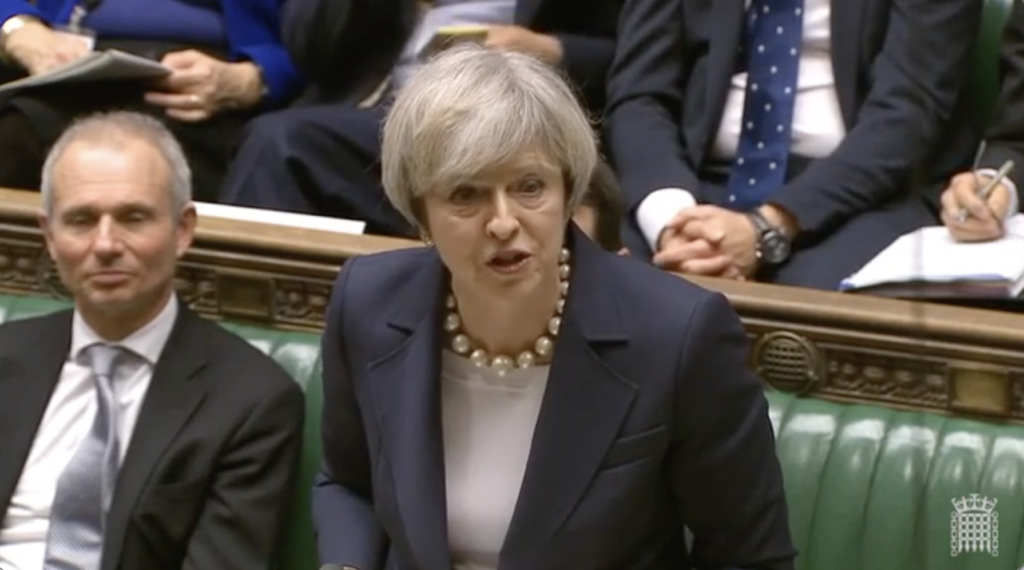
On 1 February 2017, the House of Commons voted to grant the prime minister, Theresa May, the legal authority to begin the UK’s formal withdrawal from the European Union (EU). MPs approved the second reading of the European Union (Notification of Withdrawal) Bill by 498 votes to 114 – a majority of 384.
The legislation empowered the prime minister to notify the Council of the European Union of the UK’s intention to withdraw, formally triggering the process set out in Article 50 of the Treaty on European Union.
***
May outlines Brexit strategy in landmark Lancaster House speech
The European Union (Notification of Withdrawal) Bill was introduced after the UK supreme court ruled in R (Miller) v Secretary of State for Exiting the European Union that the government could not initiate withdrawal from the EU without an act of parliament.
Gina Miller, a business owner and transparency campaigner, had brought the case before the high court in 2016, arguing that the executive could not use the royal prerogative to effectively nullify previous acts of parliament relating to European integration. The government, led in court by the attorney general, Jeremy Wright, maintained that the 2016 referendum result represented a clear mandate for the executive to exercise prerogative powers.
On 24 January 2017, the supreme court ruled by a majority of eight to three that because the European Communities Act 1972 had incorporated EU law, only an act of parliament could authorise its removal.
Delivering the verdict, Lord Neuberger, the president of the supreme court, said: “Withdrawal effects a fundamental change by cutting off the source of EU law, as well as changing legal rights.
“The UK’s constitutional arrangements require such changes to be clearly authorised by parliament.”
Parliamentary sovereignty
The majority judgement determined that ministers could not “frustrate the purpose of a statute or a statutory provision, for example by emptying it of content or preventing its effectual operation.”
It added: “Where, as in this case, implementation of a referendum result requires a change in the law of the land, and statute has not provided for that change, the change in the law must be made in the only way in which the UK constitution permits, namely through parliamentary legislation.”
The court also unanimously rejected the argument that the devolved legislatures in Scotland, Wales and Northern Ireland had a legal right to veto the process.
***
The two-day commons debate on the European Union (Notification of Withdrawal) Bill represented the first major collision between the 2016 referendum result, seen as an expression of the popular will, and Britain’s sovereign parliament.
Theresa May addressed the commons at prime minister’s questions shortly after noon on 1 February. She said MPs had a “very simple decision to take”.
May declared: “We gave the right of judgment on this matter to the British people, and they made their choice… The question every member must ask themselves as they go through the lobby tonight is: do they trust the people?”
David Davis, the secretary of state for exiting the European Union (Brexit secretary), opened the debate for the government on 31 January. He told the House that the legislation responded directly to the supreme court judgment of 24 January and “the outcome of the referendum held on 23 June 2016.”
The bill, Davis insisted, was not about whether the UK should leave the European Union, nor about the terms of departure, but simply “about parliament empowering the government to implement a decision already made – a point of no return already passed.”
He added: “At the core of this bill lies a very simple question: do we trust the people or not? The democratic mandate is clear: the electorate voted for a government to give them a referendum.
“Parliament voted to hold the referendum, the people voted in that referendum, and we are now honouring the result… I commend [the bill] to the House. Trust the people.”
The shadow Brexit secretary, Keir Starmer, maintained that the Labour frontbench accepted the referendum result and would therefore support the bill.
“When I was imploring people up and down the country to vote in the referendum and to vote to remain, I told them that their vote really mattered and that a decision was going to be made”, Starmer told the House.
“I was not inviting them to express a view.”
The opposition to the bill was led by the father of the House, Kenneth Clarke, a veteran parliamentarian, former chancellor and longstanding europhile.
In his contribution, Clarke reflected on a political career that “entirely coincides with British involvement with the European Union”. He recalled supporting former prime minister Harold Macmillan’s first application to join in 1961, helping to secure the cross-party majority for the European Communities Act 1972 and witnessing Britain’s entry into the EEC in 1973.
Membership of the European Union, Clarke argued, restored Britain’s “national self-confidence” after the Suez Crisis.
Suez ceasefire comes into effect after political crisis
He likened the decision to leave the EU to following “the rabbit down the hole” and hoping to emerge in wonderland.
He told the House: “Apparently, when we follow the rabbit down the hole, we will emerge in a wonderland where, suddenly, countries throughout the world are queuing up to give us trading advantages and access to their markets that we were never able to achieve as part of the European Union.
“Nice men like president Trump and president Erdogan are impatient to abandon their normal protectionism and give us access. Let me not be too cynical; I hope that that is right. I do want the best outcome for the United Kingdom from this process.
“No doubt somewhere a hatter is holding a tea party with a dormouse in the teapot.”
On the second day of debate, Ed Miliband, the former Labour leader, warned that a “hard Brexit” would see Britain align with the recently inaugurated US president, Donald Trump.
Miliband declared: “I can go along with the prime minister that Brexit means Brexit, but I cannot go along with the idea that Brexit means Trump.”
The debate was marked by a substantial Labour rebellion, with 47 MPs defying Jeremy Corbyn’s three-line whip to vote against the bill. Shortly before the division, shadow cabinet members Rachael Maskell and Dawn Butler resigned from the frontbench.
Butler stated she could not let down future generations by voting for a “poor excuse of a bill.”
In a statement after the resignations, Corbyn said: “MPs have a duty to represent their constituents as well as their party, and I understand the difficulties that MPs for constituencies which voted remain have in relation to the European Union withdrawal bill.”
Jo Stevens had already resigned as shadow Welsh secretary in order to vote against the triggering of article 50. Labour MP Tulip Siddiq also gave up a junior frontbench role.
Shadow home secretary Diane Abbott missed the vote due to illness. She was accused of having “Brexit flu”.
In total, 10 junior shadow ministers and three opposition whips defied the Labour leadership. The Scottish National Party (SNP), Plaid Cymru and the Liberal Democrats opposed the bill.
Only one Conservative MP, Clarke, voted against the bill.
One MP was heard to shout “suicide” as the result was announced in the chamber.
Following the 498-114 vote, Boris Johnson, the then foreign secretary, described the result as an “absolutely momentous thing.”
The bill received its commons third reading by 494 votes to 122 on 8 February, before proceeding to the House of Lords.
On 1 March, peers passed an amendment by 358 votes to 256, seeking to protect the residence rights of EU nationals living in the UK. On 7 March, a second amendment was passed, 366 to 268, requiring a confirmatory vote by parliament on the final withdrawal agreement.
Both amendments were overturned by the commons on 13 March. The act received royal assent three days later on 16 March 2017.
***
On 29 March 2017, Theresa May formally triggered Article 50 of the Treaty on European Union, beginning the legal process for the United Kingdom’s departure from the EU.
The notification was delivered in a six-page letter, signed by the prime minister, which was handed to the president of the European Council, Donald Tusk, in Brussels by the UK’s permanent representative, Sir Tim Barrow.
The letter officially started a two-year negotiating period for the UK and the EU to agree the terms of the withdrawal.
In a statement to the House of Commons shortly after the letter was delivered, May told MPs: “The Article 50 process is now underway. And in accordance with the wishes of the British people, the United Kingdom is leaving the European Union.
“This is an historic moment from which there can be no turning back. Britain is leaving the European Union. We are going to make our own decisions and our own laws. We are going to take control of the things that matter most to us.
“And we are going to take this opportunity to build a stronger, fairer Britain – a country that our children and grandchildren are proud to call home. That is our ambition and our opportunity. That is what this government is determined to do.”
The invocation of Article 50 marked the legal point of no return, in lieu of any attempts to revoke – moving Brexit from a political instruction delivered by the 2016 referendum into a formal process with a fixed deadline.
The deadline set by the triggering of Article 50 was 29 March 2019.
***
On 15 January 2019, May’s Brexit withdrawal agreement suffered a catastrophic defeat in the House of Commons, in the first of three so-called “meaningful votes”.
Theresa May’s Brexit deal defeated in historic commons vote
On 20 March, May’s government sent a letter to Tusk, asking for an extension of the Article 50 period until 30 June 2019. The EU agreed to an extension until April 2019.
A third meaningful vote on May’s deal was rejected by 344 votes to 286 on 29 March.
In April 2019, May announced she would seek a further extension to the Article 50 process. The UK and EU ultimately agreed to extend Article 50 until 31 October 2019.
In the end, May’s inability to produce a withdrawal agreement to her party’s liking led to her defenestration by Conservative MPs and replacement with Boris Johnson.
Theresa May announces resignation, admitting failure to deliver Brexit
Johnson’s appointment as prime minister on 24 July 2019 represented the beginning of a new phase in the so-called “Brexit wars”.
The European Union (Withdrawal) (No. 2) Act 2019, commonly known as the “Benn act”, effectively prevented the UK leaving the European Union without a withdrawal agreement on the 31 October deadline.
Commons backs ‘Benn act’ to block no-deal Brexit
On 28 October, Johnson and the EU formally approved the extension of Article 50 to 31 January 2020.
The 2019 general election that followed, which the Conservative Party won on a “Get Brexit Done” platform, proved the decisive development that paved the way to “Brexit day”.
On 9 January 2020, the European Union (Withdrawal Agreement) Bill passed its third reading in the House of Commons by 330 votes to 231.
The UK finally left the EU at 11:00 pm on 31 January 2020.
Britain leaves the European Union after 47 years of membership

Politics.co.uk Newsletters
DAILY
Politics@Lunch
WEEKLY
Week in Review
