Theresa May announces resignation, admitting failure to deliver Brexit
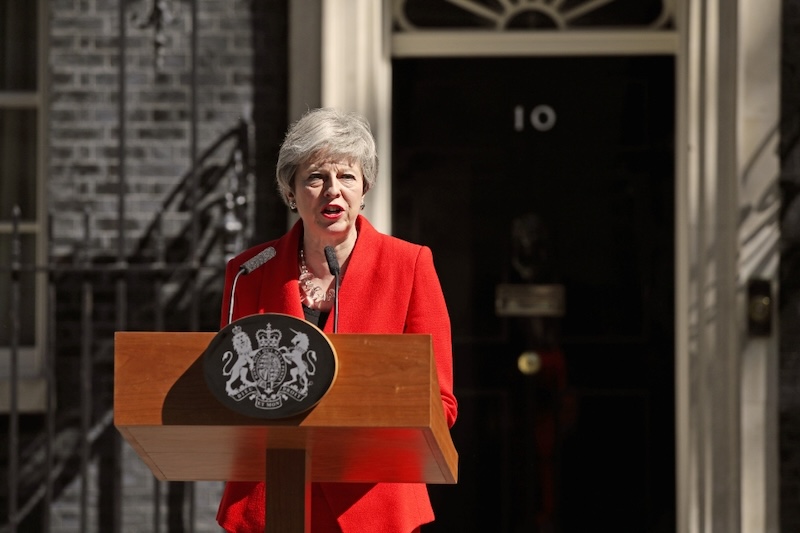
On 24 May 2019, Theresa May announced her resignation as Conservative leader, succumbing to a cabinet revolt over her final attempt to pass her Brexit withdrawal agreement.
In an emotional statement on the steps of 10 Downing Street, May confirmed she would step down as leader on 7 June, triggering the contest to select her successor as prime minister.
***
May succeeded David Cameron as prime minister in 2016 following the referendum on Britain’s membership of the European Union (EU). Her premiership was defined and ultimately destroyed by the challenge of implementing the result. In 2017, May called a snap general election that resulted in a hung parliament with the Conservatives as the largest party. She was forced to agree a confidence and supply deal with the Democratic Unionist Party (DUP) to remain in power.
From 2017 to 2019, May was repeatedly undermined by deep divisions within her party over the future relationship with the EU. Notably, her resignation came after her Brexit withdrawal agreement was rejected by MPs on three occasions – including by historic margins.
The first defeat came on 15 January, when the government’s motion was rejected by 432 votes to 202 – the largest defeat for a sitting government in modern parliamentary history. A second “meaningful vote” on May’s Brexit deal was held in March 2019. MPs again rejected the withdrawal agreement by 391 votes to 242. A third meaningful vote on May’s deal was rejected by 344 votes to 286 on 29 March.
In April 2019, May announced she would seek a further extension to the Article 50 process. The UK and EU ultimately agreed to extend Article 50 until 31 October 2019. As the EU noted, this extension meant Britain was now under an “obligation to hold the elections to the European Parliament in accordance with Union law.”
Meanwhile, on 17 May, the Labour leadership pulled out of cross-party Brexit talks, telling the prime minister that they had “gone as far as they can”. These negotiations, conducted with Jeremy Corbyn and his allies, helped alienate Tory MPs beyond the point of no return.
The immediate trigger for May’s resignation was the backlash to her last-ditch Brexit plan. May’s 10-point “new Brexit deal”, announced on 22 May, included the promise to give MPs a binding vote on a second referendum.
Unveiling the plan in the commons, May committed to “let parliament decide” the issue of a future trading relationship by holding binding votes on future customs arrangements during the passage of the Withdrawal Agreement Bill.
She added: “The government will include in the withdrawal agreement bill at its introduction a requirement to vote on whether to hold a second referendum… If this House votes for a referendum, it would require the government to make provisions for such a referendum.”
The strategy enraged eurosceptic MPs and proved insufficient to win over Labour support.
Corbyn dismissed the offer as a “repackaged version of her three times rejected deal.”
Jacob Rees-Mogg, a leading Conservative Brexiteer, rejected the package as “folderol”.
Boris Johnson, who supported May’s deal at the third time of asking, said May’s proposed Withdrawal Agreement Bill contravened the 2017 manifesto. “We can and must do better – and deliver what the people voted for”, Johnson said.
A cabinet backlash, led by the foreign secretary, Jeremy Hunt, and the home secretary, Sajid Javid, ultimately sealed May’s fate. Both Hunt and Javid were seen as positioning for a Conservative leadership contest that was now widely seen as inevitable.
Andrea Leadsom, the leader of the commons, resigned rather than assume responsibility for introducing the bill to the House. In her resignation letter, Leadsom said she no longer believed that the government’s “approach will deliver on the referendum result”.
Leadsom, who ran for the Tory leadership in 2016, wrote: “I fully respect the integrity, resolution and determination that you have shown during your time as prime minister.
“No one has wanted you to succeed more than I have, but I do now urge you to make the right decisions in the interests of the country, this government and our party.”
May reportedly realised her time was up following a meeting with Graham Brady, the chair of the influential 1922 committee of backbench Conservative MPs. Brady told the prime minister that his committee was prepared to trigger a second vote of no confidence in her leadership if she refused to resign.
***
In her resignation speech, May conceded that she had failed to convince MPs to pass her Brexit deal.
She stated: “I negotiated the terms of our exit and a new relationship with our closest neighbours that protects jobs, our security and our union. I have done everything I can to convince MPs to back that deal. Sadly, I have not been able to do so.
“I tried three times. I believe it was right to persevere, even when the odds against success seemed high. But it is now clear to me that it is in the best interests of the country for a new prime minister to lead that effort.”
May concluded her resignation speech by saying that serving as the prime minister had been the “honour of my life”.
Her voice cracking with emotion, May said: “I will shortly leave the job that it has been the honour of my life to hold – the second female prime minister but certainly not the last.
“I do so with no ill-will, but with enormous and enduring gratitude to have had the opportunity to serve the country I love.”
Corbyn responded that May was “right to resign. She’s now accepted what the country’s known for months: she can’t govern, and nor can her divided and disintegrating party”.
Cameron, the prime minister from 2010 to 2016, said his successor should be thanked for her “tireless efforts”.
He added: “I know how painful it is to accept that your time is up and a new leader is required. She has made the right decision – and I hope that the spirit of compromise is continued.”
Jeremy Hunt described May as a “true public servant”.
Johnson responded: “A very dignified statement from [Theresa May]. Thank you for your stoical service to our country and the Conservative Party. It is now time to follow her urgings: to come together and deliver Brexit.”
https://x.com/Jeremy_Hunt/status/1131852239650394114
***
On 26 May, the results of the European Parliament elections were announced – some days after voting took place. The outcome confirmed the parlous position of the Conservative Party.
The Tories suffered their worst national election result since 1832, finishing in fifth place with just 9.1% of the vote and four MEPs (down 15). The Labour Party also performed poorly, coming third with 14.1% and 10 seats (down 10).
Significantly, the Brexit Party – which was only incorporated with Companies House on 23 November 2018 – topped the poll with 31.6% of the vote, securing 29 seats and becoming the largest single party in the European parliament. In the wake of the results, Nigel Farage vowed to stand Brexit Party candidates at a future general election.
A total of 10 candidates entered the 2019 Conservative leadership contest.
Boris Johnson, who resigned as foreign secretary in 2018, entered the race as the clear frontrunner – promising to deliver Brexit by the latest deadline of 31 October, “do or die”.
In successive rounds of voting, Johnson consistently secured the largest share of support, eliminating rivals including Michael Gove, Sajid Javid, Rory Stewart and Dominic Raab. Johnson won 160 votes in the fifth and final ballot of MPs – leaving him to face the foreign secretary, Jeremy Hunt, in the all-important vote among the wider party membership.
Johnson ultimately prevailed with 66.4% of the members’ vote.
He entered office as prime minister on 24 July 2019.

Politics.co.uk Newsletters
DAILY
Politics@Lunch
WEEKLY
Week in Review