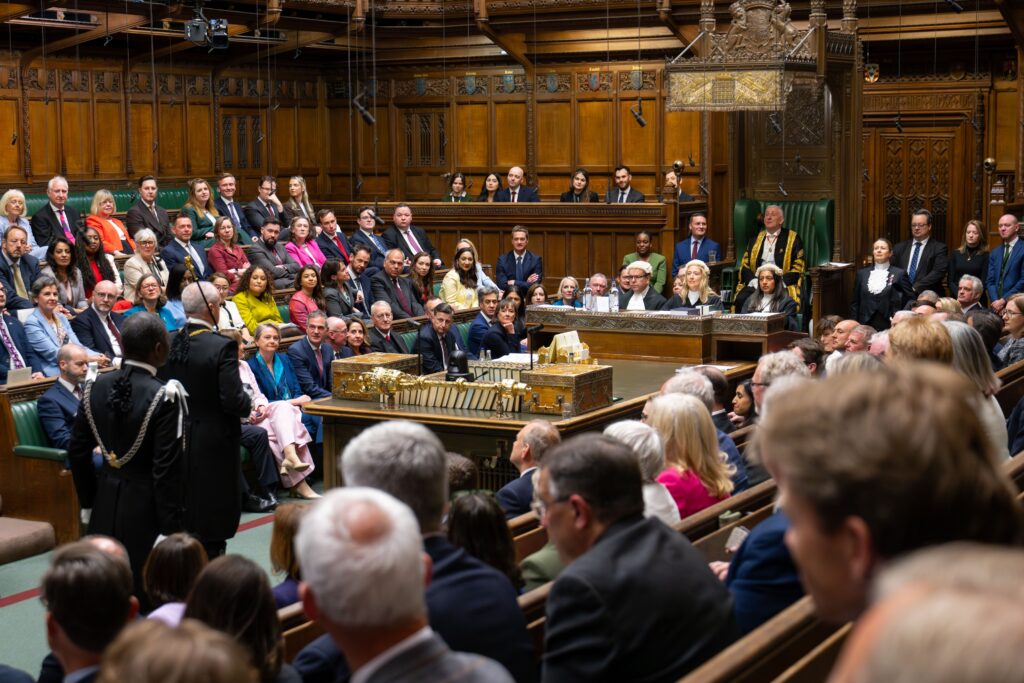
Parliamentary sovereignty is the defining principle of the United Kingdom’s constitution. It holds that the UK parliament is the supreme legal authority in the country and that it can create, amend, or repeal any law it wishes.
Under this doctrine, the courts cannot overrule legislation passed by parliament, and no parliament can bind its successors by passing a law that a future parliament cannot change. The principle establishes the legislative supremacy of the “crown in parliament” – the monarch acting with the consent of the House of Lords and the House of Commons.
While the traditional theory of sovereignty is absolute, its practical application in the modern era is subject to significant political and legal limitations.
It is possible to distinguish between legal and political sovereignty.
Parliamentary sovereignty in theory
The “orthodox” definition of parliamentary sovereignty was most famously articulated by the 19th -century jurist A.V. Dicey.
According to Dicey, the principle of “parliamentary sovereignty means neither more nor less than this, namely, that parliament thus defined has, under the English constitution, the right to make or unmake any law whatever; and, further, that no person or body is recognised by the law of England as having a right to override or set aside the legislation of parliament.”
According to Dicey’s sovereignty formula, parliament can make or unmake any law. There are no legal limits on the subject matter of an act of parliament. It can legislate on any topic and can theoretically override common law, international law and previous statutes.
Moreover, parliamentary sovereignty means that no parliament can bind a future parliament. Any law passed by the current parliament can be repealed or amended by a future parliament; this means a government cannot entrench its legislation, and parliament’s power remains absolute for each successive generation.
Practical limitations on parliamentary sovereignty
In practice, the sovereignty or power of parliament is constrained by several factors.
Devolution
The UK parliament has devolved significant powers to the Scottish Parliament, the Senedd Cymru (Welsh Parliament), and the Northern Ireland Assembly. While Westminster remains legally sovereign and could theoretically abolish these institutions, the devolved bodies are recognised features of the political landscape in their respective jurisdictions.
On top of this, a political rule known as the Sewel convention provides that the UK parliament will “not normally” legislate on devolved matters without the consent of the relevant devolved institution. The convention takes its name from Lord Sewel, the Scotland Office minister, who was responsible for the progress of the Scotland Bill through the upper chamber in 1998.
In a debate in the House of Lords in July 1998, he stated that while the devolution of legislative competence did not affect the ability of the UK parliament to legislate for Scotland, “we would expect a convention to be established that Westminster would not normally legislate with regard to devolved matters in Scotland without the consent of the Scottish parliament.”
The Scotland Act 2016 amended the Scotland Act 1998 to contain an explicit and specific legal reference to the so-called Sewel convention. Subsections (7) and (8) of section 28 in the Scotland Act 1998 now state:
“(7) This section does not affect the power of the Parliament of the United Kingdom to make laws for Scotland.
“(8) But it is recognised that the Parliament of the United Kingdom will not normally legislate with regard to devolved matters without the consent of the Scottish Parliament.”
The Wales Act 2017 included provisions recognising the Sewel convention.
The UK government is expected to consult with the devolved administrations if it plans to introduce a bill with provisions that fall within the scope of the convention.
A legislative consent motion is the means by which a devolved legislature indicates that it is willing for the UK parliament to legislate on a devolved matter.
However, the convention has come under some strain in recent years.
In 2017, the supreme court ruled that the Sewel convention did not require the consent of the devolved institutions for the government to notify the Council of the European Union of the UK’s intention to withdraw from the EU (triggering Article 50 of the Treaty on European Union).
The ruling found that the Sewel convention “operates as a political constraint on the activity of the UK parliament” and “therefore plays an important role in the operation of the UK constitution.”
It added: “But the policing of its scope and operation is not within the constitutional remit of the courts. The devolved legislatures do not have a veto on the UK’s decision to withdraw from the EU.”
This confirmed that, in legal terms, the UK parliament remains sovereign and can pass laws for any part of the UK, with or without consent.
Evaluation question
How effectively can a convention that relies solely on political pressure safeguard the devolved legislatures against the absolute legal authority of the Westminster parliament?
The convention’s power, therefore, is said to lie in the political pressure applied by the longstanding convention, not legal force.
During the Brexit process, the UK government passed the UK Internal Market Act 2020 to prevent internal trade barriers within the UK. This is despite all three devolved legislatures refusing consent for the proposed legislation.
Between 2018 and 2023, the Westminster parliament passed six acts (five of which related to Brexit) where the UK government accepted that the Sewel convention was engaged but consent was refused by one or more of the devolved legislatures.
The Human Rights Act 1998
The Human Rights Act, passed by Tony Blair’s Labour government, incorporates the European Convention on Human Rights (ECHR) into UK law. It requires courts, so far as it is possible to do so, to interpret legislation in a way that is compatible with convention rights. If a compatible interpretation is not possible, the court can issue a “declaration of incompatibility”.
This does not invalidate the act, thus preserving parliamentary sovereignty, but it creates strong political pressure on the government and parliament to amend the law.
The future of the Human Rights Act has been a subject of political debate, during the 2024 Conservative leadership election, Robert Jenrick, who went on to become the shadow justice secretary, said that his party would “die” if they didn’t leave the ECHR and that it makes it “impossible to secure our borders”.
In June 2025, the justice secretary, Shabana Mahmood, told the council of Europe that Britain will pursue reform of the ECHR.
Referendums
While referendums are not a traditional feature of the UK’s system of representative democracy and parliamentary sovereignty, they have become an established, if infrequent, mechanism for seeking public approval for fundamental political change.
The result of a UK-wide referendum is technically advisory and not legally binding upon parliament. Any UK-wide referendum must be authorised by a specific act of parliament. This legislation sets out the question to be asked, the date of the vote, the franchise (who is eligible to vote) and the rules for the conduct of the campaign.
Parliament must also pass legislation to enact the result of a referendum.
However, the political legitimacy derived from a direct democratic mandate is extremely powerful. It is widely acknowledged that it would be exceptionally difficult, and even politically illegitimate, for parliament to ignore a clear referendum result – advisory or not.
In this regard, in the UK’s uncodified constitution, referendums act as a “weapon of entrenchment.” Because an act of parliament can be repealed by a simple majority in the future, referendums provide a “moral” entrenchment.
A referendum result can, in effect, create competing sources of sovereignty and constitutional antagonisms between the technically sovereign parliament and the “will of the people”.
The impact of Europe and Brexit
The most significant practical constraint on parliamentary sovereignty in recent decades was the UK’s membership of the European Union. The European Communities Act 1972 required UK courts to give supremacy to EU law where it conflicted with UK domestic law.
The 2016 referendum and subsequent withdrawal from the EU were framed by supporters as a means to restore sovereignty. With the repeal of the 1972 act, the UK parliament proved its enduring sovereignty – repealing a piece of legislation passed by one of its predecessors.
The supreme court and parliamentary sovereignty
Unlike the US supreme court, the UK supreme court, established in 2009 under the Constitutional Reform Act 2005, cannot strike down or invalidate primary legislation passed by parliament.
If parliament disagrees with a supreme court ruling, it can simply pass a new law to override that decision. Such action can be controversial, however, as was the case over the Rwanda deportations scheme pursued by a series of Conservative governments from 2022 to 2024.
Rwanda scheme
On 15 November 2023, the supreme court delivered a unanimous ruling upholding the court of appeal’s decision that the government’s Rwanda deportations scheme was unlawful. The court found that there were “substantial grounds for believing” that asylum seekers sent to Rwanda faced a “real risk of ill-treatment as a consequence of refoulement” – the practice of being returned to a country where they might face persecution or human rights abuses.
The prime minister, Rishi Sunak, unveiled a two-pronged strategy to overcome the court ruling: first, negotiate a new international treaty with Rwanda that would provide a legally binding guarantee against refoulement; and second, introduce emergency legislation that would enable parliament to confirm Rwanda as a safe country under UK law.
The Safety of Rwanda (Asylum and Immigration) Bill, later act, sought to disapply certain aspects of domestic law and the Human Rights Act 1998, and legally declare – for the purposes of the government’s deportation scheme – that Rwanda was a safe country.
The Safety of Rwanda (Asylum and Immigration) Act was repealed by the Border Security, Asylum and Immigration Act 2025 passed by the Labour government elected at the 2024 general election.
Brexit rulings
The UK supreme court has established itself as a check on executive power and, by extension, an effective protector of parliamentary sovereignty. In 2017, for instance, the supreme court ruled that the government could not notify the Council of the European Union of the UK’s intention to withdraw from the EU (formally triggering the process set out in Article 50 of the Treaty on European Union) under the royal prerogative.
Gina Miller, a business owner and transparency campaigner, had brought the case before the high court in 2016, arguing that the executive could not use the royal prerogative to effectively nullify previous acts of parliament relating to European integration. The government, led in court by the attorney general, Jeremy Wright, maintained that the 2016 referendum result represented a clear mandate for the executive to exercise prerogative powers.
On 24 January 2017, the supreme court ruled by a majority of eight to three that because the European Communities Act 1972 had incorporated EU law, only an act of parliament could authorise its removal. Delivering the verdict, Lord Neuberger, the president of the supreme court, said: “Withdrawal effects a fundamental change by cutting off the source of EU law, as well as changing legal rights.
In September 2019, the supreme court unanimously ruled that Boris Johnson’s request for Queen Elizabeth II to prorogue parliament was unlawful. Eleven justices, led by Lady Hale, ruled that the prorogation was “void and of no effect”, meaning parliament could be reconvened the following day.
The leader of the House of Commons, Jacob Rees-Mogg, had convened a meeting of privy councillors which advised the queen to prorogue parliament on 28 August 2019. The approach was denounced by critics, including those within the Conservative Party, as an anti-democratic, unconstitutional ploy to bypass MPs – at a time when the parliamentary arithmetic was finely balanced.
Prorogation in order to secure a ‘no deal’ Brexit – the default legal position under EU law’s Article 50 process – had been a point of debate in the recent Tory leadership contest.
In its judgment, the supreme court noted its historical role in protecting “parliamentary sovereignty from threats posed to it by the use of the prerogative powers and in doing so have demonstrated that prerogative powers are limited by the principle of parliamentary sovereignty”.
The court added: “The sovereignty of parliament would, however, be undermined as the foundational principle of our constitution if the executive could, through the use of the prerogative, prevent parliament from exercising its legislative authority for as long as it pleased.”
Political challenges to parliamentary sovereignty
The principle of parliamentary sovereignty has been challenged by critics of the UK’s constitutional framework.
A school of thought contends that a Diceyan understanding of sovereignty is a purely English principle, which may not resonate more widely. Proponents of this perspective see the Westminster parliament as the inheritor of both the Scottish and English Parliaments, following the 1707 Acts of Union. They maintain that the constitutional tradition of one parliament should not take precedence over another.
In 1953, Judge Lord Cooper delivered an unexpected obiter dicta in the case of MacCormick v. Lord Advocate. The case saw the nationalist politician and activist, John MacCormick, unsuccessfully challenge the title of Queen Elizabeth II in Scotland. MacCormick held the view that Queen Elizabeth II should in fact be Queen Elizabeth I because Scotland had yet to be ruled by an individual of that name.
The 1707 Acts of Union came after the reign of Queen Elizabeth I (1558-1603).
Lord Cooper’s unexpected aside on British constitutionalism has proved far more long-lasting than his ruling on the rights and wrongs of MacCormick’s case, however.
Referencing a distinctive Scottish constitutional tradition, Cooper argued that the “principle of the unlimited sovereignty of parliament is a distinctively English principle which has no counterpart in Scottish constitutional law”.
He added: “Considering that the Union legislation extinguished the parliaments of Scotland and England and replaced them by a new parliament, I have difficulty in seeing why it should have been supposed that the new parliament of Great Britain must inherit all the peculiar characteristics of the English parliament but none of the Scottish parliament, as if all that happened in 1707 was that Scottish representatives were admitted to the parliament of England.”
Evaluation question
If the 1707 Acts of Union created an entirely new parliament, to what extent is the absolute, Diceyan doctrine of parliamentary sovereignty an illegitimate imposition of an “English constitutional tradition” upon Scotland? Placement after “…the parliament of England.””
On 30 March 1989, a wide coalition of politicians and civic leaders gathered in Edinburgh to sign “A Claim of Right for Scotland”. The gathering marked the beginning of a new phase in the long campaign for Scottish devolution/home rule. The Claim of Right, signed by 59 of Scotland’s 72 MPs, explicitly asserted “the sovereign right of the Scottish people to determine the form of government best suited to their needs”.
Signatories included two future Labour leaders, John Smith and Gordon Brown; other senior figures such as Robin Cook and Alistair Darling; privy counsellors Smith and Donald Dewar; and veteran anti-devolutionists like Brian Wilson, Bob Hughes and Eric Milligan.
The Claim of Right, the founding declaration of the Scottish Constitutional Convention (SCC), sought to prepare a devolution/home rule scheme that broke with the Diceyan understanding of sovereignty.
The Scotland Act 1998, notwithstanding the development of the Sewel convention, nevertheless acknowledged the “power of the Parliament of the United Kingdom to make laws for Scotland”.
Additional resources
- House of Commons Library – Parliamentary sovereignty and EU renegotiation: https://researchbriefings.files.parliament.uk/documents/CDP-2016-0033/CDP-2016-0033.pdf
- House of Commons Library – The Sewel Convention: https://researchbriefings.files.parliament.uk/documents/SN02084/SN02084.pdf
- UK Parliament – The rule of law and parliamentary sovereignty: https://publications.parliament.uk/pa/ld5801/ldselect/ldconst/151/15110.htm

