Britain leaves the European Union after 47 years of membership
At 11:00 pm GMT on 31 January 2020, the United Kingdom formally left the European Union, ending 47 years of membership. The departure marked the culmination of the verdict delivered at the 2016 referendum, in which 52% of the electorate voted to leave, and followed a protracted period of parliamentary deadlock.
Boris Johnson’s appointment as prime minister on 24 July 2019, replacing Theresa May, represented the beginning of a new phase in the so-called “Brexit wars”. The 2019 general election that followed, which the Conservative Party won on a “Get Brexit Done” platform, proved the decisive development that paved the way to “Brexit day” on 31 January 2020.
Johnson first presented his renegotiated Brexit deal to parliament on 19 October during a rare Saturday sitting. However, a House of Commons majority – an anti-“no deal” alliance of opposition and Tory rebel MPs – backed an amendment that called for any consideration of Johnson’s new withdrawal agreement to be delayed until the legislation to implement it had been passed.
The anti-no-deal alliance, scarred by Johnson’s unlawful decision to prorogue parliament, was determined to prevent the government from attempting to engineer a disorderly exit.
In accordance with the previously-agreed European Union (Withdrawal) (No. 2) Act 2019 – commonly known as the Benn Act – Johnson was thereby compelled to write to the European Council to seek an extension of the Brexit deadline to 31 January 2020.
On 30 October, the government introduced the Early Parliamentary General Election Bill, which set the date for a general election on 12 December. It passed by 439 votes to 22 at third reading.
The subsequent election returned a Conservative majority of 80 seats.
***
On 9 January 2020, the European Union (Withdrawal Agreement) Bill passed its third reading in the House of Commons by 330 votes to 231.
The bill’s final legislative stage in January 2020 involved a confrontation between the commons and the House of Lords. On 20-21 January, peers passed five amendments to the bill – including the “Dubs amendment”, tabled by Labour peer Lord (Alf) Dubs, which sought to reinstate a guarantee that unaccompanied refugee children could continue to join relatives in the UK after Brexit.
On 22 January, the government used its majority to overturn all five amendments. The motion to reject the Dubs amendment passed by 342 votes to 254. Stephen Barclay, the Brexit secretary, argued that the bill was not the right vehicle for the measure.
https://x.com/AlfDubs/status/1220031254990639112
The European Union (Withdrawal Agreement) Act 2020 received royal assent on 23 January.
Section 38(1) of the act expressly reaffirmed that the parliament of the United Kingdom is sovereign.
“It is recognised that the parliament of the United Kingdom is sovereign”, the act states.
***
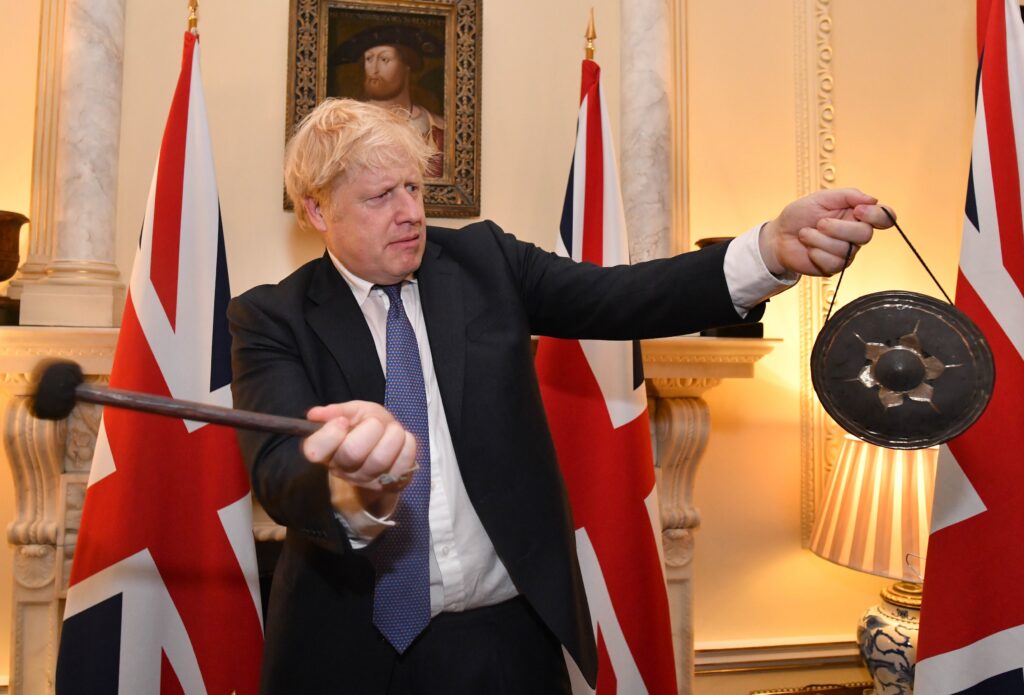
On the evening of 31 January, official buildings along Whitehall were illuminated by a red and blue light show. A clock was projected onto 10 Downing Street to count down to 11:00 pm; Big Ben did not chime as it was undergoing restoration works.
Brexit supporters nonetheless gathered in Parliament Square. Nigel Farage, the leader of the Brexit Party, took to the stage to the strains of Europe’s The Final Countdown.
Farage declared: “The fact is that the war is over. We have won… Let us celebrate like never before.”
https://x.com/theresa_may/status/1223292541556183040
Inside 10 Downing Street, Johnson hosted a reception for cabinet ministers and Vote Leave veterans – including his chief adviser, Dominic Cummings. Guests were served British-sourced canapés, including savoury shortbread with Shropshire blue cheese, roast beef and Yorkshire puddings.
In a video message, Johnson styled Brexit as “the dawn of a new era” and a moment of “real national renewal.”
The prime minister declared: “Tonight we are leaving the European Union. For many people this is an astonishing moment of hope, a moment they thought would never come. And there are many of course who feel a sense of anxiety and loss.
“And then of course there is a third group – perhaps the biggest – who had started to worry that the whole political wrangle would never come to an end…
“This is the moment when the dawn breaks and the curtain goes up on a new act in our great national drama…
“We have taken back the tools of self-government. Now is the time to use those tools to unleash the full potential of this brilliant country.”
Jeremy Corbyn, the Labour leader of the opposition, issued his own video statement.
https://x.com/jeremycorbyn/status/1223267966436958210
Emmanuel Macron, the French president, commented that Brexit was an “alarm signal”.
He claimed the 2016 referendum campaign, won by Cummings and Vote Leave, was based on “lies, exaggerations and cheques that were promised but will never come.”
Ursula von der Leyen, the European Commission president, remarked that “strength does not lie in splendid isolation, but in our unique union.”
She said: “We want to have the best possible relationship with the United Kingdom, but it will never be as good as membership. Our experience has taught us that strength does not lie in splendid isolation, but in our unique union.”
At 11:01pm, the Department for Exiting the European Union was formally abolished.
Barclay submitted his resignation as Brexit secretary, stating that with Brexit secure, the department had “delivered its purpose.”
In a letter to the prime minister, Barclay wrote: “It has been a great honour to serve as the secretary of state for the Department for Exiting the European Union. With the purpose of the department now complete, and our departure secure, I write to resign formally at 11.01pm.”
Johnson responded: “On the day that the United Kingdom leaves the EU, you can take particular pride that we are delivering on our promise to the British people to get Brexit done.
“Your work, and that of your department, has been absolutely crucial in ensuring that we are leaving the EU with a great new deal and that we are in such a strong position going into the negotiations about our future relationship.”
https://x.com/SteveBarclay/status/1223410734945705989
***
Britain subsequently entered an 11-month transition period, remaining in the single market and customs union while a long-term trade deal was negotiated.
Britain completed its separation from the EU at 11:00 pm on 31 December as the transition period came to an end, four and a half years after the 2016 referendum. It followed the agreement of the UK-EU Trade and Cooperation Agreement (TCA) and the passage of the European Union (Future Relationship) Act.

Politics.co.uk Newsletters
DAILY
Politics@Lunch
WEEKLY
Week in Review