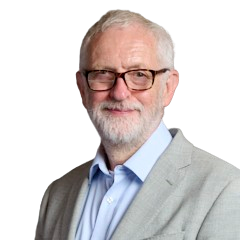
Jeremy Corbyn is the Your Party MP for Islington North, having first been elected to parliament at the 1983 general election.
Corbyn previously served as the Labour MP for the same constituency from 1983 until 2020 before his suspension from the party. He led Labour, serving as leader of the opposition in the House of Commons, from September 2015 to April 2020.
Cocrbyn currently serves as parliamentary leader of Your Party (since March 2026).
In the 2024 general election, Corbyn received 24,120 votes in Islington North, representing 49.2% of the vote share. The Labour candidate, Praful Nargund, placed second with 16,873 votes (34.4%), while the Green Party candidate, Sheridan Kates, secured 2,660 votes (5.4%). Corbyn was duly elected with a majority of 7,247.
Corbyn had the Labour whip withdrawn in October 2020 following his response to the Equality and Human Rights Commission (EHRC) report on antisemitism within the Labour Party. In May 2024, after being blocked by Labour’s national executive committee (NEC) from standing as a Labour candidate, he announced he would run as an independent, leading to his automatic expulsion from the Labour Party after over 50 years of membership.
Jeremy Corbyn: leader of the Labour Party (2015-2020)
Corbyn served as leader of the Labour Party and leader of the opposition from September 2015 to April 2020. During his tenure as leader, he championed anti-austerity, anti-war and public ownership policies.
Corbyn was the unexpected victor of the 2015 Labour leadership contest, triggered by Ed Miliband’s resignation after the general election of the same year resulted in a majority Conservative government. Corbyn was the chosen representative of the Socialist Campaign Group (SCG) of left-wing Labour MPs. John McDonnell and Diane Abbott, both SCG members, had launched leadership campaigns in 2007 and 2010. Corbyn was the latest candidate of the left to contest the leadership; few expected he would succeed where McDonnell and Abbott failed.
Announcing his candidacy, Corbyn declared: “This decision to stand is in response to an overwhelming call by Labour Party members who want to see a broader range of candidates and a thorough debate about the future of the party.
“I am standing to give Labour Party members a voice in this debate.”
Corbyn was nominated by 36 fellow MPs (15.52% of the PLP) – but several supported his candidacy because they believed the party’s left wing should be represented in the debate. Around a dozen of Corbyn’s ‘supporters’ in the first round went on to back rival candidates. He stood against three more mainstream Labour candidates, all of whom possessed frontbench experience. Andy Burnham and Yvette Cooper were both former cabinet ministers. Liz Kendall, seen as the race’s “Blairite” candidate, had held a shadow junior ministerial role from 2011 to 2015.
Corbyn began the campaign as a mostly unknown 200-to-1 rank-outsider; he ended it addressing mass rallies on an explicitly, unapologetic socialist platform.
Corbyn, a rebellious backbencher for the previous 32 years, ultimately won 59.5% of the vote in the first round.
Within hours of the result, senior MPs including Cooper, Kendall, Rachel Reeves and Tristram Hunt declared they would not serve on Corbyn’s frontbencher. Alongside the leadership race, the contest for the vacant deputy post was won by Tom Watson. Corbyn and Watson would go on to forge a difficult relationship, reflecting their disparate political outlooks.
Over time, several MPs who nominated Corbyn to “broaden the debate”, notably Neil Coyle and Jo Cox, later expressed their regret.
In June 2016, Corbyn faced a crisis of confidence in his leadership after 23 of 31 shadow cabinet members resigned – including Hilary Benn, Lucy Powell and Lisa Nandy. The rebellion was triggered by widespread anger within the PLP over what was seen as Corbyn’s lukewarm and ineffective support for the ‘Remain’ campaign. It was coordinated by the shadow foreign secretary, Hilary Benn, whom Corbyn sacked for allegedly plotting to oust him.
On 28 June 2016, Corbyn suffered an emphatic defeat in a vote of no confidence among his own MPs, with 172 MPs voting against him and only 40 offering their support.
In the subsequent leadership election, held over the summer of 2016, Corbyn defeated rival candidate Owen Smith comfortably. Corbyn won 313,209 votes (61.8%) to Smith’s 193,229 (38.2%).
Corbyn led Labour into the 2017 general election campaign. It resulted in a hung parliament – a shock outcome that saw the Conservative party lose its parliamentary majority and prime minister Theresa May’s authority severely diminished – after Labour ran an unexpectedly effective and energetic campaign.
The Labour Party manifesto, entitled For the Many Not the Few, was well-received. It featured pledges to scrap tuition fees, nationalise England’s nine water companies, guarantee the triple lock for pensioner incomes, end to zero hours contracts, and re-introduce the 50p rate of tax on the highest earner.
In the manifesto’s foreword, Corbyn argued that the election was about the “what sort of country we want to be after Brexit. Is it one where the majority are held back by the sheer struggle of getting by? That isn’t the Britain Labour is determined to create.”
He added: “So let’s build a fairer Britain where no one is held back. A country where everybody is able to get on in life, to have security at work and at home, to be decently paid for the work they do, and to live their lives with the dignity they deserve.”
In the end, the Tories won 317 seats – a net loss of 13 and nine short of the 326 required for an overall majority. Labour made a net gain of 30 seats to finish on 262.
The election outcome somewhat secured Corbyn’s standing. He led Labour MPs in their opposition to May’s Brexit deal, which was defeated on three occasions from January to March 2019. However, relations between Corbyn and Labour MPs soured markedly over the course of the 2017-2019 parliament.
On 18 February 2019, seven Labour MPs resigned from the party to form a new parliamentary bloc called The Independent Group, citing Corbyn’s leadership, the party’s handling of antisemitism allegations and its position on Brexit. The coordinated move was the most significant schism suffered by the Labour party since the formation of the Social Democratic Party (SDP) in 1981.
The 2019 general election, Corbyn’s second as Labour leader, resulted in the party’s worst defeat since 1935. The party returned just 202 MPs.
Labour went into the election with a promise to re-negotiate the existing Brexit deal, before putting it to a public vote – a second referendum – which the party would observe neutrally. The party’s manifesto, It’s Time For Real Change, contained a series of radical policies. It featured pledges to nationalise energy, water, rail and broadband.
Corbyn announced his intention to stand down as Labour leader from his Islington North election count. He said Labour had put forward a “manifesto of hope” and criticised the “way the media behaved” towards his party during the campaign.
He stated: “Brexit has so polarised and divided debate in this country, it has overridden so much of a normal political debate. I recognise that has contributed to the results that the Labour Party has received this evening all across this country.”
A post-mortem report by Labour Together found that by September 2019, 67% of voters disliked Corbyn, with only 12% viewing him favourably.
Jeremy Corbyn and Keir Starmer
On 4 April 2020, Keir Starmer was elected leader of the Labour Party. The result, announced in a scaled-back virtual event due to the Covid-19 pandemic, saw Starmer defeat his rivals Rebecca Long-Bailey and Lisa Nandy overwhelmingly in the first round of voting. Long-Bailey, the shadow business secretary, was widely regarded as the continuity candidate for the party’s left/Corbynite wing.
In October 2020, the Equality and Human Rights Commission (EHRC) published its report into antisemitism within the Labour Party. The report found Labour responsible for unlawful acts of harassment and indirect discrimination. In response to the report, Corbyn issued a response to the EHRC report, arguing “the scale of the [antisemitism] problem was also dramatically overstated for political reasons by our opponents”.
The Labour Party suspended Corbyn from membership and withdrew the parliamentary whip. His party membership was reinstated by Labour’s national executive committee disciplinary panel in November 2020, but Labour leader Keir Starmer declined to restore the parliamentary whip.
In March 2023, the Labour NEC passed a motion formally barring Corbyn from standing as a Labour candidate in the next general election. After the announcement of the 2024 general election, Corbyn left the Labour Party to run as an independent in Islington North. Corbyn announced his intentions in an article for the Islington Tribune.
He wrote: “Local Labour Party members in Islington North have been prevented from choosing their own candidate, which has disempowered everyone in the community. I am appalled at the way local people have been treated.
“We have to stand up and defend our rights. That is why I am standing to be an independent candidate for the people of Islington North.”
Jeremy Corbyn and Your Party
Corbyn was one of five independent MPs returned at the 2024 general election on platforms that emphasised Palestinian solidarity. He went on to form the so-called Independent Alliance of pro-Palestinian MPs, alongside Shockat Adam (Leicester South), Adnan Hussain (Blackburn), Ayoub Khan (Birmingham Perry Barr) and Iqbal Mohamed (Dewsbury and Batley).
In a joint-statement issued upon the group’s founding, the Independent Alliance MPs committed themselves “to provide hope in a parliament of despair”.
They added: “Millions of people are crying out for a real alternative to austerity, inequality and war – and their voices deserve to be heard. As individuals we were voted by our constituents to represent their concerns in parliament on these matters, and more, and we believe that as a collective group we can carry on doing this with greater effect.”
On 3 July 2025, leading left-wing parliamentarian Zarah Sultana announced she was leaving Labour to co-found a new political party alongside Corbyn. “Jeremy Corbyn and I will co‑lead the founding of a new party, with other independent MPs, campaigners and activists across the country”, Sultanta stated.
However, the apparent launch was marred by confusion over whether Corbyn had agreed to “co-lead the founding of a new party” – as the Sultana statement put it.
Corbyn’s public response to the statement was issued on the afternoon of 4 July. He was conspicuously more cautious, stating that “discussions are ongoing” over the prospect of a new party. He said he was “delighted” that Sultana would help build a left-wing “alternative” to Labour.
It was widely reported that the pair’s disparate levels of enthusiasm reflected strategic divisions and internal tensions over the founding of a new party.
On 24 July, Corbyn and Sultana launched a website which invited prospective supporters to register. The promotional material referred to “Your Party”, which was interpreted as an interim name. 100,000s of supporters signed up the new party’s mailing list over the first few days.
However, the developments that followed Sultana’s announcement continued to reflect significant internal friction.
In September, Sultana launched a membership portal without the full agreement of Corbyn and the interim leadership. More than 20,000 people registered within hours. Corbyn publicly described the new membership portal as a “false… system” and referred the matter to the Information Commissioner’s Office.
In response, Sultana accused Corbyn’s inner circle of forming a “sexist boys’ club” that sought to exclude her from decision-making, an allegation his team denied.
The new organisation officially registered with the Electoral Commission as “Your Party” on 30 September 2025. Mere weeks later, independent MPs Adnan Hussain and Iqbal Mohamed quit the party entirely. Hussain and Mohamed remained members of the Independent Alliance in the House of Commons.
The party’s inaugural conference in Liverpool in November 2025 was marred by a first-day boycott by Sultana, who protested the expulsion of several members who also belonged to the Socialist Workers Party. Sultana described the move as a “witch-hunt.” However, the conference concluded with a significant victory for the Sultana faction; members voted by 51.6% to 48.4% to adopt a collective leadership model rather than the single-leader system preferred by Corbyn.
Delegates also voted to make the Your Party name permanent.
Corbyn and Sultana led rival slates for Your Party’s Central Executive Committee (CEC) elections.
Corbyn’s slate, The Many, ran on a platform of community-led organising, while Sultana’s Grassroots Left slate campaigned for total transparency and an end to “top-down” control of the party.
In February, it was announced that Corbyn’s slate had won a majority on Your Party’s newly formed central executive committee. The Many, won 14 of the 24 seats in the leadership collective, while Grassroots Left won seven.
On 9 March, according to the new collective structure, Corbyn was formally appointed as the party’s parliamentary leader.
Corbyn formally identified as a Your Party MP on 10 June 2026.
Jeremy Corbyn: backbench career and rise to prominence (1983-2015)
Before his election as leader of the Labour Party, Corbyn had never before held a frontbench position. Rather, he was known for his activism outside of parliament, particularly with the anti-war movement. He served as chair of the Stop the War Coalition from 2011 to 2015 and was involved with the Campaign for Nuclear Disarmament (CND).
Throughout his political career, Corbyn has been a long-time supporter of Palestinian rights and a critic of Israeli government policies in the occupied territories. He supports a two-state solution to the Israeli-Palestinian conflict. Corbyn also supports Irish unification. An invitation extended, alongside Ken Livingstone, to Sinn Féin leader Gerry Adams to visit London in 1983 caused controversy at the time.
Corbyn frequently rebelled against the party whip under the leaderships of Neil Kinnock, Tony Blair and Gordon Brown. Records indicate he voted against the Labour whip over 600 times while he was a Labour MP. He was the most rebellious MP in the 2001-2005 parliament (148 rebellions) and in the 2005-2010 parliament (216 rebellions).
Corbyn was a member of the House of Commons social security committee from April 1992 to 1997 and the justice committee from May 2011 to March 2015. He is currently listed as a member of the all-party parliamentary groups (APPGs) for Chagos (British Indian Ocean Territory), Dalits and Adivasis (tribals) and Egypt.
Corbyn delivered his maiden speech on 1 June 1983 during a debate on the rate support grant for England.
In it, he stated: “We are suffering massive unemployment and massive cuts imposed by the Government on the local authorities.”
He added: “I represent an area of London that has suffered as much as any other from the policies of this government, and I shall be telling the House repeatedly that we do not intend to take these issues lying down. We shall not allow unemployment to go through the roof. We shall not allow our youth to have no chance and no hope for the future.
“We shall not allow our borough councils to be attacked mercilessly in the way that they have been by the Government and by the press in the past year.”
Political Views
Leadership elections and loyalty
Labour leadership 2010: Corbyn was one of 16 Labour MPs who supported John McDonnell for the party’s leadership in May 2010. The election followed the resignation of Gordon Brown, who stepped down as prime minister and Labour leader after the 2010 general election.
McDonnell, a prominent member of the Socialist Campaign Group (SCG), stood on a platform of opposition to the New Labour legacy. He withdrew from the contest on 9 June after securing only 16 nominations from the Parliamentary Labour Party (PLP), well short of the 33 required to reach the final ballot. McDonnell subsequently threw his support behind Diane Abbott to ensure a candidate from the party’s left appeared on the membership ballot.
Corbyn also went on to support Abbott’s candidacy. Abbott secured the minimum 33 nominations after several senior figures, including Harriet Harman and David Miliband, lent her their support to ensure a ideologically diverse ballot. She finished fifth in the contest with 7.4% of the vote.
Factional identity and party tradition
Socialist Campaign Group: Corbyn was for many years a member of the Socialist Campaign Group (SCG) – the standard-bearer of the left wing within the Parliamentary Labour Party (PLP). Founded in 1982 by followers of Tony Benn, the group has traditionally advocated policies such as widespread public ownership, wealth redistribution and strengthened trade union rights. Corbyn was a close ally of Benn during his tenure as a Labour MP.
Green new deal champion: Corbyn is listed as one of activist group Green New Deal Rising’s “cross-party green new deal champions”. GNDR is a progressive campaign organisation which promotes rapid decarbonisation and the transformation of the UK economy with a “Green New Deal” – a long-term plan to tackle climate change with large-scale public investment in renewable energy, green infrastructure and public services.
Spycops vote (2020): In October 2020, Corbyn was one of the 34 Labour MPs to break the party whip by voting against the covert Human Intelligence Sources (Criminal Conduct) Bill at its commons third reading. The proposed legislation, often referred to as the “spycops bill”, was introduced by the Conservative government to authorise undercover agents and informants to commit crimes while on operations. The Labour Party had whipped its representatives to abstain on the bill on the basis that the legislation is “far from perfect” yet “necessary” due to “the need to provide a clear lawful framework for the use of human intelligence sources”.
Anti-austerity letter (2015): Corbyn was among the 16 Labour MPs – generally associated with the party’s left wing – who signed a statement demanding then-leader Ed Miliband oppose further austerity, take rail franchises back into public ownership and strengthen collective bargaining arrangement.
The statement, issued in January 2015, read: “There is an alternative way out of endless austerity. We need public investment to kickstart the economy out of faltering growth and to generate real job creation and rising incomes.”
Brexit and Europe
Brexit referendum: Corbyn supported Remain in the 2016 Brexit referendum, and therefore agreed with the vast majority of his constituents, 78.4% of whom also voted to Remain.
Corbyn, who has a long history of euroscepticism, nonetheless argued that it was “perfectly possible to be critical and still be convinced we need to remain a member”.
Article 50: In February 2017, Corbyn voted in favour of the European Union (Notification of Withdrawal) Bill. The legislation empowered the prime minister to notify the Council of the European Union of the UK’s intention to withdraw, formally triggering the process set out in Article 50 of the Treaty on European Union. MPs supported the bill by 498 votes to 114 at second reading.
Welfare
Welfare vote (July 2015): Alongside almost one quarter of his Labour colleagues, Corbyn voted against the Conservative government’s Welfare Reform and Work Bill at second reading – defying the party whip which instructed Labour MPs to abstain. This decision to abstain, taken by interim Labour leader Harriet Harman, caused a furious backlash within the party, particularly from its left wing. It became a defining issue in the ongoing leadership contest. In fact, Corbyn was the only candidate to vote against the bill. Overall, 48 Labour MPs voted against the proposed legislation.
Assisted dying
Corbyn voted against the Terminally Ill Adults (End of Life) Bill, better known as the assisted dying bill, at both second reading (November 2024) and third reading (June 2025).
In a statement setting out his position, Corbyn said: “Any legislation of this kind must robustly safeguard against abuse, and guarantee that those who are seriously ill would not feel coerced or pressured to prematurely end their life. I am not satisfied that this legislation provides these safeguards – and that is why I cannot support it.”
Social values and conscience issues
Abortion decriminalisation (2025): Corbyn voted in favour of a backbench amendment to the Crime and Policing Bill that sought to decriminalise abortion in England and Wales in June 2025. The amendment, which was passed by a majority of 242 votes, removed women from the threat of prosecution for ending a pregnancy at any stage. As an issue of conscience, MPs were allowed to vote according to their personal beliefs.
Same-sex marriage (2013): In February 2013, Corbyn voted in favour of the Marriage (Same Sex Couples) Bill at its second reading. The landmark piece of legislation, which received its second reading by 400 votes to 175, legalised marriage for same-sex couples in England and Wales
Foreign policy and security
Nato-scepticism: In February 2022, following Russia’s invasion of Ukraine, Corbyn signed a statement by the Stop the War Coalition which criticised Nato, accusing the military alliance of “eastward expansion”.
Trident renewal (2016): Corbyn voted against a government motion calling for the renewal of the Trident nuclear deterrent system in July 2016. The motion, which was passed by 472 votes to 117, committed the UK to constructing a new fleet of submarines to carry the nation’s nuclear weapons. Labour was split over the issue with 140 of its 230 MPs going against leader Jeremy Corbyn and backing the motion.
Syria airstrikes (2015): Corbyn voted against a government motion to extend UK airstrikes against Isis from Iraq into Syria in December 2015. The motion, which was passed by 397 votes to 223 after a ten-hour debate in the House of Commons, authorised the RAF to conduct strikes against Isis targets in Syria.
Syria airstrikes (2013): Corbyn voted against the government’s motion on the principle of military intervention in Syria in August 2013. The government motion was defeated by 285 votes to 272, a move which effectively ruled out UK participation in any US-led military strikes.
Libya intervention (2011): Corbyn was one of only 13 MPs to vote against the government motion authorising UK military intervention in the Libyan civil war in March 2011. The House of Commons approved the action by 557 votes to 13. The government, with opposition frontbench support, argued the intervention was necessary and legal under UN Security Council Resolution to protect civilians from attack by forces loyal to Colonel Gaddafi.
Iraq War vote (2003): In March 2003, Corbyn voted for a rebel amendment which argued that the case for war against Iraq had not been established. A total of 139 Labour, 53 Liberal Democrat and 15 Conservative MPs backed the amendment. The government’s unamended motion authorising military action against Iraq passed by 412 votes to 149.
Palestine
Palestine Action vote: In July 2025, Corbyn was one of 26 MPs to vote against the proscription of Palestine Action under the Terrorism Act 2000. The ban, passed by 385 votes to 26, came after the Home Office accused the group of “aggressive and intimidatory attacks against businesses, institutions and the public”. However, civil liberties organisations argued proscription represented an overreach of state power and a threat to the right to protest.
Ceasefire vote (November 2023): Corbyn voted for a Scottish National Party (SNP) amendment to the king’s speech in the House of Commons calling for an “immediate ceasefire” in the Israel-Hamas war. Labour had tabled a rival motion, making a more moderate appeal for a “humanitarian pause” in the conflict.
Palestinian recognition vote (2014): In October 2014, Corbyn supported a commons motion to recognise Palestine as a state. The motion, passed by 274 votes to 12, called on the government to “recognise the state of Palestine alongside the state of Israel as a contribution to securing a negotiated two-state solution”. In the vote, Corbyn acted as a “Noe” teller to ensure the historic division could take place.
Civil liberties
Covid passes vote (2021): Corbyn was one of 126 MPs to vote against Covid passes in England in December 2021. The measure, introduced by Boris Johnson’s government, was carried by 369 votes to 126.
Covid passes campaign (2021): Corbyn was one of over 70 MPs and peers who launched a cross-party campaign against the “divisive and discriminatory use” of Covid passes in April 2021. The campaign was triggered by government reviews into “vaccine passports”, which signatories argued would create a two-tier society and infringe upon fundamental civil liberties.
Before Politics
Corbyn was born in Chippenham, Wiltshire, in 1949 and grew up in Shropshire. He was educated at Castle House School, an independent preparatory school, and later attended Adams’ Grammar School in Newport, Shropshire, leaving with two A-levels at grade E.
After school, Corbyn undertook voluntary service overseas with Voluntary Service Overseas (VSO) in Jamaica for two years. Upon returning to Britain, he worked as an organiser for trade unions including the National Union of Public Employees (NUPE) and the Amalgamated Engineering and Electrical Union (AEEU).
Corbyn’s first elected role was as a councillor for the London Borough of Haringey, where he served from 1974 until 1983.
Personal Life
Corbyn has been married three times. His third wife is Laura Alvarez, whom he married in 2012. He has three sons from his previous marriages.
He lives in the Finsbury Park area of his Islington North constituency. He is known for his allotment and for making his own jam.
His personal interests include cycling and maintaining his allotment. His brother, Piers Corbyn, is known as an anti-vaccine activist and conspiracy theorist.
In the late 1970s, Corbyn was romantically involved with Diane Abbott.
However, the relationship did not last, in her memoir, Abbott recalled: “I began to realise that, realistically, ours was not a match made in heaven…
“Once, after I lamented our lack of social activity as a couple, he pondered it for a few days and told me we were going out. Feeling excited, I dressed up nicely and we bundled into the car. I had no idea where we were going – perhaps a nice wine bar? It turned out Jeremy’s idea of a social outing was to drive me to Highgate cemetery and proudly show me the tomb of Karl Marx.”
Trivia
Corbyn has won parliamentary the “beard of the year” award, organised by the Beard Liberation Front, on multiple occasions. In 2001, he reportedly described his beard as “a form of dissent” against New Labour.
During the 2017 general election campaign, Corbyn received an unexpected endorsement from the heavy metal music magazine Kerrang!.
He is reported to be teetotal and a vegetarian.
Comment: Israel, not Iran, is the biggest obstacle to a nuclear-free Middle East
20 April 2012