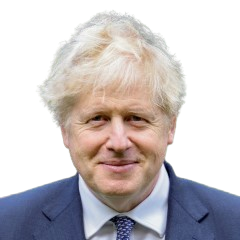
Boris Johnson served as the prime minister of the United Kingdom of Great Britain and Northern Ireland from 2019 to 2022.
Johnson, who also served as foreign secretary (2016-2018) and mayor of London (2008-2016), was the leading pro-Leave figure in the 2016 Brexit referendum.
He served as the Conservative MP for Uxbridge and South Ruislip between 2015 and 2023, having previously represented the Henley constituency from 2001 to 2008.
Johnson’s frontline political career was ultimately brought to an end by the revelations concerning lockdown gatherings during the Covid-19 pandemic. After a cross-party parliamentary committee concluded he misled the commons over “Partygate”, Johnson resigned as an MP.
Boris Johnson: delivering Brexit (2019-2020)
Johnson was appointed prime minister following his decisive victory in the 2019 Conservative Party leadership contest, triggered by Theresa May’s resignation. May announced her resignation on 24 May, having failed to convince Conservative MPs to back her Brexit withdrawal agreement in three separate “meaningful votes”.
The ensuing contest, which formally began on 10 June, saw 10 candidates compete for the Conservative leadership. Johnson entered the race as the clear frontrunner, promising to deliver Brexit by the latest deadline of 31 October “do or die” and “no ifs no buts”.
In successive rounds of voting, Johnson consistently secured the largest share of support, eliminating rivals including Michael Gove, Sajid Javid, Rory Stewart and Dominic Raab. Johnson won 160 votes in the fifth and final ballot of MPs – leaving him to face his successor as foreign secretary, Jeremy Hunt, in the all-important vote among the wider party membership. The result, announced on 23 July, confirmed Johnson’s victory. He won 92,153 votes (66.4%) to Hunt’s 46,656 (33.6%).
Upon arriving in Downing Street, Johnson delivered his first speech as prime minister. He paid tribute to May’s “fortitude and patience” as well as her “deep sense of public service”.
He said: “We are going to fulfil the repeated promises of parliament to the people and come out of the EU on 31 October – no ifs or buts.
“And we will do a new deal, a better deal that will maximise the opportunities of Brexit while allowing us to develop a new and exciting partnership with the rest of Europe based on free trade and mutual support.”
In forming his government, Johnson dismissed 11 senior ministers from Theresa May’s government and accepted the resignation of six others. Conservative MP Nigel Evans described this clearout as “not so much a reshuffle as a summer’s day massacre”.
In August 2019, Johnson instructed the leader of the House of Commons, Jacob Rees-Mogg, to convene a meeting of privy councillors and advise Queen Elizabeth II to prorogue parliament. Prorogation in order to secure a “no-deal” Brexit – the default legal position under EU law’s Article 50 process – had been a point of debate in the 2019 Tory leadership contest. The approach was denounced by critics, including those within the Conservative Party, as an unconstitutional ploy to bypass MPs – at a time when the parliamentary arithmetic was finely balanced.
That said, a critical mass of UK parliamentarians remained bitterly opposed to a no-deal, “do or die” Brexit scenario, and on 3 September, a cross-party alliance led by the Conservative backbencher Sir Oliver Letwin successfully passed a motion by 328 votes to 301 to seize control of the commons order paper. It allowed for the introduction of a bill to block a no-deal exit.
This act of rebellion provoked a ruthless response from Johnson and the government. On the evening of 3 September, the Conservative whip was withdrawn from all 21 Tory MPs who had voted against the government. This included former chancellors Philip Hammond and Kenneth Clarke, and Nicholas Soames, Winston Churchill’s grandson. This purge effectively cost Johnson his working majority.
The European Union (Withdrawal) (No. 6) Bill, sponsored by the Labour MP Hilary Benn, imposed a legal duty on the prime minister to send a specific, pre-written letter to the European Council requesting an Article 50 extension until 31 January 2020 in the event that a withdrawal deal had not been approved by 19 October.
In response, Johnson immediately moved a motion under the Fixed-term Parliaments Act 2011 to call a general election. It was supported by 298 votes to 56 – short of the two-thirds majority of MPs required under the 2011 act. On 5 September, Johnson said he would “rather be dead in a ditch” than ask the EU for another Brexit extension, as the so-called ‘Benn act’ required.
On 7 September, the work and pensions secretary, Amber Rudd, resigned from the cabinet and surrendered the Conservative whip. She called the expulsion of the 21 MPs an “act of political vandalism” and stated she no longer believed “leaving with a deal is the government’s main objective.”
The European Union (Withdrawal) (No. 6) Act received royal assent on 9 September. Johnson and his supporters in the Conservative Party referred to Benn’s legislation as the “surrender bill”, later “surrender act”. Also on 9 September, a second attempt to trigger a snap election failed 293-46.
Parliament was officially prorogued in the early hours of 10 September – in the face of considerable protest from opposition MPs and the commons speaker, John Bercow.
However, on 24 September 2019, the supreme court unanimously ruled that the prime minister’s request for the queen to prorogue parliament was unlawful. Eleven justices, led by Lady Hale, ruled that the prorogation was “void and of no effect”, meaning parliament could be reconvened the following day.
Johnson said that he “strongly disagreed” with the ruling, but the government would “respect the judicial process”.
Johnson first presented his renegotiated Brexit deal to parliament on 19 October during a rare Saturday sitting. However, MPs responded by backing an amendment that called for any consideration of a new withdrawal agreement, negotiated by Johnson, to be delayed until the legislation to implement it has been passed. This triggered the provisions of the Benn act.
The delay forced a reluctant Johnson to send the extension request, averting a no deal Brexit. On 19 October, the government sent three letters to the president of the European Council, Donald Tusk. The first was an unsigned photocopy of the extension request letter as specified in the Benn act. A second covering letter from the UK’s permanent representative in Brussels, Tim Barrow, affirmed that the first letter complied with the act. The third, signed by Johnson, argued that any delay would be “corrosive”.
On 30 October, the government introduced the Early Parliamentary General Election Bill, later act, which set the date for a general election on 12 December. The bill circumvented the official procedure provided for in the Fixed Term Parliaments Act, and therefore only required a simple majority. It passed by 439 votes to 22 at third reading.
The Conservative 2019 general election campaign was defined by the relentless repetition of the slogan “Get Brexit Done” – an attempt to exploit widespread Brexit fatigue. The party targeted the so-called “red wall” of traditional Labour seats in the Midlands and North, which had supported ‘Leave’ during the 2016 Brexit referendum. The approach, masterminded by Dominic Cummings and Isaac Levido, was devastatingly effective. The Tories gained 48 seats, toppling supposed Labour strongholds such as Bishop Auckland (Conservative for the first time in 134 years), Blyth Valley, Workington, and Great Grimsby.
Overall, the Conservatives secured a landslide majority of 80 seats. It marked the party’s best result since 1987 and the highest share of the popular vote (43.6%) for any party since 1979. Labour, led by Jeremy Corbyn, suffered its worst defeat in terms of seats since 1935. The party returned just 202 MPs.
The Brexit Party, led by Nigel Farage, won zero seats but played a crucial role in the campaign. On 1 November, launching the Brexit Party’s campaign, Farage called on Johnson to “build a leave alliance” and drop his renegotiated deal with the EU. Otherwise, he said, the Brexit Party would “contest every single seat in England, Scotland and Wales.” But on 11 November, Farage announced that the Brexit Party would stand down its candidates in the 317 constituencies won by the Conservatives at the 2017 general election. Johnson welcomed the decision, saying that there was “only one way to get Brexit done and that is to vote [Conservative].”
Johnson addressed the nation at 7:00 am on 13 December. He said that the “irrefutable, irresistible, unarguable decision of the British people” had settled the Brexit question. He thanked Labour voters, many of whom, he said, had backed the Conservatives for the first time.
On 9 January 2020, the European Union (Withdrawal Agreement) Bill passed its third reading in the House of Commons by 330 votes to 231. It received royal assent on 23 January.
At 11:00 pm GMT on 31 January 2020, the United Kingdom formally left the European Union, ending 47 years of membership. The departure marked the culmination of the verdict delivered at the 2016 referendum, in which 52% of the electorate voted to leave, and followed a protracted period of parliamentary deadlock.
Inside 10 Downing Street, Johnson hosted a reception for cabinet ministers and Vote Leave veterans – including his chief adviser, Dominic Cummings. Guests were served British-sourced canapés, including savoury shortbread with Shropshire blue cheese, roast beef and Yorkshire puddings.
In a video message, Johnson styled Brexit as “the dawn of a new era” and a moment of “real national renewal.”
The prime minister declared: “Tonight we are leaving the European Union. For many people this is an astonishing moment of hope, a moment they thought would never come. And there are many of course who feel a sense of anxiety and loss.
“And then of course there is a third group – perhaps the biggest – who had started to worry that the whole political wrangle would never come to an end…
“This is the moment when the dawn breaks and the curtain goes up on a new act in our great national drama…
“We have taken back the tools of self-government. Now is the time to use those tools to unleash the full potential of this brilliant country.”
Britain subsequently entered an 11-month transition period, remaining in the single market and customs union while a long-term trade deal was negotiated.
Britain completed its separation from the EU at 11:00 pm on 31 December as the transition period came to an end, four and a half years after the 2016 referendum. It followed the agreement of the UK-EU Trade and Cooperation Agreement (TCA) and the passage of the European Union (Future Relationship) Act.
Boris Johnson: Coronavirus and crisis (2020-2022)
In the weeks that followed “Brexit day” on 31 January, Johnson’s premiership was overtaken by the Covid-19 crisis.
On 23 March, after weeks of strategic confusion over the direction of government policy, Johnson delivered his famous television broadcast, declaring a blanket stay-at-home order. This development beyond the chamber only influenced the latter stages of the debate. In his broadcast, Johnson announced that to stop the “invisible killer” from spreading between households, the British people were required to stay at home, with only four strictly limited exceptions.
The prime minister stated: “From this evening I must give the British people a very simple instruction – you must stay at home. Because the critical thing we must do is stop the disease spreading between households.”
The four exceptions were for shopping for basic necessities; one form of exercise a day; any medical need, to provide care or to help a vulnerable person; and travelling to and from work, but only where absolutely necessary.
To ensure the “stay at home” order was effective, the government moved to shut down the social and commercial life of the nation, closing all shops selling non-essential goods, stopping all gatherings of more than two people in public, and banning all social events, including weddings, baptisms and other ceremonies, but excluding funerals.
In late March 2020, reports emerged that Dominic Cummings, the chief adviser to the prime minister, had driven 260 miles from London to his parents’ farm near Durham with his family, while his wife had Covid-19 symptoms. During their stay, he also made a 60-mile round trip to the town of Barnard Castle, which he claimed was to test his eyesight before the long drive back to London.
These journeys were in apparent breach of the government’s own strict ‘stay at home’ guidance. Johnson, however, stood by his adviser. This prompted a fierce political backlash – with widespread anger that there appeared to be one rule for senior government figures and another for the public.
Cummings held an extraordinary press conference in the Downing Street rose garden to defend his actions. During the press conference, Cummings offered no apology and insisted he had acted “reasonably and legally”. He argued that there was “no regulation covering the situation I found myself in”.
Cummings said: “I don’t regret what I did… I think what I did was actually reasonable in these circumstances. The rules made clear that if you are dealing with small children that can be exceptional circumstances.”
Cummings ultimately departed Downing Street in November 2020 – the culmination of a protracted power struggle between him and other members of the prime minister’s inner circle, including the prime minister’s then-fiancée, Carrie Symonds. Cummings was famously photographed leaving through the front door of Downing Street carrying a cardboard box.
On 26 May 2021, Cummings appeared before the House of Commons health and science select committees for a seven-hour oral evidence session. He told MPs the government had failed the public during the pandemic. “Tens of thousands of people died who didn’t need to die”, he stated. Cummings described Johnson as a “shopping trolley”, smashing from one side of the aisle to the other. He also alleged that in October 2020, Johnson had expressed a preference to “let the bodies pile high in their thousands” rather than order a second lockdown. Downing Street denied the quote.
On 30 November 2021, the Daily Mirror’s political editor, Pippa Crerar, reported that Johnson had broken lockdown rules with a series of Downing Street gatherings during the 2020 festive period.
The report read: “The prime minister gave a speech at a packed leaving do for a top aide last November when the country was in the grip of its second lockdown.
“Then just days before Christmas, with London in tier 3 restrictions, members of his top team held their own festive bash in Downing Street.”
One source told Crerar: “It was a Covid nightmare”.
Johnson returned to the House of Commons for prime minister’s questions on 1 December. He told MPs “that all guidance was followed completely in No 10”.
On 7 December, ITV News broadcast a 47-second clip that showed Allegra Stratton, the Downing Street press secretary, joking about a Christmas party. Stratton, addressing a mock press conference, laughingly said that the party in question “was a business meeting and it was not socially distanced”.
The following day, Johnson told the commons that he was “furious to see” the clip of Stratton. He insisted that “the guidance was followed and the rules were followed at all times.” The prime minister confirmed that the cabinet secretary, Simon Case, would lead an investigation into possible rule-breaking in Downing Street. Stratton was ultimately forced to resign as Downing Street press secretary.
Over the following days and weeks, further revelations – in the form of source quotes and pictures – appeared in the media that pointed to gatherings held during the 2020 festive period. On 17 December, a joint investigation by the Independent and Politico referred to a Christmas party held in the Cabinet Office for Simon Case’s staff. As a result, leading civil servant Sue Gray assumed the reins of his investigation into reported Downing Street gatherings.
The next major revelation came in the form of the “bring-your-own-booze” story broken by ITV News on 10-11 January 2022. The report was based on a leaked email sent by the prime minister’s principal private secretary, Martin Reynolds, on 20 May 2020. The email invited more than 100 Downing Street staff to “make the most of the lovely weather” with socially distanced drinks.
In full, Reynolds’ email read: “Hi all,
“After what has been an incredibly busy period we thought it would be nice to make the most of the lovely weather and have some socially distanced drinks in the No10 garden this evening.
“Please join us from 6pm and bring your own booze!”
At the time of the event, strict lockdown rules were in place across England, forbidding large gatherings and limiting social meetings to just one person from outside one’s household in an outdoor public space.
Johnson was once again forced to address the Partygate affair in the House of Commons.
The prime minister told MPs that he “believed implicitly” that the gathering “was a work event”.
He said: “I want to apologise. I know that millions of people across this country have made extraordinary sacrifices over the last 18 months.
“I know the anguish that they have been through, unable to mourn their relatives and unable to live their lives as they want or to do the things they love.
“I know the rage they feel with me and with the government I lead when they think that in Downing Street itself the rules are not being properly followed by the people who make the rules.”
He added: “When I went into that garden just after 6 O’clock on 20 May 2020, to thank groups of staff before going back into my office 25 minutes later to continue working, I believed implicitly that this was a work event, but with hindsight, I should have sent everyone back inside.”
Johnson asked that “Sue Gray be allowed to complete her inquiry into that day and several others, so that the full facts can be established.”
On 18 January, Dominic Cummings, Johnson’s former chief adviser, alleged that the prime minister knew in advance about the “bring-your-own-booze” gathering on 20 May 2020 and agreed that it could go ahead.
In a post to his Substack, Cummings said he would “swear under oath” that he raised concerns about the gathering.
Cummings wrote on his Substack: “Amid discussion over the future of the cabinet secretary and PPS himself, which had been going on for days, I said to the PM something like: ‘Martin’s invited the building to a drinks party, this is what I’m talking about, you’ve got to grip this madhouse.’
“The PM waved it aside.”
He added: “The events of 20 May alone, never mind the string of other events, mean the PM lied to parliament about parties.”
On 3 February 2022, Johnson’s premiership was plunged into a deeper crisis when four of his most senior Downing Street aides, including Martin Reynolds, resigned within hours of each other. The exodus came as the prime minister battled to contain the political fallout from the partygate scandal – as well as a row over a controversial remark he made in parliament.
The first and most damaging resignation was that of Munira Mirza, the head of the No 10 policy unit. She quit in protest at the prime minister’s use of a false claim linking Keir Starmer, a former director of public prosecutions (DPP), to the failure to prosecute the sex offender Jimmy Savile.
In her resignation letter, Mirza criticised Johnson’s “inappropriate and partisan reference to a horrendous case of child sex abuse”.
Mirza’s resignation was followed by those of Jack Doyle, the director of communications; Dan Rosenfield, the chief of staff; and Reynolds, the prime minister’s principal private secretary and author of the infamous “bring your own booze” email.
The departures of Reynolds and Rosenfield were said to be part of a planned clear-out in response to the initial findings of Sue Gray’s report.
On 12 April 2022, Johnson and the chancellor of the exchequer, Rishi Sunak, were issued with fixed penalty notices by the Metropolitan Police for breaching Covid-19 lockdown regulations.
The fines made Johnson the first serving prime minister in British history to be sanctioned for breaking the law. They were issued as part of the police investigation, known as Operation Hillman, into the Partygate scandal.
The specific event for which Johnson and Sunak were penalised was a birthday celebration for the prime minister held in the cabinet room on 19 June 2020, at a time when restrictions banned most indoor gatherings involving more than two people.
At the start of business on 19 April 2022, the speaker of the House of Commons, Lindsay Hoyle, announced that he would allow a debate to be held on a motion referring Johnson, then the prime minister, to the privileges committee. The speaker confirmed he had received letters from a number of MPs calling for this course of action, including the Labour leader of the opposition, Keir Starmer.
The matter, Hoyle said, concerned “the prime minister’s statements to the House regarding gatherings held at Downing Street and Whitehall during lockdown.” The commons subsequently debated a motion tabled by Starmer as leader of the opposition, calling for an investigation on 21 April 2022.
The motion noted “the issue of fixed penalty notices by the police in relation to events in 10 Downing Street and the Cabinet Office” and the prime minister’s assertions on the floor of the House, including that “all guidance was followed in No 10”.
On 6 June 2022, Johnson survived a vote of no confidence in his leadership. Johnson won the secret ballot of Conservative MPs by 211 votes to 148 – a victory that technically secured his position under party rules for another year. However, the scale of the revolt was far larger than had been anticipated. The publication of Gray’s critical report into Partygate had galvanised discontented MPs to act.
Boris Johnson: the ‘Pincher affair’ and collapse (2022)
On 30 June 2022, Chris Pincher resigned as deputy chief whip following allegations that he had drunkenly groped two men at the Carlton Club in London. A loyal ally of the prime minister, Pincher was promoted to the position of deputy chief whip in February 2022 in a bid to shore up Johnson’s premiership. It came after the publication of senior civil servant Sue Gray’s interim report into “Partygate” – the scandal relating to a series of gatherings in Downing Street during Covid lockdowns. Gray found that some of the government’s behaviour was “difficult to justify” given the “backdrop of the pandemic”.
Pincher’s appointment formed part of a wider strategic shift termed “Operation Save Big Dog”.
The so-called Pincher Affair, and Downing Street’s botched handling of it, formed the final catalyst for Johnson’s defenestration as prime minister.
In his resignation letter to the prime minister, Pincher admitted that he had “drank far too much” and “embarrassed myself and other people”. The letter contained no admission to the specific allegations of groping.
Initially, Downing Street insisted that the prime minister considered the matter closed and that Pincher would remain a Conservative MP, having lost only his government job. However, this position became untenable as a storm of new allegations about Pincher’s past behaviour emerged over the following days. The critical political question became what Johnson knew about these previous allegations when he appointed Pincher to the whips’ office in February 2022.
Downing Street’s official account of what the prime minister knew changed repeatedly. Ministers were sent out to defend the prime minister with briefings that were later shown to be false, fatally undermining their own and the government’s credibility. In a critical intervention, Cummings claimed the prime minister had once said “Pincher by name, pincher by nature” in reference to the loyalist MP.
The scandal culminated in the explosive revelation from Lord (Simon) McDonald, the former top civil servant in the Foreign Office, that Johnson had been personally briefed on a formal complaint against Pincher in the past, during his time as a Foreign Office minister, directly contradicting No 10’s claims. McDonald wrote an open letter to the parliamentary commissioner for standards and delivered an interview that refuted Downing Street’s line. He likened Downing Street’s statements to “telling the truth and crossing your fingers at the same time and hoping that people are not too forensic in their subsequent questioning”.
His letter read: “Inaccurate claims by 10 Downing Street continue to be repeated in the media. On 3 July, the BBC website reported: ‘No official complaints against [Mr Pincher] were ever made.’
“This is not true.”
It was a devastating intervention. A government minister subsequently confirmed that Johnson had been made aware of a complaint about Pincher. This latest evolution of No 10’s position proved to be the final straw for the Johnson premiership.
On 5 July, the health secretary, Sajid Javid, and the chancellor, Rishi Sunak, resigned in protest.
In the 24 hours that followed Sunak and Javid’s resignations, 36 MPs stepped down from their roles in government. Johnson initially resisted calls to resign. He conducted a cabinet reshuffle that saw Nadhim Zahawi replace Sunak as chancellor, and Steve Barclay appointed health secretary.
When he returned to the House of Commons on 6 July to face prime minister’s questions, the leader of the opposition, Keir Starmer, referred to Johnson as a “pathetic spectacle”. Following PMQs, Javid rose to deliver a scathing personal statement. With Johnson sitting on the government frontbench, he declared that “enough is enough”. The intervention drew comparisons to Geoffrey Howe’s 1990 famous post-resignation statement, which precipitated the collapse of the Thatcher government.
Johnson then attended a scheduled hearing of the liaison committee of senior MPs. There, he was confronted with the news that a delegation of ministers, including Zahawi, the newly appointed chancellor, and transport secretary Grant Shapps, had gathered in Downing Street to convince him to resign.
With the chaos still escalating, Michelle Donelan, who had been appointed as education secretary in the recent reshuffle, stepped down. Her tenure lasted just two days. Michael Gove, the levelling up secretary, was sacked for “disloyalty”. Suella Braverman, the serving attorney general, announced her candidacy for a post-Johnson leadership election. And Zahawi said the situation was “not sustainable and will only get worse” in a public statement.
On 12:30 on 7 July, Johnson delivered a defiant resignation speech outside 10 Downing Street, blaming the “herd instinct” at Westminster for his removal.
He stated, ruefully: “It is clearly now the will of the parliamentary Conservative Party that there should be a new leader of that party and therefore a new prime minister.”
Johnson’s resignation as Tory leader triggered a leadership race, which was contested by a series of senior party figures. Sunak, Javid, Braverman, Shapps and Zahawi were among those who stood as candidates.
Liz Truss, the foreign secretary, ultimately defeated Sunak in the final round. She had not resigned from cabinet in July 2022, but later issued a statement calling Johnson’s departure “the right decision” and for “calmness and unity”.
Boris Johnson’s late-political career (2022-2023)
Johnson returned to the backbenches in the wake of his resignation as prime minister. But the rapid collapse of the Truss administration appeared to open the door to a comeback.
The October 2022 Conservative leader contest, triggered by Truss’ resignation, was dominated by speculation that Johnson could reclaim his position as prime minister. Johnson sensationally flew back from a holiday in the Dominican Republic on the morning of Saturday 22 October. His supporters quickly claimed he had secured the support of the necessary 100 MPs to progress to a vote of the Tory membership.
At least six cabinet ministers endorsed Johnson in the October 2022 Tory leadership contest, namely Ben Wallace, Jacob Rees-Mogg, Simon Clarke, Chris Heaton-Harris, Alok Sharma and Anne-Marie Trevelyan.
On the evening of 22 October, Johnson and Sunak – the former chancellor whose resignation precipitated his defenestration – met, reportedly to discuss the possibility of a joint ticket.
Johnson withdrew from the contest on 23 October, however, having yet to formally declare his candidacy. In a statement, the former PM said he had been “overwhelmed by the number of people who suggested” he should stand.
He added: “I believe I am well placed to deliver a Conservative victory in 2024 – and tonight I can confirm that I have cleared the very high hurdle of 102 nominations, including a proposer and a seconder, and I could put my nomination in tomorrow.
“But in the course of the last days I have sadly come to the conclusion that this would simply not be the right thing to do. You can’t govern effectively unless you have a united party in parliament.”
Johnson’s withdrawal produced a two-way race between Sunak, the former chancellor and staunch critic of ‘Trussonomics’, and Penny Mordaunt, the leader of the House of Commons. In the end, Mordaunt failed to secure the necessary backers and withdrew two minutes before the 2:00 pm nomination deadline.
Sunak formally accepted King Charles III’s invitation to become prime minister on 25 October. Brady later confirmed that Johnson had indeed secured the 100 MPs necessary to force a ballot of the Conservative membership – which he could well have won.
Johnson, who remained a backbencher after Sunak’s coronation, still had the matter of the privileges committee inquiry into Partygate to deal with.
As part of its investigation, the privileges committee focused on six gatherings between May 2020 and January 2021, and statements Johnson made to parliament about them: a gathering in the No 10 garden on 20 May 2020; Johnson’s birthday gathering on 19 June 2020; leaving celebrations on 13 November 2020, 27 November 2020 and 14 January 2021, and “cheese and wine” Friday night press office gatherings.
The privileges committee, unlike many other select committees, has the power “to order the attendance of any member before the committee and to require that specific documents or records in the possession of a member relating to its inquiries be laid before the committee or any sub-committee”. Under these rules, Johnson was called before the cross-party MPs to deliver evidence under oath.
The televised evidence session in March 2023, some months after Johnson’s resignation as prime minister, provided a moment of unprecedented political drama.
In a combative and unapologetic performance, Johnson defended his statements, arguing that he had made them in good faith based on the advice he had been given by his officials. Having previously accepted that he delivered misleading comments in the commons, he insisted any such statements were delivered unintentionally or inadvertently.
In his opening statement, Johnson told the committee: “I am here to say to you, hand on heart, that I did not lie to the House. When those statements were made, they were made in good faith, and on the basis of what I honestly knew and believed at the time.
“When this inquiry was set up, I was completely confident that you would find nothing to show I knew or believed anything else, as indeed you have not. I was confident not because there has been some kind of cover-up; I was confident because I knew that is what I believed, and that is why I said it.”
On 9 June 2023, Johnson announced his resignation as an MP after receiving a draft of the committee’s final report. In a statement, the former prime minister Johnson branded the committee a “kangaroo court” and claimed its year-long inquiry had delivered “what is intended to be the final knife-thrust in a protracted political assassination”.
The 106-page final report of the privileges committee, published a week later on 15 June 2023, found that Johnson committed “repeated contempts of parliament”.
The report also accused Johnson of having “breached the confidence” of the privileges committee by discussing its draft findings prior to their publication. The former prime minister was accused of being complicit in a “campaign of abuse and intimidation of the committee.”
The committee’s report stated that had Johnson remained an MP, it would have recommended that he be suspended from the House of Commons for 90 days. This proposal, subject to approval by a vote of the commons, would have triggered a recall petition in Johnson’s Uxbridge and South Ruislip constituency under the Recall of MPs Act 2015, and possibly a by-election.
On 19 June, the House of Commons endorsed the report by 354 votes to 7, with a large number of abstentions. Rishi Sunak, the serving prime minister, was among those who abstained. The then-PM maintained that he had other commitments.
Boris Johnson’s rise to prominence (2001-2016)
Johnson was first elected to parliament as the Conservative MP for Henley at the 2001 general election.
In March 2003, Johnson voted in favour of the government motion authorising military action against Iraq. The vote, one of the most contentious in recent parliamentary history, gave the prime minister, Tony Blair, the authority to join the US-led invasion.
In 2004, Michael Howard, the Conservative leader of the opposition, appointed Johnson as shadow arts minister. However, Howard dismissed Johnson from the frontbench only seven months later after rumours surfaced regarding Johnson’s private life.
Johnson was re-elected as the MP for Henley at the 2005 general election. He supported David Cameron in the Conservative leadership contest of that year. Cameron subsequently appointed Johnson as the shadow higher education minister.
In 2007, Johnson announced his candidacy for mayor of London, challenging Labour incumbent Ken Livingstone. Following a tightly contested campaign in 2008, Johnson won a narrow victory. This was seen by many as a significant achievement against the national political tide, with Labour still in government under Gordon Brown. In 2012, Johnson was re-elected mayor, beating Livingstone again.
Johnson’s tenure as mayor of London coincided with the London Olympics. He was widely credited with the introduction of a public bicycle hire scheme (“Boris bikes”). During the rollout, he said he “hoped the bikes would become as common as black cabs and red buses in the capital.”
Johnson also attracted criticism over transparency and a series of perceived vanity projects. His Garden Bridge scheme was ultimately abandoned after £43 million of public funds had been spent. Johnson’s purchase of second-hand water cannons – later prohibited from use by the home secretary – was also subjected to criticism. Johnson bought and refurbished three second-hand Ziegler Wasserwerfer 9000s from Germany for £322,000. They were sold for scrap in 2018 for just £11,025 – a loss of over £300,000.
Johnson’s public profile and national popularity nonetheless increased markedly during this period.
In 2015, while still mayor of London, Johnson returned to parliament as the MP for Uxbridge and South Ruislip. He held both offices from 2015 to 2016. The Conservative manifesto for the 2015 general election featured a pledge to a hold an in-out referendum on Britain’s membership of the European union (EU).
Johnson voted in favour of a government motion to extend UK airstrikes against Isis from Iraq into Syria in December 2015. The motion, which was passed by 397 votes to 223 after a 10-hour debate in the House of Commons, authorised the RAF to conduct strikes against Isis targets in Syria.
Boris Johnson and the 2016 Brexit referendum
On 21 February 2016, Johnson announced that he would campaign for Britain to leave the EU – a dramatic intervention that proved to be a major boost to the Leave campaign in the upcoming referendum. The decision represented a severe blow to Cameron, who was leading the effort to keep the UK in the EU.
Johnson, who sat in political cabinet, said he had reached his decision “after a huge amount of heartache”. He told reporters that the decision was “not about whether you love Europe or not. Actually, I love Brussels, I used to live in Brussels – fantastic city, wonderful place – and I love European culture and civilisation.”
But Johnson argued that the surrounding political project was in “real danger of getting out of proper democratic control. That is my view, and it’s a view I’ve held for a long time – I’ve written a huge number of articles about it.”
The London mayor also vowed not to take “part in loads of blooming TV debates against other members of my party.”
Johnson’s declaration was widely seen as reflecting a degree of political ambition on his part. Cameron, addressing the commons on 22 February, told MPs that he had “no other agenda than what is best for our country” – remarks widely interpreted as an oblique reference to Johnson’s leadership ambitions. Johnson reportedly responded by shaking his head and shouting “rubbish” from the backbenches.
Johnson went on to play a starring role in the referendum campaign.
The Vote Leave campaign, fronted by Johnson and Michael Gove, organised its strategy around the slogan “Take Back Control” – arguing that leaving the EU was a chance to restore parliamentary sovereignty and curb immigration. This strategy, masterminded by Dominic Cummings as Vote Leave director, capitalised on the loss aversion of the electorate.
Arguably, Vote Leave’s most potent visual weapon was a red battle bus emblazoned with the slogan: “We send the EU £350 million a week – let’s fund our NHS instead.” While independent authorities rubbished the accuracy of this £350 million figure, the messaging effectively linked the abstract notion of sovereignty to public service funding. It also kept the figure at the centre of public debate despite disputes over its precise size.
On 22 April, US president Barack Obama appeared to bolster the anti-Brexit campaign when he warned that a vote to leave would place Britain at the “back of the queue” for any future trade deal with the United States. The intervention immediately provoked a furious backlash from Leave supporters. Writing in the Sun newspaper, Johnson blamed the US president’s remarks on his “ancestral dislike of the British empire”.
On 21 June, just two days before the national vote, the BBC broadcasted its final, climactic television debate of the European Union referendum campaign in front of a 6,000-strong audience at Wembley Arena. Johnson was among the three Brexit-supporting voices on the stage, alongside Andrea Leadsom and Gisela Stuart.
Britain ultimately voted to leave the EU by 51.9% to 48.1%. The result, on a turnout of 72.2%, overturned the 1975 decision to remain in the bloc and triggered a period of immense political turmoil.
It later emerged that Johnson, before issuing his pro-Brexit proclamation in February 2016, had written two separate Telegraph columns: one arguing to remain and one to leave, before making his final choice. In the remain-supporting column, Johnson criticised the renegotiation carried out by Cameron as prime minister. He argued that the new terms did not amount to “a fundamental reform of Britain’s position in the EU, and no-one could credibly claim it is.”
But the London mayor questioned whether, “despite all the defects and disappointments of this exercise – do you really, truly, definitely want Britain to pull out of the EU?”
Writing in his memoir, published September 2019, Cameron argued that Johnson did not believe in Brexit during the referendum campaign and backed the Leave campaign “because it would help his political career”.
The former prime minister wrote: “It soon became clear this issue was secondary to another concern for Boris: what was the best outcome for him?”
“Whichever senior Tory politician took the lead on the Brexit side – so loaded with images of patriotism, independence and romance – would become the darling of the party. He didn’t want to risk allowing someone else with a high profile – Michael Gove in particular – to win that crown.”
Boris Johnson: foreign secretary and journey to PM (2016-2019)
In the wake of the Brexit referendum, Cameron announced his resignation as prime minister. Cameron, addressing the first time since the defeat of his Remain campaign, conceded that he could not “be the captain that steers our country to its next destination.”
The 2016 Conservative leadership campaign continued the relative chaos of the referendum campaign.
Theresa May, the home secretary and Remain-supporter, was among the first to put her name forward. May was not initially seen as the frontrunner, but the shock defenestration of Johnson at the hands of his erstwhile Vote Leave ally, Michael Gove, cleared the field.
In a shock intervention, Gove stunned Westminster by declaring his own candidacy and rubbishing Johnson’s credentials as a possible prime minister. The justice secretary argued that “Boris cannot provide the leadership or build the team for the task ahead.”
In a statement, Gove declared: “I have repeatedly said that I do not want to be prime minister. That has always been my view. But events since last Thursday have weighed heavily with me.”
He suggested that Johnson, his fellow Vote Leave figurehead, could not lead Britain to a “better future”.
Johnson responded to Gove’s act of treachery by effectively withdrawing from the contest. The event intended as his campaign launch was instead repurposed to signal his decision to stand aside.
The former mayor of London told supporters: “I must tell you, my friends, you who have waited faithfully for the punchline of this speech, that having consulted colleagues and in view of the circumstances in parliament, I have concluded that person cannot be me.”
May prevailed after two rounds of Conservative MP ballots and the self-defenestration of her lead rival, Andrea Leadsom. She appointed Johnson as foreign secretary, constructing a cabinet that finely balanced both Brexit- and Remain-supporting politicians.
Johnson had endorsed Leadsom, the minister of state for energy and climate change. She publicly supported Brexit in the 2016 referendum campaign and emerged as the leading “Leave” candidate after the Johnson-Gove debacle.
Johnson voted in favour of a government motion calling for the renewal of the Trident nuclear deterrent system in July 2016. The motion, which was passed by 472 votes to 117, committed the UK to constructing a new fleet of submarines to carry the nation’s nuclear weapons.
In February 2017, Johnson voted in favour of the European Union (Notification of Withdrawal) Bill. The legislation empowered the prime minister to notify the Council of the European Union of the UK’s intention to withdraw, formally triggering the process set out in Article 50 of the Treaty on European Union. MPs supported the bill by 498 votes to 114 at second reading.
During his tumultuous two-year spell as foreign secretary, Johnson demonstrated a remarkable tendency to commit diplomatic blunders. May was forced to intervene in December 2016 after Johnson accused Saudi Arabia of abusing Islam and acting as a puppeteer in proxy wars throughout the Middle East.
In May 2017, speaking in a gurdwara, Johnson argued that a free trade deal with India could boost exports of Scottish whisky. He was confronted by a worshipper who reminded him that the drinking of alcohol is forbidden under some Sikh teachings.
In July 2017, Johnson joked that a traditional Māori greeting could be misinterpreted and start a Glasgow pub fight. “I think it’s a beautiful form of introduction, though it might be misinterpreted in a pub in Glasgow”, he said.
Brexit strains greatly complicated cabinet relations in this period, culminating in the fateful ministerial “away day” at Chequers in July 2018. The cabinet met at Chequers, the country house of the UK prime minister, to agree May’s Brexit strategy. The plan proposed a “common rulebook for all goods” for goods, the “continued harmonisation” with EU rules, a “joint institutional framework” to interpret UK-EU agreements, and an end to free movement, “giving the UK back control over how many people enter the country”.
Initially, the proposals were not met with public criticism from cabinet ministers. The undramatic deliberations suggested May could well have achieved the impossible: Brexit consensus. Michael Gove, the environment secretary, was reportedly among the first to back the scheme during the discussions at Chequers.
In a letter to Conservative MPs, May suggested the agreement marked the moment cabinet collective responsibility would be reimposed.
The prime minister wrote: “During the EU referendum campaign collective responsibility on EU policy was temporarily suspended. As we developed our policy on Brexit I have allowed cabinet colleagues to express their individual views.
“Agreement on this proposal marks the point where that is no longer the case and collective responsibility is now fully restored.”
David Davis, the secretary of state for exiting the European Union (EU), resign on 8 July. In his resignation letter, Davis told the prime minister he would not be a “reluctant conscript” to the plan agreed at Chequers.
The following day, 9 July, Johnson resigned as foreign secretary. In his resignation letter, Johnson claimed the Chequers plan meant the UK was “heading for a semi-Brexit” that would leave it as a “colony” of the EU. He argued that the “Brexit dream is dying, suffocated by needless self-doubt” and accused the prime minister of “sending our vanguard into battle with the white flags fluttering above them”.
Jeremy Hunt, the longserving health secretary, replaced Johnson at the Foreign Office.
The resignation of two of the most senior Brexit-supporting ministers threw the political viability of the Chequers plan into doubt. May’s draft withdrawal agreement, unveiled in November 2018, broadly reflected the framework set out in the Chequers scheme.
May initially delayed a vote on her Brexit deal before subjecting it to three defeats from January to March 2019. Johnson only voted for the deal at the third time of asking. But it was not enough. May’s inability to secure parliament’s support for her Brexit deal precipitated her resignation.
Before politics
Alexander Boris de Pfeffel Johnson was born in New York City on 19 June 1964. As a child, he lived in New York, London and Brussels before attending Eton College on a scholarship. He went on to study classics at Balliol College, Oxford, where he was president of the Oxford Union in 1986.
After a brief stint as a management consultant, Johnson focused on a career in journalism. He began at the Times in 1987 but was dismissed for fabricating a quotation. He then worked for the Daily Telegraph (1989-1999), initially as its Brussels correspondent known for eurosceptic reporting, and later as assistant editor and political columnist.
In 1999 he was named the editor of the Spectator magazine, a role he held until 2005. He also became a popular television personality through appearances on shows like Have I Got News for You.
Personal life
Johnson has been married three times. He married Allegra Mostyn-Owen in 1987 (divorced 1993). He married Marina Wheeler in 1993 (separated 2018, divorced 2020), with whom he has four adult children.
Johnson married Carrie Symonds (now Carrie Johnson) in a private ceremony in May 2021.
Carrie Johnson previously worked in Conservative politics, including as the party’s head of communications and as a special adviser. Boris and Carrie Johnson became the first unmarried couple to officially live together in 10 Downing Street.
During his time in Downing Street, Johnson became a father on two further occasions with Carrie. Their son, Wilfred Lawrie Nicholas Johnson, was born in April 2020, and a daughter, Romy Iris Charlotte Johnson, was born in December 2021. A third child, Frank Alfred Odysseus Johnson (known as Frankie), was born in July 2023, after Johnson had left office.
Johnson has been close friends with Charles Spencer (the 9th Earl Spencer, younger brother of Diana, Princess of Wales) since their time together at Eton College.
As prime minister, Johnson was hospitalised with Covid-19 in April 2020, spending several nights in intensive care at St Thomas’ Hospital in London.
Boris Johnson has not written for Politics.co.uk.