DUP
The Democratic Unionist Party (DUP) is a unionist political party in Northern Ireland. It is currently the largest unionist party and the second-largest party overall in the Northern Ireland Assembly.
The party’s core objective is the maintenance and strengthening of Northern Ireland’s position within the United Kingdom.
Founded on a platform of “no surrender”, “not an inch” unionism, the DUP has evolved from a party of protest to a party of government, now participating in the power-sharing institutions it once vehemently opposed.
Gavin Robinson, the MP for Belfast East, has served as DUP leader since May 2024. Emma Little-Pengelly, the member of the Legislative Assembly (MLA) for Lagan Valley, is the party’s most senior figure in the Northern Ireland Assembly, serving as deputy first minister (since February 2024).
It is socially conservative and, on the UK political spectrum, is generally considered to be on the right wing.
House of Commons representation: The DUP won five of Northern Ireland’s 18 parliamentary constituencies and 22.1% of the vote. The result makes the DUP the largest Northern Ireland party at Westminster. Sinn Féin’s abstentionist policy means its MPs do not attend parliament.
House of Lords representation: The DUP has six peers in the House of Lords, including former first minister Arlene Foster (Baroness Foster of Aghadrumsee).
Northern Ireland Assembly: The party won 25 seats in the Northern Ireland Assembly at the most recent election (2022).
Local government representation: The DUP won 122 councillors across Northern Ireland’s 11 councils in the May 2023 local government elections, making it the second largest party at local government level.
Who is the leader of the DUP?
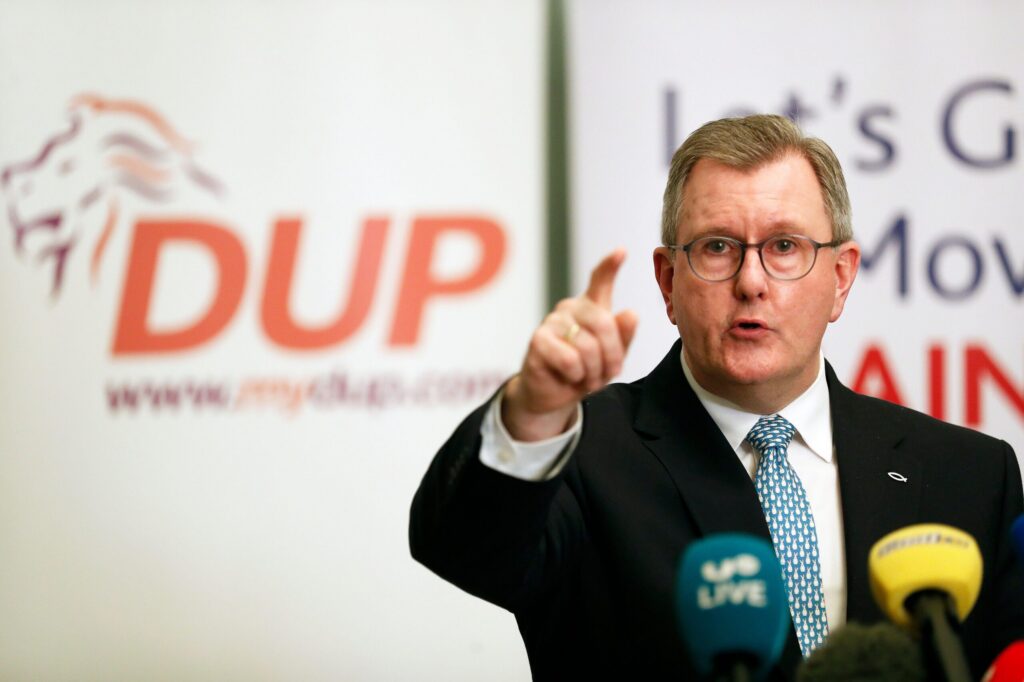
The current leader of the Democratic Unionist Party is Gavin Robinson. Robinson, who has served as the DUP MP for Belfast East since 2015, succeeded Sir Jeffrey Donaldson as leader.
The party has experienced significant leadership turmoil in recent years. Donaldson resigned as DUP leader after being charged with rape and other historical abuse offences.
In a statement issued after Donaldson was charged, the DUP said: “The party chairman has received a letter from Sir Jeffrey Donaldson MP confirming that he has been charged with allegations of an historical nature and indicating that he is stepping down as leader of the Democratic Unionist Party with immediate effect.
“In accordance with the party rules, the party officers have suspended Mr Donaldson from membership, pending the outcome of a judicial process.
“The party officers have this morning unanimously appointed Mr Gavin Robinson MP as the interim party leader.”
Robinson was “unanimously” ratified as the DUP’s leader after a meeting of the party executive on 29 May 2024. This came one week after Rishi Sunak, the prime minister, called a general election in a surprise statement outside 10 Downing Street.
In his first speech as DUP leader, Robinson stated: “It is with honour, humility and commitment that I look forward to leading our party into the future.”
Donaldson succeeded Edwin Poots, whose leadership lasted for 21 days in May and June 2021. Poots was elected following an internal party move against Arlene Foster, who served as leader from 2015 to 2021.
The party’s current deputy leader is Michelle McIlveen, the MLA for Strangford. She was reportedly elected unopposed in March 2025.
The DUP leadership is elected by the party’s 130-strong executive, which is composed of its MPs, MLAs, peers, constituency association and university group members.
What does the DUP stand for?
The DUP’s foundational principle is the preservation of Northern Ireland’s constitutional position within the United Kingdom.
It is a socially conservative and eurosceptic party that draws its support from the Protestant community.
The DUP campaigned for the UK to leave the European Union in 2016. It subsequently opposed the Northern Ireland Protocol and the Windsor Framework, arguing that they created and entrenched an economic border in the Irish Sea between Great Britain and Northern Ireland.
The party’s decision to return to power-sharing in February 2024 was based on the UK government’s Safeguarding the Union command paper, which the DUP leadership stated secured significant changes to the Framework and affirmed Northern Ireland’s constitutional position.
In the foreword to the DUP’s 2024 general election manifesto, Gavin Robinson argued that the DUP has the “strength and depth to be able to make the pro-Union case and to unashamedly make the case for Northern Ireland in parliament.”
Robinson added: “For Northern Ireland to truly flourish, it needs the United Kingdom to succeed and likewise for the UK to truly flourish it needs all its constituent parts and regions to succeed.”
The party argued that, in returning to power sharing in early 2024, the party had “secured meaningful, visible and practical proposals to deepen connections throughout our United Kingdom.”
The party’s manifesto for the 2022 NI Assembly election was framed around a five-point plan “to build a better future for Northern Ireland within the Union, by fixing our National Health Service and investing £1 billion more in it, growing our economy and creating 20,000 jobs in the next 5 years, helping working families by delivering 30 hours free childcare per week and tackling the cost of living crisis, keeping our schools world-class, and working to remove the Irish Sea border.”
In social policy, the DUP is said to be the most socially conservative of the established UK political parties. It has historically opposed the extension of abortion rights and the legalisation of same-sex marriage in Northern Ireland.
Who votes for the DUP? (Demographics of support)
The following data is drawn from the 2022 Northern Ireland Life and Times (NILT) survey conducted by ARK, regarding first preference votes in the 2022 assembly election.
Age: Support for the DUP is notably higher among older age groups. The party secured 19% of the vote among those aged 65+ and 15-16% among the middle-aged brackets (35-64). Conversely, the DUP performed relatively more poorly among younger voters, winning just 8% of the vote from 18-24 year olds.
Gender: The DUP won 16% of the vote among women and 15% of the vote among men at the 2022 NI Assembly election, according to the NILT survey.
Religion: The DUP’s voter base is almost entirely concentrated within the Protestant community. The DUP won 35% of the vote among Protestants, making them the most popular party within that community (leading the Ulster Unionist Party at 24%). In contrast, they secured only 1% of the vote among Catholics and 6% among those with no religion.
DUP history and emergence as a major force
On 30 September 1971, Reverend Ian Paisley co-founded the Democratic Unionist Party.
The party, formed against the backdrop of escalating violence in Northern Ireland, was created in reaction to the perceived moderation of the established, or ‘official’, Ulster Unionist Party, particularly following Terence O’Neill’s tenure as prime minister of Northern Ireland. The DUP provided an institutional platform for a more resistant or hardline unionism – loyalism – rooted in a not an inch, never surrender ethos.
Paisley formed the party alongside Desmond Boal, who defected from the UUP. The official unionist party had dominated Northern Ireland’s political institutions since their creation in the 1920s, enjoying an unchallenged hegemony at Stormont and among the majority (Protestant/unionist) community.
The DUP evolved from the Protestant Unionist Party (PUP), which itself had emerged from the Ulster Protestant Action movement. Its development owed much to the street disturbances of the 1960s, and loyalist opposition to the civil rights movement – which Paisley was instrumental in organising. The party therefore exhibited a more class-based and populist image than the predominant UUP.
Boal described the party as “right wing in the sense of being strong on the constitution” but “to the left on social policies”.
The DUP’s profile as a socially conservative and fundamentalist political party drew from Paisley’s Free Presbyterian Church.
In April 1970, Paisley was elected to the Northern Ireland parliament.
Paisley was elected as the MP for North Antrim in the 1970 United Kingdom general election on a Protestant Unionist Party platform, defeating UUP incumbent Henry Clark.
The DUP initially campaigned for the immediate restoration of Northern Ireland self-government after the imposition of direct rule in March 1972. Its first main electoral test came with the 1973 Sunningdale Agreement.
The Sunningdale scheme proposed a power-sharing executive between nationalists, represented by the Social Democratic and Labour Party (SDLP), and unionists, primarily represented by the UUP. Central to the agreement was a cross-border Council of Ireland, which would have provided for North-South co-operation. The agreement was championed by pro-agreement unionists in the UUP, including its leader, Brian Faulkner, as well as the SDLP.
The DUP was bitterly opposed to the scheme – a stance which exerted significant centrifugal pressure on the official Unionist position.
At the February 1974 general election, the DUP and UUP – now vehemently anti-Sunningdale – joined forces within the United Ulster Unionist Council (UUUC). The electoral pact secured 11 out of 12 of Northern Ireland’s parliamentary seats. The UUUC won 58.3% of the vote.
In the 1980s, Paisley was involved in efforts to establish a paramilitary-style movement, notably the Third Force and later Ulster Resistance.
Paisley’s pre-eminence in founding a church, a political party and the Ulster Resistance paramilitary movement highlights his extraordinary place in European history. He was also a member of several parliaments: the Northern Ireland parliament, the Westminster parliament (both as an MP and peer), the European parliament and the Northern Ireland Assembly.
For decades, the DUP remained the primary political vehicle for unionists opposed to power-sharing – including the arrangements set out in the 1998 Good Friday Agreement. In the years following the Belfast Agreement, the DUP steadily eroded the UUP’s dominance, emerging as the largest unionist party in the 2003 Northern Ireland Assembly election.
On 26 March 2007, in a moment of immense historical significance, Paisley and Sinn Féin’s Gerry Adams sat alongside each other for the first time and publicly announced their agreement to form a power-sharing government in Northern Ireland. The private negotiating session that preceded the announcement was the first time the two parties had ever held direct talks.
Announcing the deal at a news conference, Paisley declared: “Our goal has been to see devolution returned in a context where it can make a real, meaningful improvement in the lives of all the people of this part of the United Kingdom.
“On Saturday, the DUP executive overwhelmingly endorsed a motion committing our party to support and participate fully in government in May of this year — this is a binding resolution.”
Paisley held his North Antrim seat in the House of Commons for 40 years, until his retirement in 2010. He died on 12 September 2014, aged 88.
The DUP’s influence peaked at Westminster in 2017, when its 10 MPs entered a ‘confidence and supply’ agreement with Theresa May’s Conservative government after the 2017 general election. It came after the 2017 general election resulted in a hung parliament.
To remain in power, May entered into negotiations with the DUP. After several weeks, an agreement was reached, in which the DUP’s 10 MPs agreed to support the Conservative minority government on key votes, such as the budget and motions of confidence, in exchange for an additional £1 billion in funding for Northern Ireland over five years.
The DUP’s significance in Westminster significantly subsided in the wake of the 2019 general election when the Conservative Party under Boris Johnson won an 80-seat majority.
In February 2022, the Democratic Unionist Party (DUP) withdrew its first minister from the executive, collapsing the power-sharing institutions. This action was taken in protest against the post-Brexit trading arrangements known as the Northern Ireland Protocol, which the DUP argued undermined Northern Ireland’s place within the United Kingdom.
The DUP were enthusiastic supporters of leaving the European Union during the 2016 Brexit referendum.
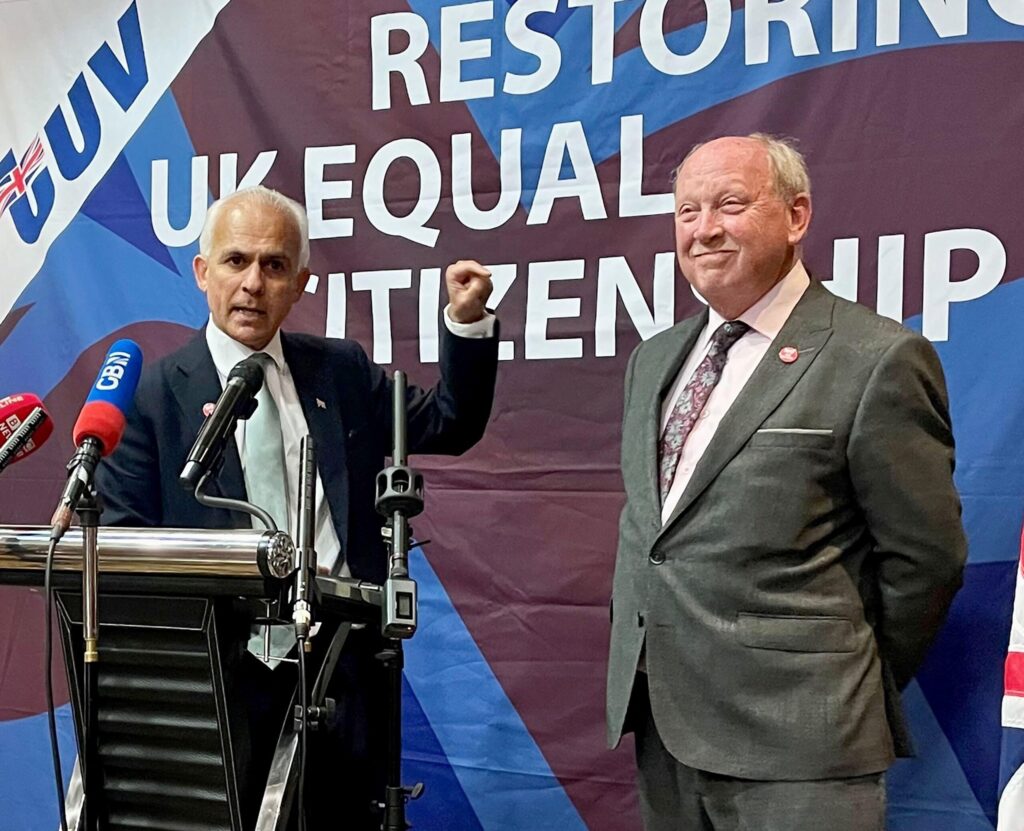
The impasse finally broke in late January 2024 after the DUP’s party executive voted to accept a deal with the UK government. The agreement, detailed in a command paper titled Safeguarding the Union, included measures to reduce checks and paperwork on goods moving from Great Britain to Northern Ireland. Some hardline unionists, including Jim Allister of the Traditional Unionist Voice (TUV) party, remained implacably opposed to restoring power-sharing arrangements.
On 3 February 2024, devolved government in Northern Ireland was restored following a two-year political stalemate. The restoration of the power-sharing arrangements resulted in Michelle O’Neill’s appointment as first minister. O’Neill of Sinn Féin became the first nationalist to hold the post since the creation of Northern Ireland in 1921.
The DUP’s Emma Little-Pengelly was appointed as deputy first minister.
O’Neill’s appointment followed the 2022 Northern Ireland Assembly election, which returned Sinn Féin as the largest party. It marked the first time that an Irish nationalist party won the most seats in an assembly election. The DUP’s vote share fell by almost 7%. Sinn Féin’s victory meant the party had the right to nominate O’Neill as first minister under the power-sharing arrangements agreed in 1998.
At the 2024 general election, the DUP lost three seats – including the historic and symbolic stronghold of North Antrim. Ian Paisley Jr lost to TUV leader Jim Allister, a former ally of Paisley Sr.