May outlines Brexit strategy in landmark Lancaster House speech
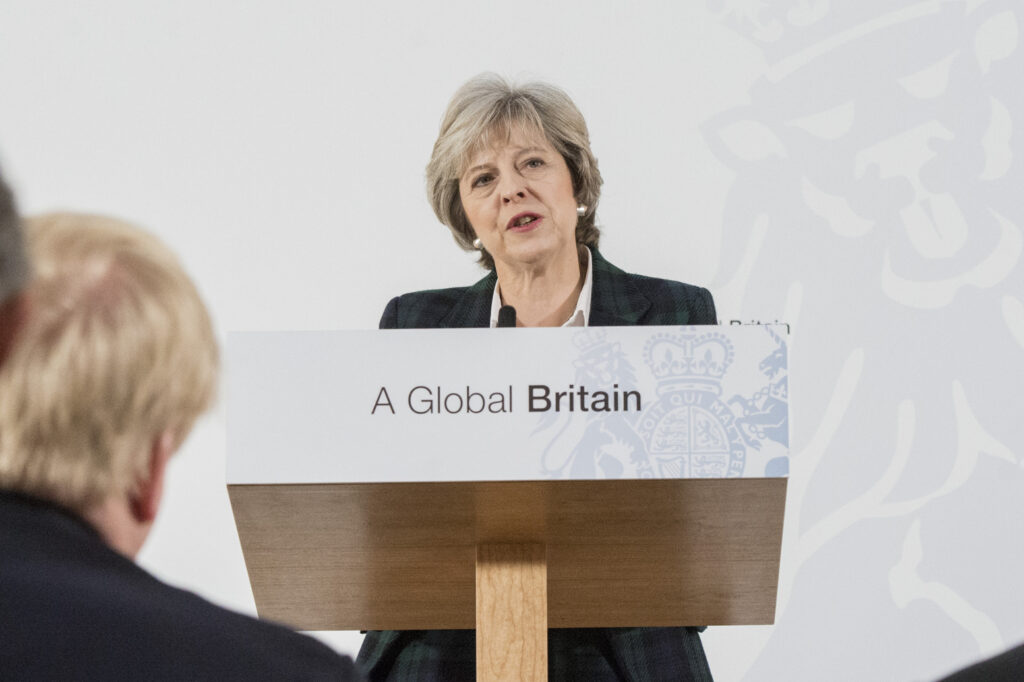
On 17 January 2017, prime minister Theresa May delivered a landmark address at Lancaster House in London, setting out her “Plan for Britain” and 12 negotiating priorities for Brexit. The speech marked the end of months of speculation and confusion by formally ruling out Britain’s continued membership of the European single market.
The speech was delivered with May at the height of her political powers – after the 2016 Conservative leadership contest and before the disastrous 2017 general election.
***
The Lancaster House speech was a long-anticipated elucidation of May’s Brexit strategy and negotiating position. The prime minister’s central proposition, which was generally well-received, was her rejection of any “half-in, half-out” arrangement.
May stated: “We are leaving the European Union, but we are not leaving Europe. And that is why we seek a new and equal partnership – between an independent, self-governing, global Britain and our friends and allies in the EU.
“Not partial membership of the European Union, associate membership of the European Union, or anything that leaves us half-in, half-out. We do not seek to adopt a model already enjoyed by other countries. We do not seek to hold on to bits of membership as we leave.”
May maintained that remaining in the single market would mean being bound by EU laws and the jurisdiction of the European Court of Justice (ECJ). She argued that such a model would, in practice, mean “not leaving the EU at all.”
The prime minister said that any agreement could not “mean membership of the single market.”
She stated: “European leaders have said many times that membership means accepting the ‘four freedoms’ of goods, capital, services and people. And being out of the EU but a member of the single market would mean complying with the EU’s rules and regulations that implement those freedoms, without having a vote on what those rules and regulations are.
“It would mean accepting a role for the European Court of Justice that would see it still having direct legal authority in our country. It would to all intents and purposes mean not leaving the EU at all.”
May proposed a “new, comprehensive, bold and ambitious free trade agreement.”
The PM said: “We do not seek to adopt a model already enjoyed by other countries. We do not seek to hold on to bits of membership as we leave.”
She said the agreement should allow for the “freest possible trade in goods and services between Britain and the EU’s member states.”
May also warned those European leaders who might seek a “punitive deal that punishes Britain and discourages other countries from taking the same path.”
She said that this approach would be “an act of calamitous self-harm for the countries of Europe.”
She continued: “Britain would not – indeed we could not – accept such an approach. And while I am confident that this scenario need never arise – while I am sure a positive agreement can be reached – I am equally clear that no deal for Britain is better than a bad deal for Britain.”
***
The 12 priorities set out at Lancaster House served as the foundation for the UK’s negotiating position. The negotiating strategy, or “red lines”, were framed as follows:
- Provide certainty about the process of leaving the EU: May recognised “how important it is to provide business, the public sector, and everybody with as much certainty as possible as we move through the process”.
- Control of our own laws: May said the UK would no longer be under the jurisdiction of the European court of justice, because “we will not have truly left the European Union if we are not in control of our own laws”.
- Strengthen the Union between the four nations of the United Kingdom: May said it was “more important than ever that we face the future together, united by what makes us strong”.
- Maintain the Common Travel Area with Ireland: May promised to deliver a “practical solution that allows the maintenance of the Common Travel Area with the Republic”.
- Control of immigration: May vowed to “get control of the number of people coming to Britain from the EU”, arguing that immigration had “put pressure on public services”.
- Rights for EU nationals in Britain, and British nationals in the EU; May described guaranteeing the rights of EU citizens who are already living in Britain as “the right and fair thing to do.”
- Protect workers’ rights: May said an agreement would “ensure that workers rights are fully protected and maintained”.
- Free trade with European markets: May promised a “new, comprehensive, bold and ambitious free trade agreement”.
- New trade agreements with other countries; May said she wanted “Britain to be able to negotiate its own trade agreements”.
- The best place for science and innovation; May said the government would “welcome agreement to continue to collaborate with our European partners on major science, research, and technology initiatives.”
- Cooperation in the fight against crime and terrorism; May said Britain would “continue to work closely with our European allies in foreign and defence policy even as we leave the EU itself.”
- A smooth, orderly Brexit; May said the government would “seek to avoid a disruptive cliff-edge”.
May also confirmed for the first time that parliament would have a vote on the final deal reached between the UK and the EU.
The prime minister concluded: “After all the division and discord, the country is coming together. The referendum was divisive at times. And those divisions have taken time to heal.
“But one of the reasons that Britain’s democracy has been such a success for so many years is that the strength of our identity as one nation, the respect we show to one another as fellow citizens, and the importance we attach to our institutions means that when a vote has been held we all respect the result.”
The speech was generally well-received among its target audiences.
Boris Johnson, the foreign secretary, praised May’s address as a “fantastic speech”.
Nigel Farage, the former UK Independence Party (Ukip) leader, said: “I can hardly believe that the PM is now using the phrases and words that I’ve been mocked for using for years. Real progress.”
Anna Soubry, a Remain-supporting Conservative MP, welcomed the “language and tone” of the speech.
But she added: “What I am agitated about is that I believe that immigration benefits British business and I think we are making a serious and grave mistake by thinking we can cut the number of migrant workers without damaging our economy.”
Jeremy Corbyn, the Labour leader of the opposition, said May was “determined to use Brexit to turn Britain into a bargain basement tax haven on the shores of Europe”.
He added: “We welcome that the prime minister has listened to the case we’ve been making about the need for full tariff-free access to the single market but are deeply concerned about her reckless approach to achieving it.”
Tim Farron, leader of the Liberal Democrats, said May’s strategy was “a theft of democracy, a presumption that the 51.9% of people who voted to leave meant the most extreme version of Brexit available.”
In Brussels, negotiator Guy Verhofstadt warned that Britain could not “cherry-pick” when it came to a Brexit deal.
https://x.com/guyverhofstadt/status/821420358435794945
The Lancaster House speech was not the final iteration or set-piece explanation of the government’s approach to Brexit.
May’s Florence speech on 22 September 2017 followed the loss of her parliamentary majority in the 2017 election. The prime minister proposed a “transition phase” – a “strictly time-limited” implementation period of roughly two years, during which market access would continue on current terms. She also pledged that Britain would “honour commitments” when it came to financial contributions. May said Britain would “cover our fair share of the costs” to participate in “specific policies and programmes… such as science, education and culture – and mutual security.”
The Mansion House Speech on 2 March 2018, May’s most detailed yet, was framed around “hard facts”. The prime minister admitted that the UK’s access to European markets would be “less than it is now”.
She said: “In certain ways, our access to each other’s markets will be less than it is now. How could the EU’s structure of rights and obligations be sustained, if the UK – or any country – were allowed to enjoy all the benefits without all of the obligations?”
May also said she was prepared to ensure that UK regulatory standards would remain “at least as high as the EU’s” to ensure trade could be “as frictionless as possible with no hard border between Northern Ireland and Ireland”. This was the central pillar of May’s “managed divergence” strategy.
She set out “five tests for the deal”: that any agreement would deliver on the 2016 referendum result; provide an enduring solution; protect security and prosperity; maintain the UK as a “modern, open, outward-looking, tolerant, European democracy”; and strengthen the union.
The speech, like its predecessors, was broadly welcomed across the Conservative Party. However, the thinking behind the address culminated in the Chequers proposals in July 2018, which precipitated the resignations of Boris Johnson and David Davis as foreign secretary and Brexit secretary respectively.
Over time, the Lancaster House speech was used by Brexiteers as a benchmark to judge future government announcements and positions. In November 2018, leading Brexiteer Jacob Rees-Mogg argued that the government’s withdrawal agreement did not live up to the promises set out in May’s Lancaster House speech.
May’s deal was rejected by the House of Commons on three occasions from January to March 2019, leading to her resignation as prime minister.
Politics.co.uk Newsletters
DAILY
Politics@Lunch
WEEKLY
Week in Review