Theresa May’s Brexit deal defeated in historic commons vote
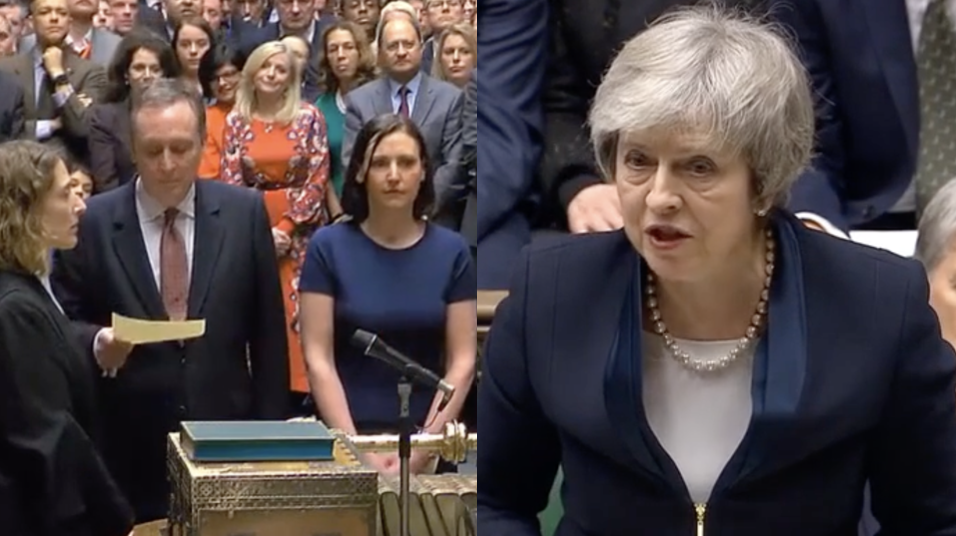
On 15 January 2019, prime minister Theresa May’s Brexit withdrawal agreement suffered a catastrophic defeat in the House of Commons, in the first of three so-called “meaningful votes”. The government’s motion was rejected by 432 votes to 202 – the largest defeat for a sitting government in modern parliamentary history.
The 585-page draft withdrawal agreement, the product of protracted negotiations with European Union (EU) officials and representatives, was first published on 14 November 2018.
Its publication precipitated four resignations, including those of two serving cabinet ministers, Dominic Raab (Brexit secretary) and Esther McVey (work and pensions secretary). Suella Braverman and Shailesh Vara also stepped down as Brexit and Northern Ireland ministers respectively. In his resignation letter, Raab stated that he could “not in good conscience” support the deal. Raab argued that the Northern Ireland backstop presented a “very real threat to the integrity of the United Kingdom.”
The deal’s strained development had already led to the resignations of former foreign secretary Boris Johnson and ex-Brexit secretary David Davis in July 2018.
In the wake of Raab’s resignation, May appointed Steve Barclay as the new Brexit secretary – who would assume responsibility for steering the deal through the commons.
***
Opposition to May’s Brexit deal centred on the Northern Ireland backstop – the agreement’s proposed solution to the Irish border problem. The mechanism, designed to maintain an open border on the island of Ireland in any Brexit scenario, provided for a UK-wide customs union with the EU, covering all goods (except for fish). The backstop would apply indefinitely, until the UK and EU agreed on a different arrangement.
The measure, described by its proponents as an “all-weather insurance policy”, was a safety net in the event that no formal deal could be reached on trade and security arrangements. It avoided a customs border down the Irish Sea – an outcome May insisted that no prime minister “could ever agree”.
Among its opponents were the Democratic Unionist Party (DUP), the minority Conservative government’s “confidence and supply” partner. Without DUP votes, the May government – following the 2017 general election – could not command a working majority in the House of Commons.
May addressed the House on 15 November to defend the draft agreement. She conceded that delivering Brexit means “difficult choices for all of us”, but described calls to “rip-up the UK’s commitment to a backstop” as “entirely irresponsible”.
Jacob Rees-Mogg, the vehement eurosceptic and leading figure in the European Research Group (ERG) of Conservative MPs, responded by submitting a letter of no-confidence in the prime minister.
On 10 December, facing a catastrophic defeat, May delayed the vote on her Brexit deal. The agreement was originally set to be put before MPs on 11 December 2018; the eleventh-hour decision came after three full days of debate.
Addressing MPs on 10 December, May declared: “If we went ahead and held the vote tomorrow, the deal would be rejected by a significant margin. We will therefore defer the vote scheduled for tomorrow, and will not proceed to divide the House at this time.”
She vowed to return to Brussels for “further assurances” regarding the Northern Ireland backstop.
Jeremy Corbyn, the leader of the Labour Party, responded that the government had “lost control of events and are in complete disarray”.
On 12 December, Sir Graham Brady, the chairman of the 1922 committee of Conservative backbenchers, announced that he had received at least 48 letters of no confidence – exceeding the threshold of 15%.
The confidence vote, held that evening, somewhat stabilised the prime minister’s position. May won by 200 votes to 117 – a majority of 83.
***
On 9 January, with the debate on May’s Brexit deal set to resume, commons speaker John Bercow sparked outrage among Conservative MPs by allowing an amendment from Tory rebel Dominic Grieve to a business motion.
The usually uncontentious business motion, which sets out how a debate should be structured and organised, was an attempt to change the terms of the debate that had been set back in December. This followed May’s decision to delay the vote.
Grieve’s amendment, which was backed by 308 votes to 297, required the government to return with a Brexit “Plan B” within three working days – in the event that its withdrawal agreement was rejected by MPs. A 21-day requirement was set out in the European Union (Withdrawal) Act 2018. This 21-day period was now considered to be too long in the view of those, like Grieve, opposed to a “no deal” Brexit. Britain was on course to leave the EU on 29 March, regardless of whether or not a deal was in place.
The speaker’s unprecedented decision to allow an amendment to a motion that was to be put “forthwith” – believed to mean without debate or amendment – was met with vehement opposition from Tory MPs. The clerk of the House, Sir David Natzler, reportedly advised Bercow that Grieve’s amendment was “out of order”.
But Bercow told MPs: “I interpret [‘forthwith’] to mean that there can be no debate, but I must advise the House that the terms of the order do not say that no amendment can be selected or moved.”
The decision sparked an hour-long “point of order” spiral as Conservative MPs expressed their objections to Bercow’s ruling.
Rees-Mogg argued that the move was “deeply troublesome” for the neutrality of the chair. Fellow Conservative MP Adam Holloway challenged the speaker’s impartiality, citing a “derogatory” anti-Brexit sticker in his car. Bercow responded that the sticker was “affixed to, or in the windscreen of, my wife’s car” and that she was entitled to her own views.
Bercow said: “I am sure the honourable gentleman would not suggest for one moment that a wife is somehow the property or chattel of her husband.”
***
Re-opening the debate for the government on 9 January, Barclay said the withdrawal agreement remained the “best deal to honour the referendum result” and to provide “certainty for our businesses, our citizens and our security.”
On 14 January, May returned to the commons to address concerns about the Northern Ireland backstop. The prime minister insisted that she had negotiated further assurances to ensure any backstop would be a “temporary arrangement.” But she ruled out the prospect of “unilateral exit mechanism or a hard time limit to the backstop”.
On the final day of the debate, Geoffrey Cox, the attorney general, warned MPs that if they did not accept the deal, they risked condemning Britain to the chaos of a no-deal Brexit. “It would be the height of irresponsibility for any legislator to contemplate with equanimity such a situation”, he said.
Cox added: “What are you playing at? What are you doing? You are not children in the playground. You are legislators, and this is your job.”
Closing the debate, May argued that the deal struck a “fair balance between the hopes and desires of all our fellow citizens – those who voted to leave and those who voted to stay in”.
Before the main division, the House rejected an amendment proposed by Conservative MP John Baron by 600 votes to 24. The amendment called on the government, contrary to the terms of the withdrawal agreement, to terminate the backstop unilaterally.
In the end, Cox and May’s final appeals were not enough to convince MPs – not nearly.
The main government motion was rejected by 432 votes to 202 – a majority of 230. This marked the largest defeat for a sitting government in modern parliamentary history. In total, 118 Conservative MPs – of both pro-‘Leave’ and ‘Remain’ backgrounds – voted against their own government’s flagship policy.
In the Leave camp, former Brexit secretaries Dominic Raab and David Davis were among those who voted against the agreement – as was senior backbencher Graham Brady. Philip Lee, Justine Greening, Dominic Grieve and Sam Gyimah – Conservative MPs who supported a “people’s vote” or second referendum – also rejected the deal.
The DUP also voted against the deal.
In total, just three Labour MPs supported the prime minister’s deal (Ian Austin, Kevin Barron and John Mann).
The 230-vote margin by which May lost the meaningful vote significantly outstripped the three losses of 166, 161 and 140 votes suffered by the minority Labour government of Ramsay MacDonald in 1924. The only postwar government defeats on a similar scale were by 89 in March 1979 and 86 in January 1978 (both came during Jim Callaghan’s tenure as prime minister).
***
Speaking after the debate had concluded on 15 January, May began by acknowledging the result, stating: “The House has spoken and the government will listen.”
She added that while it was clear “the House does not support this deal”, the vote revealed “nothing about what it does support” and “nothing about how, or even if, it intends to honour the decision the British people took in a referendum that parliament decided to hold.”
May then set out a three-stage process for the government to follow. First, she stated the need “to confirm whether the government still enjoy the confidence of the House”.
She confirmed that if the official opposition tabled a confidence motion, the government would “make time to debate that motion tomorrow”.
Then, if the House’s confidence in the government was confirmed, she would “hold meetings” with Conservative MPs, the DUP, and “senior parliamentarians [to] identify what would be required to secure the backing of the House”. May said the government would focus on “ideas that are genuinely negotiable”; such ideas, she added, would be presented to the European Union.
The leader of the opposition, Jeremy Corbyn, called the result the “greatest defeat for a government in this House since the 1920s”.
He concluded that the government had “lost the confidence of this House” and informed the speaker that he had “now tabled a motion of no confidence in this government” for debate the following day.
The House ultimately rejected Labour’s ‘“no-confidence” motion by a vote of 325 to 306. Both the DUP and eurosceptic Conservative MPs rallied behind May.
Responding to this vote, May said the government had a “responsibility to identify a way forward that can secure the backing of the House.”
She proposed a series of “meetings between senior parliamentarians and representatives of the government over the coming days.”
May added: “I should like to invite the leaders of parliamentary parties to meet me individually, and I should like to start those meetings tonight.
“The government approach the meetings in a constructive spirit, and I urge others to do the same, but we must find solutions that are negotiable and command sufficient support in the House.”
On 21 January, May set out the government’s “Plan B” proposals. She stated the government’s intention to table a neutral, amendable motion as a “fulfilment of the process following the House’s decision” to reject her withdrawal agreement. The motion would provide a mechanism by which the commons could express a majority in favour of a path forwards.
May promised to be “more flexible, open and inclusive in how we engage Parliament in our approach to negotiating our future partnership with the European Union.”
***
On 29 January, the House of Commons voted on a series of amendments to the motion tabled by May relating to the government’s Brexit strategy.
The most significant outcome was the passing of the so-called “Brady amendment” by 317 votes to 301, proposed by Graham Brady. This motion, which was supported by the government, called for the contentious Northern Ireland backstop to be replaced with “alternative arrangements to avoid a hard border [on the island of Ireland]” and expressed support for the prime minister’s withdrawal agreement “subject to this change”.
In another vote, MPs supported the so-called “Spelman amendment”, tabled by Conservative MP Dame Caroline Spelman, by 318 votes to 310. The amendment rejected leaving the EU without a deal and was not supported by the government.
A second “meaningful vote” on May’s Brexit deal was held in March 2019. MPs again rejected the withdrawal agreement by 391 votes to 242.
On 20 March, May’s government sent a letter to Donald Tusk, the president of the European Council, asking for an extension of the Article 50 period until 30 June 2019. The EU agreed to an extension until April 2019.
A third meaningful vote on May’s deal was rejected by 344 votes to 286 on 29 March.
In April 2019, May announced she would seek a further extension to the Article 50 process. The UK and EU ultimately agreed to extend Article 50 until 31 October 2019.
May announced her resignation on 24 May 2019, shortly before the results of the recent European parliament elections were announced.

Politics.co.uk Newsletters
DAILY
Politics@Lunch
WEEKLY
Week in Review
