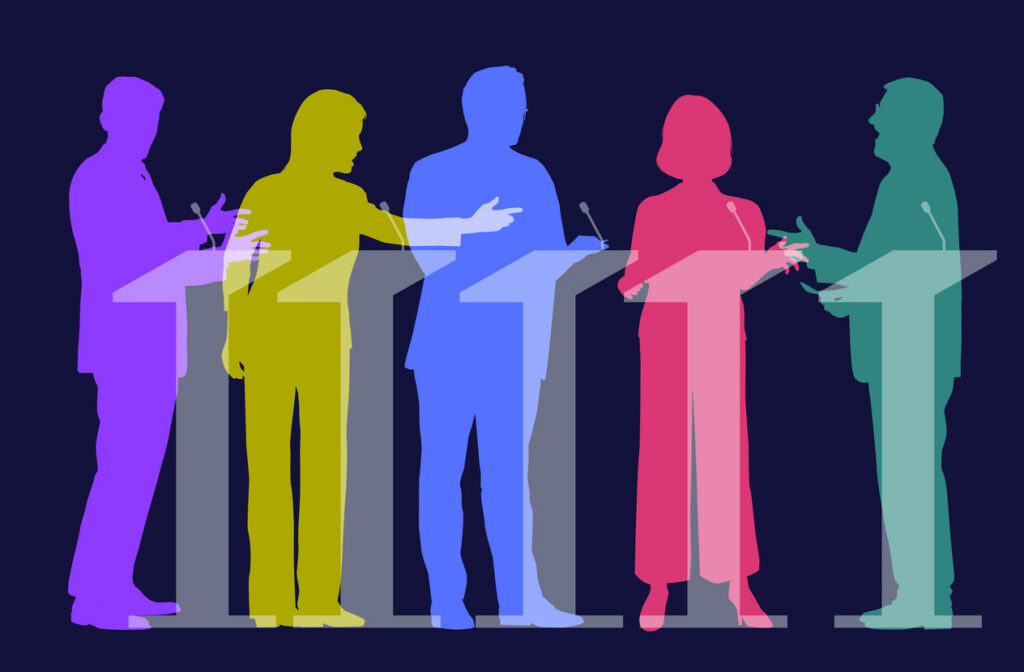
Televised leaders’ debates are live broadcast events in which the leaders of the main political parties are questioned during a general election campaign. They have become a regular, though not constitutionally required, feature of UK elections since they were first introduced in 2010.
While the debates provide a rare opportunity for voters to see the leaders challenge each other directly, their actual impact on changing the minds of the electorate and altering the outcome of an election is highly contested.
The development of leadership debates in the UK
2010 general election
The UK was unusual among major democracies in not holding televised leaders’ debates until 2010. The United States held its first televised presidential debate fifty years previously in 1960 (John F. Kennedy vs Richard Nixon).
As such, the first of three debates, between Gordon Brown (Labour), David Cameron (Conservative) and Nick Clegg (Liberal Democrat), was a major media event.
Clegg’s strong performance in the first debate led to a phenomenon dubbed “Cleggmania” and a significant, though ultimately temporary, surge in the polls for the Liberal Democrats.
2015 general election
The 2015 debates were marked by contentious negotiations over the format.
Cameron, the incumbent prime minister, said that he would not take part in the debates unless the minor parties were also in attendance. In the end, Cameron only attended one, seven-way debate. The televised bout also featured Clegg, Labour leader Ed Miliband, UK Independence Party (Ukip) leader Nigel Farage, Scottish National Party (SNP) leader Nicola Sturgeon, Green party leader Natalie Bennet and Plaid Cymru leader Leanne Wood.
In part, the seven-way format reflected the increasingly fragmented, multi-party nature of the political system.
Evaluation question
Does the apparent necessity of hosting seven-way leaders’ debates reflect Britain’s transition into a fragmented multi-party political system?
A second debate was held, but neither Cameron nor Clegg took part.
Cameron and Miliband were each subjected to separate long-form interviews in a special programme jointly broadcast by Sky News and Channel 4. During his exchange with veteran inquisitor Jeremy Paxman, Miliband memorably mispronounced “enough”. Paxman put it to Miliband that “people think you’re just not tough enough”. The Labour leader lent forward and responded: “Well, let me tell you, right… Am I tough enuss [sic]? Hell yes, I’m tough enough.”
This sit-down format in front of a live audience is now a fixture of general elections campaigns.
2017 general election
In 2017, the prime minister Theresa May refused to participate in any head-to-head debates, insisting that she had already debated her opponent, Labour leader Jeremy Corbyn, many times in parliament.
May said: “I’ve been very clear from the start that the sort of campaign I want to do is about taking questions, meeting people. I’ve not been off the television screens, I’ve been doing things on the television, but predominantly taking questions from voters and listening to voters.
“I think debates where the politicians are squabbling among themselves doesn’t do anything for the process of electioneering.”
Corbyn had also been considering his attendance but announced just 24 hours before a BBC broadcast that he would be taking part. Amber Rudd, the home secretary, ultimately attended in May’s stead.
At one point during the debate, Corbyn asked: “Where is Theresa May, what happened to her?”
Liberal Democrat leader Tim Farron stated: “Where do you think Theresa May is tonight? Take a look out your window. She might be out there sizing up your house to pay for your social care.”
Farron’s remark was a reference to the Conservative Party’s disastrous social care policy, which was dubbed the “dementia tax”.
Upon her resignation as prime minister in 2019, May expressed her regret over not attending the 2017 debate. “I should have done the TV debates”, she told the Daily Mail. “I didn’t because I had seen them suck the life blood out of David Cameron’s campaign [in 2010].”
2019 general election
The 2019 election featured two one-on-one debates between the Conservative leader, Boris Johnson, and the Labour leader, Jeremy Corbyn. These debates were seen as score-draws and had little discernible impact on the polls.
Evaluation question
If highly anticipated debates, such as the 2019 Johnson vs Corbyn clashes, are consistently viewed as “score-draws” that only reinforce existing voter preferences, to what extent are these events actually incapable of changing the trajectory of a general election?
Notably, Channel 4 held a leaders’ debate focused only on the climate crisis. Nigel Farage, the leader of the Brexit Party, and Johnson both refused to attend, leading Channel 4 to controversially replace them with ice sculptures of their party logos.
2024 general election
The campaign for the 2024 general election featured a series of televised debates.
Prime minister Rishi Sunak initially challenged Keir Starmer to six televised debates. Starmer, the leader of the Labour Party, announced that he would not agree to such a proposal.
In the end, the two main events were head-to-head debates between Sunak and Starmer hosted by ITV and the BBC. These were accompanied by multi-party debates featuring leaders or senior representatives from the Conservatives, Labour, Liberal Democrats, SNP, Green Party, Plaid Cymru and Reform UK.
Generally, Sunak was seen to have overperformed relative to his party’s dismal polling. But the debates did not have any discernible impact on the election result. The Conservative campaign was instead overshadowed by a series of gaffes, including Sunak’s disastrous decision to leave the D-Day 80th anniversary commemorations early.
TV viewership figures
Audience numbers for the main leaders’ debates have shown a downward trend since their introduction. (Note, this is not an exhaustive list).
2010 general election
- 15 April (ITV): Three-way debate (Brown, Cameron, Clegg) – 9.4 million
- 22 April (Sky News): Three-way debate – 4.0 million
- 29 April (BBC One): Three-way debate – 8.1 million
2015 general election
- 26 March (Sky/Ch4): The Battle for Number 10 (Cameron & Miliband interviews) – 2.9 million (total)
- 2 April (ITV): Seven-party leaders’ debate – 7.0 million
- 16 April (BBC One): Opposition leaders’ debate – 4.3 million
2017 general election
- 31 May (BBC One): Seven-way debate (Theresa May not in attendance) – 3.6 million
- 2 June (BBC One): Question Time Leaders’ Special programme – 4.1 million.
2019 general election
- 19 November (ITV): Johnson vs. Corbyn debate – 6.7 million
- 22 November (BBC One): Question Time Special (four leaders debate) – 4.2 million
- 29 November (BBC One): Seven-way debate – 2.5 million
2024 general election
- 4 June (ITV): Sunak vs. Starmer debate – 5.4 million
- 7 June (BBC One): Seven-way debate – 3.2 million (Meanwhile, viewership for England’s Euros win over Switzerland was 13.6 million)
- 13 June (ITV): Seven-way debate – 2.1 million
- 26 June (BBC One): Final Sunak vs. Starmer debate – 2.7 million (More people watched Belgium and Ukraine draw 0-0)
Evaluation question
To what extent does the continued media focus on televised leaders’ debates distract from more effective modern campaigning strategies, given the significant decline in viewing figures since 2010?
Do the debates matter?
There is a broad consensus among political analysts that leaders’ debates have a limited effect on UK election outcomes.
Arguments for the importance of leaders’ debate
It is said that debates provide voters with a rare opportunity to see party leaders debate one another directly. These encounters test not only a leader’s command of policy but also their ability to perform under pressure in an unscripted setting.
A particularly strong performance, or a serious misstep, can dominate the political news agenda for several days.
This is one way of understanding the significance of the BBC debate in 2017; Theresa May committed a memorable gaffe by refusing to turn up. (If May’s non-attendance is all that is remembered about the 2017 debate, it also suggests that the content cannot have been of much interest).
Evaluation question
To what extent do televised leaders’ debates enhance democratic scrutiny, given that their most memorable moments are often gaffes rather than substantive policy discussion?
A study commissioned by the Electoral Reform Society and conducted by academics at the University of Leeds found that 34% of those who watched the 2017 BBC’s Question Time Leaders’ Special, which May did attend, said the programme helped them decide who to vote for. A much larger share, 60%, said the programme helped them engage with the election campaign; however, only 52% felt that the party leaders provided factual evidence in their answers.
Debates also force parties to distil their core messages into clear and accessible language, making their priorities more intelligible to a wide audience.
A study by Oxford’s Reuters Institute for the Study of Journalism into the 2010 televised debates found that around two-thirds of respondents said they had learned something new from watching, while roughly three-quarters felt they had gained a better understanding of the personal qualities of the party leaders. Large majorities – ranging from 58% to 70% – also reported that the debates helped them understand party policies more clearly.
The impact was particularly pronounced among younger voters. 55% of those aged 18 to 24 said the debates made them “more interested” in the campaign, a higher proportion than in any other age group, and they were also the most likely to discuss the debates with others.
Arguments against the importance of leaders’ debates
Party leaders are highly media-trained and risk-averse, which often results in cautious, formulaic exchanges dominated by pre-prepared lines rather than genuine engagement.
In 2019, Steven Fielding, professor of politics at the University of Nottingham, told the i newspaper that television debates resemble Formula One racing. “They’re boring until someone has a car crash, so now everyone is waiting for that car crash’, he said, “but there usually isn’t one as the people participating are so well prepared that they just avoid all mistakes”.
Evaluation question
To what extent is the Formula One analogy accurate? Do highly media-trained leaders and sterile formats mean that debates now offer little genuine insight for voters, or is the chance to see leaders perform under pressure still valuable?
On top of this, viewing figures have declined sharply since their peak in 2010, and post-debate polling consistently suggests that only a small number of voters change their views as a result. Instead, debates tend to reinforce existing preferences.
More broadly, shifts in media consumption mean that fewer voters seek out live televised debates, increasingly turning instead to social media, podcasts and other digital platforms for political information.
Evaluation question
How far does the declining viewership of televised broadcasts indicate a broader disengagement with politics among voters, as opposed to a shift toward consuming political information through different/rival digital mediums?
In 2024, Nick Anstead, an associate professor in the Department of Media and Communications at the LSE, argued that expectations of televised debates being “game-changing” rest on a “misconception”.
Anstead argued that debates reflect the broader forces shaping an election campaign.
He wrote: “The main reasons the Conservative campaign is struggling – the country’s economic performance, fatigue after fourteen years of government, a perception of political chaos following multiple leadership changes, and the fragile election coalition constructed in 2019 – won’t miraculously disappear during a televised debate; they are reflected in it.
“In this context, the hope that a moment of rhetorical brilliance can change everything is a fantasy.”
The debate over a ‘debates commission’
The UK does not have a formal body to organise and regulate election debates. Instead, the format, participants, and dates are the result of ad-hoc and often fraught negotiations between the broadcasters (primarily the BBC, ITV, and Sky News) and the main political parties.
This has led to repeated calls for the creation of an independent debates commission, similar to the one that operates in the United States. The US Commission on Presidential Debates, a non-profit organisation that seeks to ensure TV debates for US presidential elections every four years, was established in 1987.
Proponents argue that a commission would ensure that debates happened at every election, and that it would set fair and consistent rules on format and participation, preventing political parties from vetoing debates or dictating terms.
There is, of course, no requirement for leaders of political parties to participate in television debates during a general election. An e-petition started in 2018 advocated for compulsory televised leaders’ debates, and attracted almost 150,000 signatures.
The petition was backed by Sky News, as well as senior cross-party figures including Jeremy Corbyn (Labour), Caroline Lucas (Green), Sir Vince Cable (Liberal Democrat), Amber Rudd (Conservative) and Peter Bone (Conservative).
However, when the petition was debated in parliament in January 2019, the government argued that it should remain a matter of agreement between political parties and broadcasters.
Chloe Smith, the Cabinet Office minister on duty, told MPs that she was not “persuaded that mandating television election debates is the way to achieve that very important goal.”
Smith pointed out that “TV election debates have already happened – under their own steam – in the last three general elections, without having to be mandated by election law”.
She added: “I do not think that having a quango and simply calling it independent is the answer to every policy question. It raises many questions that are as yet unresolved.
“Who would appoint the members of such a body? How would it function? What would happen if political parties, or any figure involved with that body, disagreed with the suggested format? Those are all questions that would have to be bottomed out if we went for an independent debates commission format.”
2010 general election: ‘Cleggmania’
The first televised leaders’ debate in a British general election campaign, which took place on 15 April 2010, is best-remembered for the accidental soundbite: “I agree with Nick”.
Nick Clegg, the Liberal Democrat leader, was widely seen to have outdebated his opponents, the prime minister, Gordon Brown, and Conservative leader David Cameron. Clegg’s revelatory performance inspired a political phenomenon dubbed “Cleggmania” which briefly upended the established two-party dynamic in the wider campaign.
As the least known of the three leaders, Clegg seized the opportunity provided by the debate to present himself as a fresh alternative to the “old parties”. For much of the event, Brown and Cameron focused their attacks on each other, creating space for Clegg to exploit.
At one point, the Lib Dem leader interjected: “The more they attack each other, the more they sound exactly the same.”
He declared: “Don’t let them tell you that the only choice is between two old parties that have been playing pass the parcel with your government for 65 years now making the same old promises, breaking the same old promises.”
Clegg referred to “these two”, denigrating Brown and Cameron simultaneously.
In his closing statement, he urged voters to say “yes to something new”.
Brown and Cameron’s strategy for handling the Liberal Democrat leader, to “agree” him, effectively elevated Clegg’s status to that of an equal. In particular, the “I agree with Nick” refrain proved Brown’s catchphrase for the night.
The immediate impact of the debate was a dramatic surge in support for the Liberal Democrats, a phenomenon that was quickly dubbed “Cleggmania”. An instant YouGov poll published after the debate found viewers judged Clegg the clear winner, with 51% naming him as the best performer (29% for Cameron, 19% for Brown).
In the days that followed the debate, Cleggmania fundamentally altered the dynamics of the campaign. The Conservative and Labour parties were forced to directly respond to the third party’s new prominence. All of a sudden, Liberal Democrat policies received a level of media scrutiny usually reserved for the two main parties.
Responding to Clegg’s performance in the 2010 debate, Cameron commented: “I think ‘a plague on both your houses’ is a very good song.”
A YouGov poll, published on 20 April, placed the Liberal Democrats on 34%, one point above the Conservatives and six points ahead of Labour.
Another opinion poll suggested Clegg was almost as popular as Sir Winston Churchill.
The second debate, held on 22 April, was a feistier, more evenly matched contest. Brown and Cameron were better prepared for Clegg’s profitable positioning.
Cleggmania, in the end, was an ephemeral phenomenon. The party won 57 seats, down 5, at the 2010 general election; its final share of the vote (23%) marked a one point improvement on the 2005 election.
However, in the hung parliament that resulted from the 2010 campaign, Clegg’s Lib Dems held the balance of power. The party entered coalition with Cameron’s Conservatives and Clegg secured the post of deputy prime minister.
In his 2019 memoir, For The Record, Cameron said that before the debate he had “never been so nervous in my life.”
He wrote: “The news channels covered the build-up as if it was England in the World Cup final. Brown, Clegg and I stood on a primary-coloured set like gameshow contestants. As predicted, Clegg was painting the blue and red parties as the old guard, and himself as the new kid on the block. It seemed a breeze for him.”
Cameron added: “I was bad. Not switch-off-the-telly, hide-behind-the-sofa bad.But aloof and stiff. Lacking passion. Anecdotes that were too contrived. And one bit of absolutely essential preparation that I failed to put into practice was properly looking down the camera when I spoke.
“Colleagues and friends were polite afterwards, because while Clegg had undoubtedly won, at least I hadn’t lost (that honour went to Brown).”
July-September 2022 Conservative leadership contest debates
Televised debates have also become a staple of internal party leadership contests. In fact, such debates made their first appearance in British politics during the 2005 Conservative leadership election. David Cameron, the modernising upstart, and David Davis, the veteran shadow home secretary, clashed in a series of televised bouts. During a special edition of the BBC’s Question Time programme, Davis stressed his experience and said voters were tired of the “era of spin”.
He added: “So frankly, this is the worst moment for the Conservative Party to imitate Tony Blair.”
Televised debates have featured in most leadership contests since, including the 2010 Labour leadership contest.
The July-September 2022 Conservative leadership election featured a series of acrimonious televised debates. The second debate, held on 17 July 2022, featured the remaining five leadership candidates, namely Liz Truss, Rishi Sunak, Kemi Badenoch, Penny Mordaunt and Tom Tugendhat.
Truss, the foreign secretary, accused Sunak of planning to “choke off” growth with tax rises. Truss said Sunak had “raised taxes to the highest level in 70 years”, arguing that this would not “drive economic growth”.
She said: “The fact is that raising taxes at this moment will choke off economic growth, it will prevent us getting the revenue we need to pay off the debt.”
Sunak, the former chancellor, said his onetime cabinet colleague was peddling “something-for-nothing economics”.
He declared: “This something-for-nothing economics isn’t Conservative. It’s socialism.”
Sunak accused Mordaunt of a “dangerous” plan to scrap his fiscal rule of only borrowing to invest. Badenoch accused Sunak of not taking her seriously when she raised concerns about Covid loan fraud. The debate was so bitter that Sky News cancelled a subsequent debate after Sunak and Truss both pulled out, fearing more “blue-on-blue” infighting.
A further debate on 25 July came after the conclusion of the parliamentary voting rounds, which had successively eliminated Tugendhat, Badenoch and Mordaunt. The final, decisive round was the members voting stage.
Truss entered the debate as the clear frontrunner among party members. Sunak, desperately looking for a ‘moment’ to shift the dynamics of the race, pressed Truss on her economic policy. He condemned the foreign secretary’s alleged £40 billion of unfunded tax cuts as immoral, warning the “sugar rush” of borrowing could push interest rates as high as 7%.
Truss insisted her plans were funded and necessary to stimulate growth. She accused Sunak of pursuing “project fear” economics – comparing his warnings to those used by the ‘Remain’ campaign during the 2016 Brexit referendum.
The foreign secretary even likened Sunak to Gordon Brown, questioning how high tax is “going to lead to economic growth”.
The debate reflected a bitter ideological battle.
Sunak’s combative strategy drew some criticism and Sophie Raworth, the debate moderator, was forced to intervene on several occasions. A spokesperson for the Truss campaign criticised Sunak’s “aggressive mansplaining and shouty private school behaviour”.
While a “snap debate poll” of viewers pointed to a slight victory for Sunak, his performance did not definitively change the nature of the contest. Indeed, the same polling suggested Conservative voters felt Truss had performed better.
Truss had succeeded in avoiding major errors, and had not come off worse in the adversarial exchanges. The foreign secretary maintained her position as favourite over the following months and, on 5 September 2022, was declared leader of Conservative Party. She secured 57.4% of the members’ vote to Sunak’s 42.6%.
Truss was appointed prime minister the following day, 6 September.
The Brexit referendum ‘great debate’
Televised debates have also featured in referendum campaigns.
During the 2014 Scottish independence referendum, the first minister of Scotland, Alex Salmond, and the leader of the “No” campaign, Alistair Darling, clashed in two televised debates.
On 21 June 2016, just two days before the national vote, the BBC broadcasted its final, climactic television debate of the European Union referendum campaign in front of a 6,000-strong audience at Wembley Arena.
The Remain side was represented by the recently elected mayor of London, Sadiq Khan, the leader of the Scottish Conservatives, Ruth Davidson, and the TUC general secretary, Frances O’Grady. The Leave campaign featured the former mayor of London, Boris Johnson, the Labour MP and Vote Leave campaign chair Gisela Stuart, and the Conservative energy minister Andrea Leadsom.
The EU Referendum: The Great Debate programme was hosted by veteran broadcaster David Dimbleby, and featured clashes over immigration, the economy and sovereignty.
Khan accused Johnson, his predecessor, of unleashing “project hate” and peddling falsehoods, particularly over the prospect of Turkey joining the EU – which the London mayor referred to as a “big fat lie”.
He said immigration brought “huge economic, cultural and social benefits to our country”.
Johnson, meanwhile, called the EU a “job destroying engine”.
“You can see it all across southern Europe and you can see it, alas, in this country as well”, he said, accusing the EU of imposing a “multitude of regulations” on British businesses.
Davidson launched the Remain team’s countercharge. Responding to Johnson, she said: “You’re going to be asked to vote in two days time and all you’ve heard tonight is ‘trust us and it will all be fine’ and that’s not good enough.”
She added: “They [Leave] won’t tell us how much the economy will be hit by, they won’t tell us how many jobs might go, they won’t tell us what they will replace the single market with.”
Davidson won cross-party praise for her performance, including from the deputy Labour leader, Tom Watson.
Immediate reaction to the contentious debate was divided, with opinion polls showing no clear winner. A snap YouGov poll for the Times found Leave had ‘won’, with 39% of respondents who watched saying Johnson, Stuart and Leadsom did best. 34% believed the ‘Remain’ team did best.
Several of the debate’s participants found the debate raised their profile significantly.
Andrea Leadsom stood in the 2016 Conservative leadership election that followed the referendum and David Cameron’s resignation. She finished second and was appointed to cabinet by the new prime minister, Theresa May.
Johnson opted not to stand in the 2016 leadership contest, having faced a full-frontal assault on his character and ability by Michael Gove, an erstwhile Leave ally.
In 2017, Ruth Davidson led the Scottish Conservatives to their best general election result since 1983. She resigned as leader in 2019 and entered the House of Lords.
Social media and 2024: the first Tik Tok election?
As traditional television audiences decline and use of social media rises, many pundits and political commentators anticipated that the 2024 general election was going to be fought on social media. A survey from the year prior by Ofcom found that 10% of people aged 16 and above received their news from TikTok, which was on par with the Guardian.
The political parties themselves spent surprisingly little energy and resources on social media campaigns during the election, particularly on TikTok. The breakout star was undoubtedly Nigel Farage, leader of Reform UK, whose seven second clip of him saying “Guess who’s back?” while the Eminem song is playing in the background went viral: It received over 8 million views on TikTok alone, and was widely reshared across all other social medias.
Labour’s tongue-and-cheek takedowns of Conservative policies were sometimes popular. Its most viewed post received around 5.5 million views, which had the caption “POV: Rishi Sunak turning up on your 18th birthday to send you to war” in response to Conservative plans to re-introduce national service. One Labour campaign source told the Guardian that the reason such little energy was spent on TikTok was because “Almost everyone on TikTok is already on our side… we need to reach swing voters.”
Meanwhile, a BBC investigation found that the Conservatives spent most of their budget on Facebook, where they targeted older voters across the UK, likely to help secure their base during a difficult and unpopular campaign.
Social media is said to have played a significant role in the 2024 US presidential election.
Donald Trump reached large and potentially untapped audiences at the end of the campaign by appearing on a series of widely watched podcasts, including those hosted by Theo Von and Joe Rogan, which attracted millions of views and reshares. The long-form podcast format was widely seen as allowing Trump to present himself in a more “authentic” and relaxed manner, an approach that appeared to resonate with some voters.