Anthony Eden becomes prime minister as Churchill era ends
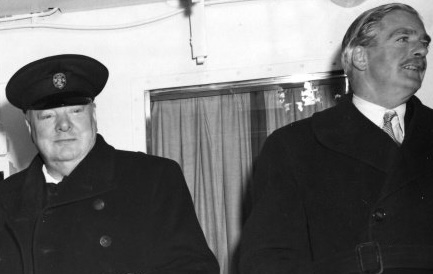
On 6 April 1955, Sir Anthony Eden was appointed prime minister. The transition marked the end of the Churchillian era that had dominated British politics since the start of the Second World War.
Eden was the first of 15 British prime ministers appointed by Queen Elizabeth II during her 70-year reign.
***
Churchill became the prime minister of the United Kingdom on 10 May 1940, replacing Neville Chamberlain on the same day that Nazi Germany launched its invasion of France and the Low Countries.
Eden served under Churchill as secretary of state for war, foreign secretary and leader of the House of Commons during the Second World War.
Following the break-up of the wartime coalition government shortly after VE Day in May 1945, Churchill called a general election. The Conservative Party was ultimately reduced to 197 seats, losing 190. Labour secured 393 seats, a net gain of 239, and a landslide parliamentary majority of 145. The swing of 12 points to Labour was unprecedented; both Churchill and Labour leader Clement Attlee were said to be astounded at the result.
Churchill returned to office in the wake of the 1951 general election, having secured a Conservative majority of 17 seats. He became the second oldest prime minister in history – second only to William Gladstone. Roy Jenkins referred to Churchill as “gloriously unfit for office” upon his election in 1951.
Churchill was 80 at the time of his departure as prime minister. His resignation on 5 April 1955, owing to his advanced age and failing health, followed a dinner party held at 10 Downing Street attended by the queen and the Duke of Edinburgh, alongside several of the prime minister’s past and present government colleagues.
Eden’s accession had been anticipated for years. As Churchill’s long-serving foreign secretary and de facto deputy, he was the undisputed heir apparent. Eden is reported to have grown resentful at Churchill’s refusal to step down in the preceding years.
***
Eden, a hugely popular and telegenic figure, was regarded for his extensive experience in foreign affairs – particularly for his pre-war resignation in protest at Neville Chamberlain’s policy of appeasement. His diplomatic skills were seen as a considerable political asset at the time of his succession, during the early years of the Cold War.
Upon entering Downing Street as prime minister, Eden insisted that “Peace comes first, always”. The declaration only consolidated his political standing.
Within nine days of Churchill’s retirement, the new prime minister called a general election for 26 May.
In the Conservative Party’s 1955 general election manifesto, entitled United for Peace and Progress, Eden said he called the election to secure his own mandate from the people.
He wrote: “This parliament is already in its fourth year, and it is inevitable that, with a change of Prime minister, there should be expectation of a general election.
“I believe that it is better to face this issue now. Uncertainty at home and abroad as to the political future must be bad for our influence in world affairs and bad for our trade.”
Eden described the year of 1955 as representing an “age of peril and promise”.
During the campaign, the prime minister hosted a half-hour television programme which pitted government ministers against the editors of 10 national newspapers. Eden was flanked by Rab Butler and Harold Macmillan, his chancellor and foreign secretary respectively.
The editor of the Daily Mirror, Hugh Cudlipp, asked Eden to comment on the impression that he was “not well versed in home affairs” as a long-serving foreign secretary.
Eden responded: “Perfectly fair criticism, Mr Cudlipp, perfectly fair… On the other hand, I have sat in cabinets on and off for 20 years… and I’m afraid I have said more than somewhat sometimes about domestic affairs.”
Eden won the 1955 election comfortably, increasing the Conservative Party’s commons majority from 17 to 60. The contest followed an electioneering budget that promised a cut in income tax.
The 1955 election was Clement Attlee’s last as Labour leader. The former prime minister’s party won 277 seats, representing a net loss of 17. His resignation led to Hugh Gaitskell’s election as Labour leader.
***
In the end, Eden’s premiership was defined and ultimately destroyed by the Suez Crisis of 1956. Eden’s collusion with France and Israel to use military force against General Abdel Nasser, after the Egyptian leader had nationalised the Suez canal in 1956, drew domestic and international condemnation.
His reputation as a specialist in the intricacies of foreign policy was singularly shredded.
Eden resigned on health grounds in January 1957. He was prime minister for just one year and 279 days.
In a statement announcing his resignation, Eden said: “When I returned to this country a month ago I hoped that my health had been sufficiently restored to enable me to carry out my duties effectively for some considerable time. That hope has not been realised.
“I do not feel that it is right for me to continue in office as the Queen’s first minister knowing that I shall be unable to do my full duty by my Sovereign and the country.”
Eden was created Earl of Avon in 1961. He died in January 1977.
In 1967, Eden said of the Suez crisis: “I am still unrepentant… People never look at what would have happened if we had done nothing. There is a parallel with the [1930s]. If you allow people to break agreements with impunity, the appetite grows to feed on such things.
“I don’t see what other we ought to have done. One cannot dodge. It is hard to act rather than dodge.”

Politics.co.uk Newsletters
DAILY
Politics@Lunch
WEEKLY
Week in Review