Conservatives
The Conservative and Unionist Party, most commonly known as the Conservative party or Tory party, has been a dominant force in British politics for much of its history. A centre-right party, its ideology incorporates a broad range of factions, including one-nation conservatives, Thatcherites and traditionalist conservatives.
Since its devastating defeat in the 2024 general election, which ended 14 years of Conservative-led governance, the party has been the second-largest party in parliament and performed the role of official opposition in the House of Commons.
In the immediate aftermath of the 2024 defeat, Rishi Sunak announced his resignation as Conservative leader, paving the way for a contest to replace him.
In November 2024, Kemi Badenoch emerged victorious, securing 56.5% of the membership vote in the final round against Robert Jenrick.
Recent leaders of the Conservative Party include Sunak (2022-2024), Liz Truss (2022), Boris Johnson (2019-2022), Theresa May (2016-2019), and David Cameron (2005-2016).
House of Commons representation: The Conservatives returned 121 MPs in the 2024 general election. This number has reduced following defections to Reform UK.
House of Lords representation: The Conservative Party remains the largest party in the House of Lords with over 230 peers.
Scottish Parliament representation: The Conservatives won 12 seats in the 2026 Scottish Parliament election – a net reduction of 19.
Senedd Cymru representation: The Conservatives won seven seats in the 2026 Senedd Cymru election – a net reduction of nine.
Directly elected mayors: Two. Ben Houchen was first elected as the mayor of Tees Valley in May 2021. Paul Bristow was elected as mayor of Cambridgeshire and Peterborough in May 2025.
The 2024 general election and Badenoch’s leadership
The 2024 general election resulted in a spectacular landslide victory for the Labour Party, led by Keir Starmer, bringing 14 years of Conservative government to a definitive end.
Despite the technical freedom to wait until January 2025, the prime minister, Rishi Sunak, had defied expectations and called a snap election in a surprise statement in the pouring rain outside 10 Downing Street on 22 May.
This inauspicious start kicked off an omnishambolic Conservative campaign, marred by a series of high-profile gaffes – including Sunak’s early departure from D-Day commemorations and a betting scandal in which several Conservative candidates and officials were investigated for allegedly betting on the July election date. Labour’s campaign, in contrast, was highly disciplined and cautious, constructed around the single-word slogan: “Change”.
When the results came in, the scale of the Conservative collapse was unprecedented, with 12 cabinet ministers losing their seats. Among the cabinet casualties were leader of the House of Commons Penny Mordaunt (Portsmouth North) and defence secretary Grant Shapps (Welwyn Hatfield). Liz Truss was ousted in her constituency of South West Norfolk.
The Liberal Democrats, led by Sir Ed Davey, achieved a record result. Following a campaign dominated by water-themed stunts, the party ravaged the Conservative “blue wall” of affluent commuter-belt constituencies in southern England. Davey’s party won 72 seats.
Significantly, Reform UK, led by Nigel Farage, received 4,117,610 votes, representing 14.3% of the national total.
According to analysis by Ipsos, the Conservatives won only 53% of those who supported the party at the 2019 general election. The Conservative vote fragmented significantly; a total of 23% switched to Reform UK, while 12% moved to Labour and 7% backed the Liberal Democrats.
Evaluation question
To what extent does the Conservative Party’s loss of historic support at the 2024 general election point to a permanent realignment in British voting behaviour rather than temporary disillusionment?
The Conservative Party secured only 121 seats in the House of Commons, a precipitous (notional) decline of 251, with just 23.7% of the vote.
Evaluation question
To what extent should the Conservative Party’s 2024 defeat be attributed to ideological exhaustion after 14 years in power, as opposed to a failure in delivering basic administrative competence?
On 5 July, power transferred from the Conservative Party to Labour for the first time since 1997. Sunak announced his resignation on the steps of Downing Street. The outgoing PM said he had “given this job my all” but voters had sent a “clear message”.
The 2024 Conservative leadership election
Sunak’s resignation precipitated a Conservative leadership election – the party’s fourth such contest in five years.
Kemi Badenoch declared her candidacy on 29 July 2024, pledging to return the Conservative Party to “first principles”. She joined fellow candidates Robert Jenrick, the former immigration secretary; Priti Patel, the former home secretary; Mel Stride, the former work and pensions secretary; Tom Tugendhat, the former security minister; and James Cleverly, the former foreign secretary in the race to replace Sunak.
Badenoch, the former business and trade secretary, had previously stood in the July-September 2022 Conservative leadership contest.
The Conservative Party’s leadership election rules, introduced under William Hague (1997–2001), set out a two-stage process: successive ballots of Conservative MPs reduce the field to two candidates, after which the wider membership selects the leader through a one-member-one-vote (OMOV) ballot.
Both Badenoch and Jenrick made it through to the critical membership stage. In the final head-to-head vote, Badenoch won a clear majority of the Tory membership, securing 53,806 votes (56.5%) compared to Jenrick’s 41,388 votes (43.5%).
The margin of victory, however – 12,418 votes – made it the narrowest win of the five contests (2001, 2003, 2005, 2019 and summer 2022) held since the party changed its rules to allow members the final say. Badenoch’s victory made her the fourth woman and first black person to lead the Conservative Party.
In her victory speech, Badenoch said it was “the most enormous honour to be elected” to the role leading the “party that has given me so much.”
Badenoch set about appointing her first shadow cabinet; Jenrick returned to the frontbenches as shadow justice secretary.
Evaluation question
To what extent must leaders balance the projection of party unity against the risk of empowering internal rivals when constructing their frontbench?
2025 local elections
The 2025 local elections, held on 1 May, represented a further erosion of the Conservative Party’s support.
The Conservative Party suffered widespread losses, losing control of 16 councils across England. The party won only 319 seats.
Reform UK won 677 seats, accounting for around 41% of the total up for election. Farage’s party secured overall control of 10 local authorities – including Kent, Lancashire and Lincolnshire. These results marked the first time that Reform UK had won majority control of any council.
The Liberal Democrats won more seats than the Conservatives (370) for the second set of local elections in a row.
Reform defections
In the wake of the 2024 general election, a steady procession of Conservative politicians have defected to Reform UK. Initially, defections were mostly confined to lower-profile former Conservative MPs and ex-allies of Boris Johnson – including Ben Bradley, Nadine Dorries, Jonathan Gullis and Dame Andrea Jenkyns.
Danny Kruger, the MP for East Wiltshire, bucked this trend upon his defection to Reform UK in September 2025.
On 12 January 2026, the Reform-Tory defection trend reached a new height when former chancellor Nadhim Zahawi announced his move to Reform UK.
Three days later, Badenoch announced that Robert Jenrick – her enduringly ambitious leadership rival – had been suspended from the party; Badenoch cited “clear, irrefutable evidence” of the shadow justice secretary’s intention to defect. Later that day, Nigel Farage unveiled Jenrick as the latest Reform UK MP.
Evaluation question
Does the steady stream of defections to Reform UK suggest that the Conservative Party has lost its monopoly over the British political right?
Suella Braverman, the former home secretary, joined Reform UK on 26 January.
Despite these defections, Badenoch’s improved performances in the House of Commons, her handling of Jenrick’s departure and a modest recovery in the polls have helped secure her position as Conservative leader.
Badenoch reshuffled her shadow cabinet in August/September 2026 after James Clevely, the incumbent shadow housing secretary, announced he would be standing for London mayor. Among other moves, she appointed close ally Alex Burghart as deputy leader of the Conservative Party.
Conservative Party shadow cabinet
Kemi Badenoch appointed her shadow cabinet on 5 November 2024 following her election as Conservative leader.
Badenoch conducted her first shadow ministerial reshuffle as leader in July 2025 and her second in August/September 2026.
The current shadow cabinet is as follows:
- Leader of the opposition: Kemi Badenoch
- Shadow chancellor of the Duchy of Lancaster, shadow secretary of state for Northern Ireland and deputy leader of the Conservative Party: Alex Burghart
- Shadow chancellor of the exchequer: Andrew Griffith
- Shadow secretary of state for foreign, commonwealth and development affairs: Tom Tugendhat
- Shadow secretary of state for the home department: Chris Philp
- Shadow secretary of state for defence: James Cartlidge
- Shadow minister for policy renewal: Neil O’Brien
- Chairman of the Conservative Party: Kevin Hollinrake
- Shadow secretary of state for business, innovation, science and trade: Claire Coutinho (cover while on maternity leave: Julia Lopez)
- Shadow secretary of state for work and pensions: Helen Whately
- Shadow secretary of state for energy security: Andrew Bowie
- Shadow secretary of state for education: Laura Trott
- Shadow secretary of state for justice: Nick Timothy
- Shadow secretary of state for health and social care: Damian Hinds
- Shadow secretary of state for environment, food and rural affairs: Victoria Atkins
- Shadow secretary of state for transport: Richard Holden
- Shadow secretary of state for housing, communities and local government: Katie Lam
- Shadow secretary of state for culture, media and sport: Rebecca Paul
- Shadow secretary of state for Scotland: Harriet Cross
- Shadow secretary of state for Wales: Mims Davies
- Shadow secretary of state for women and equalities: Joy Morrissey
- Shadow chief secretary to the treasury: Richard Fuller
- Shadow leader of the House of Commons: Jesse Norman
- Shadow leader of the House of Lords: Lord True
- Opposition chief whip: Rebecca Harris
What does the Conservative Party stand for?
The Conservative Party is broadly positioned on the centre-right to right-wing of the United Kingdom’s political spectrum.
It is economically liberal, generally favouring the free market and opposing government controls. It advocates for lower taxation and has historically opposed the state ownership of industries and companies.
In the 20th century, the Conservative Party was associated with conservative social attitudes. At the beginning of the 21st century, the party under David Cameron’s leadership adopted a more socially liberal outlook. Notably, Cameron’s government spearheaded the Marriage (Same Sex Couples) Act, which legalised same-sex marriage in England and Wales. (136 Conservatives opposed the bill, while 127 voted in favour.)
The Conservative Party is generally seen as being more in favour of greater immigration controls than both the Labour Party and Liberal Democrats.
Evaluation question
Can the party maintain a unified stance on immigration when its free-market wing demands flexible labour markets and its traditionalist wing demands strict border controls?
Historically, there were both eurosceptic and europhile wings in the Conservative Party, but in the 21st century the party has become more staunchly eurosceptic. Some of the party’s leading figures, notably Boris Johnson, Michael Gove and Priti Patel, were supporters of Brexit in the 2016 referendum on Britain’s membership of the European Union (EU).
The fraught Brexit process precipitated the resignations of two Conservative prime ministers (Cameron and Theresa May) and consolidated the party’s standing as a eurosceptic force in British politics. Boris Johnson, who succeeded May as prime minister, won the 2019 general election on a promise to “Get Brexit Done”.
The Conservatives remain a strongly pro-union party and oppose the break-up of the United Kingdom. The party is also generally opposed to constitutional reform. Its status as the Conservative and Unionist Party is derived from its historic opposition to home rule/devolution. It has also opposed efforts to reform the House of Lords and the electoral system. The party is a strong advocate of the first past the post (FPTP) electoral system.
Evaluation question
In light of recent electoral shifts, how strong is the case for the Conservative Party to reconsider its traditional defence of the FPTP electoral system?
The Conservative Party has long been characterised as a “broad church”, encompassing a range of viewpoints. The party’s core ideological tenets are interpreted and emphasised in different ways by successive leaders, as well as by internal factions. Critically, its historical longevity is defined less by ideology than its enduring pragmatism and political flexibility.
Conservative traditions and factions
The Conservative Party is composed of a range of factions, traditions and ginger groups, both historically and in its contemporary state.
One Nation Conservatives
This tradition, historically significant within the party, emphasises paternalism and social responsibility. In contemporary politics, those with claims to the one-nation tradition support well-funded public services, environmental stewardship and a pragmatic approach to economic management and state intervention.
The tradition is historically associated with the political thought and governments of Benjamin Disraeli.
Disraeli and his governments were responsible for landmark legislation such as the Second Reform Act (1867), which expanded the parliamentary franchise to large numbers of working-class men; the Public Health Act 1875, which codified sanitation laws; the 1875 Climbing Boys Act, which reinforced the ban on employing juvenile chimney sweeps; the Factory Act 1874, which raised the minimum working age to nine and limited the working day for women and young people in textile factories to 10 hours; and the Conspiracy, and Protection of Property Act 1875, which together with the Employers and Workmen Act 1875, fully decriminalised the work of trade unions.
In the 20th century, one nation conservatives generally embraced Keynesian economic theory and objectives. The government of Harold Macmillan (1957-1963), as well as its immediate predecessors and successors, accepted a Keynesian post-war economic consensus. Macmillan later emerged as an outspoken critic of the laissez-faire economics and monetarist policies pursued by Margaret Thatcher during her tenure as prime minister.
More recently, figures such as David Cameron, Theresa May and Boris Johnson have been described as operating within this tradition.
In his first speech after the 2015 general election, which produced a Conservative majority, Cameron stated: “We will govern as a party of one nation, one United Kingdom. That means ensuring this recovery reaches all parts of our country: from north to south, from east to west.”
Johnson’s 2019 general election manifesto argued that his “new One Nation Conservative Government is giving the NHS its biggest ever cash boost, with 20 hospital upgrades and 40 new hospitals, while delivering 50,000 more nurses and 6,000 more doctors and creating an extra 50 million general practice appointments a year.”
Amber Rudd’s resignation as work and pensions secretary in September 2019, during Johnson’s tenure as prime minister, objected to his unilateral expulsion of “21 talented, loyal One Nation Conservatives” from the parliamentary party. These 21 MPs, including former chancellors Philip Hammond and Kenneth Clarke, were opposed to Johnson’s Brexit strategy.
In January 2026, Kemi Badenoch suggested that centrist/one nation ideas were no longer wanted in the Conservative Party under her leadership.
Evaluation question
Given the historic reliance of the Conservative Party on pragmatic evolution, does Kemi Badenoch’s apparent rejection of “one nation” ideas risk limiting the party’s long-term electoral viability?
Badenoch declared that those who objected to the party’s rightward direction “need to get out of the way”. The comments came after Andy Street, the former West Midlands mayor, and Ruth Davidson, the former Scottish Tory leader, announced the formation of Prosper UK, a new campaign vehicle for moderate Conservatives. The group’s targets were identified as “politically homeless” centrist and centre-right voters.
The Tory Reform Group (TRG) is the traditional standard-bearer for the “one nation” position in the Conservative Party. The TRG, associated with senior party figures such as Kenneth Clarke and Michael Heseltine, was established in 1975 to champion socially progressive and centrist policies – acting as an intellectual counterweight to the emerging free-market, Thatcherite wing of the party.
In parliament, the One Nation Conservatives caucus of moderate Tory MPs was established in 2019 to provide a voice for the party’s more pragmatic and professedly “moderate” elements – a factional counter-weight to its ideological free-market, eurosceptic and socially conservative groups. In the 2019 to 2024 parliament, the group was chaired by former first secretary of state Damian Green, who went on to lose his seat at the 2024 general election. The 21 MPs expelled from the party in September 2019 were associated with this group.
Thatcherite/free-market Conservatives
This influential wing advocates for liberal economic policies, including reduced taxation, supply-side economics and a smaller state role in the economy.
It rose to prominence under Margaret Thatcher during her tenure as prime minister from 1979 to 1990. Thatcher’s unbending support for a monetarist and laissez-faire economic programme initially attracted significant criticism from senior party “wets” (one-nation party grandees associated with Edward Heath’s Conservative leadership). Thatcher referred to her allies as the “dries”.
Thatcher’s September 1981 reshuffle, referred to as the “purge of the wets”, is remembered for promoting a series of her “dry” allies – at the expense of one nation Conservative ministers.
In his 1984 Mais lecture, Nigel Lawson, the then chancellor, explained the rationale behind the government’s monetarist vision. He argued that macroeconomic policy should be focused on the “conquest of inflation, and not the pursuit of growth and employment.”
Lawson’s budget in 1988 included a reduction in the basic rate of income tax from 27% to 25% and the abolition of the top rate of tax, which stood at 60%. The decision meant no person would pay more than 40% on their earnings.
These tax-cutting tenets found further expression during the short-lived Liz Truss premiership. The politically disastrous “mini-budget” represented an attempt to implement radical free-market policies.
Institutionally, this free market tradition has been represented by the Free Enterprise Group (FEG) of Conservative MPs – a parliamentary caucus, founded in 2011 by Truss, that championed free-market, libertarian economic policies. The group, seen as a standard-bearer for the Thatcherite wing of the party, was notable for the political ascent of its founding members. Key figures in the FEG included Truss, Kwasi Kwarteng, Priti Patel, Dominic Raab and Chris Skidmore. The 2012 book, Britannia Unchained, served as the group’s unofficial manifesto for radical free-market reform. It was effectively succeeded by the Free Market Forum, which was launched in 2021.
The Conservative Growth Group (CGG), which professed similar objectives, was founded by Liz Truss in the 2019-2024 parliament.
Traditionalist conservatives
This faction places strong emphasis on established institutions, social order and often espouses a more socially conservative stance on cultural issues. It frequently overlaps with socially conservative elements within other groups and voices concerns regarding national identity, law and order and family values.
Traditionalist Conservative MPs opposed some of the social reforms associated with the Cameron government, which held office from 2010 to 2016, notably same-sex marriage legislation.
Iain Duncan Smith, the Conservative leader from 2001 to 2003, instructed Tory MPs to vote against an amendment to the Adoption and Children Bill, which sought to enable unmarried couples to adopt children, opening the door for gay couples to adopt. This clear expression of traditionalist conservatism sparked a rebellion among Conservative MPs and likely expedited Duncan Smith’s downfall.
The Cornerstone Group was a highly traditionalist and socially conservative faction of Conservative MPs. Its political philosophy was summarised by its motto: “Faith, Flag, and Family”.
In July 2005, the group published a pamphlet that accused the party’s then leader, Michael Howard, of running a general election campaign that was too “timid” about tax cuts, public service reform and family values.
It stated: “We believe that these values must be stressed: tradition, nation, family, religious ethics, free enterprise. We want to use the leadership election to argue for principles and policies, not about personalities.”
The Cornerstone Group was generally critical of “modernising” forces within the party – forces that came to be associated with Cameron and his leadership.
The Blue Collar Conservatives group, founded in 2012 by the former cabinet minister Esther McVey, aimed to “champion working people and develop a conservative agenda to benefit the voters and communities most neglected by Labour”.
The Common Sense Group (CSG) of socially conservative MPs came to prominence in the 2019-2024 parliament. The CSG’s principal focus was to combat what it described as “woke” ideology. In 2021, it published a manifesto, Common Sense: Conservative Thinking for a Post-Liberal Age, which took aim at the Equality Act 2010, the supreme court, British broadcasters and environmentalist direct action group Extinction Rebellion. Veteran Conservative MP Sir John Hayes served as the group’s chair.
The New Conservatives were a socially conservative faction that emerged in the aftermath of the 2019 general election. Upon the group’s launch in July 2023, it published a “10-point plan” to reduce net immigration to the UK to below 226,000 a year – which was seen as a challenge to the authority of Rishi Sunak, the then prime minister.
Euroscepticism
The Conservative Party possesses a long tradition of euroscepticism, defined as an opposition to and hostility towards European integration.
The parliamentary debates over the European Communities Act 1972, which made legal provision for Britain’s accession to the European Economic Community (EEC), were marked by a political divide within the Conservative Party. Opposition to European accession was led by Enoch Powell. Subsequently, Powell urged the public to vote for the Labour Party in the February 1974 general election in protest at Edward Heath’s europhile programme. Labour had promised to hold a referendum on Britain’s continued EEC membership.
Conservative euroscepticism became more pronounced in the years that followed Britain’s accession to the EEC.
Margaret Thatcher supported the successful pro-EEC campaign during the 1975 referendum, but during her time as prime minister she became a leading critic of further European integration – a stance she set out most clearly in her landmark Bruges speech in 1988.
In the speech’s most consequential passage, Thatcher warned that the British government had not “embarked on the business of throwing back the frontiers of state at home, only to see them re-imposed at a European level with a European superstate exercising a new dominance from Brussels.”
The address, a seminal statement of Conservative euroscepticism, marked a point of departure in Conservative thought on the ‘European question’, electrifying those elements that were instinctively hostile to integration. Commentators have observed a continuity between Thatcher’s Bruges speech and the positions later adopted by ‘Leave’ supporters during the 2016 Brexit referendum.
In July 1993, Thatcher’s successor as prime minister, John Major, unaware that microphones were still live after a television interview, referred to three unnamed eurosceptic cabinet colleagues as “bastards”. The incident occurred shortly after Major’s government had survived a vote of confidence, by 339 votes to 299, linked to the ratification of the Maastricht Treaty, the foundation treaty of the European Union. The parliamentary battles over the treaty had bitterly divided the Conservative Party, with a group of eurosceptic backbenchers (the ‘Maastricht Rebels’) repeatedly challenging the government’s position.
The European Research Group (ERG) of eurosceptic Conservative MPs emerged from the Maastricht debates. A highly organised “party within a party”, the ERG was a leading advocate of Brexit and a seemingly insatiable critic of Theresa May’s attempts to deliver it.
The group proved instrumental in May’s downfall as prime minister. Among its number were the 28 so-called “Brexit spartans”, a group of hardline eurosceptic Tory MPs who voted against May’s withdrawal agreement on all three occasions it was put to parliament in 2019.
Conservative Party’s organisational structure
Conservative Campaign Headquarters (CCHQ)
Conservative Campaign Headquarters (CCHQ), known as Conservative Central Office until 2004, is the party’s national headquarters. Based in Westminster, CCHQ runs national election campaigns, manages the party’s finances and administration, and maintains the list of approved parliamentary candidates from which local associations make their selections.
CCHQ is led by the chairman of the Conservative Party. Kevin Hollinrake was appointed as Tory chairman in July 2025.
The board of the Conservative Party
The Conservative Party board is the ultimate decision-making authority within the Conservative Party. It is responsible for overseeing all operational matters including fundraising, membership and party candidates.
According to the Conservative constitution, the board has the “power to do anything which in its opinion relates to the management and administration of the party.” This includes the “development and implementation of the strategies for the party, for its campaigning, organisation, membership, and fund-raising at a National, and local level.”
The board, which meets at least six times each year, is made up of representatives from each section of the party. The party chairman serves as chair of the board in the absence of the party leader. The chairman of the National Conservative Convention serves ex officio as deputy chairman of the board. A second deputy chairman is appointed by the leader.
The board also contains places for the party treasurer, the chairman of the 1922 committee of Conservative backbenchers, the chairman of the Conservative Councillors’ Association, and the chairpersons of the Scottish Conservative and Unionist Party, and the Welsh Conservative Party.
National Conservative Convention (NCC)
The National Conservative Convention (NCC) is described as the “parliament of the voluntary party.”
The Conservative Party constitution provides the NCC with a broad remit to “promote the objects and values of the party”, represent the views of party members and serve as a “link between the party leader and party members.” The body is also responsible for electing representatives to sit on the Conservative Party board.
Furthermore, the NCC is a component of the constitutional college of the Conservative Party, meaning it has a significant sway over amendments to the party’s constitution (including leadership rules).
The NCC, which meets at least two times a year, is composed of all local association chairmen, all regional chairmen and deputy regional chairmen, as well as select recognised organisations, such as the Young Conservatives and Conservative Women’s Organisation groups.
Conservative Policy Forum (CPF)
The Conservative Policy Forum (CPF) provides a mechanism for party members to take part in the policy development process. All party members are automatically members of the CPF.
The body conducts party-wide consultations and accepts submissions from party members. The Conservative constitution states that the party leader “shall determine the political direction of the party having regard to the views of party members and the Conservative Policy Forum.”
The director of the CPF is elected by the National Conservative Convention for a term of three years. The CPF’s director sits on a leadership council alongside the appointed chairman (selected by the party leader) and senior representatives from the wider party.
The CPF traces its origins back to the Conservative Political Centre (CPC), which was established in 1945. The CPC changed its name to the Conservative Policy Forum in 1999.
Local associations
The grassroots structure of the party is built around local Conservative associations, which generally correspond to parliamentary constituency boundaries.
These associations are run by officers, including a president, chairman and two deputy chairmen (a deputy chairman for membership and finance, and a political deputy chairman).
The associations are the volunteer base of the party, providing an organisation structure for campaigning and fundraising. They deliver campaign leaflets and interact with voters on behalf of the party. Every association is also said to have a CPF discussion group.
Devolved party structures
Scottish Conservative and Unionist Party
Russell Findlay was elected as leader of the Scottish Conservatives in September 2024, succeeding Douglas Ross.
In the 2021 Scottish Parliament election, the Scottish Conservatives secured 31 MSPs, garnering 21.9% of the constituency vote and 23.5% of the regional list vote, thereby remaining the second-largest party and the official opposition in Scotland. The Conservatives won 12 seats in the 2026 Scottish Parliament election – a net reduction of 19.
Welsh Conservatives
Darren Millar was elected leader of the Conservative group in the Senedd Cymru in December 2024, succeeding Andrew RT Davies.
In the 2021 Senedd election, the Welsh Conservatives won 16 seats (an increase of five from 2016), with 26.1% of the constituency vote and 25.1% of the regional list vote, establishing themselves as the second-largest party in the Senedd.
The Conservatives won seven seats in the 2026 Senedd Cymru election – a net reduction of nine.
Northern Ireland Conservatives
This branch is chaired by Paul Leeman, who has held the position since 2023. The Conservative Party is the only major Great Britain-based party that fields candidates in Northern Ireland, although it typically contests a very small number of seats and commands a minimal support base.
In the 2022 Northern Ireland Assembly election, the party secured only 0.03% of the vote and won no seats. Similarly, in the 2024 general election, their vote share in Northern Ireland was a mere 0.1%.
Historically, the Conservative Party has had a close relationship with the Ulster Unionist Party (UUP). The UUP resigned the Conservative whip at Westminster in protest against prime minister Edward Heath’s decision to impose direct rule on Northern Ireland, effectively dismantling the region’s devolved parliament.
Conservative Party membership
As of November 2024, at the conclusion of the leadership election that saw Kemi Badenoch become leader, the Conservative Party had 131,680 members.
This figure represents a significant decline from the approximately 172,437 members eligible to vote in the 2022 leadership contest that elected Liz Truss. The party therefore lost approximately 40,000 members, nearly a quarter of its 2022 membership, in the intervening two years. This continues a longer-term downward trend.
The Conservative Party currently does not publish membership figures. However, the party’s leadership elections, which involve a full membership ballot, have provided some clarity in this regard.
In the early 1950s, membership of the Conservative Party is said to have stood at around 2.8 million.
- July 2025: ~123,000 | Source: Report by the Daily Telegraph newspaper
- November 2024: 131,680 (eligible voters) | Source: Leadership election (Badenoch victory)
- September 2022: 172,437 (eligible voters) | Source: Leadership election (Truss victory)
- March 2021: 200,000 | Source: Comments by Conservative Party chairman Amanda Milling
- May 2019: 159,320 (eligible voters) | Source: Leadership election (Johnson victory)
- September 2014: 149,800 | Source: Hailed by Conservative Party chairman Shapps as “the first rise in a decade”
- September 2013: ~134,000 | Source: Comments by Conservative Party chairman Grant Shapps
- October 2010: ~177,000 | Source: Comments by Conservative activist Tim Montgomerie
- December 2005: 253,689 (eligible voters) | Source: Leadership election (Cameron victory)
- September 2001: 328,000 (eligible voters) | Source: Leadership election (Duncan Smith victory)
The 1922 committee
“The 1922” is a committee of all backbench Conservative MPs. It traditionally meets in committee room 14, the largest of its kind in parliament.
The committee oversees the rules for leadership contests and votes of confidence in the party leader. The proverbial “men in grey suits” – a semi-official delegation from the 1922 committee informing a leader that their time is up – has become a recurring image in British political life, especially between the years 2018-2022. The committee is today best recognised for its role as the Conservative Party’s in-house assassination bureau.
A vote of confidence is triggered once a threshold (a percentage of the Conservative parliamentary party) is met of MPs asking for such a vote. MPs do so in the form of a letter, sent to the 1922 committee chairman. Critically, only the chairman knows how many letters have been received.
At present, the relevant threshold stands at one-third of the Conservative parliamentary party. This was raised from 15% in the early stages of the parliament created after the 2024 general election. Bob Blackman, the new chair of the committee, announced the change following Kemi Badenoch’s election as Tory leader.
The committee is led by an 18-member executive, who are elected by and from the pool of backbench Conservative MPs. Blackman succeeded Sir Graham Brady as chairman; Brady’s tenure (2010-2024) comprised five different party leaders.
The committee traces its origins to April 1923, when a group of newly elected Conservative MPs held a meeting that led to the formation of “the Conservative private members (1922) committee”.
The committee’s founding purpose was to foster “mutual co-operation and assistance in dealing [with] political and parliamentary questions and in order to enable new [MPs] to take a more active interest and part in parliamentary life.”
Following further general elections in 1923 and 1924, new Conservative members were invited to join the committee. In February 1926, the committee was opened to all backbench Conservative MPs.
Lord Norton, who is responsible for the definitive study on the committee, has written: “Until 1965, Tory leaders came into office through a process of ‘emergence’ and gave up office when they were old, ill or ground down by political pressures.
“None, though, left office because of a visitation by ‘the men in grey suits’. It was only after the introduction of rules for election – and later removal – by MPs that the 1922 committee became a major force in determining the fate of party leaders. Indeed, the introduction of rules for election transformed the 1922 committee.”
In total, the committee has overseen three ‘votes of confidence’ in three Conservative leaders: Iain Duncan Smith (2003), Theresa May (2018) and Boris Johnson (2022). Of these votes, only the first has been successful — with 90 voting against (i.e. ‘no confidence’) and 75 for (confidence). The 2018 and 2022 ballots nonetheless weakened, perhaps fatally, the standing of May and Johnson. Both were sitting prime ministers at the time.
How does the Conservative Party elect its leader?
A Conservative leadership vacancy usually occurs in one of two ways.
The leader may choose to step down following a general election loss or as a result of insurmountable criticism in the party at large.
There is also a mechanism for a vote of no confidence. Conservative MPs who wish to trigger a no-confidence motion must submit letters to the chair of the 1922 committee of Conservative backbenchers. Historically, 15% of Conservative MPs had to submit private letters to the 1922 committee chair. Following the 2024 election, the threshold was raised to one-third (33%) of sitting MPs.
If the threshold is met, a secret ballot of all Conservative MPs is held. If the leader fails to secure a majority of Conservative MPs, they are officially ousted and barred from standing in the subsequent leadership election.
The MP elimination rounds
The rules of the first stage of a leadership contest are set by the executive body of the 1922 committee in consultation with the Conservative Party board.
These bodies must decide how many MP backers (nominations) a candidate needs to formally enter the contest; they must also decide the timetable and how long the voting rounds will last.
The constitution of the Conservative Party states: “The rules for deciding the procedure by which the 1922 committee selects candidates for submission for election shall be determined by the executive committee of the 1922 committee after consultation of the board.”
The goal of the MP elimination rounds is to whittle a crowded field of candidates down to just two names. To this end, MPs hold a series of secret ballots; usually, the candidate with the fewest votes is eliminated in each round.
This continues until only two candidates remain. If only one candidate is nominated or all others withdraw (as happened with Rishi Sunak in October 2022), they are declared leader immediately.
Party membership vote
The final two candidates are put to a ballot of party members. To be eligible to vote in the one-member-one-vote contest, a prospective voter must have been a party member for at least 90 days prior to the close of the ballot.
The final two typically travel the country for “hustings”, debating each other in front of members to win over the grassroots.
Following the final ballot, the winner is then declared by the chair of the 1922 committee, the returning officer in such elections.
The evolution of Conservative leadership election rules
‘Emergence’
The traditional means of Conservative succession did not call for anything so formal as a leadership contest. Rather, the sovereign would consult a trusted coterie of Conservative grandees, who would collectively determine which leading figure could best command the support of the parliamentary party. This process aligned with the constitutional duty of the outgoing prime minister to recommend a successor who could command a majority in the House of Commons.
This informal process of “emergence” functioned by following an agreed line of succession.
For instance, Neville Chamberlain was the established and uncontested heir apparent to Stanley Baldwin prior to his elevation as Conservative leader in 1937. Chamberlain, shortly before his resignation as prime minister in 1940, conferred with two possible successors: Lord Halifax, the foreign secretary, and Winston Churchill, the first lord of the Admiralty. Halifax responded that, in order to govern effectively, the prime minister should not be a member of the House of Lords. And so Churchill, seen as a lesser candidate in some quarters, emerged as Chamberlain’s heir apparent.
Anthony Eden’s accession had been anticipated for years by the time of Churchill’s resignation in April 1955.
However, the process came under strain when it was forced to adapt to abrupt and/or unforeseen resignations. Eden stood down as prime minister in the wake of the Suez Crisis, citing ill health. Following consultations with senior party figures, including Winston Churchill and the Marquess of Salisbury, Harold Macmillan was invited to take office as prime minister. The chancellor of the exchequer was selected ahead of his main rival, Rab Butler, to the surprise of some contemporaries.
The informal consultation process did not survive the fraught leadership scuffle that followed Macmillan’s resignation as prime minister. Macmillan, hospitalised for prostate surgery, announced his resignation during the height of Conservative Party conference in October 1963. His resignation statement referred vaguely to the “customary processes of consultation”; but the bed-bound Tory leader lacked an obvious, settled successor.
The initial frontrunners were Butler, who had strategically occupied the leader’s suite at the Imperial Hotel as deputy prime minister; Reginald Maudling, the chancellor of the exchequer; and the 2nd Viscount Hailsham (Quintin Hogg), who in a speech on the evening of 10 October announced his intention to renounce his peerage.
However, on 18 October, Macmillan – still confined to his hospital bed – advised a 37-year-old Queen Elizabeth II to send for the foreign secretary, the 14th Earl of Home (Alec Douglas-Home). Home, who subsequently renounced his peerage, had placed himself into contention with a well-targeted intervention from the conference floor.
Following Home’s elevation, Iain Macleod, the former party chairman, penned a damning article for the Spectator in which he suggested the leadership race had been fixed by “the magic circle” – a clandestine cabal of Conservative kingmakers.
The first Conservative leadership election
Douglas-Home’s resignation in the wake of the 1964 general election therefore paved the way for the party’s first ever leadership contest.
The new election procedure was agreed in discussion with the 1922 committee. The chair of the 1922 committee was made responsible for the conduct of the ballot and “all matters in relation thereto”.
The rules required a candidate to obtain more than 50% of the vote and establish a lead of 15% over their nearest rival to win outright on the first ballot. If there was no clear winner on the first ballot, the election went on to a second ballot; in this vote, a candidate could win with a simple majority.
If this failed to happen, a third ballot would be held between the top three candidates from the second ballot using the preferential alternative vote (AV) system. In the event that no candidate had won an overall majority, the third placed candidate’s second preferences would be redistributed.
A ballot of Conservative MPs, held on 27 July 1965, identified one Edward Heath as the parliamentary party’s choice. Heath won 150 votes – compared to 133 for Reginald Maudling and 15 for Enoch Powell. Heath narrowly missed the threshold necessary to win on the first ballot, but Maudling conceded defeat.
Rules changes and the introduction of the membership vote
Initially, contests were only permitted when a vacancy occurred. This changed in 1975 due to Heath’s refusal to resign in the wake of the October 1974 general election. These new rules enabled Margaret Thatcher’s successful challenge and her elevation as Conservative leader.
The procedures established in 1975 provided for annual elections to the Conservative leadership. Under the previous rules, the successful candidate needed to establish a lead of 15% over their nearest rival to win outright on the first ballot. This was changed to 15% of the total parliamentary party.
For much of Thatcher’s tenure as Conservative leader and prime minister, she avoided a challenge via this route. In December 1989, however, she was challenged by longstanding Tory “wet” Anthony Meyer, who volunteered himself as a “stalking horse” candidate. Meyer intended to stand in the first round, testing the parliamentary party’s confidence in Thatcher, before standing down in favour of more credible candidates.
Meyer was summarily defeated in the first round. However, pressure on Thatcher soon intensified, culminating in the 1990 Conservative leadership election. The contest triggered Thatcher’s downfall as prime minister after she failed to defeat Michael Heseltine, the former defence secretary, on the first ballot. Thatcher’s majority was 52 votes; she needed 56 to meet the all-important 15% threshold.
The leadership rules were amended in 1991. The changes confined a hypothetical third ballot to the top two candidates, scrapping the proposed preferential third ballot. They also abolished the annual leadership elections; instead, a contest would be triggered if 10% of Conservative MPs notified the chair of the 1922 committee of their support for a ballot.
The current leadership rules were introduced in 1998 by William Hague, who succeeded John Major as Conservative leader following the 1997 general election.
Iain Duncan Smith, who led the Conservatives from 2001 to 2003, was the party’s first leader to be chosen by a ballot of the membership. His subsequent defenestration paved the way for the coronation of Michael Howard; the former home secretary was selected as leader by effective acclamation of the parliamentary party, thereby avoiding a vote of the wider membership.
Following the 2005 general election, Howard initially delayed his departure in an attempt to reform the party’s leadership rules. In a document titled A 21st Century Party, he proposed returning the power to elect Conservative leaders to Tory MPs, undoing the changes overseen during Hague’s tenure as leader. Hague himself had called for the rules to be reformed; in May 2005, he argued that the party membership was “no more representative of the population than the MPs, but without the personal knowledge of the possible leaders.”
However, Howard’s proposed reforms failed to achieve the required 66% threshold of the party’s constitutional college, composed of MPs, peers and MEPs and party volunteers.
Conservative membership ballots have since been responsible for electing David Cameron, Boris Johnson, Liz Truss and Kemi Badenoch as party leader.
Theresa May and Rishi Sunak, like Howard in 2005, emerged as Conservative leader without the need for a membership ballot, after their rivals withdrew and/or failed to secure the requisite number of MP nominations.
Who votes for the Conservative Party? (Demographics of support)
The following data is drawn from the study of the 2024 general election conducted by Ipsos.
Age: The Conservatives maintained their strongest support among voters aged 65 and over, from whom 43% of their vote share was derived. This was double their vote share among under 65s. Overall, their vote share declined across every age group compared to 2019.
Gender: The traditional gender gap narrowed, primarily due to a more significant drop in Conservative support among men (-23 percentage points) than among women (-17 percentage points). Among older voters, the party performed slightly better with women (40%) than men (35%). This was attributed to older men showing a greater inclination to vote for Reform UK (20% among that group).
Social class: Differences by social class were relatively minor for the Conservatives. Notably, among C2 voters (skilled manual workers), the Conservatives’ vote share (25%) was matched by Reform UK.
Education: Among university graduates, 19% voted Conservative. The party led among those with no formal qualifications (39%), but this represented a substantial reduction from their 36-point lead with this group in 2019.
Ethnicity: The Conservatives secured 17% of the vote among ethnic minority voters, significantly trailing Labour (46%). Among white voters, the Conservatives received 26% of the vote, while Labour received 33%. This marked a reversal from 2019 when the Conservatives held a 19-point lead among white voters.
Brexit: Among those who voted Leave in the 2016 EU referendum, the Conservatives still held a lead (38%), but this was a dramatic fall from 73% in 2019. Reform UK captured 29% of this political demographic. Among 2016 Remain voters, the Conservatives secured 18% of the vote.
Housing tenure: The Conservatives lost their previous lead among mortgage holders, where a 10-point advantage in 2019 turned into a 17-point lead for Labour in 2024. Their lead among outright owner-occupiers was also significantly reduced. Reform UK surpassed the Conservatives among social renters, pushing them into third place with this group (with 20% supporting Reform and 12% the Conservatives).
The emergence of the Conservative Party
The Tamworth Manifesto
The old Tory party had emerged in the 17th century as a supporter of divine-right monarchy and the established church. Something of a successor to this tradition coalesced around William Pitt the Younger in the late 18th and early 19th centuries. Pittite Toryism was inherently sceptical of popular politics and reform that threatened established institutions and the existing social order.
The birth of the modern Conservative Party is usually traced to the political upheavals of the early 19th century – and Robert Peel’s seminal response specifically.
Peel’s famous Tamworth Manifesto, regarded as the foundational document of the modern Conservative Party, was conceived as a response to the Great Reform Act of 1832. The Great Reform Act mostly abolished the ‘rotten boroughs’ and aristocratic corruption that had sustained the old Tory party.
As such, the Conservatives were badly beaten at the 1832 general election – the first since the Great Reform Act. Political reform had also been resisted by the Tory supporters of the Duke of Wellington during his tenure as prime minister.
In November 1834, King William IV dismissed the Whig ministry of Lord Melbourne. The sovereign initially sent for Wellington, who was reluctant. He said the next prime minister should sit in the commons, and recommended Peel to form the first Tory administration since the Great Reform Act.
Peel, facing a hostile House of Commons, requested a dissolution of parliament. During the campaign, he issued his Tamworth Manifesto – an appeal to the property-owning middle classes enfranchised by the Great Reform Act. The manifesto marked a declaration of Peel’s attitude to current political issues and outlined the principles that would define his government. He sought to reassure voters that the issue of reform had been settled.
He accepted the Reform Act 1832 as a “final and irrevocable settlement of a great constitutional question.” It was a settlement, the prime minister proclaimed, that “no friend to the peace and welfare of this country would attempt to disturb, either by direct or by insidious means.”
But Peel also warned against constant radical change. He stated he would not accept office if it meant living in a “perpetual vortex of agitation.”
The general election held in January and February 1835 saw a significant recovery for Peel’s party. The Conservatives gained approximately 100 seats – proving the party could survive and compete in the reformed political system. However, Peel’s Conservatives remained in a clear minority at Westminster, returning 273 MPs. The Whigs, allied with Daniel O’Connell’s Irish Repeal Association, held 385 seats.
Peel resigned on 8 April 1835. But the Tamworth Manifesto and Peel’s short-lived ministry had reinvented his party.
The Peelite split
Peel’s Conservative Party returned to power after the 1841 general election.
The second Peel ministry was one of the great reforming governments of the nineteenth century, notably reintroducing the income tax in 1842. The Mines Act of 1842 banned the employment of women and children underground; the Factory Act 1844, meanwhile, limited working hours for children and women in factories.
Peel’s defining decision, however, was the 1846 repeal of the Corn Laws. The policy, spurred by the failure of the Irish potato crop in 1845 and the famine that followed, split his party and ended his premiership. In the end, Peel’s act of career suicide passed with a majority of 98, with two-thirds of his own MPs – Conservative protectionists and landowners – voting against the government. Peel resigned as prime minister.
Those Conservatives who remained loyal to Peel, known as the pro-free trade Peelites, included the Earl of Aberdeen and William Ewart Gladstone. In 1859, the Peelites merged with the Whigs and the Radicals to form the Liberal Party.
Disraeli’s ‘leap in the dark’
Benjamin Disraeli, a proponent of protectionism, had risen to prominence for his vitriolic attacks on Peel and his followers. In February 1845, he said Peel – the then prime minister – had “caught the Whigs bathing, and walked away with their clothes.”
Disraeli helped transform the face of the Conservative Party. In the later 1860s, he resolved on a strategy to outflank the Liberals (“dish the whigs”) by embracing the cause of political reform. He hoped to win the gratitude of the newly enfranchised and regain the political initiative for his Conservative Party. This strategy was famously described by the Earl of Derby, the Conservative prime minister at the time, as a “leap in the dark”.
Disraeli introduced a Reform Bill on 18 March 1867. Addressing the commons, he couched his argument in conservative language, framing the legislation as a “constitutional” measure born of “principle” rather than “democracy”.
Disraeli’s measures and concessions produced an act that granted the vote to all male householders who paid rates, as well as to male lodgers paying £10 or more in annual rent. Disraeli’s “leap in the dark” did not initially land him on safe ground. The Conservatives lost the 1868 general election, the first held according to the new franchise.
Disraeli returned to office as prime minister in 1874. Commenting on the impact of Disraeli’s social and economic reforms (described above), early Liberal-Labour MP Alexander Macdonald told his constituents in 1879 that the Conservative Party had “done more for the working classes in five years than the Liberals have in fifty.”
Disraeli was made Earl of Beaconsfield by Victoria in 1879, and therefore governed from the House of Lords until the 1880 general election. The result of that election, won by William Ewart Gladstone’s Liberals, led to Disraeli’s resignation on 21 April 1880.
The Liberal-Unionist merger
In the late 19th century, the Conservative Party was shaped by its virulent opposition to Gladstone’s attempts to introduce Irish home rule.
Gladstone introduced the first Irish Home Rule Bill to the House of Commons in April 1886. The proposed legislation, which sought to grant Ireland a measure of self-government and national autonomy within the British Empire, marked parliament’s first major reckoning with the constitutional crux of the so-called ‘Irish Question’. The debate over the First Home Rule Bill sparked the beginning of a permanent schism within the Liberal Party. A powerful faction, headed by Joseph Chamberlain and the Marquess of Hartington, broke away to form the Liberal Unionists. The new grouping feared home rule would destabilise the British Empire by injecting the possibility of self-determination; Chamberlain had resigned from Gladstone’s cabinet on these terms.
Gladstone’s response to the defeat of his First Home Rule Bill was to dissolve parliament. The 1886 general election produced a radically different picture to the parliament constituted just one year before. A new Conservative Party and Liberal Unionist pact returned 393 MPs (316 Conservatives, 78 Liberal Unionists), up 146. Gladstone’s Liberals crashed from 319 seats to 192.
The Liberal Unionist faction officially fused with the Conservative Party in 1912. This official coalescence produced the Conservative and Unionist Party as it stands today.
Notable Conservative prime ministers: from Churchill to Truss
Winston Churchill
Winston Churchill became prime minister on 10 May 1940, the same day that Nazi Germany launched its invasion of France and the Low Countries. His appointment marked the end of Neville Chamberlain’s policy of appeasement and the beginning of a strategy of total war against the Axis powers.
Churchill had been a long-standing critic of appeasement, having voiced concerns about the rate of German rearmament as early as 1934. In the wake of the famous Norway Debate, which fatally weakened Chamberlain’s authority, Churchill accepted the king’s invitation to form a government and set about constructing a cross-party war cabinet. On 11 May, the Labour Party agreed to join the national government under Churchill’s leadership.
In his first speech to the House of Commons as prime minister, Churchill defined the spirit of his new government. “I have nothing to offer but blood, toil, tears and sweat”, he declared.
He spoke of “victory at all costs, victory in spite of all terror, victory however long and hard the road may be.”
The early weeks of Churchill’s premiership were marked by military catastrophe. France surrendered on 22 June 1940, following the dramatic evacuation of Allied troops from Dunkirk between 26 May and 4 June. While the operation was widely regarded as a success, Churchill cautioned that “wars are not won by evacuations.”
The fall of France left Britain as the sole combatant against the Axis powers in Western Europe. Churchill argued in favour of striking at the “soft underbelly” of the Axis, a policy that led to the North African campaigns and the eventual invasion of Italy.
In December 1941, Churchill became the first British prime minister to address a joint session of the United States Congress. The speech took place just weeks after the Japanese attack on Pearl Harbor and the US entry into the Second World War. Germany declared war against the US on 11 December – four days after the Pearl Harbor attack and three days after the US declaration of war against Japan. Addressing the joint session of congress, Churchill predicted the Allies would need at least 18 months to turn the tide of war in their favour.
On 1 December 1942, the British government published the Beveridge Report. Authored by Sir William Beveridge, the report identified five “giants on the road of reconstruction”: Want, Disease, Ignorance, Squalor and Idleness, and laid the intellectual foundations of the post-war welfare state.
The report faced some resistance in the wartime coalition, especially among Conservative cabinet ministers, who were taken aback by the transformative scope of the proposals. In a March 1943 radio broadcast, entitled ‘After the War’, Churchill said he was aware of attempts to “over-persuade or even to coerce” the government into accepting the terms of a post-war settlement “in conditions which no one can foresee and which may be years ahead”.
At the Tehran and Yalta conferences (1943-1945), Churchill met with Franklin D. Roosevelt and Joseph Stalin to determine the future of liberated Europe.
The 1945 general election, the first such contest held in nearly a decade, followed the dissolution of the wartime coalition shortly after VE Day. The result delivered a landslide victory for Labour under Clement Attlee. Despite his stature as the victorious wartime leader, Churchill was decisively defeated.
The Conservative campaign centred heavily on Churchill himself, urging voters to “help him finish the job”. The strategy was complacent and out of step with a public eager for social reform. Churchill’s failure to embrace the Beveridge Report, and his notorious “Gestapo speech” warning that a Labour government would require secret police, were especially damaging.
During his tenure as leader of the opposition, Churchill gave one of the defining addresses of the post-war era, declaring that an “iron curtain” had descended across Europe. Speaking at Westminster College in Fulton, Missouri, Churchill declared: “From Stettin in the Baltic to Trieste in the Adriatic, an iron curtain has descended across the Continent. Behind that line lie all the capitals of the ancient states of Central and Eastern Europe.”
The speech is also remembered for its direct appeal to a “special relationship between the British Commonwealth and Empire and the United States”
Churchill returned to office after the Conservative victory at the 1951 general election. The campaign emphasised Churchill’s experience and a pledge to build 300,000 houses a year, a programme overseen by Harold Macmillan as housing minister.
Significantly, Churchill’s government – the Conservative Party’s first since the Second World War – did not move to dismantle the welfare state constructed by Attlee’s government. The actions of the Conservative government after the 1951 election therefore served to consolidate the emerging post-war economic consensus. Labour’s Hugh Gaitskell was replaced as chancellor by Rab Butler. The economic consensus defined by the latter’s implicit deference to the former was termed ‘Butskellism’.
Churchill’s resignation in April 1955 followed a dinner party held at 10 Downing Street attended by Queen Elizabeth II and the Duke of Edinburgh, alongside several of the prime minister’s past and present government colleagues. Churchill was 80 at the time of his departure as prime minister.
Margaret Thatcher
On 11 February 1975, Margaret Thatcher was elected leader of the Conservative party, becoming the first woman to lead a major British political party. The leadership contest was called after two general election defeats in 1974 under the incumbent leader, Edward Heath.
Speaking at a press conference after the result was declared, Thatcher stated: “To me it’s like a dream that the next name in the line, Harold Macmillan, Alec Douglas-Home and Edward Heath, is Margaret Thatcher.”
Thatcher led the Conservatives into the 1979 general election, securing a decisive victory and becoming the first female prime minister in British – and European – history. Her first government quickly embarked on an ambitious programme of economic and social reform. One of its flagship policies was the Housing Act 1980, which introduced the “right to buy” for council house tenants. Coming into force on 3 October 1980, the legislation enabled millions of public-sector tenants to purchase their homes at heavily discounted prices.
The “right to buy” policy is today seen as a defining policy of Thatcherism. It aimed to foster a “property-owning democracy”, underpinned by the ideological understanding that home ownership fosters aspiration, independence, and responsibility – central tenets of Thatcherism.
The year of 1981 was the most testing of Thatcher’s premiership. The prime minister’s approval ratings plummeted; riots in Brixton, Toxteth, and Moss Side raised the spectre of social upheaval. The new Social Democratic Party (SDP)-Liberal Alliance, meanwhile, was seen as a potentially existential threat to the deeply unpopular Conservative Party. The Conservative candidate was routed in the November 1981 Crosby by-election by Shirley Williams of the SDP.
On 14 September 1981, the prime minister, having already declared that she was “not for turning”, conducted a wide-ranging cabinet reshuffle. She dismissed senior “wets” and promoted loyalists (‘dries’), those who shared her economic convictions, in their place.
In January 1982, official figures revealed that unemployment in the United Kingdom had risen above three million for the first time since the 1930s. The total of 3,070,621 people out of work – representing one-eighth of the workforce – was a devastating milestone. Thatcher’s political stock, however, surged following her response to the Falklands War (April 1982). The 74-day war claimed the lives of 649 Argentine and 255 British servicemen, as well as three Falkland Islanders. Britain’s decisive victory forged Thatcher’s reputation as the ‘Iron Lady’, and proved a significant factor in the Conservative Party’s landslide victory at the 1983 general election.
The prime minister’s authority to see out her economic programme had been secured, in effect, by her response to overseas developments. Inflation fell to 4.6% by 1983.
A central pillar of Thatcher’s economic programme was the large-scale privatisation of state-owned utilities and industries. The sale of British Telecom in November 1984, followed by British Gas in December 1986, served to reduce the state’s role in the economy. Former prime minister Harold Macmillan is often paraphrased as describing Thatcher’s privatisation programme as “selling the family silver”.
In March 1984, the National Coal Board announced plans to close 20 “uneconomic” pits, with the loss of 20,000 jobs. This triggered a year-long miners’ strike, running from 6 March 1984 to 3 March 1985, during which some 140,000 of Britain’s 187,000 miners walked out.
The strike represented the culmination of years of preparation by Margaret Thatcher’s Conservative government, which had been determined to avoid a repeat of the defeat inflicted on Heath’s government by the miners in 1974. In March 1985, the NUM’s executive narrowly voted for a return to work, having made no headway with their demands. The planned pit closure programme was implemented. By 1994 only 15 of the 174 pits remained open. The remnants of Britain’s coal industry were privatised.
Thatcher, who was determined to limit the trade unions which she saw as having too much political power, had succeeded. The strike served to cement Thatcher’s reputation as the Iron Lady.
In June 1987, Margaret Thatcher led the Conservative Party to a historic third consecutive general election victory, securing a landslide 102-seat majority.
In September 1988, the prime minister delivered a famous speech at the College of Europe in Bruges in which she set out her stark opposition to European supranationalism and integration. Over the following years, divisions within the Conservative Party over Europe deepened, particularly regarding monetary policy and Britain’s role in European economic integration.
The anti-integrationist worldview Thatcher expounded at Bruges found finer expression in her defiant “No. No. No.” declaration on 30 October 1990. For Geoffrey Howe, the last remaining member of Thatcher’s original 1979 cabinet, this proved to be the last straw. He resigned as deputy prime minister and leader of the House of Commons in protest at the prime minister’s stance on Europe and opposition to a single European currency, believing her rhetoric undermined the government’s negotiating position.
By 1990, the government was suffering from the intense unpopularity of the Community Charge, known universally as the “poll tax”. In December 1989, Thatcher survived a leadership challenge forced by ‘stalking horse’ candidate Anthony Meyer.
On 13 November, Howe delivered his highly anticipated personal statement in the House of Commons to a packed chamber. In the speech’s most famous passage, he said Thatcher’s position was “rather like sending your opening batsmen to the crease only for them to find, the moment the first balls are bowled, that their bats have been broken before the game by the team captain.”
Howe’s speech galvanised opposition to Thatcher’s premiership. It spurred Michael Heseltine, the former defence secretary, to launch a leadership challenge. Heseltine had resigned from cabinet in January 1986 over the Westland Affair and remained a bitter critic of the prime minister.
Although Thatcher won the first ballot of Conservative MPs, the margin was insufficient to prevent a second round. Thatcher withdrew from the contest on 22 November, ending her 11-year premiership.
David Cameron
On 6 December 2005, David Cameron was declared the new leader of the Conservative Party, securing a decisive victory over his rival David Davis. In a ballot of party members, the 39-year-old Old Etonian won 134,446 votes (68%) to Davis’ 64,398 (32%).
Cameron, who first entered parliament at the 2001 election, was initially seen as an outsider. He campaigned on a programme of “modernisation”, a long-standing source of contention in the Conservative Party, which his fellow candidates, including David Davis, Kenneth Clarke and Liam Fox, had not embraced.
The Conservative Party’s annual conference in Blackpool on 4 October 2005 is remembered as a breakthrough moment for Cameron. In his 20-minute speech at the party’s Blackpool conference, Cameron eschewed the standard politician’s lectern, roaming the stage without notes. “Some say that we should move to the right”, he told delegates. “I say that will turn us into a fringe party, never able to challenge for government again.”
The 2010 general election resulted in the country’s first hung parliament since February 1974, ending 13 years of Labour government and leading to the formation of a Conservative-Liberal Democrat coalition under Cameron as prime minister.
Cameron and Clegg, who emerged as deputy prime minister, presented their new coalition government to the nation on 12 May 2010 at a joint press conference in the Downing Street rose garden. This inaugural coalition press conference coincided with the publication of a seven-page document outlining the initial “Conservative–Liberal Democrat coalition agreement”. Key concessions to the Liberal Democrats included a referendum on changing the electoral system to the alternative vote (AV) and a commitment to legislate for five-year fixed-term parliaments.
The defining economic programme of the Cameron-Clegg coalition was “austerity”, aimed at eliminating the structural deficit following the 2008 financial crisis. In the October 2010 spending review, George Osborne, the chancellor, announced £81 billion in departmental budget cuts.
In October 2011, addressing Conservative Party conference as prime minister, Cameron stated that he was in favour of redefining marriage because of, not in spite of, being a Conservative. “Conservatives believe in the ties that bind us; that society is stronger when we make vows to each other and support each other”, he stated.
“So I don’t support gay marriage despite being a Conservative. I support gay marriage because I’m a Conservative.”
In February 2013, the House of Commons voted in favour of legalising same-sex marriage in England and Wales by 400 votes to 175 – a majority of 225.
One month previously, in January 2013, Cameron pledged to hold an in-out referendum on Britain’s membership of the EU if the Conservatives won the 2015 election – a move designed, at least in part, to neutralise the growing electoral threat from the UK Independence Party (Ukip) and placate the eurosceptic wing of his own party.
This pledge would prove momentous. But first Cameron experienced a further referendum success in Scotland; the “No” campaign also prevailed in the 2011 referendum on the alternative vote (held in May 2011).
On 18 September 2014, the people of Scotland voted to remain part of the United Kingdom in a historic referendum on independence. The 2012 Edinburgh Agreement, signed by Cameron and Scottish first minister Alex Salmond, had set out the legal framework (a Section 30 order) for the Scottish parliament to hold a single-question referendum. The No campaign ultimately won with 2,001,926 votes (55.3%) against 1,617,989 votes (44.7%) for the Yes campaign.
In late September 2014, Cameron said the Queen “purred down the line” when he informed her of the referendum result. The prime minister was overheard delivering the remark while in conversation with former New York mayor Michael Bloomberg.
Cameron led the Conservative Party to victory at the 2015 general election. The result – a majority Conservative government – defied pre-election polls, which had largely predicted another hung parliament, and marked the first time the Conservatives had won an outright majority since 1992. The party won 330 seats, up 24, on a 36.9% vote share.
The highly disciplined Conservative campaign, under the guidance of Australian political strategist Lynton Crosby, was framed around the party’s perceived economic credibility and commitment to a “long term economic plan”. During the campaign, Cameron regularly brandished a note left by the former chief secretary to the Treasury, Liam Byrne, to his Liberal Democrat successor, David Laws. The notorious note stated: “Dear chief secretary, I’m afraid there is no money. Kind regards – and good luck! Liam.”
The campaign was also shaped heavily by opinion polling and by speculation that the result might produce a second hung parliament. A steady stream of polls from all the major companies appeared to show the Conservative and Labour parties as effectively neck-and-neck. Cameron’s party foregrounded a memorable poster depicting Miliband peeking out of the top pocket of the former Scottish first minister, Alex Salmond. It came just days after new polling, conducted by Conservative peer Lord Ashcroft, showed that the SNP were on track to take all but three of the 59 Westminster seats in Scotland.
Cameron unveiled the famous pocket-themed poster in a post to Twitter (now X). “Alex Salmond with Ed Miliband in his pocket”, Cameron commented. “The frightening prospect we must avoid.”
After winning a majority at the 2015 general election, and following a limited renegotiation of the UK’s membership terms, Cameron set the date for the vote according to the European Union Referendum Act 2015. At this point, the prime minister had already triumphed in two referendums on Scottish independence (2014) and electoral reform (2011).
On 5 January 2016, Cameron confirmed that government ministers would be free to campaign for either side of the referendum. The prime minister’s statement, delivered to the commons, was widely seen as the unofficial starting gun for the referendum campaign. Cameron officially declared the government’s formal pro-Remain position on 20 February. “The choice is in your hands”, he stated. “But my recommendation is clear. I believe that Britain will be safer, stronger and better off by remaining in a reformed European Union.”
The February proclamation came as six cabinet ministers broke ranks with Cameron to join the official pro-Brexit campaign. The “gang of six” included Michael Gove, the justice secretary; Chris Grayling, the commons leader; Iain Duncan Smith, the work and pensions secretary; John Whittingdale, the culture secretary; Theresa Villiers, the Northern Ireland secretary; and Priti Patel, the minister of state for employment (who attended cabinet). Gove, a close political ally of Cameron, released a 1,500-word essay outlining what he called “the most difficult decision of my political life.”
Boris Johnson announced that he would campaign for Britain to leave the EU on 21 February. Johnson, coming to the end of his second term as mayor of London, soon assumed the position as de facto leader of the Leave campaign.
The campaign officially began on 15 April. The pro-Remain Britain Stronger in Europe campaign, supported by Cameron and the government, focused on the economic risks of leaving, warning of damage to trade, jobs, and household incomes. The Vote Leave campaign, fronted by Johnson and Gove, organised its strategy around the slogan “Take Back Control” – arguing that leaving the EU was a chance to restore parliamentary sovereignty and curb immigration. This strategy, masterminded by Dominic Cummings as Vote Leave director, capitalised on the loss aversion of the electorate.
On 23 June 2016, the United Kingdom voted to leave the European Union by 51.9% to 48.1% in a nationwide referendum. The result, on a turnout of 72.2%, overturned the 1975 decision to remain in the bloc and triggered a period of immense political turmoil.
Evaluation question
How far should David Cameron’s decision to call the 2016 Brexit referendum be viewed as a failure of prime ministerial judgment – rather than an unavoidable political necessity to manage internal party divisions and public demand?
In the immediate aftermath of the result, Cameron announced his intention to resign as prime minister.
In his final speech outside 10 Downing Street, Cameron stated: “The British people have made a very clear decision to take a different path and as such I think the country requires fresh leadership to take it in this direction.”
Boris Johnson
Boris Johnson became prime minister of the United Kingdom in July 2019, following his decisive victory in the Conservative Party leadership contest triggered by Theresa May’s resignation. May announced her resignation on 24 May, having failed to convince MPs to back her withdrawal agreement in three separate ‘meaningful votes’.
Upon arriving in Downing Street, Johnson delivered his first speech as prime minister. Turning to the political battles ahead, the new PM condemned the “doubters, the doomsters, the gloomsters” who questioned his ability to deliver Brexit.
Johnson was forced to seek a further extension to the Brexit deadline on 31 October – in accordance with the European Union (Withdrawal) (No. 2) Act 2019 or ‘Benn Act’. The legislation required the PM to seek an extension to the Brexit withdrawal date if the commons had not given its consent to either a withdrawal agreement or ‘no deal’ by 19 October. The Benn Act was passed shortly after Johnson plunged the commons into further crisis by proposing a five-week prorogation of parliament. On 24 September, the supreme court unanimously ruled the prorogation unlawful and “void and of no effect.”
On 29 October, after further parliamentary wrangling, MPs agreed to Johnson’s request to hold a general election for 12 December. The Conservative 2019 election campaign was defined by the relentless repetition of the slogan “Get Brexit Done” – an attempt to exploit widespread Brexit fatigue. The party targeted the so-called “red wall” of traditional Labour seats in the Midlands and North, which had supported ‘Leave’ during the 2016 Brexit referendum.
The Conservative Party gained 48 seats at the 2019 general election, returning 365 MPs. The United Kingdom then left the EU on 31 January 2020.
Johnson was responsible for steering the United Kingdom through the Covid-19 pandemic. He announced a nationwide lockdown on 23 March 2020.
On 30 November 2021, the Daily Mirror’s political editor, Pippa Crerar, reported that the prime minister, Boris Johnson, had broken lockdown rules with a series of Downing Street gatherings during the 2020 festive period.
On 7 December, ITV News broadcast a 47-second clip that showed Allegra Stratton, the Downing Street press secretary, joking about a Christmas party. Stratton, addressing a mock press conference, laughingly said that the party in question “was a business meeting and it was not socially distanced”. The political crisis, now known as ‘Partygate’, intensified on 11 January 2022, as media reports revealed that a “bring-your-own-booze” gathering had been held in the garden of 10 Downing Street during the first Covid-19 lockdown.
In April 2022, Johnson and the chancellor of the exchequer, Rishi Sunak, were issued with fixed penalty notices by the Metropolitan Police for breaching Covid-19 lockdown regulations. The fines made Johnson the first serving prime minister in British history to be sanctioned for breaking the law. They were issued as part of the police investigation, known as Operation Hillman, into the Partygate scandal.
In June 2022, Chris Pincher resigned as deputy chief whip following allegations that he had drunkenly groped two men at the Carlton Club in London. A loyal ally of the prime minister, Pincher had been promoted to his post in February 2022 in a bid to shore up Johnson’s premiership. His appointment formed part of a strategic shift termed “Operation Save Big Dog”.
Initially, Downing Street insisted that the prime minister considered the matter closed and that Pincher would remain a Conservative MP, having lost only his government job. This position quickly became untenable as a storm of new allegations about Pincher’s past behaviour emerged over the following days.
The scandal culminated in the explosive revelation from Lord (Simon) McDonald, the former top civil servant in the Foreign Office, that Johnson had been personally briefed on a formal complaint against Pincher in the past, during his time as a Foreign Office minister, directly contradicting No 10’s claims.
On 5 July, the health secretary, Sajid Javid, and the chancellor, Rishi Sunak, resigned in protest.
Javid delivered a blistering resignation statement in the House of Commons. It drew parallels with Lord Howe’s fatal parting shot that sank the Thatcher government.
The wave of resignations that followed, totalling over 60, forced Johnson to announce his own departure on 7 July, against his obstinate wish to remain in office.
Liz Truss
On 6 September 2022, Liz Truss became prime minister, succeeding Boris Johnson.
Truss’ appointment followed her victory in the July-September 2022 Conservative Party leadership contest, where she defeated the former chancellor, Rishi Sunak. Truss secured 81,326 votes (57.4%) from the party membership, compared with Sunak’s 60,399 (42.6%).
In her first speech outside 10 Downing Street, Truss pledged to deliver a “bold” economic agenda. Then, in one of her first moves as prime minister, Truss sacked the Treasury’s most senior civil servant, Tom Scholar. Truss had repeatedly railed against what she called “Treasury orthodoxy” during the July-September Conservative leadership election. Sacking Scholar, the long-serving public servant, was a symbolic statement of intent.
On 8 September 2022, only two days after her appointment as prime minister at Balmoral, Liz Truss was tasked with announcing the death of Queen Elizabeth II. Truss described the late monarch as “the rock on which modern Britain was built.” The ensuing 10 days of mourning, known officially as Operation London Bridge, led to the total suspension of political and parliamentary business.
Truss’ premiership was defined by the ‘mini-budget’ delivered by her chancellor, Kwasi Kwarteng, on 23 September 2022.
The fiscal package, officially called the ‘Growth Plan’, announced £45 billion of unfunded tax cuts, including the abolition of the 45p top rate of income tax, all without an accompanying independent forecast from the Office for Budget Responsibility (OBR). Almost immediately, the 23 September package provoked a market meltdown. The value of sterling fell sharply, and the cost of government borrowing (gilt yields) soared.
The Bank of England was forced to launch an emergency intervention to buy government bonds and stabilise the market. Truss’ political authority collapsed. She was forced to sack Kwarteng on 14 October and appoint Jeremy Hunt as chancellor, who proceeded to reverse almost all of the mini-budget’s policies. After a further farce – a botched whipping operation over an ‘opposition day’ fracking vote – Truss announced her resignation on 20 October 2022.
In doing so, Truss became the shortest-serving prime minister in British history, lasting just 49 days in office (excluding the brief caretaker period before her successor took over). The previous record was held by George Canning, who died in office after 119 days in 1827.
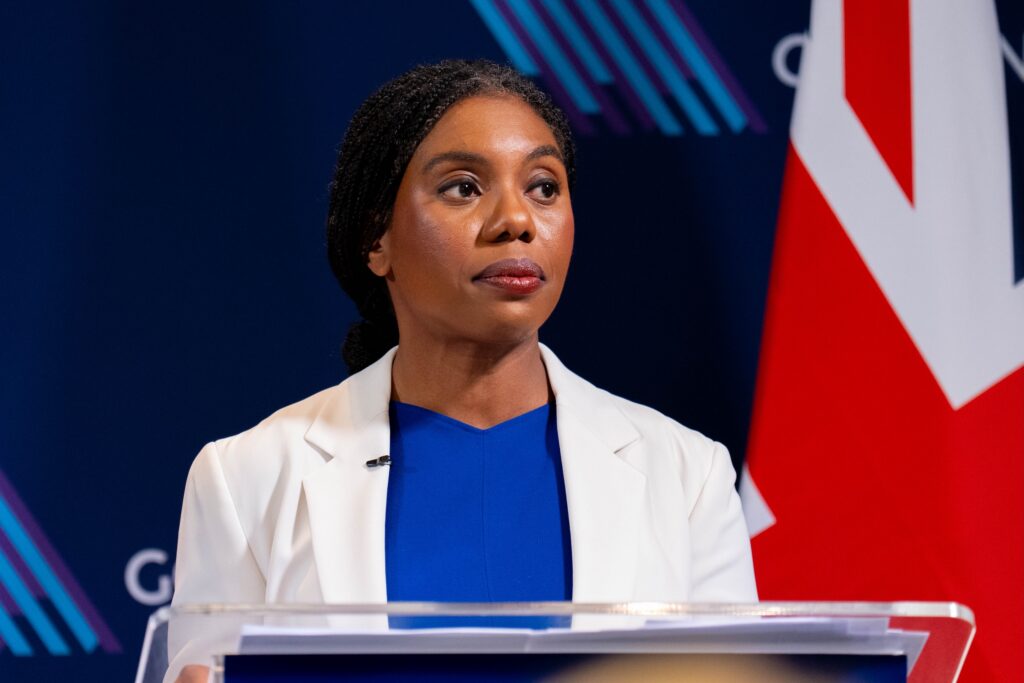
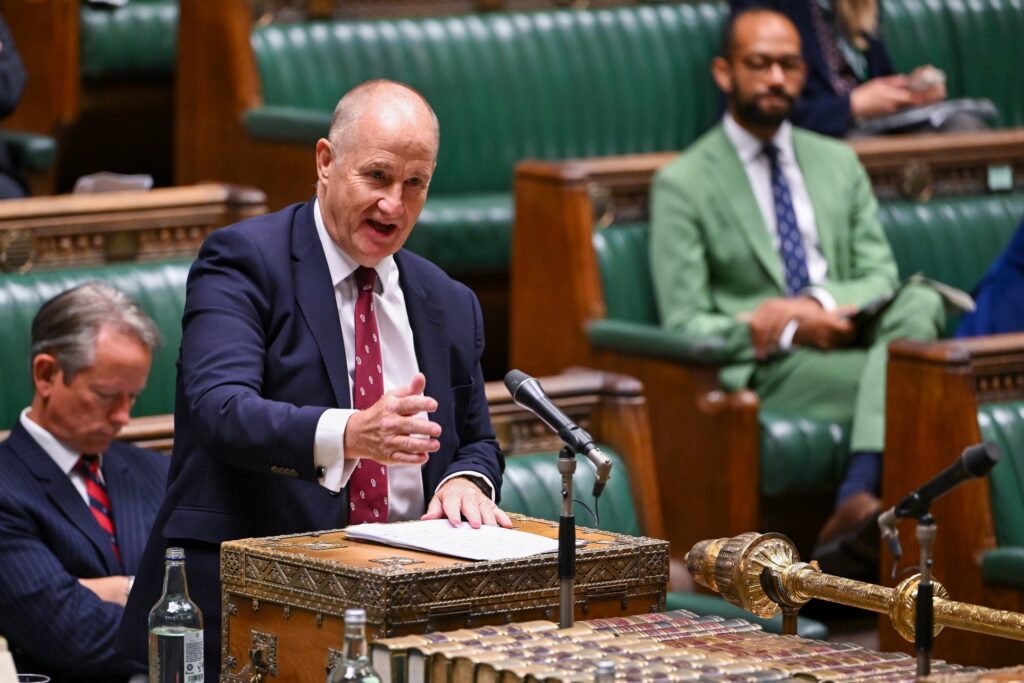
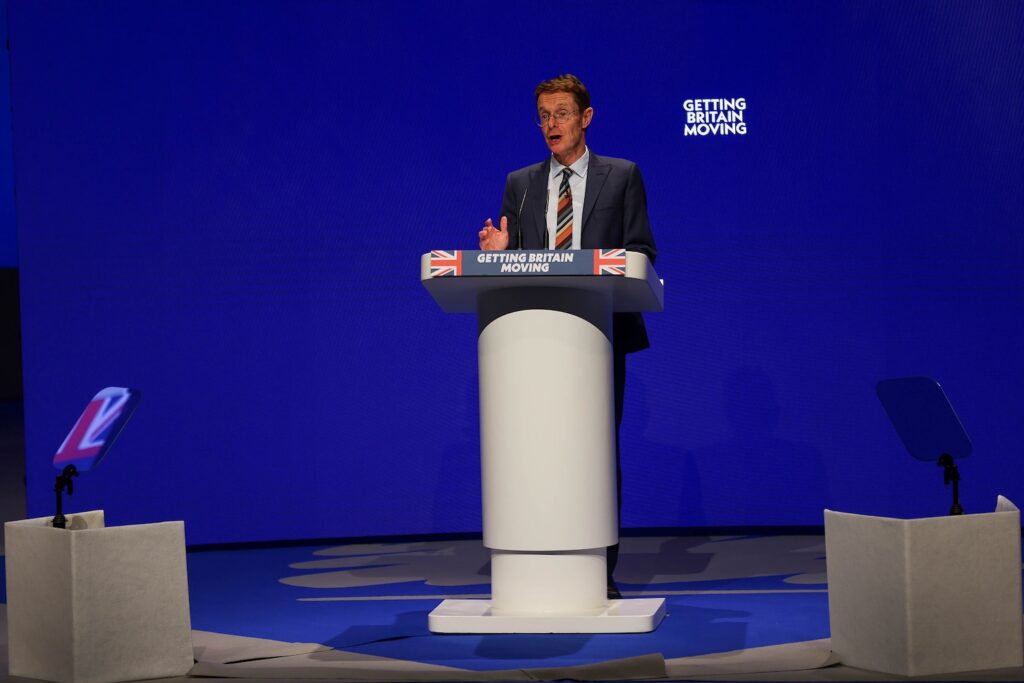
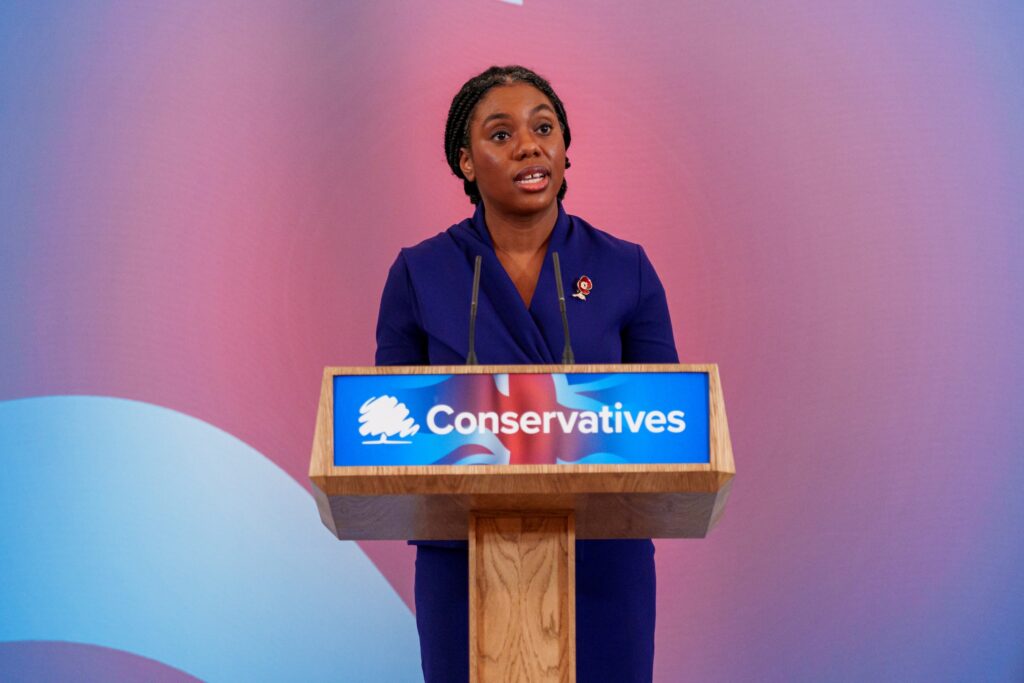
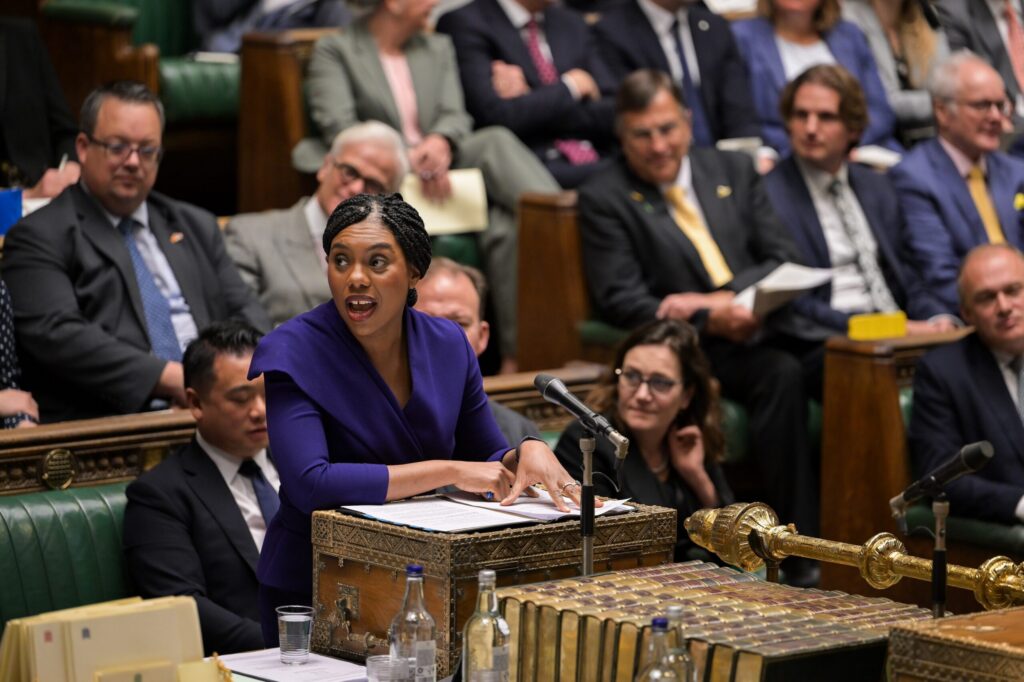
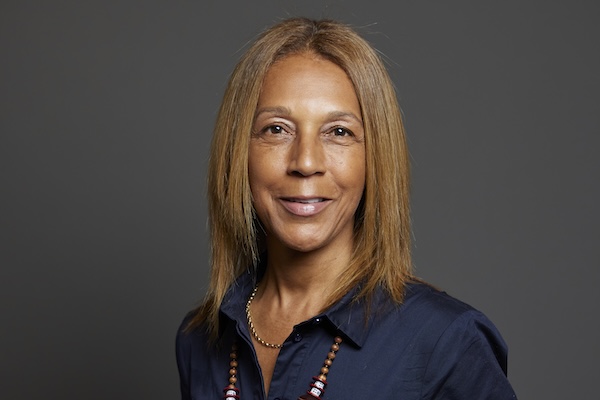

- Research the national outcome of the 2024 general election, assessing the overarching reasons for the Conservative Party’s loss of power.
- Compare the Conservative Party leadership elections of summer 2022 and 2024, evaluating how the differing political contexts of these two contests shaped their respective campaigns and outcomes.
- Investigate the series of scandals that led to the resignation of Boris Johnson in 2022. Consider how the cumulative weight of Partygate and the Chris Pincher scandal ultimately drove the parliamentary Conservative Party to oust its leader.
- Investigate the role of the European Research Group (ERG) during the parliamentary debates over Theresa May’s withdrawal agreement to evaluate the power that organised backbench factions hold over the executive in the UK parliament.
- Research the Conservative Party’s transition from the “magic circle” emergence to the modern dual-stage leadership election (MP ballots followed by a membership vote).
- Investigate the political landscape of the 1997 general election, assessing the key factors that led to the end of 18 years of Conservative rule.
- Research the 1983 general election, assessing the key factors that enabled Margaret Thatcher’s Conservative Party to secure a historic parliamentary landslide.
- Investigate the broader societal and political context that compelled Robert Peel to issue the Tamworth manifesto. What was it about the manifesto that laid the foundations of modern Conservatism?
- Evaluate the view that Labour and the Conservatives continue to command the political landscape.
- ‘Two-party dominance in Britain is a thing of the past.’ Analyse and evaluate this statement.
- ‘The United Kingdom is now a fragmented multi-party democracy trapped within a two-party electoral system.’ Analyse and evaluate this statement.
- ‘The most significant limits on a prime minister’s power come from within their own party.’ Analyse and evaluate this statement.
- Evaluate the view that political participation in the UK has fallen to crisis levels.
- Multi-party politics → The party has faced significant centrifugal pressure from right-wing populist insurgencies. Entities like Ukip and later Reform UK have heavily squeezed the traditional Conservative vote by advocating culturally conservative policies, reduced taxation and lower immigration.
- Referendums in the United Kingdom → David Cameron pledged the 2016 EU referendum to pacify the eurosceptic wing of the party. The resulting Leave vote triggered a period of immense political turmoil and exposed deep ideological fractures within the Conservative ranks.
- Whips → The European Research Group (ERG) operated as a highly organised faction and even a “party within a party”. The ERG’s defiance of the party whip helped bring about Theresa May’s downfall after she failed to pass her Brexit withdrawal agreement.
- British monarchy → Conservatives are the most consistent defenders of the monarchy as an institution. This ideological attachment reflects a broader belief in the continuity of established institutions and a shared national identity.
- Reform UK → The steady stream of high-profile defections from the Conservative Party to Reform UK suggests the party may have permanently lost its monopoly over the British political right. The question of whether the two parties can coexist, compete, or eventually merge is likely to define the future shape of right-wing politics in Britain.