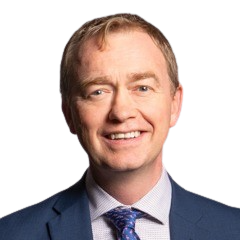
Tim Farron is the Liberal Democrat MP for Westmorland and Lonsdale, having first been elected to parliament in May 2005.
Farron served as leader of the Liberal Democrats from 2015 to 2017. He is currently the party’s spokesperson for environment, food and rural affairs.
In the 2024 general election, Farron won 31,061 votes, representing 62.7% of the vote. The Conservative candidate, Matty Jackman, received 9,589 votes (19.4%), while the Reform UK candidate, James Townley, secured 4,842 votes (9.8%). Farron was duly elected with a majority of 21,472 votes.
The Westmorland and Lonsdale constituency covers the southern part of Cumbria, including areas within the Lake District National Park such as Kendal, Windermere and Ambleside. It is largely rural. The seat was gained by the Liberal Democrats in 2005 and has been held by the party since, becoming their longest continuously held seat in England.
Farron’s immediate predecessor as the MP for Westmorland and Lonsdale was Tim Collins of the Conservative Party, who represented the seat from 1997 to 2005.
Political Career
Farron serves on the Liberal Democrat frontbench as environment, food and rural affairs spokesperson. He was appointed to this role in September 2020.
Farron served as leader of the Liberal Democrats from July 2015 to July 2017, succeeding Nick Clegg, the former deputy prime minister. Farron seized the reins of the party after its disastrous performance at the 2015 general election, when it was reduced from 57 to just eight seats. In that election, Farron was the only Lib Dem MP to secure more than 50% of the vote.
Announcing his candidacy for leader in May 2015, Farron insisted that the Liberal Democrats “can be saved” and “must be saved”. He told BBC Radio 4‘s Today programme that his party should be a “liberal” and “tolerant” force in British politics.
Reflecting on his own party’s fortunes, he added: “We know that we have fallen an awful long way short of where we want to be, but absolutely Britain needs a liberal voice now more than it ever has.
“And I am determined that, fuelled by a sense of desire for justice, belief in the rightness of our cause, I can inspire us to come back to the centre of British politics.”
Farron secured 56.5% of the votes cast – besting his rival candidate, Norman Lamb, the former health minister. In a post to Twitter (now X), Farron said he aimed to turn “millions of liberals throughout the UK into Liberal Democrats”.
Farron, considered on the left of the Liberal Democrats, was seen as representing a more definite and symbolic break with the party’s tenure serving in the 2010-2015 coalition government. Unlike Lamb, he had remained a backbench MP for the duration of the Liberal Democrat-Conservative coalition.
In 2015, Farron said he would have “loved” to have served as a minister, telling the Guardian: “The point is, I didn’t make the cut… I understand Nick’s got to make tough choices, and there’s no point sulking”.
Shortly before the 2015 general election, Farron claimed that his party’s participation in the coalition government could damage its “brand over the next generation”. In an interview with the Financial Times, published March 2015, Farron declared that his party only deserves “two out of 10” for its handling of the politics of coalition government.
These comments were criticised by Liberal Democrat stalwarts Lord (Paddy) Ashdown, a former leader, and Vince Cable, a senior MP and cabinet minister. Lord Ashdown maintained that Farron’s judgement was not his “strong suit”, calling on the MP to temper his “well-known ambitions”. Cable remarked that Farron’s “credibility isn’t great.”
Farron led his party into the 2017 general election, resigning after his party failed to make significant progress. The Lib Dems won 12 seats, up four from its 2010 total. In his resignation speech, Farron stated that he found it difficult to reconcile his Christian faith with the demands of leadership.
Farron, who had been repeatedly questioned throughout the election over his beliefs on issues such as homosexuality, said: “The consequences of the focus on my faith is that I have found myself torn between living as a faithful Christian and serving as a political leader.
“To be a political leader – especially of a progressive, liberal party in 2017 – and to live as a committed Christian, to hold faithfully to the Bible’s teaching, has felt impossible for me.”
He added: “I seem to be the subject of suspicion because of what I believe and who my faith is in. In which case we are kidding ourselves if we think we yet live in a tolerant, liberal society.”
In January 2011, he was elected president of the Liberal Democrats – narrowly defeating Susan Kramer, the party’s former London mayoral candidate, by 53% to 47%. He served in this post until 2015.
In this post, Farron proved a regular critic of the coalition government’s agenda – and Liberal Democrat endorsement of it. Notably, he voted against increasing the cap on undergraduate university tuition fees from £3,000 to £9,000. Referring to Nick Clegg’s infamous pledge not to raise fees, Farron remarked at the time: “Integrity is important… You must not only keep your word but be seen to keep your word. You can say no.”
In November 2013, Farron was also one of just two Lib Dems to back a Labour motion condemning the so-called “bedroom tax”. This vote prompted one senior Lib Dem to declare: “Which bit of the sanctimonious, God-bothering, treacherous little **** is there not to like?”
His criticism of the coalition led Farron to be seen as a possible defector to the Labour Party. He raised eyebrows at the time after reportedly describing himself as an admirer of Ed Miliband.
According to a Telegraph profile, Farron became an enthusiastic user of Twitter (now X) during this period – posting more than 17,000 tweets a year, a rate of one every 20 minutes.
In 2014, Farron played the role of Ukip leader Nigel Farage as Nick Clegg prepared for his televised debate ahead of the European parliament elections. The Lib Dems went on to lose all but one of their seats.
Farron stood the deputy leadership of the Liberal Democrats in 2010, after the incumbent, Vince Cable, announced his decision to stand down to focus on his new role as business secretary in the coalition government.
Farron secured the support of 18 Liberal Democrat MPs (32.1%) – and was therefore defeated by Simon Hughes, who was endorsed by 38 colleagues (67.9%). Both Hughes and Farron were backbenchers at the time, having not been appointed to posts in the coalition government. The rivals were also generally considered as aligned with the party’s centre-left elements. Sir Menzies Campbell, the former Lib Dem leader, endorsed Farron – describing the candidate as “one of the best communicators the party has”.
Hughes, whom Farron describes as a “mentor”, won the backing of prominent MPs Ed Davey, Tom Brake, Jeremy Browne and Vince Cable.
Announcing his candidacy in May 2010, Farron said: “We were right to enter this coalition because it was in the national interest to do so and because at long last it has given us the chance to create a fair, free and green country.
“But it is also vital that the independence, radicalism and distinctiveness of the Liberal Democrats are maintained.”
During his tenure as a member of parliament, Farron has held several Liberal Democrat spokesperson roles – especially since his leadership ended in 2017.
He has occupied the party’s lead environment spokesperson post on three occasions: from September 2020 to present, from October 2017 to February 2019, and from October 2008 to May 2010.
He has twice served as the Liberal Democrat housing, communities and local government spokesperson: from August 2019 to July 2022, and again from February 2019 to August 2019.
He was the party’s food and rural affairs spokesperson from January 2020 to September 2020; North of England spokesperson from August 2019 to September 2020; and work and pensions spokesperson from August 2019 to January 2020.
Prior to the 2010 general election, Farron served as his party’s shadow environment, food and rural affairs minister from December 2007 to October 2008, its shadow children, schools and families spokesperson from May 2005 to March 2006 and shadow home affairs minister from April 2007 to December 2007.
Farron resigned from the Lib Dem frontbench in 2008, alongside David Heath and Alistair Carmichael, to vote for a referendum on the Lisbon Treaty. The Liberal Democrat leadership had had ordered its 63 MPs to abstain. The Conservative call for a referendum was ultimately defeated by 311 votes to 248.
Reflecting on the rebellion at the time, Clegg commented: “Though we have disagreed on this issue I fully understand and respect their strongly held views on the subject… However, as they have recognised, the shadow cabinet cannot operate effectively unless the principle of collective responsibility is maintained.”
Farron served as parliamentary private secretary (PPS) to Sir Menzies Campbell, Liberal Democrat leader from March 2006 to October 2007. A PPS acts as an unpaid parliamentary assistant, providing a link between the senior frontbencher and backbench MPs. Farron later said it was a “great shame” that Campbell had decided to stand down. He continued to serve as PPS to interim leader Vince Cable from October 2007 to December 2007.
Farron served as a member of the House of Commons European scrutiny committee from July 2010 to November 2013, the environmental audit committee from May 2006 to July 2007, and the education and skills committee from July 2005 to May 2006.
Farron is listed as a member of the all-party parliamentary groups (APPGs) for Christians in Parliament, migration, radiotherapy and volunteer rescue services.
Farron delivered his maiden speech on 25 May 2005. In it, he said: “It is 99 years since the last Liberal [MP] made his maiden speech to this House. 99 years ago, my predecessor, Mr. Dudley Stewart-Smith, campaigned for fairer taxation and for greater support for pensioners and against an iniquitous and counterproductive foreign war.
“As we can see, despite being a century apart, we Liberals are nothing if not consistent.”
He added: “I know that my job here is lent to me; it is not mine in perpetuity. I have it only so long as I deserve it in the eyes of the people of Westmorland and Lonsdale.
“The people of my constituency voted for the first time in 99 years for a progressive Liberal Democrat who will fight to protect and strengthen our communities, who will be a powerful advocate for them and who will be Westmorland’s man at Westminster, and not Westminster’s man in Westmorland.
“For the duration of my time here, that is precisely what they will get.”
Before entering parliament, he served on Lancashire County Council from 1993 to 2000, and South Lakeland District Council from 2004 to 2008.
Farron stood for election to the House of Commons on three occasions before winning his Westmorland and Lonsdale seat at the 2005 general election.
He unsuccessfully contested his current constituency at the 2001 general election, finishing second on 19,339 votes (40.4%).
Farron contested the South Ribble and North West Durham constituencies at the 1997 and 1992 general elections respectively.
In South Ribble, he finished third on 5,879 votes (10.6) as the seat changed hands between the Conservative incumbent, Robert Atkins, and Labour candidate David Borrow.
In North West Durham, Farron again finished third with 6,728 votes (14.6%). Labour’s Hilary Armstrong was re-elected – securing a 13,987-vote majority over the Conservative candidate, one Theresa May. Farron and May would later battle at the 2017 general election – as in 1992, neither candidate could be reasonably described as satisfied with the outcome of that contest.
Farron stood unsuccessfully as a Liberal Democrat candidate in the 1999 European parliament elections.
Political views
Farron’s tenure as leader of the Liberal Democrats was dominated by commentary on his faith as Christian and its influence on his politics.
During the 2017 general election, Farron was repeatedly asked whether he considered gay sex to be a sin. He spent weeks dodging the question, before eventually clarifying in a BBC radio interview: “I don’t believe that gay sex is a sin.”
In January 2018, Farron was asked by Premier Christian Radio why he suddenly changed his tune and whether he had felt under pressure to say gay sex was not a sin.
He responded: “Yes. I’m going to write about this more in the coming weeks. But the bottom line is yes, of course I did.
“There are things, including that, that I said that I regret. There was a sense in which I felt, look, I’ve got to get this off my table… I would say foolishly and wrongly I attempted to push it away by giving an answer that frankly was not right.”
Speaking in a televised debate pitting him against 2015 leadership rival Norman Lamb, Farron described abortion as “always a tragedy”.
He later sought to clarify his position, telling the Guardian: “For me to say that abortion is a tragedy does not mean you should make it illegal – but I’d be staggered if anybody thought it was a good thing.”
In a 2007 interview, Farron claimed that “abortion is wrong” and something that he would like to “wish away”.
He told War Cry, the Salvation Army’s official magazine: “Society has to climb down from the position that there is nothing morally objectionable about abortion before a certain time. If abortion is wrong, it is wrong at any time.”
However, Farron argued against the idea of abortion being “abolished tomorrow”, saying that the impact of such a move would be horrendous. “Women would still want abortions and they’d have them illegally. So a complete ban on abortion would not achieve what I want.
“The reality is that abortion is too widely available. There needs to be tighter restrictions. The challenge to Christians is to come up with realistic alternative strategies.”
Asked about the interview in 2017, during his leadership of the Lib Dems, Farron said he strongly believed that “when procedures take place, it should be safe and it should be legal”. He expressed his support for the law as it stands.
Pressed on his personal view, he said: “I am pro-choice. I believe that abortion should be safe and legal and that the limit should be set by science.”
Factional identity and party tradition
At the time of his election as party president in late 2011, Farron was a member of the centre-left Beveridge Group – a faction with the Liberal Democrats. Established in 2001, the group sought to respond to a perceived rightward shift in the party’s positioning. It was named after the economist, pioneering social reformer and Liberal politician, William Beveridge, whose work helped shape the formation and development of the welfare state.
The Beveridge Group was seen as an ideological and political counterweight to the rise of Orange Book liberalism, typified by thinking of Nick Clegg, a market liberal, as leader. During the Conservative-Lib Dem coalition government, the Orange Booker or market liberal wing of the party was considered to be in the ascendancy – signified by the prominence of sympathetic figures around the cabinet table. Clegg, Davey, Cable and David Laws all penned chapters in the Orange Book, published September 2004, which called for party policy that emphasised greater personal choice and market solutions.
In 2007, Farron contributed an essay to Reinventing the State: Social Liberalism for the 21st Century – which was interpreted as an attempt to take on the Lib Dems’ Orange Book faction. Richard Grayson, one of the book’s editors and ex-Lib Dem director of policy, said the publication sought to “influence the [2010 election] manifesto, so it will put issues such as social justice and the environment at its heart and will be an avowedly centre-left manifesto.”
Grayson added: “I think the approach of this book is to value the state more than the market in a way in which some of the Orange Book authors might not be comfortable with.”
In 2014, delivering the annual Beveridge Memorial Lecture, Farron set out a vision of liberalism focused on the issues of housing and poverty in modern Britain – rejecting implicit calls for a “centre-right, laissez-faire liberal party.”
He said: “I fully count myself as a Beveridge liberal. Mostly because he believed in ambitious government that could improve the lives of its citizens…
“We should be for active, ambitious, liberal government. We’re not for turning the clock back to pre-Thatcher. We’re for saying that Thatcherism’s day has been and gone. It failed, just as the state socialism that preceded it failed.
“The consensus broke down for good reason, let’s never forget that.”
He added: “Never mind economic liberalism versus social liberalism – its time to stake out the case for comprehensive liberalism based on a true understanding of what creates and what prevents freedom…
“There is no political market for a centre-right, laissez-faire liberal party amongst the British electorate, or for a party that sets itself up as the permanent see-saw coalition partner. To aim to be either would be to neuter our movement and invite electoral annihilation”.
He continued: “We are Beveridge liberals, not because we think that the clock must be turned back to pre-1979, but because we share the values of the architects of that earlier consensus. Not just Beveridge, but Keynes too.
“Neither of those two were dogmatists, they were not concerned about what the apparatus of the state must look like – big or small – instead they were interested in the end results, the wellbeing of all citizens.”
During the 2015 Liberal Democrat leadership contest, Tim Farron published a manifesto setting out his political credo, titled My Values – My Liberalism. The account set out Farron’s vision for liberalism based on five core values: freedom, democracy, fairness, environmentalism, and quality of life.
Farron defined liberalism as “about championing the individual against the powerful, that means standing firm for our Human Rights Act, against internet surveillance and illiberal extremism orders. But it’s also about protecting individuals from those giant evils that rob people of their freedom: poverty, poor housing, inequality.”
Farron is a member of the Green Liberal Democrats, an official environmental group within the Liberal Democrats. It aims to “promote a green approach to policy formation within the Liberal Democrats” and “develop links with the wider green movement.” The grouping, formed in 1977 as a faction within the Liberal Party, is “committed to a net-zero and nature positive future and driving ambition across the national party and in local governance.”
Farron was endorsed by local groups of the cross-party organisation Compass during the 2024 general election. Compass is a thinktank and campaign group. As part of its “Win as One” campaign in the 2024 election, local Compass groups backed a slate of progressive candidates who had pledged their support for electoral reform. The central aim of the initiative was to elect a “caucus” of MPs who would champion the cause of replacing the first past the post (FPTP) electoral system.
Leadership elections and loyalty
During the 2010-2015 parliament, which saw the Liberal Democrats join the Conservatives in government, Farron established himself as something of a firebrand critic of his party’s leadership. He was among the 21 Liberal Democrat rebels who voted against the tuition fee rise.
In June 2010, Farron said that the Conservatives and Liberal Democrats were “ideologically a poor fit” as coalition partners.
Speaking after the coalition’s first budget, he told the BBC: “I’m sure he [Clegg] and [prime minister] David Cameron get on perfectly well as individuals.
“But Nick Clegg is a social liberal, a liberal democrat in the truest tradition, and whilst I’m sure he respects David Cameron’s ideas, in the sense that they are working together, there is a very clear difference between the two of them. There will be lots of things that jar with them ideologically.
“It’s very very odd to be sitting amongst a group of people I spent 20-odd years fighting against.”
In July 2010, Farron said many Conservative MPs were “toxic” and claimed that David Cameron, the then prime minister, was using his coalition partners as “cover” for unpopular decisions.
“The reality is that David Cameron has a toxic brand… His brand, including most of his MPs, are toxic”, he told the BBC.
“It is not my job to detoxify it… I think we have to be aware he has envisaged that he gets something out of all this. Part of it is that the Conservative Party, at the end of it, is less ugly than when it went into it. The problem is that most Tory MPs are determined to keep it ugly.”
In November 2011, Farron told the Guardian he had more in common with “your average Labour party member than your average Tory party member.”
In December 2011, Farron – the newly elected president of the Lib Dems – told the Independent he needed “daily counselling” to cope with the strains of working alongside the Conservatives in coalition.
Ahead of the 2015 general election, Farron urged his party to “actively consider” a proposal short of a full coalition in the event of another hung parliament.
Farron supported Simon Hughes’ candidacy in the 2006 Liberal Democrat leadership election.
Farron had called on Charles Kennedy, the party’s leader from 1999 to 2006, to stand down from his post. According to a Guardian report, Farron was among a group of 25 Lib Dem MPs who signed a letter indicating he was not prepared to serve under Kennedy’s leadership.
Calls for Kennedy to resign came after he admitted that he was battling against alcoholism. He stood down from his post on 7 January 2006, shortly after the aforementioned letter was publicised.
Farron supported Clegg’s successful candidacy in the 2007 Lib Dem leadership election. At the time, Farron called Clegg a “very good communicator who relates to voters” and backed him to “broaden [the party’s] appeal and win support in the north.”
Brexit and Europe
Brexit referendum: Tim Farron supported the Remain campaign in the 2016 referendum on Britain’s membership of the European Union (EU), and therefore agreed with a majority of constituents, 52.9% of whom also voted to Remain.
Article 50: In February 2017, Farron voted against the European Union (Notification of Withdrawal) Bill. The legislation empowered the prime minister to notify the Council of the European Union of the UK’s intention to withdraw, formally triggering the process set out in Article 50 of the Treaty on European Union. MPs supported the bill by 498 votes to 114 at second reading. In voting against the bill, … defied the party whip – one of 47 Labour MPs to do so.
In April 2017, Farron described himself as a “bit of a Eurosceptic” – citing his 2008 resignation from the Lib Dem frontbench because he wanted a referendum on the Lisbon Treaty.
During the 2019 general election, he stood on a manifesto that pledged to revoke Article 50 and cancel Brexit. In February 2017, he voted against the triggering of Article 50.
Customs union vote (2025): In December 2025, Farron voted in favour of the UK-EU Customs Union (Duty to Negotiate) Bill. The bill, introduced under the 10-minute rule procedure by Liberal Democrat Europe spokesperson Al Pinkerton, sought to mandate the government to enter into negotiations with the European Union to establish a bespoke customs union. In total, 13 Labour MPs joined the Liberal Democrats in supporting the motion, while the majority of the party abstained.
Electoral reform
Proportional representation bill: In December 2024, Farron voted in favour of the Elections (Proportional Representation) Bill – introduced by Liberal Democrat frontbencher Sarah Olney under the 10-minute rule procedure. The bill sought to “introduce a system of proportional representation for parliamentary elections and for local government elections in England”.
A total of 138 MPs supported the bill – with 136 opposed. Notably, 59 Labour MPs backed Olney’s bill.
Introducing the bill, Olney told the House: “First past the post is a broken and unfair system. This summer, the Labour party won a landslide election victory, securing 63% of seats in the House of Commons in return for just 34% of the vote.
“The system leaves millions of voices unheard and creates a divisive, adversarial political climate where collaboration is discouraged and accountability is often sidestepped.”
Assisted dying
Farron voted against the Terminally Ill Adults (End of Life) Bill, better known as the assisted dying bill, at both second reading (November 2024) and third reading (January 2025).
Speaking during the bill’s second reading debate, Farron said his opposition to the bill was “grounded in compassion”.
He told the House: “To legalise assisted dying would be to create the space for coercion that would undoubtedly see people die who would not otherwise have chosen to do so. There are no safeguards in the bill that would prevent that.”
He added: “I am opposed to the bill because I am a liberal. Libertarians believe that personal liberty is so important that there can be no fetters on it. But I am liberal, not a libertarian.
“I believe that freedom is essential and that the rights of the individual underpin a decent society, but my rights must be held in check if they nullify your rights.”
Social values and conscience issues
In 2007, Farron voted against most of his party in favour of the termination of pregnancy bill, which would have required compulsory counselling and a “cooling-off period” before any abortion.
Abortion decriminalisation (2025): Farron voted against a backbench amendment to the Crime and Policing Bill that sought to decriminalise abortion in England and Wales in June 2025. The amendment, which was passed by a majority of 242 votes, removed women from the threat of prosecution for ending a pregnancy at any stage. As an issue of conscience, MPs were allowed to vote according to their personal beliefs.
Same-sex marriage (2013): In February 2013, Farron voted in favour of the Marriage (Same Sex Couples) Bill at its second reading. The landmark piece of legislation, which received its second reading by 400 votes to 175, legalised marriage for same-sex couples in England and Wales.
Farron was among nine Lib Dem MPs to abstain at a third reading of the Marriage (Same Sex Couples) Bill, which was passed with 366 votes to 161 in May 2013. His abstention came despite him previously voting in favour of the bill during the previous stages.
Farron later stated that he regretted abstaining because it had given people the wrong idea about his views. In 2015, he told the Observer that he had concerns about aspects of the bill relating to “protecting people’s right to conscience”.
Farron maintains he is a supporter of same-sex marriage. In 2014, he voted in favour of the Overseas Marriage (Armed Forces) Order 2014. The order permitted same-sex marriages to be conducted at all British Army bases.
Foreign policy and security
Ceasefire vote (November 2023): Farron voted for a Scottish National Party (SNP) amendment to the king’s speech in the House of Commons calling for an “immediate ceasefire” in the Israel-Hamas war. Labour had tabled a rival motion, making a more moderate appeal for a “humanitarian pause” in the conflict.
Trident renewal (2016): Farron voted against a government motion calling for the renewal of the Trident nuclear deterrent system in July 2016. The motion, which was passed by 472 votes to 117, committed the UK to constructing a new fleet of submarines to carry the nation’s nuclear weapons. Labour was split over the issue with 140 of its 230 MPs going against leader Jeremy Corbyn and backing the motion.
Syria airstrikes (2015): Farron voted in favour of a government motion to extend UK airstrikes against Isis from Iraq into Syria in December 2015. The motion, which was passed by 397 votes to 223 after a 10-hour debate in the House of Commons, authorised the RAF to conduct strikes against Isis targets in Syria.
IPAC: Farron is a member of the Inter-Parliamentary Alliance on China (IPAC) – an international, cross-party network of legislators from democratic countries focused on relations with the People’s Republic of China. The alliance, established on 4 June 2020, the anniversary of the 1989 Tiananmen Square protests and massacre, was formed to unite “lawmakers worldwide, promoting democracy and addressing threats to the rules-based and human rights systems posed by the rise of China.”
Civil liberties
Covid passes campaign (2021): Farron was one of over 70 MPs and peers who launched a cross-party campaign against the “divisive and discriminatory use” of Covid passes in April 2021. The campaign was triggered by government reviews into “vaccine passports”, which signatories argued would create a two-tier society and infringe upon fundamental civil liberties.
Covid passes vote (2021): Farron was one of 126 MPs to vote against Covid passes in England in December 2021. The measure, introduced by Boris Johnson’s government, was carried by 369 votes to 126.
Farron was the first leader of one of Britain’s main political parties to call for the legalisation of cannabis for recreational use.
In February 2016, Farron said: “The Liberal Democrats will be releasing a report in due course that lays out the case for a legalised market for sales of cannabis. I personally believe the war on drugs is over. We must move from making this a legal issue to one of health.
“The prime minister [Cameron] used to agree with me on the need for drug reform. It’s time he rediscovered his backbone and made the case again.”
Before Politics
Born Timothy James Farron on 27 May 1970 in Preston, Lancashire, he attended Lostock Hall High School and Runshaw College, Leyland before studying Politics (BA) at Newcastle University, graduating in 1992.
He joined the Liberal Democrat party at 16.
He was active in student politics, and was elected to the National Union of Students’ National Executive in 1990. He was then elected as president of Newcastle University Students’ Union (1991-1992) and as a member of the National Union of Students (NUS) – the first Liberal Democrat to hold this position.
Before becoming an MP, Farron worked for ten years in higher education administration and lecturing, including positions at Lancaster University (1992-2002) and St Martin’s College, Ambleside (2002-2005).
Personal Life
Farron married Rosemary Cantley in 1999. They live in Milnthorpe, Cumbria, within his constituency, and have four children (two sons, two daughters).
He is a vegetarian, a keen fell runner, and a supporter of Blackburn Rovers Football Club. He completed the 2021 London Marathon in a time of 4 h 44 min 44 s.
Tim Farron first became aware of Christianity aged 18, when he stumbled across a book while on a trip to Singapore with his mother. The book was the Bible. He was baptised three years later.
According to Telegraph profile, Farron rejects the label “evangelical Christian”.
“I just count myself as a Christian, and my faith is in Jesus Christ, I put my trust in Him. I count Him as my Lord and saviour, and I’m in no way ashamed of that”, Farron told the newspaper.
During the 2015 Lib Dem leadership campaign, Farron told the Guardian he sought advice from God before deciding whether to put his name forward. “Obviously you ask for His guidance”, Farron commented.
Norman Lamb suspended two members of his campaign team after they were found to have run a survey asking party members about what Lamb’s aides considered to be Farron’s illiberal views on abortion and LGBT rights.
In the 2007 interview with War Cry, Farron commented: “Another perspective that my faith gives me is that we live in a fallen world. That doesn’t mean Christians give up. On the contrary it means we do our best to bring about the best circumstances for as many people as possible.”
In 2019, he published his autobiography, titled A Better Ambition: Confessions of a Faithful Liberal.
Trivia
Farron won the BBC television quiz show Celebrity Mastermind in 2018 – his specialist subject was Blackburn Rovers FC.
He fronted the Preston-based band called The Voyeurs between 1987 and 1992. The group was described as a “fourth rate New Order”.
As a teenager, he had pictures on his wall of former US president John F. Kennedy, former Liberal Party leader Jo Grimond and then-prime minister Margaret Thatcher.
Farron says he first became politically conscious as a 14-year-old after watching the seminal campaigning television play Cathy Come Home. He joined the homeless charity Shelter soon afterwards, and then Greenpeace.
In a 2015 interview, Farron said he “literally shed tears” over mentor Simon Hughes losing his seat in the general election of the same year.
Farron told BuzzFeed that Labour’s Neil Coyle, Hughes’ successor as the MP for Bermondsey and Old Southwark, would “not be worth a twentieth of what Simon is worth” to his constituents.
“This was a man [Hughes] who did unalloyed good. And he was swept out. And it makes you a little bit angry.”



Tim Farron: ‘My opposition to assisted dying is rooted in liberalism and Christianity’
19 September 2025