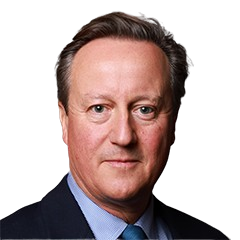
David Cameron served as prime minister of the United Kingdom of Great Britain and Northern Ireland from May 2010 to July 2016.
Cameron initially led Britain’s first coalition government since 1945, in partnership with the Liberal Democrats (2010-2015). Following the 2015 general election, he led a majority Conservative government.
Cameron was elevated to the peerage as Baron Cameron of Chipping Norton in November 2023, coinciding with his appointment as foreign secretary. He served in this position under Rishi Sunak as prime minister from 2023 to the 2024 general election.
Cameron was previously the Conservative MP for the Witney constituency in Oxfordshire. He was first elected at the 2001 general election. Cameron stood down as the MP for Witney in September 2016. The subsequent by-election in October 2016 was won by the Conservative candidate, Robert Courts, with 17,313 votes (45.0%).
David Cameron: premiership (2010-2016)
The 2010 general election resulted in the country’s first hung parliament since February 1974, ending 13 years of Labour government and leading to the formation of a Conservative-Liberal Democrat coalition under Cameron as prime minister.
Cameron and Clegg, who emerged as deputy prime minister, presented their new coalition government to the nation on 12 May 2010 at a joint press conference in the Downing Street rose garden. This inaugural coalition press conference coincided with the publication of a seven-page document outlining the initial “Conservative–Liberal Democrat coalition agreement”. Key concessions to the Liberal Democrats included a referendum on changing the electoral system to the alternative vote (AV) and a commitment to legislate for five-year fixed-term parliaments.
The defining economic programme of the Cameron-Clegg coalition was “austerity”, aimed at eliminating the structural deficit following the 2008 financial crisis. In the October 2010 spending review, George Osborne, the chancellor, announced £81 billion in departmental budget cuts.
In October 2011, addressing Conservative Party conference as prime minister, Cameron stated that he was in favour of redefining marriage because of, not in spite of, being a Conservative. “Conservatives believe in the ties that bind us; that society is stronger when we make vows to each other and support each other”, he stated.
“So I don’t support gay marriage despite being a Conservative. I support gay marriage because I’m a Conservative.”
In February 2013, the House of Commons voted in favour of legalising same-sex marriage in England and Wales by 400 votes to 175 – a majority of 225.
One month previously, in January 2013, Cameron pledged to hold an in-out referendum on Britain’s membership of the EU if the Conservatives won the 2015 election – a move designed, at least in part, to neutralise the growing electoral threat from the UK Independence Party (Ukip) and placate the eurosceptic wing of his own party.
This pledge would prove momentous. But first Cameron experienced a further referendum success in Scotland; the “No” campaign also prevailed in the 2011 referendum on the alternative vote (held in May 2011).
On 18 September 2014, the people of Scotland voted to remain part of the United Kingdom in a historic referendum on independence. The 2012 Edinburgh Agreement, signed by Cameron and Scottish first minister Alex Salmond, had set out the legal framework (a Section 30 order) for the Scottish parliament to hold a single-question referendum. The No campaign ultimately won with 2,001,926 votes (55.3%) against 1,617,989 votes (44.7%) for the Yes campaign.
In late September 2014, Cameron said the Queen “purred down the line” when he informed her of the referendum result. The prime minister was overheard delivering the remark while in conversation with former New York mayor Michael Bloomberg.
Cameron led the Conservative Party to victory at the 2015 general election. The result – a majority Conservative government – defied pre-election polls, which had largely predicted another hung parliament, and marked the first time the Conservatives had won an outright majority since 1992. The party won 330 seats, up 24, on a 36.9% vote share.
The highly disciplined Conservative campaign, under the guidance of Australian political strategist Lynton Crosby, was framed around the party’s perceived economic credibility and commitment to a “long term economic plan”. During the campaign, Cameron regularly brandished a note left by the former chief secretary to the Treasury, Liam Byrne, to his Liberal Democrat successor, David Laws. The notorious note stated: “Dear chief secretary, I’m afraid there is no money. Kind regards – and good luck! Liam.”
The campaign was also shaped heavily by opinion polling and by speculation that the result might produce a second hung parliament. A steady stream of polls from all the major companies appeared to show the Conservative and Labour parties as effectively neck-and-neck. Cameron’s party foregrounded a memorable poster depicting Miliband peeking out of the top pocket of the former Scottish first minister, Alex Salmond. It came just days after new polling, conducted by Conservative peer Lord Ashcroft, showed that the SNP were on track to take all but three of the 59 Westminster seats in Scotland.
Cameron unveiled the famous pocket-themed poster in a post to Twitter (now X). “Alex Salmond with Ed Miliband in his pocket”, Cameron commented. “The frightening prospect we must avoid.”
After winning a majority at the 2015 general election, and following a limited renegotiation of the UK’s membership terms, Cameron set the date for the vote according to the European Union Referendum Act 2015. At this point, the prime minister had already triumphed in two referendums on Scottish independence (2014) and electoral reform (2011).
On 5 January 2016, Cameron confirmed that government ministers would be free to campaign for either side of the referendum. The prime minister’s statement, delivered to the commons, was widely seen as the unofficial starting gun for the referendum campaign. Cameron officially declared the government’s formal pro-Remain position on 20 February. “The choice is in your hands”, he stated. “But my recommendation is clear. I believe that Britain will be safer, stronger and better off by remaining in a reformed European Union.”
The February proclamation came as six cabinet ministers broke ranks with Cameron to join the official pro-Brexit campaign. The “gang of six” included Michael Gove, the justice secretary; Chris Grayling, the commons leader; Iain Duncan Smith, the work and pensions secretary; John Whittingdale, the culture secretary; Theresa Villiers, the Northern Ireland secretary; and Priti Patel, the minister of state for employment (who attended cabinet). Gove, a close political ally of Cameron, released a 1,500-word essay outlining what he called “the most difficult decision of my political life.”
Boris Johnson announced that he would campaign for Britain to leave the EU on 21 February. Johnson, coming to the end of his second term as mayor of London, soon assumed the position as de facto leader of the Leave campaign.
The campaign officially began on 15 April. The pro-Remain Britain Stronger in Europe campaign, supported by Cameron and the government, focused on the economic risks of leaving, warning of damage to trade, jobs, and household incomes. The Vote Leave campaign, fronted by Johnson and Gove, organised its strategy around the slogan “Take Back Control” – arguing that leaving the EU was a chance to restore parliamentary sovereignty and curb immigration. This strategy, masterminded by Dominic Cummings as Vote Leave director, capitalised on the loss aversion of the electorate.
On 23 June 2016, the United Kingdom voted to leave the European Union by 51.9% to 48.1% in a nationwide referendum. The result, on a turnout of 72.2%, overturned the 1975 decision to remain in the bloc and triggered a period of immense political turmoil.
In the immediate aftermath of the result, Cameron announced his intention to resign as prime minister.
In his final speech outside 10 Downing Street, Cameron stated: “The British people have made a very clear decision to take a different path and as such I think the country requires fresh leadership to take it in this direction.”
David Cameron’s post-premiership career (2016-2023)
Cameron stood down as the MP in September 2016, shortly after resigning as prime minister. In the years immediately following his departure from Downing Street (2016-2023), he largely maintained a low public profile regarding domestic politics, particularly during the ensuing Brexit negotiations.
During this period, he took on the role of president of Alzheimer’s Research UK.
Cameron published his memoirs, For the Record, in December 2019.
Cameron’s business activities drew significant controversy in March 2021 with revelations about his intensive lobbying efforts on behalf of the financial firm Greensill Capital. Cameron’s work for Greensill included messaging the then chancellor, Rishi Sunak, and other senior government figures. He was reported to have texted Sunak’s private phone asking him to give Greensill special access to hundreds of thousands of pounds of emergency Covid loans during the height of the coronavirus crisis.
As a result, Cameron found himself under investigation by the Registrar of Consultant Lobbyists, a body created under the Lobbying, Non-Party Campaigning and Trade Union Administration Act 2014. This landmark lobbying legislation was passed during Cameron’s tenure as prime minister.
The watchdog ultimately concluded that Cameron’s activities did “not fall within the criteria that require registration on the Register of Consultant Lobbyists”.
The House of Commons Treasury select committee concluded that while Cameron’s actions did not break the rules, they showed a “significant lack of judgement”.
The committee reported: “Mr Cameron’s use of less formal means to lobby government showed a significant lack of judgement, especially given that his ability to use an informal approach was aided by his previous position of prime minister…
“We accept that Mr Cameron did not break the rules governing lobbying by former ministers, but that reflects on the insufficient strength of the rules, and there is a strong case for strengthening them.”
David Cameron: foreign secretary (2023-2024)
On 13 November 2023, Cameron was appointed foreign secretary by the prime minister, Rishi Sunak. This made Cameron the first former prime minister to return to the cabinet since Alec Douglas-Home, who served as prime minister from 1963 to 1964 and foreign secretary from 1970 to 1974.
In total, Cameron was the fifth ex-PM to be reappointed to the cabinet since 1900. Cameron also became the first foreign secretary to serve from the House of Lords since Lord Carrington, who held the post from 1979 to 1982.
Lord Cameron’s appointment was the centrepiece of the ministerial rejig, Sunak’s second and final reshuffle as prime minister. It sparked questions over accountability and parliamentary scrutiny. As a peer, he would not appear in the House of Commons to face questioning from MPs, as his predecessor, James Cleverly, had done. The speaker of the commons, Lindsay Hoyle, expressed some concern in this regard, highlighting the “gravity of the current international situation”.
Sunak subsequently styled Andrew Mitchell, the development minister, as deputy foreign secretary. Mitchell therefore served as the Foreign Office’s most senior presence in the commons.
Cameron’s return was also noted for creating points of policy tension, given his public opposition to some of Sunak’s decisions – including previous cuts to the foreign aid budget (as chancellor) and the cancellation of the Northern leg of the HS2 rail line.
Cameron vowed to adhere to the principle of collective responsibility.
In a statement, Cameron said that while he had “disagreed with some individual decisions, it is clear to me that Rishi Sunak is a strong and capable prime minister, who is showing exemplary leadership at a difficult time.”
Addressing the House of Lords for the first time following his appointment as foreign secretary in November 2023, Cameron acknowledged the surprise nature of his return, quipping: “I have not been sitting like some latter day de Gaulle … waiting to be asked, how should I put it, to ‘take back control’. Nor am I Cincinnatus, hovering over my plough”.
In comments widely interpreted as referring to fellow former Conservative prime minister Boris Johnson, Lord Cameron added: “I leave all classical allusions, and indeed illusions for that matter, to another former prime minister with whom I shared a number of educational experiences”.
Cameron’s tenure as foreign secretary was centred on diplomatic efforts concerning the Israel-Gaza conflict.
Cameron left the role on 5 July 2024 after the general election and did not go on to serve as shadow foreign secretary on Sunak’s caretaker/interim shadow frontbench.
What is David Cameron doing now?
Lord Cameron retains his seat in the House of Lords. He maintains a public profile through occasional speeches and media appearances.
David Cameron’s early political career (2001-2005)
Cameron unsuccessfully contested the constituency of Stafford at the 1997 general election.
Cameron was first elected to parliament as the MP for Witney in 2001. He served on the home affairs select committee until 2003.
In 2003, Cameron was appointed to the Conservative frontbench as a spokesperson shadowing the Privy Council Office. He was appointed shadow minister for communities and local government in 2004.
Cameron served as the Conservative Party’s head of policy coordination in the run-up to the 2005 general election. In the wake of the 2005 campaign, which resulted in a third consecutive majority Labour government, Cameron was appointed as shadow education secretary.
Cameron announced his candidacy for the 2005 Conservative leadership election. He was initially seen as an outsider.
Cameron campaigned on a programme of “modernisation”, a long-standing source of contention in the Conservative Party, which his fellow candidates, including Kenneth Clarke and Liam Fox, had not embraced. (The contest marked Clarke’s third attempt to secure the Conservative leadership, following his 1997 and 2001 campaigns).
Cameron’s main opponent and frontrunner was David Davis. During the campaign, Davis implicitly warned “so-called” modernisers not to “chase an ebbing political tide” by aping New Labour.
Cameron’s “moderniser” allies included George Osborne, his campaign manager and the MP for Tatton; Oliver Letwin, the former shadow home secretary and shadow chancellor; Boris Johnson, the MP for Henley, sometimes Have I Got News For You host and Spectator editor; Ed Vaizey, the Wantage MP and Guardian columnist; and Michael Gove, the Surrey Heath MP and Times journalist.
The Conservative Party’s annual conference in Blackpool on 4 October is remembered as a breakthrough moment for Cameron. In his 20-minute speech at the party’s Blackpool conference, Cameron eschewed the standard politician’s lectern, roaming the stage sans notes. There was an audacity to the 38-year-old’s central pitch.
“Some say that we should move to the right”, he told delegates. “I say that will turn us into a fringe party, never able to challenge for government again.”
Cameron concluded: “I want you to come with me. We’ll be tested, and challenged, but we’ll never give up. We’ll never turn back. So let the message go out from this conference, a modern compassionate Conservatism is right for our times, right for our party – and right for our country.
“If we go for it, if we seize it, if we fight for it with every ounce of passion, vigour and energy from now until the next election, nothing and no one can stop us.”
Opinion polls of party members conducted in the days following the speech showed a significant surge in support for Cameron, catapulting him into a commanding lead over Davis. Cameron’s principal rival had delivered a speech earlier in the week that was judged steady but uninspiring. None of the other contenders – Ken Clarke, Malcolm Rifkind or Liam Fox – seized the moment.
The “beauty contest” format, with each candidate given 20 minutes to convince the Conservative faithful, played directly into Cameron’s strengths as a communicator and political operator. Indeed, Rifkind, who subsequently dropped out of the race, had delivered a similar ‘no notes’ speech days before Cameron – but without anything like the same impact.
The conference also saw the emergence of some issues for Cameron. He reportedly told a dinner for newspaper executives that he was the “heir to Blair” – a declaration treated with disdain by Davis. He also inspired something of a media storm with his refusal to answer questions about past drug use. The News of The World seized on the story with a front page splash headlined: “Top Tory, Coke and The Hooker”. The splash was based on a 12-year-old photograph of George Osborne with a woman known variously as “Mistress Pain” and “Miss Whiplash”, reported to be the girlfriend of one of his friends.
Cameron was ultimately forced to admit that he had not snorted cocaine since becoming an MP.
The saga did not prove to be a knock-out blow. In the first ballot of Conservative MPs on 18 October, Cameron outperformed expectations with 56 votes. Davis had established only a narrow lead with 62 votes. Clarke was eliminated after securing just 38 votes. In the second ballot, Cameron placed first with 90 votes. Davis’ support declined to 57, and Liam Fox (51) was eliminated. Davis and Cameron also clashed in a series of televised debates. During a special edition of the BBC’s Question Time programme, Davis stressed his experience and said voters were tired of the “era of spin”.
Davis and Cameron also clashed in a series of televised debates. During a special edition of the BBC’s Question Time programme, Davis stressed his experience and said voters were tired of the “era of spin”.
Cameron prevailed in the final ballot of Conservative members with 134,446 votes on a 78% turnout. Davis secured 64,398 votes.
In his victory speech at the Royal Academy of Arts, Cameron promised to move away from the “Punch and Judy politics of Westminster, the name calling, backbiting, point scoring, finger pointing.”
He declared: “People in this country are crying out for a Conservative Party that is decent, reasonable, sensible, common sense and in it for the long term of this country and that is the party we are going to build.”
David Cameron: leader of the opposition (2005-2010)
Davis was retained as shadow home secretary on Cameron’s frontbench. He resigned this role in July 2008 to fight a self-imposed by-election as a protest against the “slow strangulation of fundamental British freedoms”.
During a radio phone-in interview on LBC on 4 April 2006, Cameron referred to the UK Independence Party (Ukip) as consisting of “fruitcakes”, “loonies” and “closet racists”. Nigel Farage, one of Ukip’s 12 MEPs, demanded an apology. “Let him tell us anything that we have said that could be construed as remotely racist, otherwise we demand an apology”, he said.
Cameron and his closest ally, shadow chancellor George Osborne, helped bounce Brown out of calling an election in 2007 by pledging to raise the inheritance tax threshold to £1 million.
In a February 2010 speech, entitled “Rebuilding trust in politics”, Cameron famously identified lobbying as poised to become the next major public scandal. The address was styled as a response to the 2009 expenses scandal. Cameron contended that politics should be the preserve of the “people, not big business or big unions”. He pledged that a future Conservative government would introduce a statutory register of lobbyists to force disclosure of who was lobbying whom. Cameron’s moderniser moralising was widely recalled more than a decade later during the controversy surrounding his own lobbying activities for Greensill Capital.
Gordon Brown called the 2010 general election on 6 April, declaring that “Britain is on the road to recovery” after the global financial crisis. The campaign was notable for featuring the first-ever televised debates between the main party leaders. Nick Clegg’s revelatory performance as leader of the Liberal Democrats inspired a political phenomenon dubbed “Cleggmania” which, temporarily at least, upended the established two-party dynamic. For much of the event, Brown and Cameron focused their attacks on each other, creating space for Clegg to exploit.
The hung parliament produced by the 2010 general election triggered five days of intense negotiations between the parties known as the “five days in May”. Clegg was the first to move. He indicated that the Conservative Party, as the party which had won the most seats, should have the first opportunity to begin negotiations. The Liberal Democrat leader said that he believed the Tories had gained the “first right” to attempt to form a government.
Cameron, in his first major contribution since polling day, made a “big, open, and comprehensive offer” to the Liberal Democrats: coalition.
Cameron stated: “I want to make a big, open and comprehensive offer to the Liberal Democrats. I want us to work together in tackling our country’s big and urgent problems – the debt crisis, our deep social problems and our broken political system.”
On the evening of 11 May, Brown resigned as prime minister, and Cameron entered 10 Downing Street.
Political Views
Cameron identifies as a one-nation conservative. He campaigned for the UK to remain in the European Union during the 2016 referendum. His decision to call the referendum was seen by commentators as a response to pressure from eurosceptics within the Conservative Party and the electoral challenge posed by Ukip.
During his leadership, he aimed to shift the party’s focus, exemplified by his statement that the party should “stop banging on about Europe”. While leader, he faced internal party divisions, particularly over Europe.
The Conservative Party under Cameron’s leadership adopted a more socially liberal outlook. Cameron’s government spearheaded the Marriage (Same Sex Couples) Act, which legalised same-sex marriage in England and Wales. (136 Conservatives opposed the bill, while 127 voted in favour.)
Foreign policy and security
Trident renewal (2016): Cameron voted in favour of a government motion calling for the renewal of the Trident nuclear deterrent system in July 2016. The motion, which was passed by 472 votes to 117, committed the UK to constructing a new fleet of submarines to carry the nation’s nuclear weapons.
Syria airstrikes (2015): Cameron led efforts to persuade MPs to back a government motion to extend UK airstrikes against Isis from Iraq into Syria in December 2015. The motion, which was passed by 397 votes to 223 after a 10-hour debate in the House of Commons, authorised the RAF to conduct strikes against Isis targets in Syria.
Syria airstrikes (2013): Cameron led efforts to persuade MPs to back the government’s motion on the principle of military intervention in Syria in August 2013. The government motion was defeated by 285 votes to 272, a move which effectively ruled out UK participation in any US-led military strikes.
Iraq War authorisation vote (2003): In March 2003, Cameron voted in favour of the government motion authorising military action against Iraq. The vote, one of the most contentious in recent parliamentary history, gave the prime minister, Tony Blair, the authority to join the US-led invasion.
Before Politics
Cameron was born in London on 9 October 1966. He attended Heatherdown School and Eton College. He studied philosophy, politics and economics (PPE) at Brasenose College, Oxford, graduating in 1988 with a first-class degree.
During his time at Oxford University, Cameron was a member of the Bullingdon Club.
After university, Cameron worked for the Conservative Research Department from 1988 to 1993. He then served as a special adviser to the chancellor of the exchequer, Norman Lamont (1992-1993), and subsequently to the home secretary, Michael Howard (1993-1994).
Cameron was working for Lamont at the time of Black Wednesday on 16 September 1992, when the Conservative government of John Major was forced to withdraw the pound sterling from the European Exchange Rate Mechanism (ERM) after a day of financial turmoil. The event shattered the government’s reputation for economic competence and cost the UK taxpayer an estimated £3.3 billion. It came only five months after the 1992 general election returned a surprise Conservative majority.
In 1994, Cameron left politics to work in the private sector for the media company Carlton Communications, where he served as director of corporate affairs for seven years.
Personal Life
Cameron married Samantha Sheffield in 1996. They have had four children.
Their eldest son, Ivan, who had Ohtahara syndrome, a rare neurological disorder, died in 2009 aged six.
Trivia
Lord Cameron is a descendant of King William IV and his mistress Dorothea Jordan.


Comment: AV is unfair, unclear and unaccountable
18 February 2011