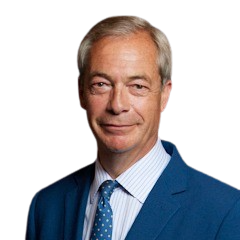
Nigel Farage is the leader of Reform UK and the MP for Clacton, having first been elected to parliament at the 2024 general election.
In the 2024 general election for the Clacton constituency, Farage received 21,225 votes, representing 46.2% of the vote share. The Conservative candidate, Giles Watling, was the runner-up with 12,820 votes (27.9%), while the Labour Party candidate, Jovan Owusu-Nepaul, secured third place with 7,448 votes (16.2%). Farage was duly elected with a majority of 8,405.
Farage resigned as an MP in July 2026 to stand in a self-imposed by-election. This came as the Reform leader faced questions over a series of donations and a parliamentary standards commissioner investigation.
In the 2026 Clacton by-election, Farage received 22,239 votes, representing 63.3% of the vote share. The satirical candidate Count Binface, Farage’s principal opponent after the main parties chose not to stand, won 9,455 votes (26.9%), while the Rejoin EU candidate, John Stevens, secured third place with 492 votes (1.4%). Farage was re-elected with a majority of 12,784.
The Clacton constituency is located in Essex, in the East of England region. Centred on the town of Clacton-on-Sea, it also includes Frinton-on-Sea and Walton-on-the-Naze. The constituency was created for the 2010 general election, largely from the abolished Harwich seat.
The seat was held by the Conservative Party from 2010 until 2014, when the sitting MP Douglas Carswell defected to the UK Independence Party (Ukip) and won the subsequent by-election. Carswell held the seat until 2017, when the Conservatives regained it.
Farage’s immediate predecessor as the MP for Clacton was Giles Watling of the Conservative Party, who held the seat from 2017 to 2024.
Farage was elected to parliament following seven previous unsuccessful attempts between 1994 and 2015. He was a member of the European Parliament (MEP) for South East England from 1999 to 2020.
Nigel Farage and Reform UK
Farage returned to frontline politics as the leader of Reform UK on 3 June 2024 during the 2024 general election campaign. He had previously stated that he would not stand as a candidate in the 2024 election.
In a statement posted to X (formerly Twitter) on 23 May, Farage said he was “fully supportive of Richard Tice’s leadership”, urging voters to “put their trust in him and Lee Anderson”. Farage, a declared supporter of Donald Trump, said that he wanted to be free to campaign in the US presidential election. “Important though the general election is”, he wrote, “the contest in the United States of America on November 5 has huge global significance.”
Farage’s subsequent U-turn helped inspire a parliamentary breakthrough for Reform UK. Farage himself was elected in Clacton, and the party secured a total of five MPs. Speaking at his election count, Farage vowed: “We’re coming for Labour – be in no doubt about that.”
Reform UK received 4,117,610 votes, representing 14.3% of the national total. Despite being the third most popular party (on national vote share), its support was spread broadly and thinly across the country. Significantly, Reform UK placed second in 98 constituencies; in 89 of those contests, it finished behind Labour.
Farage delivered his maiden speech in the House of Commons on 23 July 2024 during a debate on immigration and home affairs.
In it, he stated: “What I did not expect was to come here and find that I, with my Reform team, am more outnumbered here than we were in the European Parliament, because there are more supporters of Brexit in the European Parliament than I sense there are in this Parliament of 2024. This is very much a remainers’ Parliament. I suspect, in many cases, that it is really a rejoiners’ Parliament.”
Reform’s electoral advance continued at the 2025 local election, when the party made notable gains. It subsequently secured a series of high-profile Conservative defections, notably former cabinet ministers Robert Jenrick and Suella Braverman.
In February 2026, Reform UK unveiled its own so-called “shadow cabinet” or frontbench. Jenrick was announced as “shadow chancellor”, Braverman was appointed as “shadow education secretary”, Richard Tice as “shadow business, trade and energy secretary”, and Zia Yusuf as “shadow home secretary”.
At the time, Farage stated: “With Labour’s growing instability, and Keir Starmer’s leadership on the verge of collapse, it is vital we prepare seriously for government.
“I am bringing together a strong, disciplined and experienced team ready to rebuild Britain. The British people deserve a real alternative. Today we are demonstrating that Reform UK is ready to provide it.”
At the 2026 local elections in England, Reform UK won 1,454 council seats. It was defending just two of these seats. The party won control of 14 councils.
Reform placed second in the sensational Makefield by-election, held on 18 June 2026. The result represented Reform’s second consecutive by-election loss after the party also finished as the runner-up in the February 2026 Gorton and Denton by-election.
In the Makerfield campaign, Reform faced a challenge on its right flank from Restore Britain, led by former Reform MP Rupert Lowe. Reform won a total of 15,696 votes (34.5%), while Restore Britain received 3,111 votes (6.8%). Andy Burnham, the former mayor of Greater Manchester, was elected with a resounding 24,927 votes (54.8%) and a majority of 9,231.
Responding to the result, Farage blamed Reform’s defeat on a desire among voters to defenestrate Keir Starmer as prime minister. He also issued a plea for Restore voters to back Reform instead, as the main “challenger party to the left”.
Reform’s standing took a hit in the first half of 2026 amid a series of stories concerning Farage’s finances.
In April 2026, the Guardian reported that Farage “was given £5 million by the crypto billionaire Christopher Harborne shortly before announcing he would stand in the 2024 British general election.” In an apparent attempt to get ahead of the report, Farage confirmed in a Daily Telegraph interview that he had received the gift, but insisted it was to cover the costs of his personal security.
Reform UK maintained that no rules had been broken.
On 13 May, shortly after the 2026 local elections, the parliamentary standards commissioner announced a new inquiry into whether Farage broke commons rules by accepting the £5 million gift and not declaring it.
On 4 July, the Sunday Times reported that Farage had received support from George Cottrell, including security and social media staff who worked on Farage’s online content, in the year before his election as an MP. Cottrell, who admitted a count of wire fraud in the US in 2017, was a longstanding ally of Farage.
Reform UK again insisted that no rules had been broken.
On 7 July, Farage announced his resignation from the House of Commons and confirmed he would stand in the subsequent Clacton by-election.
In a video statement, Farage took aim at the “mainstream media” and the “establishment”, insisting he had done “nothing wrong”. He said the by-election would give voters a chance to “stick two fingers up to the establishment”.
Farage’s sensational statement was met with a united front from the major parties, who successively took the decision not to stand in Clacton. This stance cleared the field for Count Binface, Britain’s best-known satirical candidate, to emerge as Farage’s most prominent challenger. In an interview with the Daily Mail on 9 July, Farage admitted being wrong-footed by the decision of the major parties not to stand in the contest. Asked if he had considered the possibility of fighting as the only candidate from a major political party, Farage responded: “No, of course not.”
On 13 August 2026, Farage was returned as the MP for Clacton, winning 22,239 votes (63.3%) against a field of 34 candidates – the largest ever assembled for a single UK parliamentary contest. Binface won 9,455 votes (26.9%), while Farage secured a majority of 12,784 – an increase of 4,379 on his 2024 result.
Farage did not attend the count at Clacton leisure centre to hear the declaration of the result. This meant he was the first winning parliamentary candidate not to attend their declaration since Bobby Sands, the imprisoned hunger striker and member of the Provisional Irish Republican Army (IRA), who won the 1981 Fermanagh and South Tyrone by-election.
Nigel Farage and the Brexit Party
Farage previously led Reform UK when it was known as the Brexit Party from 2018 to 2021. (He was honorary president of Reform from 2021 to 2024.)
The Brexit Party was incorporated on 23 November 2018. On 20 January 2019, Farage said that Brexit Party founder Catherine Blaiklock, a former Ukip economics spokesperson, had founded the party with his “full knowledge” and “full support”.
On 20 March, Blaiklock resigned as leader of the Brexit Party after reports emerged that she had repeatedly posted and reposted racist social media messages. Two days later on 22 March, Farage announced he would take over from Blaiklock as Brexit Party leader.
Farage officially launched the Brexit Party on 12 April 2019, unveiling an “impressive list” of 70 candidates for the upcoming European Parliament elections. The Brexit Party topped the European Parliament elections in Britain with 31.6% of the vote, securing 29 seats. It also emerged as the largest single party in the European parliament. The Conservatives, meanwhile, suffered their worst national election result since the 1832 Great Reform Act – finishing in fifth place with just 9.1% of the vote and four MEPs (down 15).
In the wake of the European Parliament elections, Farage vowed to stand Brexit Party candidates at a future general election. On 1 November, launching the Brexit Party’s campaign, Farage called on Johnson to “build a leave alliance” and drop his renegotiated deal with the EU. Otherwise, he said, the Brexit Party would “contest every single seat in England, Scotland and Wales.”
On 11 November 2019, Farage announced that the Brexit Party would stand down its candidates in the 317 constituencies won by the Conservatives at the 2017 general election. The decision came amid fears that Farage’s party could split the pro-Brexit vote. Farage had previously announced that he would not stand at the general election, saying he could “serve the cause better” campaigning across the country.
In the end, the Brexit Party stood 275 candidates, winning zero seats and 2.0% of the vote.
Reacting to the general election result, a Conservative majority of 80 seats, Farage said: “This victory for Boris was hugely helped by us and is far better than the Marxist Corbyn and a second referendum.”
During the 2019 general election campaign, Farage said the Brexit Party would change its name to the “Reform Party” after the UK left the European Union. The restyled party would campaign for changes to the voting system and the abolition of the House of Lords, Farage said.
The Reform name was a conscious reference to the Reform Party of Canada, which, under the leadership of Preston Manning from 1987 to 2000, supplanted the established Progressive Conservative Party as the largest party of the right in Canada. The Canadian Reform Party and the Progressive Conservatives eventually merged, creating a new more populist-flavoured conservative party.
Farage stepped down as Reform leader in March 2021 and was replaced by Richard Tice.
In May 2023, Farage said he regretted standing aside for Conservative incumbents at the 2019 general election and was thinking “very hard” about returning to frontline politics.
In July 2023, Farage was at the centre of a significant controversy over the “de-banking” of politicians and public figures. At the time, Farage alleged that Coutts, a bank which specialises in high net-worth clients, closed his account for political reasons and was linked to his status as a politically exposed person (PEP).
Farage’s allegations led to the resignation of Alison Rose, the chief executive of NatWest Group, which owns Coutts. The Financial Conduct Authority (FCA) also issued a warning to the financial sector to do more to ensure PEPs are treated fairly.
In response to this backlash, the government introduced significant reforms via the Financial Services and Markets Act 2023. These new rules came into force in 2024. Farage and NatWest reached a confidential settlement in March 2025, with the bank apologising.
Nigel Farage: Ukip and rise to prominence (1992-2019)
Farage has been a prominent figure in British politics for at least two decades. He joined the Conservative Party as a young man but left in 1992 in opposition to the Maastricht Treaty.
In 1993, Farage was a founding member of the UK Independence Party (Ukip) in 1993, having previously been associated with the eurosceptic Anti-Federalist League (AFL). The AFL was formed by academic Alan Sked to oppose the signing of the Maastricht Treaty, the foundation treaty of the EU.
Farage, a commodities trader, had voted for the Green Party in the 1989 European election due to their eurosceptic policies.
In the 1990s, Ukip operated mostly on the margins of British politics. It was initially overshadowed by the Referendum Party, led by James Goldsmith, which stood candidates in 547 constituencies at the 1997 general election, winning 811,849 votes (2.6%). Ukip stood 193 candidates and secured 105,722 votes (0.3%).
The Referendum Party’s decline after Goldsmith’s death in 1997 created space for Ukip’s political and electoral development.
Farage became Ukip chairman in 1998, shortly before the party secured three seats in the 1999 European parliament elections. Aided by the parliament’s proportional electoral system, Ukip secured three seats – including one for Farage.
Farage sought to sharpen Ukip’s image by appropriating populist and anti-establishment positions, including on immigration. This strategic initiative put him at odds with Sked. The party founder believed that Ukip’s embrace of ultraconservative messaging would narrow its electoral appeal and dilute its euroscepticism. Sked resigned from Ukip in 1997.
At the 2004 European parliament elections, Ukip increased its representation to 12 MEPs.
In 2006, David Cameron, the recently elected leader of the Conservative Party, referred to Ukip as consisting of “fruitcakes”, “loonies” and “closet racists”. Farage demanded an apology. “Let him tell us anything that we have said that could be construed as remotely racist, otherwise we demand an apology”, he said.
At the 2010 general election, Ukip won 919,546 votes (3.1%).
Ahead of polling day, Farage had stood down as leader to focus on his campaign for the Buckingham constituency – which was then represented by commons speaker John Bercow. By convention, the major parties do not contest the speaker’s seat at election time. Farage, who was badly injured in an aircraft crash on polling day, finished third with 8,410 votes (17.4%). He later admitted it was a “miscalculation” to try an unseat Bercow.
Ukip achieved its electoral peak at the 2014 European parliament elections. The party secured 27.5% of the vote, winning 24 of the UK’s 73 seats in the European parliament. This represented a 11-seat increase on its 2009 performance and marked the high point of its electoral success.
Mere months later, Ukip gained its first MP in the form of Conservative defector Douglas Carswell. Carswell triggered a by-election in his Clacton constituency – and won it. He was followed by Mark Reckless, the MP for Rochester and Strood.
At the 2015 general election, Farage’s party secured 12.6% of the vote, finishing third in terms of votes cast, but only one seat (Carswell in Clacton). Farage, having failed to win the South Thanet constituency, initially stepped down as leader, but found his resignation rejected by Ukip’s national executive committee.
From 2010 to 2015, Ukip exerted considerable centrifugal pressure on the Conservative Party. This relationship was a critical factor in shaping Cameron’s 2013 pledge to hold an ‘in-out’ referendum on EU membership.
Farage was technically segregated from the official Vote Leave campaign during the 2016 referendum, which was headed by Dominic Cummings. But Ukip nonetheless played a significant role in the referendum campaign, as a pro-‘leave’ outrider that could appeal to voters with messaging Cummings was reluctant to embrace. Ukip’s “Breaking Point” poster, which depicted Syrian refugees near the Croatia-Slovenia border in 2015, drew condemnation from the official Britain Stronger in Europe and Vote Leave campaigns.
After the Brexit vote in 2016, with Farage seeking to step back as Ukip leader, the party descended into bitter internal disputes. Under the leadership of Paul Nuttall, Ukip won only 1.8% of the vote at the 2017 general election. In a June 2017 interview, Farage said he regretted the “reluctance” of Ukip to evolve and rebrand following the Brexit referendum.
He told Sky News: “I don’t think there’s any secret about the fact that in my last 18 months as leader I was very frustrated at the reluctance of the party to change.
“I wanted to completely rebrand it and [make it like the populist, anti-establishment] Five Star party in Italy.”
In 2018, Gerard Batten was elected unopposed in Ukip’s fourth leadership contest in 18 months. Batten shifted the party’s focus towards criticising Islam, and forged close ties with far-right activist Tommy Robinson. This move prompted a wave of resignations, including that of Farage.
Farage said Batten was “obsessed” with Islam and argued that “Ukip wasn’t founded to be a party based on fighting a religious crusade”.
Farage’s decision to leave Ukip prepared the ground for his elevation as the leader of the Brexit Party.
Nigel Farage – how many times has he stood for parliament?
Farage has stood for parliament on nine occasions.
- Eastleigh, 1994 by-election: finished 4th; 1.7% of the vote – lost deposit (£500)
- Salisbury, 1997 general election: finished 4th; 5.7% of the vote – retained deposit
- Bexhill and Battle, 2001 general election: finished 4th; 7.8% of the vote – retained deposit
- South Thanet, 2005 general election: finished 4th; 5.0% of the vote – retained deposit (just)
- Bromley and Chislehurst, 2006 by-election: finished 3rd; 8.1% of the vote – retained deposit
- Buckingham, 2010 by-election: finished 3rd; 17.4% of the vote – retained deposit
- South Thanet, 2015 general election: finished 2nd; 32.4% of the vote – retained deposit
- Clacton, 2024 general election: finished 1st; 46.2% of the vote – won
- Clacton, 2026 by-election: finished 1st; 63.3% of the vote – won
Nigel Farage and Cameo
Farage can be found on the greetings website, Cameo, which allows public figures to monetise their celebrity status.
Farage has previously been tricked by people on Cameo. He has said he did not realise that he was citing an Irish republican message when he read out a birthday message that included the slogan “Up the ’Ra!”.
“The ’Ra” is shorthand slang for the Irish Republican Army (IRA)
Political views
Farage is associated with the populist and eurosceptic wings of British politics.
In his foreword to Reform’s 2024 general election manifesto, Farage said the party would “stand up for British culture, identity and values”.
He added: “We will freeze immigration and stop the boats. Restore law and order. Repair our broken public services. Cut taxes to make work pay. End government waste and deliver our fully funded plan for zero NHS waiting lists.
“We will unlock Britain’s vast energy treasure of oil and gas to slash energy bills, beat the cost-of-living crisis and unleash real economic growth.”
Farage referred to Reform’s campaign document as a “contract with the people” because “when I say manifesto you think lie”.
Farage has previously indicated his support for a relatively wholesale programme of constitutional change. Reform’s 2024 contract called for the House of Lords to be replaced with a “more democratic smaller alternative”, and expressed support for a referendum on replace the current first past the post (FPTP) electoral system.
The contract stated: “Large numbers of voters have no representation in parliament and new parties are shut out of the political system. Voter turnout could be some 10% higher with PR. A referendum is needed.”
However, Reform has appeared to backtrack on its support for electoral reform. In February 2025, Farage pointed out that “first past the post can be your enemy, but there comes an inversion point at which it becomes your friend”. Farage said that looking at the polls, Reform is “literally at that inflection point”.
In September 2025, Farage said he was still in favour of reforming the House of Lords as it had “become a bit of an abomination”.
Speaking to PoliticsHome, the Reform leader said: “Constitutional reform is, without doubt, needed but can it be at the top of the agenda for a Reform government given all the other problems the country is facing? No. Is it important? Yes.”
Brexit and Europe
Farage famously campaigned to leave in the 2016 Brexit referendum.
In his final speech to the European Parliament before Britain left the EU, Farage outlined his ideological objections to the bloc.
He stated: “Indeed, there is a historic battle going on now across the west, in Europe, America and elsewhere. It is globalism against populism and you [the European Parliament] may loathe populism, but it is becoming very popular.
“And it has great benefits: no more financial contributions, no more European Court of Justice, no more Common Fisheries Policy, no more being talked down to, no more being bullied, no more Gey Verhofstadt.”
He continued: “I mean what’s not to like, I know you’re going to miss us. I know you want to ban our national flags but we’re going to wave you goodbye, and we look forward to working with you as a sovereign nation.”
Assisted dying
Farage voted against the Terminally Ill Adults (End of Life) Bill, better known as the assisted dying bill, at both second reading (November 2024) and third reading (June 2025).
In a statement outlining his position, Farage said: “I voted against the assisted dying bill, not out of a lack of compassion but because I fear that the law will widen in scope. If that happens, the right to die may become the obligation to die.”
Foreign policy and security
Farage has come in for criticism over the evolution of his stance on Russia’s invasion of Ukraine. Farage’s political opponents regularly point out that in a 2014 interview he said he “admired” Russian president Vladimir Putin as an “operator” .
A decade later, during the 2024 general election campaign, Farage suggested the West “provoked” Russia’s invasion of Ukraine by expanding the European Union and Nato military alliance eastwards. Farage told the BBC that he had been arguing since the 1990s that “the ever eastward expansion” of the Nato military alliance and the EU was giving Putin “a reason to… say they’re coming for us again and to go to war”.
He added: “We provoked this war. Of course, it’s [Putin’s] fault.”
James Cleverly, the then home secretary, accused Farage of “echoing Putin’s vile justification for the brutal invasion of Ukraine”.
Farage and Reform have since sought to distance themselves from such stances. In February 2025, Richard Tice said his party stood “united” in support of Ukraine and against the “monstrous tyranny of that most evil, evil villain, Putin.”
Ties to Trump
Farage has longstanding ties to Donald Trump, who was inaugurated as president of the United States for a second term in January 2025. Farage first spoke at a Trump rally in August 2016, when he urged Republicans to “get out there campaigning” to drum up support for the party’s nominee. Trump introduced Farage as the man who “brilliantly” led the Brexit charge in the United Kingdom.
In November 2016, Trump said Farage should be appointed as the British ambassador to the United States.
In June 2019, Trump described Farage as a “very smart person” and advised the government to “bring him in” for Brexit negotiations.
During the 2024 general election campaign, Farage initially announced that he would not return to frontline politics in order to support Trump’s third consecutive presidential campaign. In a statement, Farage said he intended to “help with the grassroots campaign in the USA in any way that I can.”
More recently, Farage has sought to distance himself from Trump, apparently responding to evidence that his perceived proximity to the US president is a political liability.
In March 2025, Farage distanced himself from Trump’s approach to Ukraine ceasefire talks, saying that Russia appeared to be “getting far too much”.
Before Politics
Born in 1964, Farage was educated at Dulwich College in London. He did not attend university.
After leaving school, Farage worked as a commodities trader in the City of London on the London Metal Exchange. He worked for companies including Drexel Burnham Lambert, Crédit Lyonnais Rouse and Refco.
He was a founding member of Ukip in 1993, having previously been a member of the Conservative Party.
Personal Life
Farage has been married twice. His first marriage was to Gráinne Hayes from 1988 until their divorce in 1997, with whom he has two sons. He married Kirsten Mehr, a German national, in 1999, with whom he has two daughters; the couple are now separated.
Mehr said in a 2017 interview: “My husband and I have lived separate lives for some years and he moved out of the family home a while ago. This is a situation that suits everyone and is not news to any of the people involved.”
Laure Ferrari is currently Farage’s reported partner.
Farage is said to have met his first wife, Hayes, when she was his nurse following a car accident.
Trivia
Brushes with death
In his early 20s, Farage was hit by a car in Orpington, Kent, following a night out at the pub. He was severely injured and told he might lose his leg.
In 2010, Farage survived a plane crash when a light aircraft nose-dived during an election flight as it was towing a “Vote Ukip” banner. Farage subsequently suffered from broken ribs and a punctured lung.
In 1986, Farage was diagnosed with testicular cancer which left one of his testicles “the size of a lemon”, he wrote in his 2015 biography.
In his biography, he also stated that: “Having nearly died three times has made me a much bigger risk-taker. When you think your life is about to be taken away and you are given it back, you just want to get on and do things.”
Nigel Farage and Enoch Powell
In 1993, Farage drove Enoch Powell, the former Conservative MP best known for his 1968 “Rivers of Blood” speech, to Newbury to campaign in a parliamentary by-election.
One year later in March 1994, in his capacity as Ukip’s candidate in the Eastleigh by-election, Farage asked Powell for his endorsement.
According to the Telegraph, he wrote: “I have everything in place to fight a good, aggressive campaign but a voice from you could transform things and put the issue to the forefront. Please give us the help you can. As your performance at Newbury showed the electorate are beginning to wake from that long sleep. Come and give them another jog.”
Powell declined.
Nigel Farage and ‘Im a Celeb…’
In late 2023, Nigel Farage entered the Australian jungle as a contestant on ITV’s flagship “Im a Celebrity… Get Me Out Of Here!” programme. Farage finished third in the series, missing out on the “King of the Jungle” title to social media influencer Sam Thompson.
Prior to his appearance in the I’m A Celeb… jungle, Farage was a star attraction at Conservative Party conference which he attended in his capacity as a presenter for GB News.
Speaking to the PoliticsHome website at the time, the staunch Brexiteer said: “I’d be very surprised if I were not Conservative leader by 2026. Very surprised.”
He later told the site that he made the statement “in jest”.
Nigel Farage has not written for Politics.co.uk.