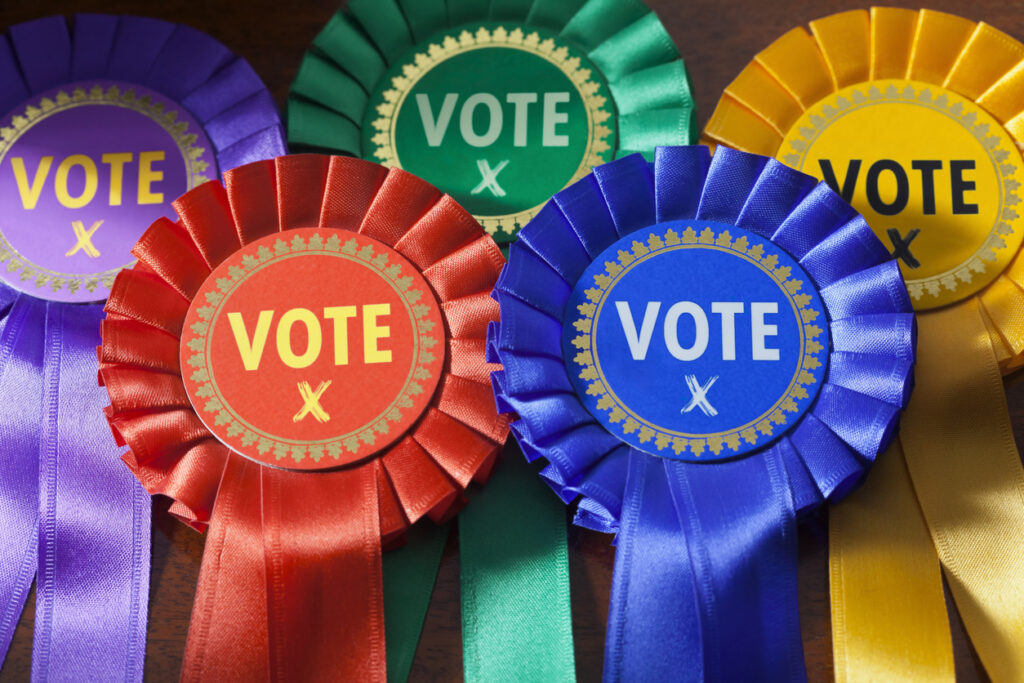
The United Kingdom’s political system has shifted markedly since the mid-20th century. From a historic dominance by two parties – Labour and the Conservatives – it has moved toward a more fragmented, multi-party system.
The 2024 general election saw the combined vote share of the two largest parties fall to record lows. Labour captured 33.7% of votes and 63.2% of seats, while the Conservatives earned 23.7% of votes and 18.6% of seats. Smaller parties such as Reform UK (14.3 %), Liberal Democrats (12.2 %), Greens (6.4 %), and others won significant shares. However, under the first past the post (FPTP) electoral system, these national vote shares were not reflected in the party’s parliamentary representation.
The Gallagher index, which measures an electoral system’s relative disproportionality between votes received and seats in a legislature, gave the election a score of 23.67. This marked 2024 as the most disproportionate election in modern British history.
The rise of the multi-party system
The post-war two-party system
From the end of the Second World War until the 1970s, the Conservative and Labour parties consistently captured over 90% of the popular vote and the overwhelming majority of seats in the House of Commons.
At the 1951 general election, the two main parties captured 48.0% (Conservatives) and 48.8% (Labour) of the vote – a combined 96.8%. The leading third party, the Liberals, secured only 3.5% of the vote and six seats.
This period established the classic model of UK politics, defined by single-party majority governments that would alternate in power.
Beginning in the February 1974 general election, the combined vote share of the two major parties began a steady decline.
The February 1974 general election, called by the Conservative prime minister, Edward Heath, produced a hung parliament – the first since 1929. While the Conservatives won a slightly larger share of the popular vote (37.9%) than Labour (37.2%), Harold Wilson’s party secured 14 more seats, winning 301 to the Conservatives’ 297.
But arguably the most dramatic story was the performance of Jeremy Thorpe’s Liberal Party, which gained over six million votes – 19.3% of the total – but won only 14 seats.
Heath did not resign immediately as prime minister. He clung to power for a total of four days, attempting to negotiate a coalition with the Liberals. Thorpe, however, under pressure from Liberal activists, could not accept the Conservative leader’s terms.
Between 1977 and 1978, James Callaghan’s Labour government remained in office through an agreement known as the Lib-Lab Pact.
A joint statement announcing the Lib-Lab pact was issued 23 March 1977. It confirmed the creation of a joint consultative committee, established under the leader of the House, Michael Foot, to examine policy before it reached the floor of the House.
Under the terms of the pact, Callaghan pledged to progress legislation for Scottish and Welsh devolution – a key Liberal demand.
The statement added: “We agree that this arrangement between us should last until the end of the present parliamentary session, when both parties would consider whether the experiment has been of sufficient benefit to the country to be continued.”
The pact ended in the summer of 1978, after 15 months, depriving the government of 13 crucial parliamentary votes. It came as Callaghan ruled out the possibility of an autumn election. Labour was left to rely on ad-hoc support and an often innovative whipping operation.
On 28 March 1979, the Labour government was defeated by a single vote in a motion of no confidence. The successful no-confidence motion – passed by 311 votes to 310 – led directly to the 1979 general election. Liberal MPs, led by David Steel, voted against the government.
The rise of the SDP
In the early 1980s, the formation of the Social Democratic Party (SDP), which split from the Labour Party, threatened to “break the mould” of British politics. A total of 28 Labour MPs defected to the SDP over the course of 1981.
The SDP, which quickly formed an alliance with the Liberal Party, also posed a major threat to the Conservative Party under Margaret Thatcher’s leadership.
The SDP-Liberal alliance won a series of significant by-election victories, including the Croydon North West by-election (October 1981), the Crosby by-election (November 1981), and the Glasgow Hillhead by-election (March 1982).
The alliance secured 25.4% of the popular vote at the 1983 general election – a mere 2.2 points short of Labour. The vagaries of FPTP translated this to only 23 seats.
The SDP-Liberal alliance failed to improve its standing at the 1987 general election; the result precipitated an official merger of the SDP and Liberal parties, producing the Liberal Democrats.
The rise of the Liberal Democrats
The Liberal Democrats won 17.8% of the vote and 20 seats at the 1992 general election, establishing itself as a significant third force in British politics. At the 1997 election, the Liberal Democrats under Paddy Ashdown won 46 seats.
Following the 1992 campaign, Ashdown delivered what became known as the “Chard speech”. Speaking in Chard, a small town in his Yeovil constituency, Ashdown described the role the Lib Dems would seek to play in the coming parliament.
Noting that “Britain still lacks a credible, electable alternative government to the Tories”, Ashdown defined a threefold mandate for his party.
It was “to create the force powerful enough to remove the Tories; to assemble the policies capable of sustaining a different government; and to draw together the forces in Britain which will bring change and reform.”
He urged his party “to work with others to assemble the ideas around which a non-socialist alternative to the Conservatives can be constructed.”
In March 1996, the Liberal Democrat and Labour parties held a series of talks on constitutional reform, led by Robin Cook (Labour) and Robert Maclennan (Lib Dems).
The group reported in March 1997. It agreed on proposals such as incorporation of the European Convention on Human Rights (ECHR) into UK law – which would bear fruit as the Human Rights Act 1998; freedom of information legislation – later the Freedom of Information Act 2000; and further constitutional reforms, including devolution, reform of the House of Lords, as well as a referendum on the voting reform for Westminster elections (to be agreed in a commission – later the ‘Jenkins commission’). The proposals were later referred to as the Cook/Maclennan agreement.
Senior Labour and Liberal Democrat politicians had also worked together in the cross-party Scottish Constitutional Convention (SCC), which set out to design a devolution scheme. The SCC (1988-1995) was co-chaired by Harry Ewing, a Labour politician, and David Steel, a former leader of the Liberal Party.
Following the 1997 election, notwithstanding his historic 179-seat majority, prime minister Tony Blair constituted a ‘Lib-Lab’ cabinet committee. The joint cabinet committee (JCC) included senior Labour and Liberal Democrat politicians, with a remit encompassing constitutional reform proposals. It was attended by Liberal Democrats Alan Beith, Robert Maclennan, Lord Holme, and Menzies Campbell. In December 1997, the JCC launched the Independent Commission on the Voting System, chaired by Lord (Roy) Jenkins, co-founder of the SDP.
The commission reported in September 1998. It proposed a shift from the first past the post electoral system to an alternative vote ‘top-up’ scheme or AV+. Under the system set out by Jenkins commission, 80-85% of the commons would be elected under the alternative vote (AV), a ranked choice, constituency-based system. The remaining 15-20% of MPs – the ‘top-up’ – would be elected under a party-list proportional representation system.
The Liberal Democrats won 62 seats and 22.0% of the vote at the 2005 general election under Charles Kennedy’s leadership.
At the 2010 general election, the combined Conservative and Labour vote share had fallen to just 65%. The Liberal Democrats, now led by Nick Clegg, won 23.0% of the vote.
Clegg’s performance in the first televised general election debate inspired the political phenomenon dubbed “Cleggmania”. As the least known of the three leaders, Clegg seized the opportunity provided by the debate to present himself as a fresh alternative to the “old parties”. All of a sudden, Liberal Democrat policies received a level of media scrutiny usually reserved for the two main parties.
In the hung parliament that resulted from the 2010 campaign, Clegg’s Lib Dems held the balance of power.
The rise of Ukip
The UK Independence Party (Ukip) was founded by the academic Alan Sked in September 1993. In the 1990s, Ukip operated mostly on the margins of British politics. It was initially overshadowed by the Referendum Party, led by James Goldsmith, which stood candidates in 547 constituencies at the 1997 general election, winning 811,849 votes (2.6%). Ukip stood 193 candidates and secured 105,722 votes (0.3%).
Ukip’s first breakthrough came in the 1999 European parliament elections. Aided by the parliament’s proportional electoral system, Ukip secured three seats – including one for a charismatic former commodities trader named Nigel Farage.
At the 2004 European parliament elections, Ukip increased its representation to 12 MEPs. At the 2010 general election, Ukip won 919,546 votes (3.1%).
Ukip achieved its electoral peak at the 2014 European parliament elections. These contests had long been a happy hunting ground for the party – on account of the proportional electoral system, the issues at hand and the apparent opportunity for voters to register a protest. But this time, Ukip won. The party secured 27.5% of the vote, winning 24 of the UK’s 73 seats in the European parliament. This represented a 11-seat increase on its 2009 performance and marked the high point of its electoral success.
Evaluation question
To what extent do smaller parties in the UK exert more power by reshaping the agendas of major parties – through ideological and electoral pressure – than through actual parliamentary representation?
The Labour Party came second with 25.4% of the vote and 20 seats (up seven), while the governing Conservative Party was pushed into third place with 23.9% and 19 seats (down seven). Farage hailed the outcome as a political “earthquake”.
Mere months later, Ukip gained its first MP in the form of Conservative defector Douglas Carswell. Carswell triggered a by-election in his Clacton constituency — and won it. He was followed by Mark Reckless, the MP for Rochester and Strood.
At the 2015 general election, Farage’s party secured 12.6% of the vote, finishing third in terms of votes cast. However, due to the first past the post electoral system, this translated into only one seat (Carswell in Clacton).
From 2010 to 2015, Ukip exerted considerable centrifugal pressure on the Conservative Party. This relationship was a critical factor in shaping Cameron’s 2013 pledge to hold an ‘in-out’ referendum on EU membership.
After 2016, with Farage seeking to step back as Ukip leader, the party descended into bitter internal disputes. Ukip’s support base steadily migrated to Faragist successor parties like the Brexit Party and Reform UK.
The impact of devolution
Scotland and the rise of the SNP
The establishment of the devolved legislatures in 1999, which were elected using more proportional electoral systems, provided a major platform for smaller parties.
Donald Dewar, the inaugural first minister of Scotland, announced his first cabinet in May 1999, which included two Liberal Democrat MSPs. Jim Wallace became deputy first minister and minister for justice; fellow Liberal Democrat Ross Finnie served as minister for rural affairs.
This Lib-Lab partnership proved remarkably stable, lasting through two elections and three different Labour first ministers (Dewar, Henry McLeish, and Jack McConnell) until 2007.
From 1999 to 2007, the Scottish National Party (SNP) served as the official opposition. The SNP, led by Alex Salmond, won 35 seats in the 1999 Scottish Parliament election.
The SNP emerged as the largest party following the 2007 Scottish Parliament election, winning 47 seats. The party formed a minority government under Salmond as first minister. The SNP then achieved a surprise majority at the 2011 Holyrood election, securing 69 of the 129 seats at Holyrood – a majority of four. In 2011, the SNP took 45.4% of the constituency vote and 44.7% of the regional vote, increasing their number of MSPs by 22 (compared to the notional 2007 base, adjusted for boundary changes).
This mandate precipitated negotiations between the Scottish National Party (SNP)-led administration and the UK Conservative-Liberal Democrat coalition government over a Scottish independence referendum, which was held in 2014.
The 2014 independence referendum resulted in a victory for the “No” campaign, backed by the British government led by David Cameron as prime minister.
At the following 2015 general election, the SNP won 56 of the 59 Scottish seats, an increase of 50.
From 2021 to 2024, the Scottish National Party (SNP) governed with the support of the Scottish Green Party through a power-sharing deal known as the Bute House Agreement. Two Green MSPs, Patrick Harvie and Lorna Slater, were appointed as ministers. Under the deal, Green ministers attended cabinet meetings at least twice a year. The agreement followed the May 2021 Scottish parliament election, in which the SNP won 64 of the 129 seats, one short of an overall majority.
At the 2024 general election, the SNP lost significant ground. The party was reduced to nine seats.
Wales
In Wales, the Senedd Cymru (formerly the National Assembly for Wales) has consistently operated without a single-party majority, necessitating various formal and informal political arrangements.
Following the inaugural 1999 election, Alun Michael led a minority Labour administration. His successor, Rhodri Morgan, formed a coalition with the Welsh Liberal Democrats in October 2000. This agreement saw Liberal Democrat leader Michael German appointed as deputy first minister and minister for economic development, while fellow Liberal Democrat Jenny Randerson served as minister for culture. The partnership lasted until the 2003 election.
The 2007 election resulted in a significant shift. The “One Wales” coalition between the Labour Party and Plaid Cymru provided a majority in the Senedd from 2007 to 2011. Under the agreement, Plaid Leader Ieuan Wyn Jones was made deputy first minister, serving under Labour’s Rhodri Morgan as first minister (and later Carwyn Jones).
In total, three Plaid Cymru members sat in the cabinet as full ministers, including Jones, Elin Jones (rural affairs), and Rhodri Glyn Thomas (heritage).
The “One Wales” coalition represented the first time a nationalist party had entered government anywhere in the UK.
From December 2021 until May 2024, the Welsh Labour government operated with support from Plaid Cymru through a formal “co-operation agreement”. Unlike a formal coalition, Plaid Cymru remained in opposition and did not take up ministerial seats in the cabinet. Instead, the parties worked together on 46 specific policy areas, including free school meals and Senedd reform. Plaid appointed special advisers to serve in the offices of the Welsh government.
Adam Price, the leader of Plaid, said his party was “transforming itself from a traditional opposition party in the Westminster sense to something new and refreshingly different, a co-opposition party, co-operating where possible, while continuing to oppose, and to scrutinise and criticise where necessary”.
The agreement was terminated early in May 2024 after Plaid Cymru withdrew. The party’s latest leader, Rhun ap Iorwerth said the decision was related to controversies surrounding the new first minister, Vaughan Gething, and what he called “a significant lack of judgement.”
The impact of Brexit
The 2016 referendum on Britain’s membership of the European Union created new political dividing lines that cut across traditional party loyalties.
The 2017 general election saw something of a return to a familiar form of two-party politics. The Conservative and Labour parties secured 42.3% (up from 36.8% in 2015) and 40.0% (up from 30.4%) respectively. The combined total vote share for the two main parties, 82.3% of the UK vote, marked the highest since 1970. The Scottish National Party won 35 seats (down 21), and the Liberal Democrats won twelve (up 4). Notably, the UK Independence Party’s (Ukip) share of the vote fell from 12.6% in 2015 to 1.8% in 2017.
However, the resulting hung parliament forced May to seek an agreement with the Democratic Unionist Party (DUP) in order to stay in office.
The Brexit impasse in the 2017-2019 parliament initially fuelled the rise of third forces critical of the position of the main parties on Brexit.
The 2019 European parliament election, held almost three years after the Brexit referendum, resulted in a seismic victory for Nigel Farage’s newly formed Brexit Party. The Brexit Party, which was less than five months old, topped the poll with 31.6% of the vote, securing 29 seats and becoming the largest single party in the European parliament. Farage and his party had campaigned in favour of a ‘no deal’ Brexit.
The Conservatives suffered their worst national election result since the 1832 Great Reform Act, finishing in fifth place with just 9.1% of the vote and four MEPs (down 15). At the time, May was facing significant pressure to resign as prime minister to make way for a Conservative leadership election. The Labour Party also performed poorly, coming third with 14.1% and 10 seats (down 10). Its ambiguous Brexit position failed to satisfy either ‘Leave’ or ‘Remain’ voters. The collective share for Labour and the Conservative Party, 23%, was well below their previous post-war low of 43.5% in 2009.
Parties with a clear pro-Remain stance performed strongly. The Liberal Democrats surged into second place with 20.3% of the vote and 16 seats (up 15), while the Green Party also had its best-ever national result, taking 12.1% and seven seats (up four). The exception to this rule was Change UK, the new pro-‘Remain’ collective of former Labour and Conservative MPs. The party stood a full slate of candidates, but won no seats on 3.3% of the vote.
Change UK, initially referred to as The Independent Group, was composed of a series of former Labour and Conservative MPs. In February 2019, eight Labour MPs resigned from the party to form a new parliamentary bloc, citing Corbyn’s leadership, the party’s handling of antisemitism allegations, and its position on Brexit. The coordinated move was the most significant schism in the Labour Party since the formation of the SDP in 1981. (Every MP associated with the Independent Group lost their seats or stood down at the general election later in 2019).
On 24 May, shortly before declaration of results, Theresa May announced her intention to resign as prime minister.
The 2019 general election, triggered by May’s successor as prime minister, Boris Johnson, resulted in a landslide victory for the Conservative Party. Johnson’s party won 43.6% of the vote and an 80-seat commons majority. The Labour Party was reduced to 202 seats (down 60).
The Liberal Democrats ran a catastrophic campaign that resulted in the party’s leader, Jo Swinson, losing her seat in East Dunbartonshire to the SNP. Swinson had begun the campaign by declaring herself a candidate for prime minister.
The Brexit Party won zero seats after Farage unilaterally stood down candidates in the 317 the Conservatives won at the 2017 election. This was to avoid splitting the ‘Leave’ vote. In total, the Brexit Party stood 275 candidates and won 2.0% of the total vote.
In Scotland, the SNP secured 48 out of 59 seats, with the party increasing its vote share to 45%.
The Brexit Party later rebranded as Reform UK.
The 2024 general election
The general election held on 4 July 2024 resulted in a spectacular landslide victory for the Labour Party, led by Keir Starmer. The result was a political earthquake. Labour secured 411 seats and a commanding House of Commons majority of 174. Conversely, it represented the worst defeat in the history of the Conservative Party, which was reduced to just 121 MPs.
The Liberal Democrats, led by Ed Davey, achieved a record result, winning 72 seats to become the largest third party in the commons in over a century. Following a campaign dominated by water-themed stunts, the party ravaged the Conservative “blue wall” of affluent commuter-belt constituencies in southern England.
The election also saw Farage’s Reform UK win its first-ever seats. Farage himself was elected in Clacton, and the party secured a total of five MPs. Speaking at his election count, Farage vowed: “We’re coming for Labour – be in no doubt about that.”
Labour’s vote was spread widely and thinly throughout the country. The party’s landslide victory, with a vote share of 33.7%, was referred to as an inherently unstable if “monumental sandcastle”. 33.7% represents the lowest vote share of any majority government in British history. Labour’s vote share only increased by 1.6 points compared to their historic defeat in 2019.
The geographic “efficiency” of Labour’s support allowed the party to almost double their seat count (based on the notional 2019 result, accounting for boundary changes). The party won many constituencies where they improved their standing and/or the vote on the right was split between the Conservative Party and Reform UK (allowing Labour to come through the middle). Conversely, Labour’s vote share declined in a number of seats it had historically treated as strongholds, particularly urban areas. Under the first past the post electoral system, Labour could “afford” to lose votes in such constituencies, while still retaining the seat.
Reform UK received 4,117,610 votes, representing 14.3% of the national total. Despite being the third most popular party (on national vote share), its support was spread too broadly and thinly across the country.
As such, the 2024 general election was highly and historically disproportional. Labour won 411 seats (63% of those available); Reform UK won just five seats (0.8%) with 14.3%.
The Labour and Conservative parties received their lowest combined vote share (57.4%) in the era of universal suffrage. On top of this, Labour and the Conservatives were in the top two in fewer than half of constituencies (306) compared to 432 in 1997.
The Green Party of England and Wales (GPEW), under the co-leadership of Carla Denyer and Adrian Ramsay, won four seats. Denyer and Ramsay entered parliament as the MPs for Bristol Central and Waveney Valley. Across the UK, Green parties received 6.7% of the vote, compared with 2.7% in 2019.
The election was also notable for the election of five independent MPs on platforms that emphasised Palestinian solidarity. One of those, former Labour leader Jeremy Corbyn, defeated his ex-party in Islington North.
The rise of Reform UK since 2024
Originally founded as the Brexit Party in 2018, Reform has evolved into an insurgent force in British politics, threatening the standing of the established Labour and Conservative parties.
At the local elections on 2 May 2025, Reform UK achieved a series of significant breakthroughs. It won 677 council seats, accounting for around 41%; gained majority control of 10 councils outright; and also secured victory in two mayoralties, Greater Lincolnshire and Hull and East Yorkshire.
These results marked the first time that Reform UK had won majority control of any council, and the first time that the party had achieved control of any mayoralty.
Andrea Jenkyns, a former Conservative MP, was elected as the Reform mayor of Greater Lincolnshire. Luke Campbell, a former Olympic boxing champion, was elected as the Reform mayor of Hull and East Yorkshire.
Among the councils where Reform UK assumed overall control were Derbyshire (42 of 64 seats), Kent (57 of 81), Doncaster (37 of 55), Durham (65 of 98), Lancashire (53 of 84), Nottinghamshire (40 of 64 seats), and Lincolnshire (44 of 70).
The party’s estimated national vote share in England was 30%.
Reform also won the Runcorn and Helsby by-election, precipitated by Mike Amesbury’s resignation as an MP. Sarah Pochin, the Reform UK candidate and former Conservative councillor, won by a margin of just six votes over Labour’s Karen Shore. After Lowe’s suspension, this restored the party’s standing to five MPs.
Reform has attracted a considerable number of Conservative defections since the 2024 general election. Suella Braverman and Robert Jenrick, the former Conservative cabinet ministers, joined the party in 2026.
At the 2026 local elections, Reform UK won 1,454 council seats. It was defending just two of these seats. The party won control of 14 councils.
The rise of the Green Party since 2024
The Green Party of England and Wales, commonly referred to as the Green Party, has steadily emerged from the fringes of British politics to establish itself as an increasingly recognised, albeit smaller, political entity.
In this regard, the election of Zack Polanski as leader in September 2025 has acted as something or a catalyst. By October 2025, mere weeks after Polanski’s election, the Greens officially reached 125,000 members, surpassing both the Liberal Democrats and the Conservative Party.
Under Polanski’s leadership, the Greens have grown into a markedly more visible force – and a serious political threat to the Labour Party from the left. Opinion polls in January 2026 placed the party on as high as 17%. The Green Party’s surge since September 2025 has been linked to Polanski’s canny communications strategy and progressive disillusionment with the Labour Party under Keir Starmer as prime minister.
The Green Party won the February 2026 Gorton and Denton by-election. The victory marked the first parliamentary by-election win in the Green Party’s history. Hannah Spencer, the victorious Green candidate, also established herself as the first Green Party MP to represent a constituency in the North of England.
Spencer won 14,980 votes, representing 40.7% of the total vote share. The Reform UK candidate, Matt Goodwin, secured 28.7%, while the Labour Party candidate, Angeliki Stogia, fell to a distant third with 25.4%. The last time Labour finished third in a by-election it was defending was in Mitcham and Morden in 1982.
The Conservative candidate, Charlotte Cadden, finished fourth with 1.9%. This, the party’s worst-ever performance at a parliamentary by-election, cost the Conservatives their £500 deposit.
Together, the Greens and Reform accounted for nearly 70% of the vote.
Moreover, the contest marked the first by-election in Great Britain since the 1945 Combined Scottish Universities election in which neither of the two best-performing candidates came from the Conservative Party, Labour, or Liberal Democrats (excluding the Rochdale by-election in 2024, which was fought under highly unusual circumstances).
Symbolically, the outcome meant that Labour had been unseated in two by-elections in a row by “populist” or insurgent rivals: Reform UK in Runcorn and Helsby (May 2025) and the Greens in Gorton and Denton (February 2026).
At the 2026 local elections, the Green Party won 587 council seats and five councils. The party also won a place in the Senedd Cymru/Welsh Parliament (two seats) for the first time.
Implications for government
Coalition and minority governments
The most direct consequence of a multi-party system is the increased likelihood of a hung parliament, where no single party wins an overall majority of seats in the House of Commons. This has become a more regular feature of UK politics.
A coalition government is a form of administration in which two or more political parties join together to govern, sharing ministerial posts, cabinet positions and responsibility for policy.
The 2010 general election resulted in the UK’s first peacetime coalition government since the 1930s, formed between the Conservative Party and the Liberal Democrats. The government lasted a full five-year term.
As we have seen, the establishment of the devolved administrations in the late 1990s means coalition politics is a staple of British governance.
Following the 2017 election, the Conservatives formed a minority government, relying on a “confidence and supply” agreement with the Democratic Unionist Party to pass legislation. A confidence and supply agreement is a formal deal in which a smaller party or independent members agree to support the government in key parliamentary votes.
Increased instability and voter volatility
A multi-party system often reflects a more volatile electorate, where voters are more willing to switch their support between elections.
This makes election outcomes harder to predict on both constituency and national levels.
Representation of diverse interests
The growth of smaller and nationalist parties ensures that a wider range of political views and regional interests are represented in parliament. Parties like the Green Party, Reform UK, the SNP, and Plaid Cymru bring specific ideological and geographical concerns to the forefront of political debate.
These issues might otherwise find themselves marginalised in a strict two-party system.
Challenges to FPTP
The FPTP electoral system for general elections tends to favour the two largest parties; it tends to produce disproportionate results for smaller parties with geographically spread support. As the political landscape becomes more fragmented, the perceived unfairness of FPTP has intensified the debate on electoral reform.
Moreover, the FPTP system will struggle to cope with a multi-party and volatile electoral landscape.
It risks producing more random and “unpopular” results.
In South West Norfolk at the 2024 general election, the Labour candidate, Terry Jermy, won with just 11,847 votes (26.7%). Three candidates (including former Conservative prime minister Liz Truss) won over 22% of the vote, while four candidates secured over 14%.
The record for the lowest percentage of the vote ever secured by a successful candidate in a UK general election was set in 2015. The incumbent MP for Belfast South, Alasdair McDonnell of the Social Democratic and Labour Party (SDLP), was returned to the House of Commons with 9,560 votes – representing just 24.5% of the total votes cast in the constituency. In total, 75.5% of the voters in Belfast South had cast their ballots for other candidates.
Such results could become more frequent as the party system fragments across the United Kingdom.