Theresa May’s election gamble backfires, resulting in hung parliament
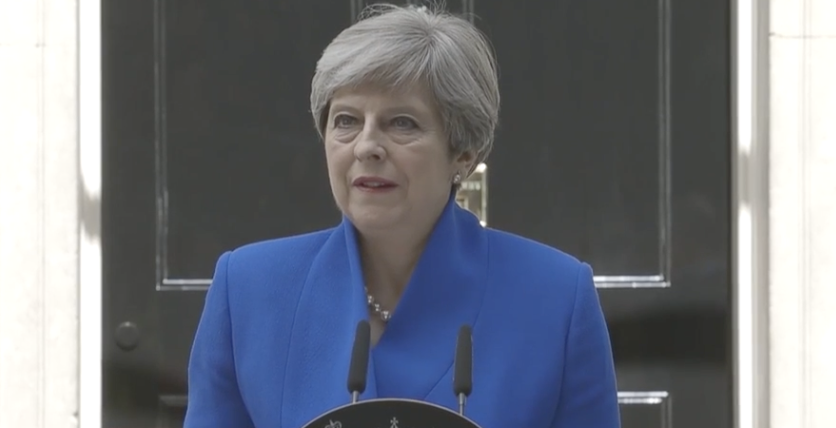
The general election held on 8 June 2017 resulted in a hung parliament, a shock outcome that saw the Conservative party lose its parliamentary majority and prime minister Theresa May’s authority severely diminished.
May, the Remain-supporting home secretary, succeeded David Cameron as prime minister on 13 July 2016 in the wake of the Brexit referendum. She called the snap election on 18 April 2017, despite previous insistences to the contrary, with a view to capitalising on the Conservative Party’s large poll lead (as high as 20 points) over Labour.
In her leadership campaign launch, May specifically ruled out an early general election, declaring: “There should be no general election until 2020.”
Under the Fixed-term Parliaments Act 2011, an election had not been due until May 2020. The 2017 contest was the only election called according to the measures set out in the 2011 act – which required the governing party to secure a two-thirds commons majority before parliament could be dissolved.
The prime minister’s thinking may have been influenced by the February 2017 Copeland by-election, which the Conservative Party won from Labour in a historic upset.
Whatever the case, May calculated that an election would see her majority increase, thus strengthening her hand in the forthcoming Brexit negotiations.
***
However, the Conservative Party’s hyper-personal, quasi-presidential campaign was widely seen as disastrous. It began with a clear emphasis on the slogan “strong and stable”, but was marred by missteps.
The Conservative manifesto launch in mid-May, the third week of the election campaign, emphasised a shift away from the politics of austerity. The manifesto, entitled Forward, Together, appeared to reject the laissez-faire policies of the Tory-Liberal Democrat coalition and featured pledges for greater state involvement.
It stated: “We do not believe in untrammelled free markets. We reject the cult of selfish individualism. We abhor social division, injustice, unfairness and inequality. We see rigid dogma and ideology not just as needless but as dangerous.”
But the manifesto as a whole was overshadowed by a controversial social care policy, dubbed the “dementia tax”. The policy, which would hit traditional Tory voters in the south of England hardest, suggested May was confident of victory come polling day.
Just four days after the manifesto launch, May was forced into an extraordinary U-turn. Attempting to downplay the reversal, she famously insisted: “Nothing has changed. Nothing has changed.”
Meanwhile, the Labour Party under Jeremy Corbyn’s leadership ran an unexpectedly effective and energetic campaign.
The Labour Party manifesto, entitled For the Many Not the Few, was well-received. It featured pledges to scrap tuition fees, nationalise England’s nine water companies, guarantee the triple lock for pensioner incomes, end to zero hours contracts, and re-introduce the 50p rate of tax on the highest earner.
In the manifesto’s foreword, Corbyn argued that the election was about the “what sort of country we want to be after Brexit. Is it one where the majority are held back by the sheer struggle of getting by? That isn’t the Britain Labour is determined to create.”
He added: “So let’s build a fairer Britain where no one is held back. A country where everybody is able to get on in life, to have security at work and at home, to be decently paid for the work they do, and to live their lives with the dignity they deserve.”
Labour’s policy platform was published alongside a costings document, which was conspicuously lacking when it came to the Tory manifesto.
Throughout the campaign, May refused to participate in any head-to-head television debates, insisting that she had already debated Corbyn many times in parliament.
May said at the time: “I’ve been very clear from the start that the sort of campaign I want to do is about taking questions, meeting people. I’ve not been off the television screens, I’ve been doing things on the television, but predominantly taking questions from voters and listening to voters.
“I think debates where the politicians are squabbling among themselves doesn’t do anything for the process of electioneering.”
Corbyn had also been considering his attendance at the BBC’s flagship election debate, held on 31 May, but announced just 24 hours before broadcast that he would be taking part.
Amber Rudd, the home secretary, ultimately attended in May’s stead. The prime minister’s absence evolved into a major debate and campaign issue.
Tim Farron, the Liberal Democrat leader, told the audience: “Where do you think Theresa May is tonight? Take a look out your window. She might be out there sizing up your house to pay for your social care.”
Farron’s remark, of course, was a reference to the Conservative Party’s disastrous social care policy.
***
The 2017 general election ultimately produced a hung parliament with the Conservatives as the largest party.
The Tories won 317 seats – a net loss of 13 and nine short of the 326 required for an overall majority. Labour made a net gain of 30 seats to finish on 262.
The Conservative and Labour parties secured 42.3% (up from 36.8% in 2015) and 40.0% (up from 30.4%) respectively. The combined total vote share for the two main parties, 82.3% of the UK vote, marked the highest since 1970.
The Scottish National Party (SNP) won 35 seats (down 21), and the Liberal Democrats won 12 (up 4). Notably, the UK Independence Party’s (Ukip) share of the vote fell from 12.6% in 2015 to 1.8% in 2017.
Turnout was 68.8%, up from 66.3% in 2015 and the highest since 1997.
Corbyn responded to the result with a call for Theresa May to resign as prime minister. Speaking from his election count, the Labour leader declared: “Politics has changed. Politics isn’t going back into the box where it was before. What’s happened is people have said they’ve had quite enough of austerity politics.”
He added: “[May] wanted a mandate. Well, the mandate she’s got is lost Conservative seats, lost votes, lost support and lost confidence. I would have thought that is enough for her to go.”
As the results came in, George Osborne, the former chancellor, said that he could not see how May could “survive in the long term”.
May addressed the nation in a speech on the steps of Downing Street in the aftermath of the campaign. The prime minister relayed that she had been to see the queen and that she had been asked to form a government.
She argued that what the country needed “more than ever is certainty” and vowed that the Conservative Party could deliver it.
May’s speech was criticised for failing to address the scale of the Conservative losses, acknowledge the MPs who had lost their seats or show humility regarding the shortcomings of the campaign.
***
To remain in power, May entered into negotiations with the Democratic Unionist Party (DUP).
After several weeks, a “confidence and supply” agreement was reached, in which the DUP’s 10 MPs agreed to support the Conservative minority government on key votes, such as the budget and motions of confidence, in exchange for an additional £1 billion in funding for Northern Ireland over five years.
The deal provided May with a narrow working majority, allowing her to remain in office, but it left her government constantly vulnerable to pressure from the DUP and eurosceptic voices on her backbenches, notably the European Research Group (ERG).
In the aftermath of the election, May’s two key political advisers, her joint chiefs-of-staff Fiona Hill and Nick Timothy, both resigned. They were viewed as crucial in persuading the prime minister to call the snap election and were blamed for the disastrous campaign that followed.
In an article for ConservativeHome, Timothy urged Conservative MPs to “get behind” May.
He wrote: “I take responsibility for my part in this election campaign, which was the oversight of our policy programme…
“Turning to the future, nothing matters more than the good government of the country. The Brexit negotiations are due to begin, and if the United Kingdom is to get the right deal, there is no time to waste. I hope the Conservative Party in parliament gets behind the prime minister, and allows her the political space to negotiate that deal.”
The House of Commons returned on 13 June for the first time since the election. MPs unanimously reelected John Bercow as speaker of the House.
Responding to Bercow’s election, May stated: “Mr Speaker-elect, on behalf of the whole House, may I congratulate you on your re-election? At least someone got a landslide.”
***
In the medium term, May was severely weakened by her decision to call the snap election and the disastrous campaign that followed.
In 2019, May failed to pass her Brexit withdrawal agreement through the House of Commons on three occasions, precipitating her resignation as prime minister.
May later expressed regret over the 2017 campaign.
Speaking to the Daily Mail in July 2019, shortly after her resignation, May stated: “Looking back, it wasn’t a ‘me style’ kind of campaign.
“I should have done the TV debates. I didn’t because I had seen them suck the life blood out of David Cameron’s campaign [in 2010].”

Politics.co.uk Newsletters
DAILY
Politics@Lunch
WEEKLY
Week in Review
