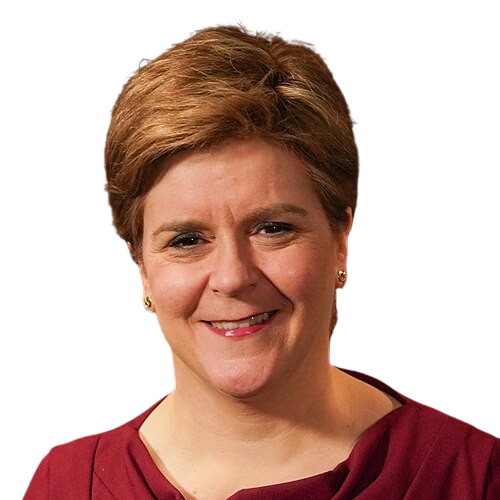
Nicola Sturgeon served as first minister of Scotland and leader of the Scottish National Party (SNP) from November 2014 until March 2023. She was the first woman to hold Scotland’s highest political office.
Sturgeon led the SNP during a period of sustained electoral dominance in Scotland, securing landslide results in general elections (notably 2015) and repeated victories in Scottish Parliament elections. Forbes magazine ranked her the 50th most powerful woman globally in 2016.
Sturgeon resigned unexpectedly as first minister in February 2023, citing the personal toll of the job. However, her departure followed controversies over proposed gender recognition reforms and the ongoing police investigation into SNP finances (Operation Branchform).
Sturgeon was arrested in connection with this investigation in June 2023 and released without charge. Police Scotland confirmed in March 2025 that she was no longer under investigation.
Sturgeon stood down as a member of the Scottish Parliament (MSP) at the 2026 Holyrood election.
Nicola Sturgeon: first minister of Scotland (2014-2023)
Sturgeon succeeded Alex Salmond as first minister in the aftermath of the 2014 Scottish independence referendum.
Under Sturgeon’s leadership, the SNP won 56 out of 59 available seats at the 2015 general election. Labour was the principal victim of this latest expression of nationalist sentiment, collapsing from 40 seats in Scotland to just one. Sturgeon remained in office as first minister following the 2016 Scottish Parliament elections, in which the SNP fell two seats short of securing a second consecutive overall majority. Sturgeon and the SNP, which remained by far the largest single party in the Scottish Parliament, led a minority government.
Initially, Sturgeon was careful not to push immediately for a second independence referendum as first minister. However, her position shifted after the 2016 Brexit referendum, when Scotland voted overwhelmingly (62% to 38%) in favour of remaining. Sturgeon forged a mostly cold relationship with Theresa May, the prime minister from 2016 to 2019, who pushed back against demands for a second independence referendum.
In the 2019 general election, the SNP secured 48 out of 59 seats in Scotland.
During 2020 and 2021, Sturgeon led the Scottish government’s response to the Covid-19 pandemic, becoming a familiar face through regular televised news conferences. Under Sturgeon, the Scottish government often took a different, generally more cautious, approach to Coronavirus restrictions compared to those followed by prime minister Boris Johnson’s government in England.
Buoyed by polls that suggested that a majority of Scottish voters favoured independence, the SNP under Sturgeon went into the 2021 Scottish Parliament elections actively campaigning for a second referendum on Scottish Independence. The SNP won 64 of the 129 seats, one short of an overall majority. The party, with Sturgeon as first minister, subsequently governed with the support of the pro-independence Scottish Green Party through a power-sharing deal known as the Bute House Agreement. Two Green MSPs, Patrick Harvie and Lorna Slater, were appointed as ministers. Under the deal, Green ministers attended cabinet meetings at least twice a year.
This coalition government, citing its electoral mandate, formally initiated its campaign for a second independence referendum. In June 2022, Sturgeon unveiled a series of papers titled Building a New Scotland, which were designed to build a fresh case for independence. She announced her intention to hold a consultative referendum on 19 October 2023.
However, the crucial question of the legality of the Scottish Parliament legislating for such a referendum without the consent of the UK parliament remained a significant obstacle. The Scotland Act 1998, which established the Scottish Parliament, reserves matters relating to the Union of the Kingdoms of Scotland and England to the UK Parliament in Westminster. To proceed with a legally binding referendum, a Section 30 order from the UK government would be required, a power the Conservative government at Westminster, under successive prime ministers Boris Johnson, Liz Truss, and Rishi Sunak, consistently refused to grant.
In an attempt to circumvent this, the Scottish government sought a ruling from the UK’s supreme court on whether the Scottish parliament had the authority to legislate for a consultative referendum on its own. In November 2022, the Supreme Court delivered a unanimous verdict, ruling that the Scottish Parliament does not have the power to legislate for a referendum on Scottish independence without the consent of the UK parliament. The court determined that any referendum, even a consultative one, would relate to the reserved matter of the Union and was therefore outside the legislative competence of Holyrood.
This ruling was a significant blow to the SNP’s strategy. In response, Nicola Sturgeon declared that the 2024 UK general election would be treated as a “de facto referendum” on Scottish independence. This new approach was met with some internal debate within the SNP.
In 2022/2023, the Scottish government under Sturgeon’s leadership introduced the Gender Recognition Reform Bill, which sought to amend the Gender Recognition Act 2004, making it simpler for people to change their gender without having to obtain a medical diagnosis. The UK government at Westminster, led by Rishi Sunak, ultimately intervened to block the bill from receiving royal assent, making use – for the first time – of a section 35 order under the Scotland Act 1998. Responding to the section 35 order on 17 January 2023, Sturgeon accused the secretary of state for Scotland, Alister Jack, of making a “direct attack on the institution of the Scottish Parliament”.
Meanwhile, the ongoing developments of Operation Branchform – a Police Scotland investigation into the SNP’s finances and the handling of funds raised for a future independence referendum campaign – were an increasingly destabilising backdrop. The probe, launched in 2021, intensified in early 2023. In the days before Sturgeon’s resignation, former SNP treasurer Douglas Chapman was among those reported to be contacted by the police.
In February 2023, Sturgeon announced her resignation as first minister, citing the personal toll of leadership and the need for a fresh voice.
Speaking at a press conference at the first minister’s official residence, Bute House in Edinburgh, Sturgeon said she knew in her “head and my heart” that the time was right to stand down. She cited the personal pressure of the job and argued that she could no longer commit the energy the role required. “It is only possible to give absolutely everything to a job of this nature for so long”, she said.
Sturgeon added: “Given the nature and scale of the challenges the country faces, I feel that duty, first and foremost, to our country – to ensure that it does have the energy of leadership it needs, not just today, but through the years that remain of this parliamentary term.”
Sturgeon’s departure triggered an internal SNP leadership contest.
In April and June 2023 respectively, Peter Murrell and Sturgeon were arrested by Police Scotland in connection with Operation Branchform. They were both released without charge. In April 2024, Murrell was re-arrested and charged with embezzlement. He appeared in court on 20 March 2025. At this time, Police Scotland also confirmed that its inquiries into Sturgeon had concluded.
Sturgeon and Peter Murrell
Sturgeon first met Murrell, her future husband in 1988 at an SNP youth event in Aberdeenshire which he helped organise. However, their romantic relationship reportedly only began years later, around 2003, when they were both deeply involved in SNP politics.
There was said to be “great excitement” among SNP activists when their relationship became public knowledge around the time of the 2004 SNP conference.
Murrell and Sturgeon married on 16 July 2010 in a ceremony in Glasgow.
As husband and wife holding the posts of party chief executive and first minister/party leader respectively, their combined influence at the top of the SNP was unparalleled for many years.
Murrell resigned as chief executive on 18 March 2023. His resignation followed disputes over the accuracy of information provided by SNP headquarters regarding party membership figures during the leadership contest to succeed Sturgeon.
In his resignation statement, Murrell said: “Responsibility for the SNP’s responses to media queries about our membership number lies with me as chief executive.
“While there was no intent to mislead, I accept that this has been the outcome. I have therefore decided to confirm my intention to step down as chief executive with immediate effect.”
On 5 April 2023, Murrell was arrested at his home as part of Operation Branchform. He was questioned and released without charge later that day, pending further investigation. Police also searched the SNP’s headquarters in Edinburgh and confiscated a luxury motorhome parked in the driveway of Murrell’s 92-year-old mother in Fife.
On 18 April 2024, Murrell was re-arrested and subsequently charged by Police Scotland with the embezzlement of funds from the SNP. He was released from custody after being charged.
Sturgeon announced in January 2025 that she and Murrell had separated.
On 20 March 2025, Murrell appeared in court in Edinburgh charged with embezzlement. He made no plea and was released on bail.
On 25 May 2026, Murrell pleaded guilty at the High Court in Edinburgh to embezzling more than £400,000 from the SNP over a 12-year period.
On 23 June 2026, Murrell was sentenced to five years and three months in jail.
Murrell used the money to buy various expensive luxury goods, including jewellery, cosmetics, a robotic lawn mower, gaming equipment, high-end pens, watches, two cars, rare books and a motorhome – as well as low-cost items such as chopsticks, a laundry basket, a shoe rack and hand cream.
The most expensive purchase made was the £124,550 motorhome in 2021, which he parked on his mother’s driveway.
Nicola Sturgeon and Alex Salmond
Sturgeon first encountered Alex Salmond in 1990 when she worked on his successful campaign for the SNP leadership. Salmond later described her at that time as “a precocious teenage prodigy…bubbling with vitality and talent”.
Sturgeon herself has acknowledged Salmond’s early influence, stating he “believed in me, long before I believed in myself”. Peter Murrell also previously worked in Salmond’s office.
From 2007 to 2014, Salmond and Sturgeon led the Scottish Government as first minister and deputy first minister.
However, this close political partnership disintegrated following allegations of sexual harassment against Salmond dating from his time as first minister, which emerged publicly in 2018. Salmond strongly denied the allegations. He resigned his membership of the SNP in August 2018 while challenging the fairness of the Scottish Government’s internal investigation procedure.
In January 2019, the Court of Session ruled that the government’s investigation had been unlawful and awarded Salmond £512,000 in legal costs.
Separately, following a police investigation, Salmond was arrested and charged in January 2019. In March 2020, Salmond was found not guilty on 12 sexual assault charges.
The handling of the initial complaints against Salmond led to a highly publicised and acrimonious fallout between him and Sturgeon, and became the subject of a Scottish Parliament committee inquiry (often referred to as the ‘Salmond inquiry’) in 2020-2021. The inquiry was set up to “consider and report on the actions of the first minister, Scottish Government officials and special advisers in dealing with complaints about Alex Salmond, former first minister, considered under the Scottish Government’s ‘Handling of harassment complaints involving current or former ministers’ procedure and actions in relation to the Scottish ministerial code.”
Murrell, Sturgeon’s husband and SNP chief executive, denied the suggestion that there was a “plot” to ensure Salmond’s downfall when he appeared before the inquiry to give evidence on 8 December 2020.
On 17 March 2021, David Davis – a Conservative MP and close friend of Salmond – used parliamentary privilege to criticise the Scottish Government’s handling of allegations against Salmond.
The inquiry report, published on 23 March, found that the Scottish government’s handling of harassment complaints against Alex Salmond was “seriously flawed”. It also found that Sturgeon had misled their inquiry in her evidence. The finding stopped short of ruling Sturgeon misled parliament “knowingly”. Sturgeon was also cleared of breaching the ministerial code by a separate independent inquiry headed by senior Irish lawyer James Hamilton.
In the aftermath of the report’s publication, Sturgeon survived a motion of no confidence brought against her by Ruth Davidson, the former leader of the Scottish Conservatives.
On 26 March 2021, Salmond officially launched the Alba Party and assumed its leadership. Alba’s formation was fuelled by the breakdown in the relationship between Salmond and Sturgeon.
The party was established to contest the regional lists in the 2021 Scottish Parliament elections with the stated aim of building a “supermajority for independence”. Alba’s core ideology was fundamentalist Scottish nationalism, arguing for independence to be treated as an “immediate necessity”. The party argued that the Scottish government does not need “permission to choose independence.”
Notably, Alba was staunchly opposed to the Gender Recognition Reform Bill. Salmond described holding a gender-critical belief as a “cardinal aspect of Alba policy”.
Responding to Alba’s formation, Sturgeon said: “I take no pleasure whatsoever in saying this but I think there are significant questions about the appropriateness of his return to public office given the concerns that have been raised about his behaviour previously but that’s for voters to judge and decide.”
In the 2021 election, Alba secured 44,913 votes (1.7%) on the regional list vote and zero MSPs.
In October 2023, the party gained its first representative in the Scottish Parliament when Ash Regan, a former SNP leadership contender and minister, defected to Alba. However, in subsequent years, the party declined in the face of political, personal and financial pressures.
In October 2024, Salmond died unexpectedly.
Sturgeon paid tribute to Salmond as her mentor.
She said: “I am shocked and sorry to learn of Alex Salmond’s death. Obviously, I cannot pretend that the events of the past few years which led to the breakdown of our relationship did not happen, and it would not be right for me to try.
“However, it remains the fact that for many years Alex was an incredibly significant figure in my life. He was my mentor, and for more than a decade we formed one of the most successful partnerships in UK politics.
“Alex modernised the SNP and led us into government for the first time, becoming Scotland’s fourth First Minister and paving the way for the 2014 referendum which took Scotland to the brink of independence.
“He will be remembered for all of that. My thoughts are with Moira, his wider family and his friends.”
Alba was voluntarily de-registered with the Electoral Commission on 26 March 2026.
What is Nicola Sturgeon doing now?
Sturgeon continued to serve as an MSP after her resignation as first minister, only standing down from the Scottish Parliament in 2026.
In 2025, Sturgeon published her memoir Frankly.
In March 2025, Police Scotland confirmed that Sturgeon was no longer under investigation as part of Operation Branchform.
Sturgeon’s early political career (1992-2014)
Sturgeon stood as the SNP candidate for the Glasgow Shettleston constituency in the 1992 general election. At only 21, Sturgeon was Scotland’s youngest parliamentary candidate at that election. She placed second with 6,831 votes (19.1%) – some distance behind Labour’s David Marshall with 21,665 votes (60.6%).
Sturgeon contested the Glasgow Govan constituency in 1997, again placing second. This time she was only 2,914 votes behind the triumphant Labour candidate.
Sturgeon was elected to the Scottish Parliament in 1999 as a regional list MSP for Glasgow.
Sturgeon expressed interest in standing for the SNP leadership in 2004 after the incumbent, John Swinney, stood down. However, she chose instead to stand for the deputy leadership after Salmond indicated he would stand for the leadership. Both Sturgeon and Salmond were successful.
At the time, Salmond did not have a seat in the Scottish Parliament and so Sturgeon acted as leader of the SNP group at Holyrood. Her leadership was a factor in the SNP’s breakthrough at the 2007 election, which resulted in her appointment as deputy first minister.
Alongside her role as deputy first minister (2007-2014), Sturgeon held further executive responsibilities, serving as cabinet secretary for health and wellbeing (2007-2012), where she earned praise for her handling of the 2009 Swine Flu pandemic, and cabinet secretary for infrastructure, investment and cities (2012-2014).
The Sturgeon-Salmond leadership spearheaded the 2011 Holyrood SNP campaign which, against expectations, delivered an outright majority for the SNP in the Scottish Parliament. This historic victory paved the way for the first Scottish Independence referendum, which was held in September 2014. Sturgeon played a leading role in the unsuccessful “Yes” campaign.
Before politics
Sturgeon was born on 19 July 1970.
Sturgeon studied law at the University of Glasgow, graduating in 1992.
Sturgeon completed her legal traineeship from 1993 to 1995 at McClure Naismith, a Glasgow law firm. She then worked as a solicitor for Bell & Craig in Stirling, and later at the Drumchapel Law Centre in Glasgow (1997-1999).
Sturgeon entered the Scottish Parliament as an MSP in 1999.
Trivia: things you may not know about Nicola Sturgeon
Sturgeon is known to be an avid reader, particularly enjoying fiction. She has previously described herself as a “historical fiction geek” and has often shared book recommendations. In an interview with the Daily Record in 2012, Sturgeon showed off an impressive bookshelf.
In her interview for BBC Radio 4’s Desert Island Discs, Sturgeon revealed her love of 1980s music, choosing tracks by bands like Duran Duran and Wham!. Sturgeon said she was an “80s girl at heart”.
In the aforementioned 2012 interview with the Daily Record, Sturgeon confessed she cannot cook. “I don’t cook”, said Sturgeon, adding, “Dinner would be interesting if I was to try to cook it. I have had lots of disasters and I now prefer not to try, but Peter [Murrell] is a good cook and he enjoys it. I am hopeless”.
Nicola Sturgeon has not written for Politics.co.uk.