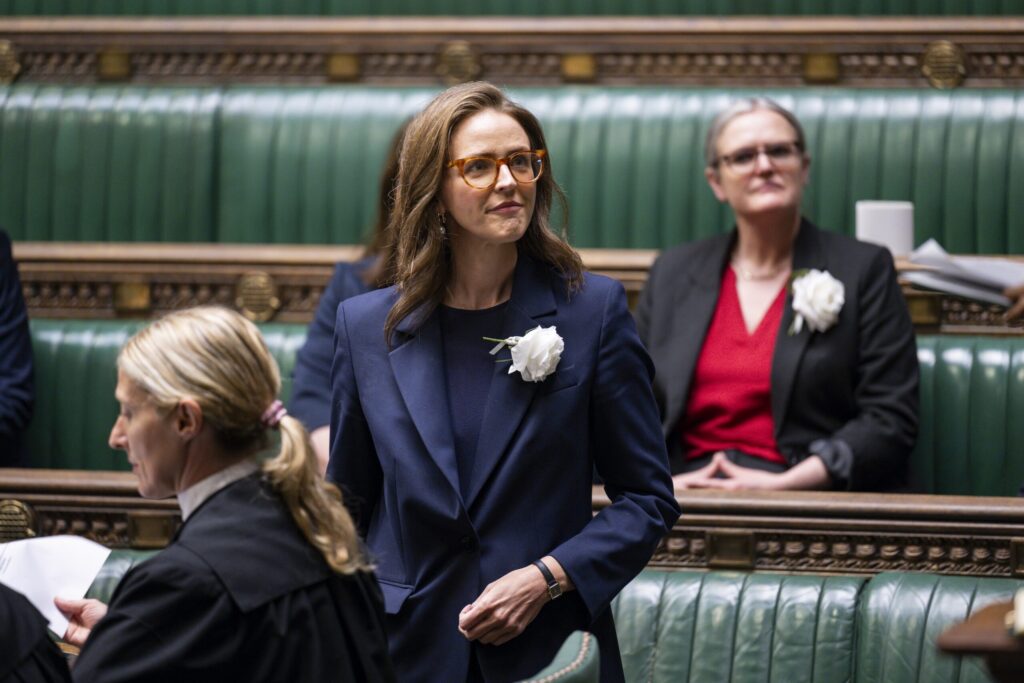
Lauren Edwards didn’t expect to be in this position.
The Labour MP tasked with hauling the assisted dying bill back through the House of Commons was on a conference call about local government reorganisation when the private members’ bill ballot, the theatrical mechanism for deciding the fate of backbench legislation, was drawn. “You sort of go, oh, I’ll check my inbox”, she tells me.
A total of 485 members entered the ballot. Nus Ghani, the senior deputy speaker sporting white silk gloves, indicated that this was a record.
Edwards was drawn second.
“I saw that I’d been successful, and then I scanned the names, and I saw that I was second, and I was like, ‘Oh God, who’s first?’ And it was Desmond Swayne” – a committed opponent of the assisted dying bill.
Edwards left the conference call without saying goodbye and rushed to tell her partner: “Oh, something big’s happened.” He responded that her phone had not stopped ringing.
As the highest-placed supporter of assisted dying in the ballot, Edwards understood that the “huge responsibility” of reintroducing the bill – which was lost in the House of Lords at the end of the last parliamentary session – now fell to her.
Edwards’ position predates her time in parliament. As a Labour candidate, she recalls being asked by interest groups on both sides of the debate how she would vote if the question of assisted dying, as was widely anticipated, came before the commons. This process of investigation and introspection led her to conclude she would support it.
“I’ve always supported the freedom of bodily autonomy and choice. I have always been a pro-choice person in terms of abortion laws”, she says. During the 2024 election campaign, she told campaigners that she “would probably support it. I would just need to make sure that the safeguards were robust.”
Edwards backed Kim Leadbeater’s bill at every turn during its commons journey, and she is full of praise for her de facto predecessor. She also insists that the process of scrutiny improved the legislation, arguing that the most significant change – the move from judicial sign-off to multidisciplinary review panels – represented a “robust strengthening of the bill.”
But Edwards did not contribute to commons proceedings on the assisted dying bill in last session, instead deferring to those with a legal or a medical background. “I didn’t think I necessarily would have added value when a lot of other people were making really considered points based on their personal experiences as GPs”, she explains.
Edwards’ decision to take up the bill is underpinned by her deep frustration at how the last attempt ended. She blames a “very small number of unelected peers” for talking the bill out during the last session, and remarks that debates in the House of Lords had been described to her as “quite nasty”.
She believes two principles are at stake this time around: “Firstly, our support for the bill and for the principle of assisted dying, and then secondly – really the main one being – do you think that what they did last time was all right?”
The conduct of the House of Lords will be a core issue as the bill returns, centring on the possibility that MPs could push the bill through parliament without it being approved by peers. Edwards describes the months since her name was drawn from the PMB ballot as a crash course in constitutional procedure. “I’ve had to know a lot more about that than I ever necessarily would have liked”, she says of the Parliament Act – the rarely-used statutory mechanism that lets an identical bill twice passed by the commons become law without the consent of the Lords.
Edwards is careful to stress that she does not go into the debate wanting, or even expecting, to make use of the Parliament Act. But she is prepared for the possibility, describing the act variously as a “backstop” and an “insurance policy” during our conversation.
Edwards tells me: “If the Parliament Act had to be in play, it wouldn’t be anything that I would be doing, it wouldn’t be anything that Kim Leadbeater would be doing, or anyone in the House of Commons would be doing.
“It would be if that same small group of people talked it out again. That is the only way that it would be in play.”
She adds: “I hope that [the Parliament Act] sitting in the background will incentivise them to behave appropriately and do the important role that they are there to do, which is to scrutinise, improve, refine legislation that we pass as the elected chamber.
“I would be hugely disappointed if they didn’t do that… It would immediately start conversations around the need for House of Lords reform. But I suspect that some of them probably would feel so strongly that maybe they wouldn’t care.
“I am entirely hoping that we will be able to send it back to them, and they can just continue to scrutinise it in the normal way… I just need to have that as a backstop.”
The decision to keep the Parliament Act on the table has major consequences for the bill’s commons stages. Edwards is unapologetic that she and her co-sponsors will resist pressure by MPs to amend it this time round. “We can’t amend it in the House of Commons because we need the bill to be in the same form – essentially within a couple of sort of minor tweaks that are allowed under the rules – that left here at third reading.”
Accepting substantive amendments from MPs, Edwards maintains, would mean that the “Parliament Act insurance policy won’t be there in the background, and we’ll be in the same situation where they will just talk it out again.” As such, Edwards plans to get the bill through the commons and into the upper chamber as quickly as possible, allowing the “maximum amount of time before the next king’s speech to go through the normal processes” in the Lords.
I ask whether MPs who backed the bill last session feel any squeamishness about the prospect of using the Parliament Act. “Only from people who… have got the wrong end of the stick about what it means”, she replies. Edwards says she has told those MPs that keeping the Parliament Act in play is not the same as “slamming” the legislation through the Lords, adding this is “not what I want to happen”.
Edwards does not rule out accepting amendments altogether. “It’s not bad legislation. It was robust, good legislation, but is it perfect legislation? No, I want it to be able to go through and be amended in the normal way [in the Lords].” By way of example, Edwards points to an agreement between her, Lord Falconer and representatives of Hospice UK “about some amendments to support the hospice industry”. But she adds that for these changes to happen, “the Lords need to take it seriously and not filibuster.”
Edwards is at her most animated when I put to her the argument, made by some Labour opponents of the legislation, that reopening this fight risks the party’s unity at a crucial moment. She rejects it outright. “This is giving people who are facing suffocating in their beds, who are facing faecal vomiting, who are facing being on a cocktail of painkillers, and knowing for months that they’re going to have a terrible, undignified death – [how could] we say, oh, that’s a distraction?”, she responds.
Assisted dying is, in her telling, precisely the kind of question elected politicians exist to answer. “That is the kind of knotty, difficult – I would argue, progressive – social change that we need to be discussing. That is key to our role as being a member of parliament.”
She adds: “We can’t say, ‘Oh, it’s a little bit tricky for us as a parliamentary Labour Party’. I think most people are professional and respectful of other people’s views, and it’s just very important that we maintain that.”
Edwards is candid that the second reading debate’s outcome is genuinely unknown. “Turnout will be an incredibly important factor in how the vote ultimately goes, and I think it will be very, very close”, she says. One dynamic that could work in the bill’s favour, she suggests, is that some opponents in the last session might abstain, in protest at the conduct of the Lords.
For Edwards, defeat at this stage would amount to the intolerable concession “that the unelected House of Lords can talk out our legislation. I don’t think that’s right.”
***
Edwards, first elected to parliament in 2024, has been a backbencher for the duration of her tenure as an MP. Turning to the turbulence of the past two years, I invite her to reflect. “I think it feels like from the first moment that you get elected that you’re on this rollercoaster”, she replies.
In the difficult moments, Edwards was sustained by what she describes as “those little wins that you can really hang on to”. She points to “opening up a new breakfast club, or a new nursery in a little primary school that wouldn’t necessarily be there if the government had not given money for them to change the use of the building”.
Edwards largely steered clear of the public debate over Labour’s future that dominated politics for much of the first half of this year. “I don’t think it’s my role to go out and publicly complain about all the things that I’m unhappy with”, she reflects.
But when prompted on specifics, Edwards is quietly scathing about the defining mistakes of Starmer’s premiership. She suggests the party relied too heavily on a “Cameron-Osborne playbook when talking about our inheritance” following the 2024 general election. Upon her selection as a parliamentary candidate, Edwards was quoted by a local newspaper saying, “I want to give people a sense of hope again.” She now believes that, “in the early days of the government, we forgot that.”
Edwards was among the signatories of the rebel reasoned amendment to the government welfare bill in June/July 2025, which she remembers as “a big deal for me”. She felt her action necessary “because we weren’t being listened to.”
Under the current government, Edwards points to the significantly improved level of engagement with backbenchers. “They’re very keen now to understand what our professional background is, what we bring to the table in terms of our expertise – and I’m afraid those conversations did not happen under the last prime minister and the last government.”
Finally, I ask what Edwards made of Keir Starmer’s resignation as an MP earlier this month.
“I was disappointed”, she responds. “I would have undoubtedly preferred that he waited a couple of weeks so that he could have voted in favour of the legislation” – referring to the former prime minister’s support for assisted dying.
She struggles, on reflection, to account for it: “I must confess I don’t understand the timing of his announcement…
“I think probably, with a bit of time and reflection, he moved to a different assessment of what was going to be the best future for him. But I absolutely was disappointed that he won’t be there to vote in favour of this bill. Because of his experience as a director of public prosecutions… he would have been a really strong voice speaking to that and why the law needs to change.”
For her closing pitch ahead of the bill’s second reading debate, Edwards refers to the support for assisted dying “across the country and in our constituencies”.
She states: “We owe it to those people who will potentially need to use the legislation, but also just to the general public who we know supports it, to resolve this issue. We cannot allow the can to be kicked down the road for another 10 years.”
She concludes by calling for a “transparent, democratic process.”
“I think if we don’t do that, there will be big implications for people’s faith in our political system, and for terminally ill people and their families.
“[They ask] ‘Why can I only go to get an assisted death if I have over £15,000 in my bank account and I can go to Dignitas? But if I do that, I have to go alone – because if my family come with me, they could potentially be interviewed by the police.’
“We owe it to those people to find a resolution.”
As we leave her office, a supportive MP passing in the corridor calls on Edwards to block out the “haters”. I get the sense that these words of encouragement were genuinely appreciated on Edwards’ part.
A combination of chance and determination has propelled Edwards to the centre of the most difficult conscience debate parliament has faced in its recent history. Whatever the scale of the hurdle today, success would promise months of unprecedented procedural intrigue and constitutional brinkmanship – all in the face of resolute opposition.
The test, for Edwards and this bill, begins in earnest.