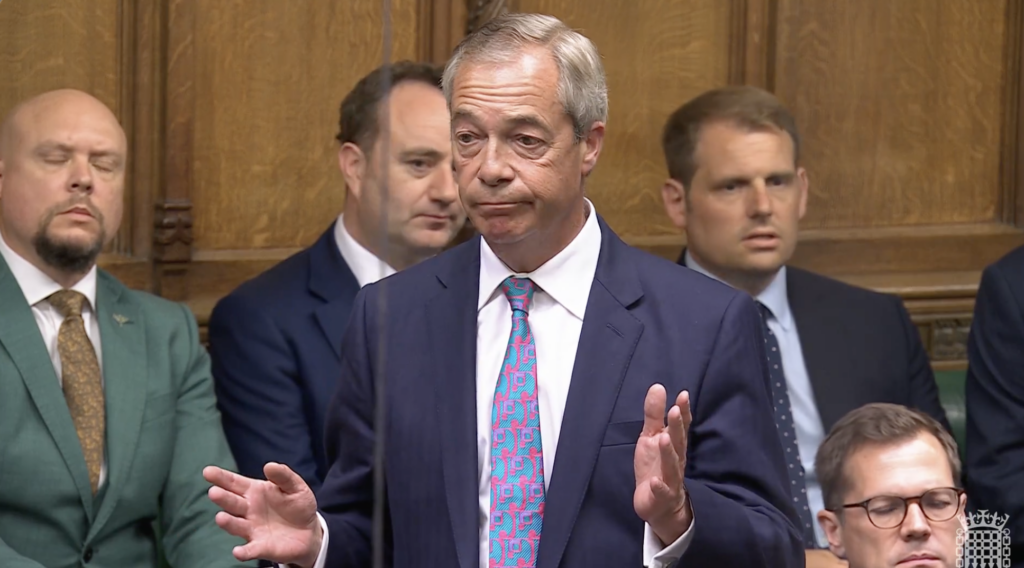
Nigel Farage’s statement on Tuesday afternoon, broadcast live from Reform UK headquarters, was supposed to be sensational. After weeks of relative quiet, Farage teased his intervention with a statement on social media, promising an update on his “future in public life”. The scene was set.
In Trumpian tones, Farage put on a furious front as he portrayed an anti-Reform conspiracy spanning the political class, press and parliament. He addressed the damaging accusations, centred on unregistered donations of cash and support, but insisted that he had done nothing wrong. The political class was guilty, he said, of employing “foul means” to thwart his political project and “threatening” the security of his family.
Farage resolved to stand down as a member of parliament, promising a “people versus the establishment by-election” and an opportunity to “continue the political revolution”.
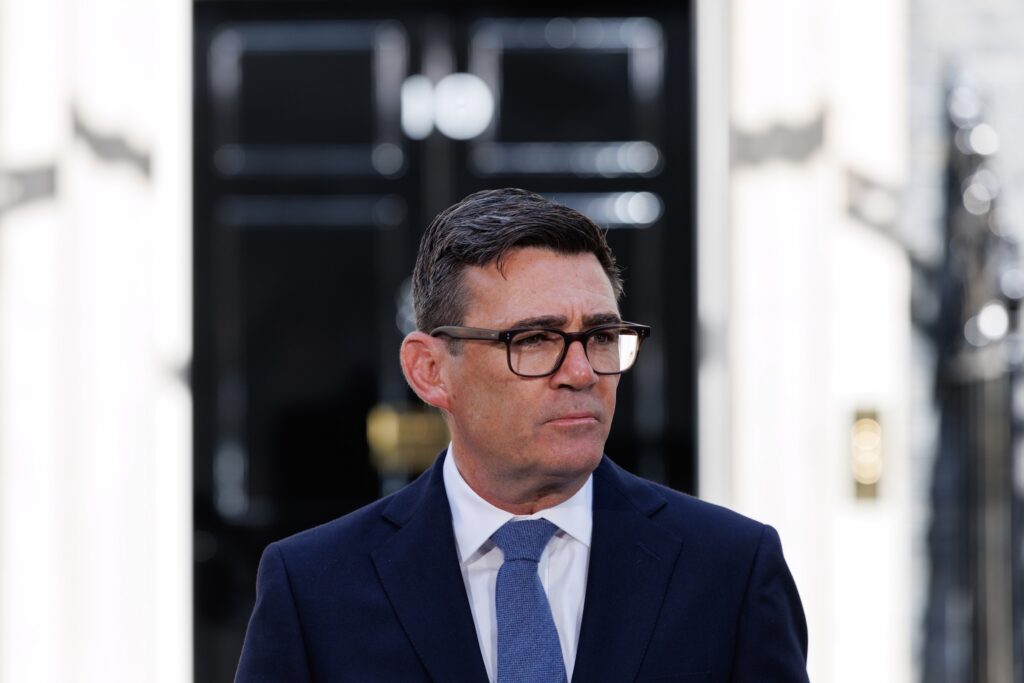
Farage’s political calculus is prejudiced towards spectacle. He reasoned that a limited contest in Clacton, the Reform capital of Great Britain, would reconfigure the political narrative – distracting from Andy Burnham’s coronation and sidelining reports of Reform sleaze.


Farage succeeds when politics is played on his terms. A preemptive assault on the parliamentary standards regime, characterised by populist appeals to “people” and scathing castigations of a conspiratorial establishment, could also restore Reform’s lost momentum.
The wheeze rested on some fairly reasonable assumptions. The purpose of self-imposed by-elections, according to their instigators, is to force a genuine test of principle onto a reluctant political class. If there is a constituency in the country willing to accept Farage’s tale of martyrdom at the hands of a vengeful establishment, it is Clacton.
So the stakes could be controlled. There would be no chance of Reform losing; instead, the likely landslide would be seized upon as a sign of popular vindication. The raw political power of Farage’s victory would delegitimise the parliamentary inquisition.
But in at least one crucial respect, Farage and Reform’s political operation badly miscalculated: their plan depended on opponents playing along.
One by one, the established parties – Labour, the Conservatives and Liberal Democrats – acted according to their obvious incentives and declined to engage. Speaking to the Daily Mail on Wednesday, Farage confessed that he had been wrong-footed by this remarkable show of strategic unity on the part of the established parties. Asked if he had considered the possibility of fighting as the only candidate from a major political party, Farage responded: “No, of course not.”
This abstention, following the recent precedent of the 2008 Haltemprice and Howden by-election, upends Farage’s gambit. Reform’s failure to register the possibility that the parties might refuse to engage points to a distinct lack of strategic clarity.
Count Binface, the satirical candidate and self-styled intergalactic space-warrior, has now emerged as Reform’s principal rival. The 2026 Clacton by-election still promises spectacle then; just not on Farage’s terms. Andy Burnham, Britain’s next prime minister, believes Binface is “carrying the hopes of the nation”.
In the 2024 general election, the Labour, Liberal Democrat and Green candidates secured a collective 11,399 votes (24.8%) in Clacton. The incumbent Conservative candidate, Giles Watling, placed second with 12,820 votes (27.9%). Assuming much of the Conservative vote in Clacton is resilient – since voters sympathetic to Reform would likely have migrated to Farage in 2024 – there remains a genuine anti-Reform bloc in Clacton.
But Binface’s candidacy does not need to threaten Farage electorally to be damaging. His campaign could prove the perfect counterpoint to the Reform leader’s martyr complex.
As with Liz Truss and the lettuce, a serious political saga – in this case Farage’s finances and political future – could find itself reduced to a single, absurd image. These stories have a habit of embedding themselves in the public consciousness. Already, Ipsos polling suggests that one in three British adults (33%) would prefer Count Binface to win the Clacton by-election, versus 21% who support Farage.
Farage trades in political theatre, and increasingly in internet virality. While he will surely survive his brush with Binface, a protracted campaign against a novelty candidate, whose whole brand rests on attracting attention, could leave some not inconsiderable battle scars.
The source of Reform’s success in recent years, which extended to the Scottish Parliament and Senedd Cymru in May, has been its professionalisation as a political operation. Research conducted since the 2024 general election suggests that a growing number of Britons see Farage as a credible candidate for Downing Street. A by-election in which Reform’s main competitor is Count Binface will do little to support Reform’s argument that it is a serious alternative to the established parties. Rather, the campaign will be characterised as an amusing sideshow as Andy Burnham enters Downing Street. Simply put, Farage will be forced to own the farce he has invited upon his Clacton constituents.
The campaign will also provide an extended platform for Farage’s opponents, including his more conventionally dressed critics, to address his funding controversies. The contest will bring allegations of Reform sleaze into the full glare of the electorate, priming the public for the release of the standards committee report and any resulting sanctions. Labour and the Conservatives can spend weeks honing their attack lines.
But even more pertinently, Farage’s by-election strategy reflects a strategic regression into Trumpian rhetoric. Robert Jenrick, the Reform Treasury spokesperson, has called the parliamentary investigation into Farage “a kangaroo court” and “a stitch-up”. In his Daily Mail interview, Farage said the committee would issue a “completely subjective judgment”, adding: “There’s no objectivity in this.”
Farage’s Trumpist turn might resonate with his base, consolidating support among the converted, but it risks shrinking Reform’s appeal in the long run. According to YouGov polling, a full 57% of Reform voters in 2024 support or strongly support Farage’s decision to call the Clacton by-election, with only 7% strongly opposed. Among all voters, 32% are strongly opposed to the decision to trigger the by-election and 11% are somewhat opposed. Meanwhile, 40% of Reform voters believe Farage has been honest about his financial affairs, compared to 12% of the country at large; 60% of the country believes that Farage has not been honest.
For Reform, the greatest danger is that Farage’s populist posturing steers the party away from the median voter and reveals the underlying limits of its coalition.
After all, the extent of Farage’s miscalculation can be explained in terms of what he wanted, and what – in a matter of days – has come to pass.
Farage sought a symbolic confrontation with the establishment – a referendum on his leadership and Reform’s platform in the most favourable conditions imaginable. After two successive by-election defeats, he wanted his own Makerfield moment. He hoped to generate momentum and change the narrative, distracting from damaging media scrutiny. A conquest in Clacton, he calculated, would infuse the Reform project with renewed energy and purpose.
Instead, Farage is defending his 8,405-vote majority against a bin. The lack of a “real” rival will produce a campaign dominated by media scrutiny, thus compounding the very crisis the wheeze was designed to resolve. All the while, the Farage sideshow will be a source of ammunition for camp Burnham as the handover is completed later this month.
Farage turned to Clacton in search of popular vindication, but humiliation awaits.
Politics.co.uk is the UK’s leading digital-only political website. Subscribe to our daily newsletter for all the latest news and analysis.