Ed Miliband narrowly defeats brother David to become Labour leader
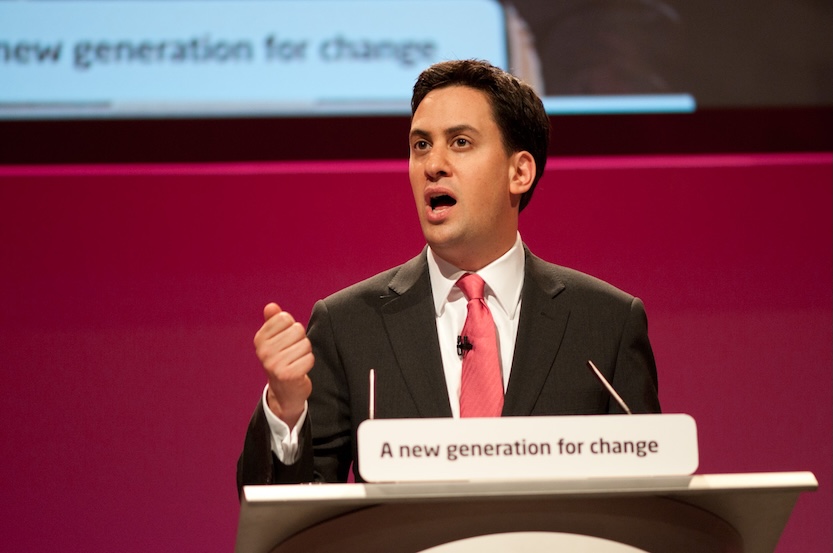
On 25 September 2010, Ed Miliband was elected leader of the Labour Party, narrowly defeating his older brother and former foreign secretary David Miliband.
The result, announced at a special conference in Manchester, marked a significant milestone in Labour’s transition to opposition after 13 years in government under Tony Blair (1997-2007) and Gordon Brown (2007-2010).
The contest was triggered by Brown’s resignation in May 2010 and the negotiation of the Conservative-Liberal Democrat coalition. Under Labour’s leadership election rules, candidates needed to secure the support of 12.5% of the Parliamentary Labour Party (PLP). After the 2010 election, which returned 258 MPs, the threshold stood at 33.
Five candidates successfully met this threshold: David Miliband (81), Ed Miliband (63), Ed Balls (33), Andy Burnham (33) and Diane Abbott (33).
John McDonnell announced his intention to stand but failed to secure the requisite nominations.
David Miliband nominated Abbott, a member of the left-wing Socialist Campaign Group (SCG). Abbott was also nominated by Harriet Harman, the interim Labour leader, to ensure an ideologically broad debate.
***
The contest was quickly seen as a two-horse race between the Miliband brothers. David, long-touted as a future Labour leader, was seen as the frontrunner – and the favoured candidate of his party’s ‘Blairite’ wing.
Ed, the former energy secretary, positioned himself to the left of his older brother.
Launching his candidacy, Ed stated that he was “proud” of what the 1997-2010 Labour government achieved, but said “deep thinking” was needed about “what went wrong”.
He argued the “central lesson” of the 2010 general election was that the government “lost that sense of progressive mission” and became “more caretakers than idealists; more technocratic than transformative.”
He added: “When political parties lose that sense of idealism and mission they become much more vulnerable to the currents of events.”
He framed immigration as a “class issue”, contrasting the view of an employer, for whom it is good to hire at “lower cost” with that of a builder. The latter, Miliband said, could view immigration as a “threat to your livelihood”.
He continued: “We never had an answer for the people who were worried about it.”
During the campaign, Miliband declared New Labour to be “dead” and denounced a perceived drift to “brutish US-style capitalism”.
These comments were designed to signal a more definite break with the past than offered by his fraternal opponent.
Ed’s positioning secured the support of three of the four biggest trade unions, Unite, Unison and the GMB. Ed was also endorsed by Neil Kinnock, the former Labour leader, who praised his prospective successor’s “leadership qualities”.
Kinnock described the younger Miliband as a “modern democratic socialist because he has got strong values and he is very practical”.
Tony Benn, Roy Hattersley and Margaret Beckett were among other senior figures to support Ed’s candidacy.
***
David Miliband, speaking at his campaign launch, said he would stand as a candidate “with humility in the face of the responsibility this post brings”.
He added: “We must renew, but we must be ready for government. We live in a new political world, and the responsibility of office may return sooner than people might think.
“I am standing because I believe I can lead Labour to rebuild itself as the great reforming champion of social and economic change in this country.
“The decision of the Liberal Democrats to join a Conservative government is a momentous one. It creates an enormous responsibility for the Labour Party, revitalised in the right way, to represent all shades of progressive opinion and present itself as an alternative government.
“That is the task in front of us.”
The 2010 contest was the last held under the Labour Party’s old electoral college system, which weighted votes equally among three sections: affiliated trade unions, individual party members, and Labour MPs/MEPs.
In the final round of the alternative vote ballot, David won a clear majority of support from MPs (53.4%) and also narrowly won among party members (54.4%). However, Ed secured 59.8% of the affiliated supporters’ section. It was enough to overcome his brother’s lead among members and MPs, providing an overall victory of 50.7% to David’s 49.3%.
In his victory speech, Ed acknowledged the political and personal significance of the contest. He paid tribute to his brother and called on the party to unite against the coalition government.
He said a “new generation” had taken charge of Labour and vowed to change the party.
Ed said that the Labour Party in the future should be a “vehicle that doesn’t just attract thousands of young people but tens of thousands, hundreds of thousands of young people who see us as their voice in British politics today.”
He paid tribute to his two immediate predecessors, Brown and Blair, but added: “We lost the election and we lost it badly. My message to the country is this: I know we lost trust, I know we lost touch, I know we need to change.
“Today a new generation has taken charge of Labour, a new generation that understands the call of change.”
Speaking to BBC News, David responded: “You don’t start these contests if you’re not keen to win, but also reconciled to the prospect that you might lose…
“This is Ed’s day – I’m obviously genuinely delighted for him, because if i can’t win, then he should lead the party. And the party’s now got a responsibility to look to the country, to set out what we stand for [and] expose what we think is wrong with what the coalition is doing…
“It’s a huge day for the Miliband family, not quite the day for the Miliband family that I would have wanted – the Miliband D family, rather than the Miliband E.
“But that’s the way things go.”
After the result was announced, former home secretary David Blunkett commented: “We’ve never seen anything quite like what we’ve had, with two brothers neck and neck. These are brothers. They’re blood brothers.
“They can’t afford to fall out in the way we had with Tony and Gordon, and neither can we.”
***
On 29 September, David announced that he would not seek election to Ed’s shadow cabinet. In a letter to the chairman of his constituency Labour Party, David said the decision was about enabling his brother to make a “fresh start”.
He wrote: “This is now Ed’s party to lead and he needs to be able to do so as free as possible from distraction. Any new leader needs time and space to set his or her own direction, priorities and policies…
“I genuinely believe that I can best serve Ed, the party and the country from a new position”.
David stood down from parliament in March 2013, saying he “feared being a distraction”.
He told the BBC: “I feel a sense of sadness because I am British. I love Britain. I am passionate about Labour, but I have had to make a choice about where I can make my best contribution.”
He added: “I am taking a job in America, not taking citizenship in America. I will continue to follow what’s going on here, but my focus is going to be making a difference through the International Rescue Committee.”
Ed responded that the move would leave British politics in “a poorer place”.
In November 2013, Ed said his relationship with his older brother had yet to fully recover after the 2010 leadership election.
He told BBC Radio 4‘s Desert Island Discs: “It has been incredibly tough; really, really tough. I didn’t take this decision [to stand in the election] lightly. I knew it would have an impact on my family and on him.
“What I thought was: ‘This is going to be hard but I’ve got things to say and things to do which I am in a better place than him or others to say and do about the way we need to move on from New Labour, about things that need to happen in the country.’”
***
The contest came to define Ed Miliband’s tenure as leader, as he sought to move the party away from its New Labour years.
As leader, the younger Miliband embraced a “One Nation Labour” image – a reference to the Conservative tradition associated with Victorian prime minister Benjamin Disraeli.
In October 2012, Miliband called for a “vision of a Britain where patriotism, loyalty, dedication to the common cause courses through the veins of all and nobody feels left out.”
He added: “Disraeli called it ‘One Nation’… We heard the phrase again as the country came together to defeat fascism. And we heard it again as Clement Attlee’s Labour government rebuilt Britain after the war.
“Friends, I didn’t become leader of the Labour Party to reinvent the world of Disraeli or Attlee. But I do believe in that spirit. That spirit of One Nation… a country where everyone has a stake… a country where prosperity is fairly shared… where we have a shared destiny, a sense of shared endeavour and a common life that we lead together.”
Ed led his party into the 2015 general election, which resulted in a shock overall Conservative majority. The result defied pre-election polls, which had largely predicted another hung parliament.
Labour won 232 seats, a net loss of 26.
In the immediate aftermath of the result, Miliband resigned as Labour leader.
***
In the aftermath of Labour’s defeat, political commentator John Rentoul declared that the 2015 contest was “an election that Labour could have won, and David Miliband could have won it”.
Rentoul’s “other brother” hypothesis has secured some unlikely seconders.
In 2019, comedian James Corden posted to Twitter (now X): “I truly believe the day David Miliband left politics it all started to unravel”.
https://x.com/jkcorden/status/1187614515220738048

Politics.co.uk Newsletters
DAILY
Politics@Lunch
WEEKLY
Week in Review