General election results in hung parliament with Conservative as largest party
The general election held on 6 May 2010 resulted in the country’s first hung parliament since February 1974, ending 13 years of Labour government and leading to the formation of a Conservative-Liberal Democrat coalition.
Held in the aftermath of the 2008 financial crisis, the Conservative Party, led by David Cameron, won the most seats and votes but fell 20 seats short of the 326 required for an overall majority. The Conservative total of 306 seats with 36.1% of the vote represented a net gain of 96 MPs compared to the notional 2005 result. The Labour party, led by Gordon Brown, lost 91 seats, returning 258 MPs on a 29.0% vote share.
The Liberal Democrats, having secured 57 seats, held the balance of power in the House of Commons.
Turnout was 65.1%, a modest increase on the previous two elections but still low by historical standards.
The contest was also notable for the election of Caroline Lucas in Brighton Pavilion as the UK’s first ever Green party MP. The Alliance Party of Northern Ireland (APNI) also gained its first elected member in the form of Naomi Long (Belfast East).
***
Brown succeeded Tony Blair as prime minister in June 2007 after a protracted and often acrimonious period as his heir apparent. Brown initially enjoyed a successful honeymoon period. He won praise for his handling of a series of crises, including terrorist attacks in London and Glasgow, an outbreak of foot-and-mouth disease and severe national flooding.
Brown’s poll ratings soared, fuelling intense speculation in the autumn of 2007 that he would call a snap general election to secure his own mandate. But the prime minister, faced with polling that showed he could lose seats, backed down. The saga was seized upon by Labour’s opponents and markedly damaged his political authority.
Brown’s premiership was subsequently dogged by accusations of indecision.
The MPs’ expenses scandal, which erupted in May 2009, sparked a wave of public anger and severely eroded public trust in politicians. Brown arguably bore the brunt of public anger as the prime minister. Jacqui Smith, one of the most senior politicians implicated in the scandal, resigned as home secretary.
Brown also faced calls to stand down as Labour leader. In June 2009, James Purnell, the work and pensions secretary and prominent Blairite, resigned and called on Brown to stand down. Some months later in January 2010, two former cabinet ministers, Patricia Hewitt and Geoff Hoon, called for a leadership contest to resolve Brown’s future.
David Miliband, the foreign secretary, was seen as a possible successor.
Brown’s response to the 2008 global financial crash won international plaudits and is regarded as his finest hour. But the recession created a difficult political environment for the incumbent prime minister.
***
Cameron was declared the leader of the Conservative Party in December 2005, securing a decisive victory over his rival David Davis. Cameron campaigned on a programme of “modernisation”, a long-standing source of contention in the Conservative Party. During the campaign, he reportedly told a dinner for newspaper executives that he was the “heir to Blair” – a declaration treated with disdain by Davis.
Cameron and his closest ally, shadow chancellor George Osborne, helped bounce Brown out of calling an election in 2007 by pledging to raise the inheritance tax threshold to £1 million.
Cameron’s rise to prominence helped stoke leadership speculation among the Liberal Democrats. The party ousted two leaders successively in 2006 (Charles Kennedy) and 2007 (Menzies Campbell), eventually electing Nick Clegg in December 2007.
Clegg was associated with the right of the Liberal Democrats and described as an “economic liberal”. He contributed to the Orange Book, described as the “unofficial manifesto of the Liberal Democrats’ right wing”.
In March 2008, a paper published by the CentreForum, a liberal think tank, called for greater Conservative-Lib Dem cooperation. The report identified a “significant congruence of opinion” between Cameron and Clegg. The two party leaders notably worked together to defeat Brown over Gurkha settlement rights in April 2009.
***
Brown called the 2010 general election on 6 April, declaring that “Britain is on the road to recovery and nothing we do should put that recovery at risk”.
The campaign was notable for featuring the first-ever televised debates between the main party leaders.
The Liberal Democrat leader’s revelatory performance inspired a political phenomenon dubbed “Cleggmania” which, temporarily at least, upended the established two-party dynamic. As the least known of the three leaders, Clegg seized the opportunity provided by the debate to present himself as a fresh alternative to the “old parties”. For much of the event, Brown and Cameron focused their attacks on each other, creating space for Clegg to exploit.
At one point, the Lib Dem leader interjected: “The more they attack each other, the more they sound exactly the same.”
The immediate impact of the debate was a dramatic surge in support for the Liberal Democrats. An instant YouGov poll published after the debate found viewers judged Clegg the clear winner, with 51% naming him as the best performer (29% for Cameron, 19% for Brown).
In the days that followed the debate, Cleggmania fundamentally altered the dynamics of the campaign. One opinion poll suggested Clegg was almost as popular as Sir Winston Churchill.
Throughout the campaign, Clegg emphasised the need to restore trust in politics. One memorable Liberal Democrat election broadcast urged voters to “Say goodbye to broken promises”.
Speaking directly into camera, Clegg stated: “Broken promises – there have been too many in the last few years… Our nation has been littered with them, a trail of broken promises… This election is different to other elections. The trail of broken promises can come to an end.”
Cleggmania, in the end, was an ephemeral phenomenon. The party’s seat total actually fell compared with the 2005 general election, despite a modest increase in its vote share.
Brown came in for significant criticism after he described a Labour-supporting voter as a “bigoted woman” in a notorious hot-mic moment. The prime minister was forced to deliver a series of apologies, first over the phone and then in-person. The Labour campaign was effectively suspended in order for Brown to return to Rochdale to express his regret to Gillian Duffy, a 65-year-old widow.
***
The inconclusive result triggered five days of intense negotiations between the parties known as the “five days in May”.
Brown exercised his constitutional right to remain in office in a caretaker capacity while the parties attempted to determine who could form a stable government.
Clegg was the first to move. He indicated that the Conservative Party, as the party which had won the most seats, should have the first opportunity to begin negotiations. The Liberal Democrat leader said that he believed the Tories had gained the “first right” to attempt to form a government.
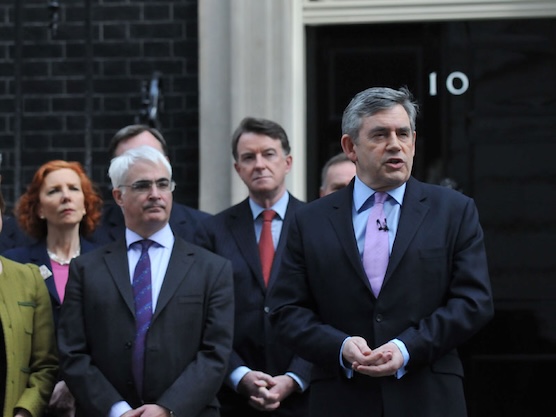
Brown addressed the nation outside No 10 Downing Street. He said he would be “willing to see any of the party leaders”. However, he added that “should the discussions between Mr Cameron and Mr Clegg come to nothing… I would be prepared to discuss with Mr Clegg the areas where there may be some measure of agreement between our two parties”.
He declared: “I understand and completely respect the position of Mr Clegg in stating that he wishes first to make contact with the leader of the Conservative Party.”
Cameron, in his first major contribution since polling day, made a “big, open, and comprehensive offer” to the Liberal Democrats: coalition.
Cameron stated: “I want to make a big, open and comprehensive offer to the Liberal Democrats. I want us to work together in tackling our country’s big and urgent problems – the debt crisis, our deep social problems and our broken political system.”
A Labour-Lib Dem coalition was considered as a possibility – likely with the support of smaller nationalist parties, and negotiations were held to this effect. For a period, the Liberal Democrats were in simultaneous negotiations with both the governing Labour Party and the opposition Conservative Party. But the most viable path to a stable government was provided by a formal arrangement between the Conservatives and the Liberal Democrats.
On the evening of 11 May, Brown resigned as prime minister, and David Cameron entered 10 Downing Street.
Cameron and Clegg then formally presented their new coalition government to the nation on 12 May 2010, at a joint press conference in the Downing Street rose garden. This inaugural coalition press conference, in which Cameron and Clegg exhibited serious chemistry, coincided with the publication of a seven-page document outlining the initial “Conservative-Liberal Democrat coalition agreement”.
Under this arrangement, Clegg was appointed as deputy prime minister.
In the foreword, the deal stated: “These are the issues that needed to be resolved between us in order for us to work together as a strong and stable government”.
The document, which would serve as the terms of reference governing the coalition, detailed the key compromises made by both parties. The central agreement was a commitment to tackle the UK’s budget deficit, with an emergency budget promised within 50 days.
Key concessions to the Liberal Democrats included a referendum on changing the electoral system to the alternative vote (AV) and a commitment to legislate for five-year fixed term parliaments. For their part, the Conservatives secured agreement on policies such as placing a cap on non-EU immigration and allowing new providers to enter the state schooling system.
The fixed-term parliament agreement represented a binding commitment by Cameron not to unilaterally collapse the coalition and call an election at a politically advantageous moment for the Conservatives.
The document also specified areas where the parties could, in effect, ‘agree to disagree’ such as on the renewal of the Trident nuclear deterrent and on education funding.
***
The cabinet featured five Liberal Democrat MPs, including Clegg as deputy prime minister, Vince Cable as business secretary, David Laws as chief secretary to the Treasury, Chris Huhne as energy and climate change secretary and Danny Alexander as secretary of state for Scotland.
To manage the relationship and make key strategic decisions, a core group known as the “quad” was established. This consisted of the prime minister, the deputy prime minister, the chancellor (George Osborne), and the chief secretary to the Treasury. Alexander succeeded Laws as chief secretary to the Treasury shortly after the coalition began its life.
The quad was set up to resolve policy disagreements, so compromises could be taken to the wider cabinet.
Despite some difficulties, notably over the AV referendum and House of Lords reform, the coalition served a full five-year term – a feat many commentators initially believed was unlikely back in May 2010.
But the electoral consequences for the Liberal Democrats as the coalition’s junior partner were severe. In the 2015 general election, the Conservative Party won a narrow outright majority; the Liberal Democrats saw their parliamentary representation collapse from 57 MPs to just eight.

Politics.co.uk Newsletters
DAILY
Politics@Lunch
WEEKLY
Week in Review
