Cameron leads Conservatives to surprise majority in general election
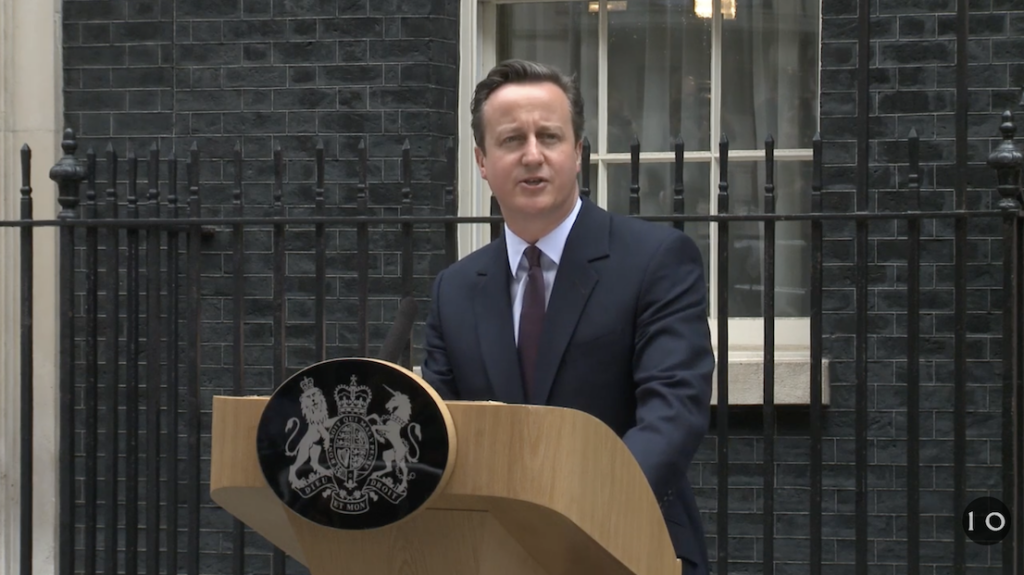
The Conservative party, led by incumbent prime minister David Cameron, secured a narrow majority in the general election held on 7 May 2015.
The result defied pre-election polls, which had largely predicted another hung parliament, and marked the first time the Conservatives had won an outright majority since 1992. The party won 330 seats, up 24, on a 36.9% vote share.
The election was a disaster for the Liberal Democrats, who were reduced from 57 to just eight seats. Several high-profile Liberal Democrat cabinet ministers, including Vince Cable, Danny Alexander and Ed Davey, lost their seats.
Labour, under the leadership of Ed Miliband, won 232 seats, a net loss of 26. The party recorded a small increase in their vote share to 30.5%.
Miliband’s party was decimated in its former stronghold of Scotland, where the Scottish National Party (SNP) won 56 of the 59 Scottish seats, an increase of 50. This SNP landslide saw prominent Labour figures, such as the then-shadow foreign secretary Douglas Alexander and the Scottish Labour leader Jim Murphy, lose their seats.
The 2015 election was the first to be held under the provisions of the Fixed-term Parliaments Act 2011. The commitment to legislate for five-year fixed term parliaments was included in the Conservative-Liberal Democrat coalition agreement. In part, the legislation represented a binding commitment on Cameron’s part not to unilaterally collapse the coalition and call an election at a politically advantageous moment for the Conservatives. Consequently, for the first time in modern history, the exact date of the poll was known years in advance, removing the “will-they-won’t-they” speculation that had characterised previous election cycles.
***
Despite some difficulties, notably over the 2011 alternative vote (AV) referendum and House of Lords reform, the Conservative-Liberal Democrat defied predictions of its hasty collapse.
But Clegg went into the 2015 election damaged politically by his tenure in government and a series of unpalatable compromises. In 2012, the Liberal Democrat leader apologised for breaking his pledge to oppose any increase in university tuition fees. The apology, an ill-fated attempt to draw a line under the most damaging episode of his time in government, began: “There’s no easy way to say this: we made a pledge, we didn’t stick to it and for that I am sorry.”
Cameron had proved more adept at managing the politics of coalition government. But the prime minister also faced pressure on his right flank in the form of the UK Independence Party (Ukip). Nigel Farage’s party secured the largest share of the vote in the 2014 European Parliament elections, pushing the Conservatives into third. Cameron’s flagship manifesto pledge to hold an in/out referendum on Britain’s membership of the European Union (EU), announced in January 2013, was widely seen as a tactic to manage electoral pressure from Ukip.
Both the Labour and Liberal Democrat manifestos only supported an in/out referendum in event of treaty change or a significant transfer of powers from the UK to the EU.
Miliband, who defeated his brother (David) in 2010 to emerge as Labour leader, struggled with credibility problems in the years preceding the election campaign. Miliband’s political opponents depicted him ungainly and not prime minister material. In its final front page before polling day, the Sun newspaper carried a photograph of the Labour leader under the headline “Save Our Bacon”, urging readers not to vote for Miliband.
The Labour leader was haunted by an unfortunate May 2014 photograph that showed him awkwardly eating a bacon sandwich.
***
The highly disciplined Conservative campaign, under the guidance of Australian political strategist Lynton Crosby, was framed around the party’s perceived economic credibility and commitment to a “long term economic plan”.
During the campaign, Cameron regularly brandished a note left by the former chief secretary to the Treasury, Liam Byrne, to his Liberal Democrat successor, David Laws. The notorious note stated: “Dear chief secretary, I’m afraid there is no money. Kind regards – and good luck! Liam.”
The prime minister addressed Byrne’s note during the final TV event of the campaign. “It takes a long time to fix the mess that I was left… We are half way through a building job”, he said.
The campaign was also shaped heavily by opinion polling and by speculation that the result might produce a second hung parliament. A steady stream of polls from all the major companies appeared to show the Conservative and Labour parties as effectively neck-and-neck.
The Guardian’s final poll projection, an average of all the polls made public, placed the Conservatives on 274 commons seats and Labour on 271 – a hung parliament. Similarly, the final opinion polls for the nine British Polling Council members all indicated a statistical dead heat.
The prospect of a hung parliament (a repeat of the 2010 result) with Labour as the largest party – potentially reliant on the voters of smaller parties – was widely seen as a realistic outcome, therefore. The Conservative campaign weaponised this narrative, warning voters in England that a minority Labour government could be held to ransom by the Scottish National Party.
Cameron’s party foregrounded a memorable poster depicting Miliband peeking out of the top pocket of the former Scottish first minister, Alex Salmond. It came just days after new polling, conducted by Conservative peer Lord Ashcroft, showed that the SNP were on track to take all but three of the 59 Westminster seats in Scotland.
The prime minister unveiled the famous pocket-themed poster in a post to Twitter (now X). “Alex Salmond with Ed Miliband in his pocket”, Cameron commented. “The frightening prospect we must avoid.”
The poster was produced by the advertising agency M&C Saatchi. Saatchi companies had worked on Conservative advertising campaigns on and off since 1978. Their most famous contribution came during the 1979 United Kingdom general election, when Saatchi & Saatchi curated the iconic “Labour Isn’t Working” poster for Margaret Thatcher. Commenting on Saatchi’s latest contribution to the pantheon of Tory attack-posters, Conservative chairman Grant Shapps said: “With Scottish voters fleeing Ed Miliband faster than Chris Hoy in a velodrome, he knows that a deal with the SNP is his only route to No 10.”
Miliband committed a notable gaffe just four days before polling stations opened when he unveiled a large stone monolith with six election pledges carved into it. The 8ft 6in limestone tablet, quickly dubbed the “EdStone”, was presented at a press event in Hastings as a symbol of Labour’s commitment to its promises. The six vague-sounding vows featured on Miliband’s monolith included: “A strong economic foundation”.
The stunt was met with immediate and widespread ridicule from the media, political opponents, and the public. Critics compared it unfavourably to a tombstone and the Ten Commandments. The saga surrounding the slab descended further into farce when Lucy Powell, vice-chair of Labour’s election campaign, suggested Miliband might break the promises he had carved into it.
The 2015 general election also helped to establish the tradition of live leaders’ debates – five years after their debut in 2010.
However, the 2015 debates were marked by contentious negotiations over the format.
Cameron said that he would not take part in the debates unless the minor parties were also in attendance. In the end, the prime minister only attended one, seven-way debate. The televised bout also featured Clegg, Miliband, Ukip leader Nigel Farage, SNP leader Nicola Sturgeon, Green Party leader Natalie Bennett and Plaid Cymru leader Leanne Wood.
The seven-way format reflected the increasingly fragmented, multi-party nature of the political system. A second debate was held, but neither Cameron nor Clegg took part.
Cameron and Miliband were both subjected to separate long-form interviews in a special programme jointly broadcast by Sky News and Channel 4. During his exchange with veteran inquisitor Jeremy Paxman, Miliband memorably mispronounced “enough”. Paxman put it to Miliband that “people think you’re just not tough enough”.
The Labour leader lent forward and responded: “Well, let me tell you, right… Am I tough enuss [sic]? Hell yes, I’m tough enough.”
***
The Conservative Party’s 6.5-point lead ultimately delivered a surprise, if small, overall majority for the Conservatives in the commons.
Notably, Ukip achieved its highest-ever vote share, securing 12.6% of the vote and finishing third in terms of votes cast. However, this translated into only one seat (Douglas Carswell in Clacton). Farage himself failed to win the South Thanet constituency. He initially stepped down as leader, but found his resignation rejected by Ukip’s national executive committee (NEC).
The Green Party also saw its vote share increase to 3.8%, retaining its single seat in Brighton Pavilion (held by Caroline Lucas). It was subsequently calculated that it took 34,000 votes to elect a Conservative MP, 302,000 to elect a Liberal Democrat and 3.9 million to elect a Ukip MP.
Labour suffered a series of notable losses in Scotland and beyond; Ed Balls, the shadow chancellor and former leadership candidate, was ousted by the Conservatives in his Morley and Outwood seat. The defeat of Balls was probably the closest the election came to a “Portillo moment”.
In the immediate aftermath of the result, both Miliband and Clegg resigned as party leaders.
Miliband said it was “time for someone else to take forward the leadership of this party”.
He added: “I want to do so straight away because the party needs to have an open and honest debate about the right way forward without constraint…
“It has been an enormous privilege. Thank you for the selfies, thank you for the support, and thank you for the most unlikely cult of the 21st century, Milifandom.”
Clegg said the result was “immeasurably more crushing and unkind” than he had feared.
The outgoing Liberal Democrat leader stated: “I always expected this election to be exceptionally difficult for the Liberal Democrats, given the heavy responsibilities we’ve had to bear in government in the most challenging of circumstances.
“But clearly results have been immeasurably more crushing and unkind than I could ever have feared. For that, of course, I must take responsibility and therefore I announce I will be resigning as leader of the Liberal Democrats.”
The unexpected Conservative majority paved the way for the promised in/out referendum on the UK’s membership of the EU.
***
The shock result precipitated a period of soul-searching among Britain’s pollsters.
Peter Kellner, chairman of YouGov, suggested that “shy Tories” deliberately misreporting their vote intention could have contributed to the polling miss.
Kellner wrote: “This year, as in 1992, the Tories have a weak image. They are widely thought to be out of touch and for the rich. But, at the margin, there may be some people who both have a poor view of the party but nevertheless think it will run the economy better than Labour.
“They are ‘shy Tories’ not because they are unwilling to admit their choice of party to a stranger but because they really would like to support someone else but, faced with a ballot paper in the privacy of the polling booth, simply can’t.”
In the aftermath, the British Polling Council commissioned an independent inquiry, chaired by professor Patrick Sturgis of the University of Southampton, to determine what went wrong and to “make recommendations for future polling.”
The BPC stated: “The final opinion polls before the election were clearly not as accurate as we would like, and the fact that all the pollsters underestimated the Conservative lead over Labour suggests that the methods that were used should be subject to careful, independent investigation.”
The Sturgis inquiry published its final report in March 2016 and concluded that the primary cause of the failure was unrepresentative samples. The methods used by the polling companies were consistently recruiting too many Labour supporters and too few Conservative supporters into their surveys, the inquiry found.
The report argued that “consistent lying” on the part of those sampled (the shy Tory explanation) was unlikely.
The report stated: “In sum, while it is very difficult to definitively rule out the possibility that respondents lied to pollsters before and after the election, circumstantial evidence from contemporaneous surveys suggests that it is unlikely to have been a contributory factor in the polling miss.”
Similarly, the report rejected claims of a significant “late swing” to the Conservatives that pollsters had failed to detect.
The inquiry did suggest that differential turnout modelling may have contributed modestly to the error. Differences in turnout rates between supporters of different parties that were not addressed by pollsters, the report found, may have slightly amplified inaccuracies in vote share projections.
Finally, the report identified evidence of a “herding” phenomenon. It found that some polling organisations appeared to make design or reporting decisions that reduced the variation between their results and those of competitors.
The BPC initially vowed to issue a follow-up report before the next scheduled general election outlining how member companies had revised their sampling and weighting procedures in light of the 2015 failure. In practice, while no single unified blueprint emerged, the immediate aftermath of the Sturgis inquiry did prompt methodological changes across the industry.
Politics.co.uk Newsletters
DAILY
Politics@Lunch
WEEKLY
Week in Review