MPs approve military action in Libya by huge majority
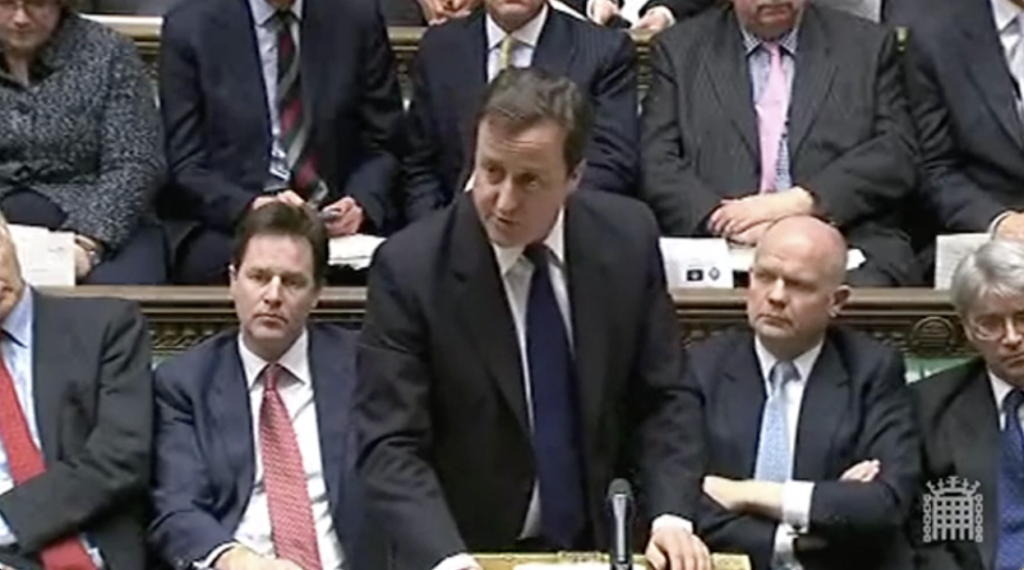
On 21 March 2011, the House of Commons voted overwhelmingly to support UK military participation in the international intervention in Libya. The government motion was approved by 557 votes to 13, a majority of 544.
The debate focused on Resolution 1973, passed by the United Nations Security Council (UNSC), which authorised “all necessary measures” – short of bringing in an occupying force – to protect Libyan citizens from Muammar Gaddafi’s forces. The resolution, adopted on 17 March, was agreed after the regime threatened to attack the rebel-held city of Benghazi. It formed the legal basis for military intervention in the Libyan Civil War.
In a statement to the commons on 18 March, the prime minister, David Cameron, said that Britain now had a responsibility to act. Cameron confirmed that the attorney general had been consulted and that he was “satisfied that there is a clear and unequivocal legal basis for the deployment of UK forces and military assets”.
He added: “Our forces will join an international operation to enforce the resolution if Gaddafi fails to comply with its demand that he ends attacks on civilians.”
Cameron vowed to table a motion considering the resolution and the British government’s response the following week, but insisted on the need to “move forward, on the basis of the Security Council resolution, immediately.”
In line with the UN resolution, an international coalition led by the United States, Britain and France launched a campaign of air and missile strikes against Gaddafi’s forces on 19 March. Cameron confirmed Britain’s participation in the military action in a statement delivered on the steps of Downing Street.
***
On 21 March, Cameron appeared in the commons to seek retrospective approval for the deployment of forces. He argued that it was “necessary, legal and right” to have instigated military action to stop Gaddafi brutalising his own people.
The prime minister told the House of Commons: “Necessary because, with others, we should be trying to prevent him using military violence against his own people. Legal because we have the backing of the United Nations Security Council. And right because I believe we should not stand aside while this dictator murders his own people.”
Cameron stressed that any military attacks on Libya would be “fully consistent” with the United Nations mandate.
Ed Miliband, the Labour leader of the opposition, supported the government’s position.
The commons debate was nonetheless marked with deep unease, expressed by MPs on both sides of the chamber. In the face of Cameron and Miliband’s staunch support, both Conservative and Labour backbenchers registered their concerns as to the proposed military action.
Kris Hopkins, a Conservative backbencher, warned of a lack of political capital after the “illegal war” in Iraq and the “folly” of the Afghan war.
Hopkins stated: “There may be moral reasons to fight again. But I will be honest with you. We are struggling to find the moral high ground from which to project that morality.”
He went on to criticise Arab leaders for failing to speak up as western countries confront an enemy.
Bob Ainsworth, who served as defence secretary from 2009 to 2010, was another to raise concerns.
Ainsworth said: “I am a late and very reluctant supporter of these operations. That is not because I have become a pacifist overnight. It is because it is relatively easy to support things on day one and relatively difficult to support them a month through or month nine.”
Conservative MP Rory Stewart, who served as deputy governor of an Iraqi province from 2003 to 2004, warned that the lesson “of Afghanistan is that if you dip your toes in you are very soon up to your neck.”
Veteran Labour MPs Jeremy Corbyn, John McDonnell and Dennis Skinner also expressed opposition to the government motion. An amendment tabled by Corbyn and McDonnell which stressed the need for conflict resolution was not selected by the speaker.
Skinner addressed Cameron in an intervention, declaring: “It is easy to get into a war; it is harder to end it. When will we know what the circumstances are for pulling out and ending the war?”
The prime minister responded: “This is different to Iraq. This is not going into a country, knocking over its government and then owning and being responsible for everything that happens subsequently.
“This is about protecting people and giving the Libyan people a chance to shape their own destiny.”
Liberal Democrat MP Menzies Campbell referenced his decision to vote against military action in Iraq seven years previously, but argued that the current action was not “illegitimate”.
He said: “On 18 March 2003, just over eight years ago, I voted against military action against Saddam Hussein.
“If I thought that the present action was illegitimate, I should have no hesitation in voting against it, because if we ask our young men and women to put their lives at risk, as we do, then the cause must be just, not only in strict legality terms but in political and even social terms.
In total, only 13 MPs opposed the government motion. They were Labour MPs Graham Campbell, Ronnie Campbell, Jeremy Corbyn, Barry Gardiner, Roger Godsiff, John McDonnell, Linda Riordan, Mike Wood and Dennis Skinner; Social Democratic and Labour Party (SDLP) MPs Mark Durkan and Margaret Ritchie; as well as Green MP Caroline Lucas and Conservative MP John Baron.
***
The military intervention led to the overthrow of the Gaddafi regime.
The subsequent descent of Libya into instability and civil war has since provoked profound criticism of the campaign’s long-term planning and consequences.
In March 2016, US president Barack Obama appeared to blame Britain and France for the perceived failures of the Libya campaign, accusing Cameron specifically of being “distracted by a range of other things”.
In September 2016, the House of Commons foreign affairs committee published the findings of its investigation into the Libyan intervention.
The report was highly critical of the British government’s approach. It found the intervention was “not informed by accurate intelligence”, hastened Libya’s political and economic collapse and drifted into an unannounced goal of regime change.
It added: “In particular, the government failed to identify that the threat to civilians was overstated and that the rebels included a significant Islamist element. By the summer of 2011, the limited intervention to protect civilians had drifted into an opportunist policy of regime change. That policy was not underpinned by a strategy to support and shape post-Gaddafi Libya.
“The result was political and economic collapse, inter-militia and inter-tribal warfare, humanitarian and migrant crises, widespread human rights violations, the spread of Gaddafi regime weapons across the region and the growth of ISIL in North Africa. Through his decision making in the National Security Council, former Prime Minister David Cameron was ultimately responsible for the failure to develop a coherent Libya strategy.”

Politics.co.uk Newsletters
DAILY
Politics@Lunch
WEEKLY
Week in Review