
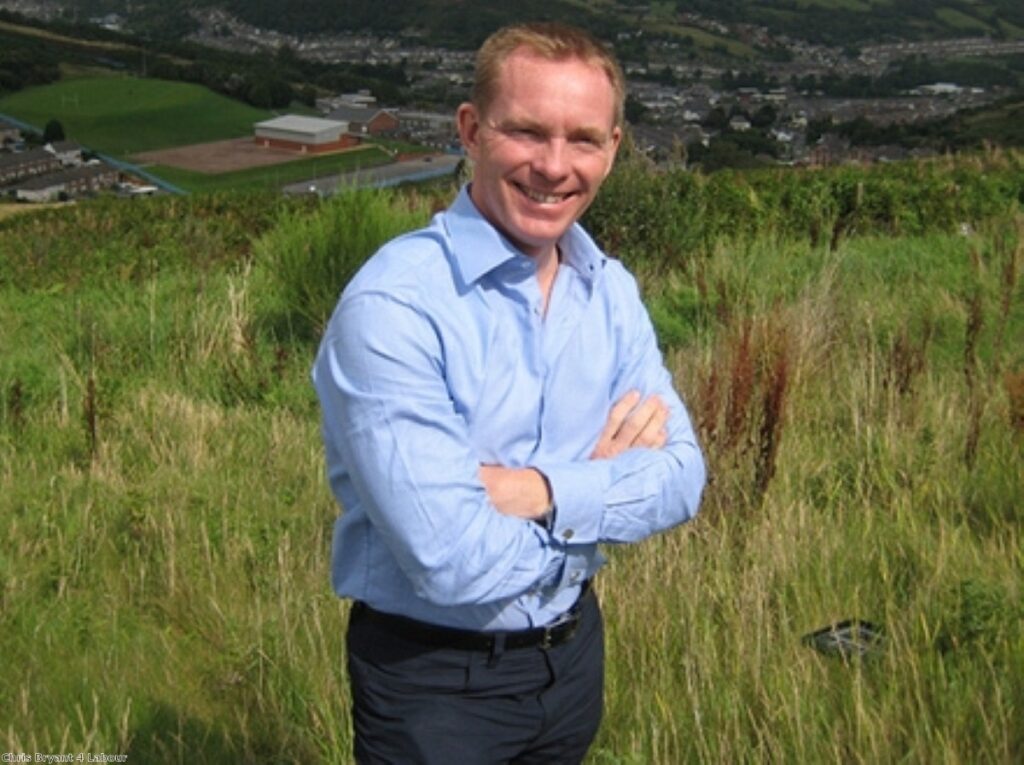
Sir Chris Bryant is the Labour MP for Rhondda and Ogmore, having first been elected to parliament for the predecessor seat of Rhondda in the 2001 general election.
In the 2024 general election for Rhondda and Ogmore, Bryant received 17,118 votes, representing 47.8% of the vote share. The Reform UK candidate, Darren James, received 9,328 votes (26.1%), while the Plaid Cymru candidate, Owen Cutler, secured 5,198 votes (14.5%). Bryant was duly elected with a majority of 7,790 votes.
The Rhondda and Ogmore constituency is located in the South Wales Valleys. It is a new seat created for the 2024 election, formed from the former Rhondda constituency plus parts of the abolished Ogmore constituency and a small part of Pontypridd. The predecessor Rhondda seat was historically one of Labour’s safest seats.
Political Career
Bryant currently serves as secretary of state for Northern Ireland. He was appointed to this role in July 2026, following the Labour leadership contest and Andy Burnham’s elevation as prime minister.
Bryant served as minister of state in the Department for Business and Trade from September 2025 to July 2026.
From July 2024 to September 2025, Bryant served jointly as minister of state in the Department for Science, Innovation and Technology (responsible for data protection and telecoms) and the Department for Culture, Media and Sport (responsible for creative industries, arts and tourism).
Prior to the 2024 general election, Bryant was shadow minister for creative industries and digital from September 2023.
Before returning to the frontbench in 2023, Bryant chaired the House of Commons committee on standards (2020-2023) and simultaneously chaired the committee of privileges (2020-2022). He resigned these chair roles upon his shadow ministerial appointment.
The standards committee oversees the rules of conduct for MPs and investigates alleged breaches; the remit of the privileges committee is to consider any matter referred to it that may amount to a contempt of parliament.
Bryant previously held senior frontbench roles under Jeremy Corbyn’s leadership of the Labour Party, as shadow leader of the House of Commons (2015-2016) and shadow secretary of state for culture, media and sport (May-September 2015).
In June 2016, Bryant was among those to resign from the shadow frontbench in protest at Corbyn’s leadership and his approach to the Brexit referendum. In his resignation letter, Bryant accused the Labour leader of “significantly contributing” to the victory of the Leave campaign.
He added: “Your ambivalent attitude in the campaign was a betrayal of the Labour Party and the wider Labour movement and it has let down a whole generation of young people who desperately hoped to hear a strong, cogent and inspiring pro-EU message from Labour.”
https://x.com/RhonddaBryant/status/747165335804121088
In the days that followed, Bryant warned that Corbyn risked “breaking the Labour Party”.
He told the BBC: “The only person who can break the logjam that there is in the Labour Party at the moment is Jeremy himself. I think if he stood aside now, the Labour Party’s not going to go back to what it was under Blair or Brown, we’ve got to move on into the future. But if he determines to stay he will go down in history as the man who broke the Labour Party.”
Bryant went on to express doubt over Corbyn’s vote during the Brexit referendum, suggesting the Labour leader had actually backed to leave.
In the New Labour governments, Bryant served as parliamentary under-secretary of state at the Foreign and Commonwealth Office (covering Europe and Asia) from 2009 to 2010, and as deputy leader of the House of Commons from 2008 to 2009.
In September 2006, Bryant and Siôn Simon coordinated a letter, ultimately signed by 17 Labour MPs, calling on Tony Blair to stand down as prime minister.
In the confidential letter, which was soon leaked, the MPs maintained that they had always “believed passionately in the same kind of modern, progressive, electable Labour Party” as Blair.
They added: “Sadly, it is clear to us – as it is to almost the entire party and the entire country – that without an urgent change in the leadership of the party it becomes less likely that we will win that election.”
Tom Watson, a junior government minister, was among the signatories. Watson was told to withdraw his name or resign by the government chief whip, Jacqui Smith; he resigned alongside six parliamentary private secretaries (Khalid Mahmood, Wayne David, Ian Lucas, Mark Tami, Chris Mole and David Wright.)
On 7 September, during a pre-arranged visit to a school in London, Blair conceded that recent developments had not been Labour’s “finest hour” and announced the coming party conference would be his last as leader.
In 2019, Bryant stood for election as speaker of the House of Commons, coming second to Sir Lindsay Hoyle. He secured the support of 213 MPs (Hoyle won the backing of 325 colleagues). The Labour MP said he stood for leader because he believes in “parliamentary democracy and I want to do things properly.”
In an article for the House magazine, Bryant wrote: “That means being an umpire, not a player, which is why, in addition to giving up Twitter since the start of September, I have turned down every radio and television request outside Wales…
“I want to get PMQs back to 30 minutes, giving the lion’s share to backbenchers. I will call people according to their relevance to the subject rather than their seniority and I will have no favourites. I will strike a balance between Michael Martin who allowed three urgent questions a year and John Bercow who recently allowed five in a day.”
Bryant has been a prominent voice on parliamentary standards and reform. In 2021, while chair of the standards committee, he warned that the Owen Paterson lobbying scandal had brought the House of Commons “into disrepute.”
In his 2023 book, Code of Conduct: Why We Need to Fix Parliament – and How to Do it, Bryant considered whether the 2019-2024 parliament should be referred to as the “worst… in history” due to the regular standards violations of its MPs.
At the time, Bryant voiced his plan to resurrect an arcane parliamentary rule to force Nadine Dorries, then the Conservative MP for Mid Bedfordshire, out of parliament. Dorries had stated her intention to resign as an MP on 9 June 2023 – but she failed to do so officially until 26 August. Her last contribution in the commons – or any parliamentary arena (bill or select committees) – came on 7 July 2022, while serving as culture secretary.
In 2022, Bryant spoke publicly about experiences of inappropriate touching by other MPs early in his parliamentary career. Bryant told LBC Radio that he never reported the incidents because he did not want to be “part of the story”, but would do so if it happened now.
He said: “I remember when I came in [to parliament] I was regularly touched up by older, senior gay – they weren’t out – MPs.
“I never felt I was able to report it because you end up being part of the story, that’s the last thing you want. I think a lot of women have been through that.”
He added: “I can think of four MPs… I was shocked at the time… none of them are out of course. I think that now, if anybody would do that, I would be absolutely robust.
“I would call the person out immediately and I would make a complaint.”
Bryant served on the foreign affairs select committee from 2017 to 2023, having chaired the finance committee from 2017 to 2019.
Bryant is a patron of LGBT+ Labour – a socialist society formally affiliated with the Labour Party.
He is a former chair of the Christian Socialist Movement.
He was knighted in the 2023 New Year Honours for political and public service.
Bryant delivered his maiden speech on 25 June 2001. In it, he stated: “The Rhondda relies on a government who are committed to sound finances and to combating unemployment. It depends on a government who are committed to a minimum wage. I particularly welcome the commitment to increasing the minimum wage for young people.”
He added: “It is not for a newcomer to lecture the House on its practices, but one of the reasons for young people – and, for that matter, not so young people – failing to take an interest in politics is I believe, because the way in which the House does its business is still incomprehensible to the majority of the population…
“In conclusion, the socialism that I espouse is based on some simple moral facts. The market was made for humanity, not humanity for the market. Poverty is not a mysterious dispensation from on high, but has very human causes and is susceptible to human remedies. Inequality gnaws at the moral fabric of society.”
Before entering parliament, Bryant was elected as a councillor on Hackney Borough Council, representing Leabridge ward from 1993 to 1998. From 1998 until his election to parliament in 2001, he was head of European affairs at the BBC.
Political Views
Leadership elections and loyalty
Labour leadership 2020: Bryant was one of 21 Labour MPs who nominated Jess Phillips for the party’s leadership in early 2020. The election was triggered by the resignation of Jeremy Corbyn following the party’s defeat in the 2019 general election, which resulted in Labour’s fewest seats in the House of Commons since 1935.
Phillips, the MP for Birmingham Yardley, had been a prominent critic of Corbyn’s leadership of the Labour Party. She withdrew from the contest on 21 January 2020, suggesting that she could not “unite all parts of our movement”.
In a social media post at the time, Bryant said Phillips’ “trademark from the heart honesty… would have real cut through with the public.”
Labour leadership 2015: Bryant nominated Yvette Cooper for the party’s leadership in June 2015. The election followed the resignation of Ed Miliband after the party’s defeat in the 2015 general election. It was the first contest held under the “one member, one vote” system, which replaced the previous electoral college.
Cooper, the shadow home secretary, secured 59 nominations from the Parliamentary Labour Party (PLP), comfortably exceeding the 35 required to reach the final ballot. She ultimately finished third in the contest with 17% of the vote.
Corbyn loyalty list: In March 2016, Bryant was labelled as “neutral but not hostile” by the Corbyn leadership in a leaked list which categorised Labour MPs by their perceived loyalty.
Labour leadership 2016: Bryant was one of 162 Labour MPs who nominated Owen Smith for the party’s leadership in July 2016. The election was triggered by a challenge to Jeremy Corbyn following the EU referendum, which led to a wave of shadow cabinet resignations and a vote of no confidence supported by 172 MPs. Smith, the former shadow work and pensions secretary, was ultimately defeated by Corbyn, who won with an increased mandate of 61.8% of the vote.
Labour leadership 2010: Bryant was one of 33 Labour MPs who nominated Diane Abbott for the party’s leadership in May 2010. The election followed the resignation of Gordon Brown, who stepped down as prime minister and Labour leader after the 2010 general election.
Abbott, a member of the Socialist Campaign Group (SCG), secured the minimum 33 nominations from the Parliamentary Labour Party (PLP). It came after several senior figures, including Bryant, Harriet Harman and David Miliband, lent her their support to ensure a ideologically diverse ballot. She finished fifth in the contest with 7.4% of the vote.
Factional identity and party tradition
SERA: Bryant has been listed as a member of the Socialist Environment and Resources Association (SERA) – a socialist society affiliated with the Labour Party. Founded in 1973, SERA is the party’s official environmental campaign group. The organisation campaigns on a wide range of issues, including renewable energy, biodiversity, air quality and the transition to a green economy. SERA describes its member MPs as “champions for the environment”.
Brexit and Europe
Bryant is a longstanding pro-European, having previously chaired the Labour Movement for Europe (2004-2007).
Brexit referendum: Bryant campaigned to remain in the 2016 referendum on Britain’s membership of the European Union (EU), and therefore disagreed with a majority of constituents, 60.4% of whom voted to Leave.
Article 50: In February 2017, Bryant voted against the European Union (Notification of Withdrawal) Bill. The legislation empowered the prime minister to notify the Council of the European Union of the UK’s intention to withdraw, formally triggering the process set out in Article 50 of the Treaty on European Union. MPs supported the bill by 498 votes to 114 at second reading.
In voting against the bill, Bryant defied the party whip – one of 47 Labour MPs to do so.
People’s vote support (2019): Bryant signed a January 2019 statement by Labour MPs calling for a “people’s vote” or second referendum. The statement, signed by 71 Labour MPs, read: “Defeat of the Tory [Brexit] deal in a public vote would give us all a chance to campaign for the anti-austerity policies and a Labour government that deals with the true causes of the Brexit vote, and a reformed Europe that works for all people.”
Remain pledge: During the 2019 general election campaign, Bryant was one of 193 Labour candidates to sign the anti-Brexit “Remain pledge”, drawn up by the campaign group Remain Labour.
It stated: “Labour is committed to a confirmatory referendum, to give you the final say on Brexit. If elected as your Labour MP, I pledge to campaign to Remain in the EU.”
Welfare
Welfare vote (July 2025): Bryant voted in favour of the government’s flagship welfare bill at second reading. The vote came after ministers agreed to significant concessions to avoid defeat via a mass rebellion of Labour MPs on 1 July 2025.
Assisted dying
On the second reading of the Terminally Ill Adults (End of Life) Bill (Assisted Dying Bill) in November 2024, Bryant abstained. However, they went on to vote in favour of the bill at third reading (June 2025).
https://x.com/PaulBrandITV/status/1931996676450914464
Social values and conscience issues
Same-sex marriage (2013): In February 2013, Bryant voted in favour of the Marriage (Same Sex Couples) Bill at its second reading. The landmark piece of legislation, which received its second reading by 400 votes to 175, legalised marriage for same-sex couples in England and Wales.
Foreign policy and security
Trident renewal (2016): Bryant voted in favour of a government motion calling for the renewal of the Trident nuclear deterrent system in July 2016. The motion, which was passed by 472 votes to 117, committed the UK to constructing a new fleet of submarines to carry the nation’s nuclear weapons. Labour was split over the issue with 140 of its 230 MPs going against leader Jeremy Corbyn and backing the motion.
Syria airstrikes (2015): Bryant voted in favour of a government motion to extend UK airstrikes against Isis from Iraq into Syria in December 2015. The motion, which was passed by 397 votes to 223 after a 10-hour debate in the House of Commons, authorised the RAF to conduct strikes against Isis targets in Syria.
Syria airstrikes (2013): Bryant voted against the government’s motion on the principle of military intervention in Syria in August 2013. The government motion was defeated by 285 votes to 272, a move which effectively ruled out UK participation in any US-led military strikes.
Iraq War authorisation vote (2003): In March 2003, Bryant voted in favour of the government motion authorising military action against Iraq. The vote, one of the most contentious in recent parliamentary history, gave the prime minister, Tony Blair, the authority to join the US-led invasion.
Palestine
LFPME: Bryant has been listed as a member of Labour Friends of Palestine and the Middle East (LFPME). The organisation’s stated aim is to promote peace and justice in the region through the application of international law and respect for human rights.
Palestinian recognition vote (2014): In October 2014, Bryant was one of 192 Labour MPs who voted in favour of recognising Palestine as a state. The motion, passed by 274 votes to 12, called on the government to “recognise the state of Palestine alongside the state of Israel as a contribution to securing a negotiated two-state solution”.
Before Politics
Born Christopher John Bryant on 11 January 1962 in Cardiff, Wales, he grew up in Spain and Cheltenham, Gloucestershire. He attended Cheltenham College and then read English at Mansfield College, Oxford. He subsequently studied theology at Ripon College Cuddesdon, Oxford.
Bryant was ordained as a priest in the Church of England in December 1986. He served as a curate at All Saints, High Wycombe (1986-1989) and then as youth chaplain to the Diocese of Peterborough (1989-1991). He left the ordained ministry in 1991.
After leaving the Church, Bryant worked for the Labour Party, including as an election agent.
Personal Life
Bryant entered into a civil partnership with Jared Cranney in 2010; the first couple to do so in the Palace of Westminster. He lives in Porth in the Rhondda valley.
In a statement after the ceremony, Bryant and Cranney said: “We never thought this day would come – and never thought we’d have to worry about cakes and flowers and rings.
“It’s amazing how much things have changed in such a short time.
“Only a few years ago there was a different gay age of consent, you could sack people or refuse to serve them just because of their sexuality and gays were banned from the military, from adopting or getting married.
“Parliament is special because it has made it possible. We are delighted that everyone in the UK can now share in a privilege that used to be available just to straight MPs.”
In 2024, PinkNews listed Bryant among a number of out LGBTQ+ parliamentarians.
He was diagnosed with stage 3 melanoma (skin cancer) in 2019 and has spoken about his treatment and recovery.
Trivia
Bryant is a former Church of England priest.
He has authored biographies of Stafford Cripps and Glenda Jackson, as well as a history of Christian Socialism and a two-volume history of parliament.
Comment: Spin over substance devalues parliament
30 June 2011