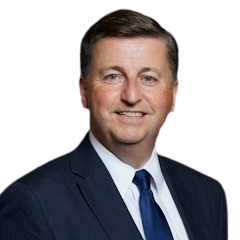
Douglas Alexander is the Labour and Co-operative Party MP for Lothian East.
Alexander was first elected to parliament for the constituency of Paisley South in a by-election on 6 November 1997, defeating the Scottish National Party (SNP) candidate, Ian Blackford. He served continuously as an MP from 1997 to 2015 – when he lost his seat in parliament.
Alexander, who held a series of cabinet roles under Gordon Brown and Tony Blair, returned to parliament at the 2024 general election.
In the 2024 general election for the Lothian East constituency, Alexander received 23,555 votes, representing 49.0% of the vote share. The SNP candidate, Lyn Jardine, came second with 10,290 votes (21.4%), while the Conservative candidate, Scott Hamilton, secured 5,535 votes (11.5%). Alexander was duly elected with a majority of 13,265.
The Lothian East contains communities situated eastwards of Edinburgh, such as Dunbar and Haddington, while extending south into the rural Lammermuir Hills.
Alexander succeeded Kenny MacAskill as the MP for Lothian East. MacAskill defected from the SNP to Alex Salmond’s Alba Party in the 2019-2024 parliament.
Political Career
Alexander was appointed to the post of secretary of state for Scotland in the September 2025 ministerial reshuffle. He succeeded Ian Murray in this role and was retained following the July 2026 cabinet reshuffle conducted by Andy Burnham upon his appointment as prime minister.
Previously, Alexander served as minister of state for trade policy and economic security from July 2024 to September 2025. He simultaneously served as a minister of state at the Cabinet Office from February 2025 to September 2025.
Alexander’s political career extends to senior roles under Blair and Brown in the New Labour period. He was seen as a Brownite figure and one of the former chancellor’s closest allies.
From June 2007 until May 2010, Alexander was the international development secretary. He served jointly as secretary of state for Scotland and secretary of state for transport from May 2006 to June 2007.
Prior to these cabinet positions, Alexander was minister of state for Europe (2005-2006) and minister of state for trade (2004-2005). He also served as chancellor of the Duchy of Lancaster and minister for the Cabinet Office (2003-2004), minister of state at the Cabinet Office (2002-2003) and minister of state for e-commerce and competitiveness (2001-2002). In this first role, Alexander was the youngest minister upon his appointment.
Alexander attended cabinet as minister of state for Europe. The post was his first cabinet-attending position.
Alexander has managed several election campaigns. He reportedly played a leading role in devising the Labour Party strategy for the inaugural 1999 Scottish Parliament elections. He went on to serve as campaign co-ordinator for the 2001 general election, which resulted in a second successive Labour landslide under Blair. (Alexander was rewarded with a promotion to a minister of state position).
Alexander also played a leading role in the 2010 general election campaign as national election co-ordinator, having advised Brown to go to the country some three years earlier in 2007.
Alexander co-chaired David Miliband’s ill-fated 2010 Labour leadership campaign.
More recently, Alexander was political co-chair of Scottish Labour’s 2026 Scottish Parliament election campaign.
Alexander held senior positions after the 2010 general election defeat, including as shadow international development secretary briefly in 2010. Under Ed Miliband, he served as shadow foreign secretary from January 2011 to March 2015. He was shadow work and pensions secretary from October 2010 to January 2011.
Alexander was defeated in the 2015 general election by the SNP candidate Mhairi Black, who, at just 20 years of age entered parliament as “baby of the House”. Black secured 23,548 votes (50.9%) and a majority of 5,684 over Alexander in second place. There was a massive 26.9-point swing from Labour to the SNP in the seat.
In his concession speech, Alexander referred to a “very difficult night” for Labour in the country at large. The SNP won a total of 56 of the 59 Scottish seats at the 2015 general election; Alexander was arguably the most high-profile political casualty of the SNP landslide in Scotland.
Alexander told his election count: “This has been a very difficult night for Labour. Scotland has chosen to oppose this Conservative government, but not placed its trust in the Labour Party. It will be our responsibility to re-win that trust in the months and years ahead.”
Alexander’s return to parliament came after he was selected as the Labour candidate for the East Lothian constituency for the 2024 general election. The senior Labour politician said he approached his comeback campaign “with humility but also determination.”
He added: “I am keen to reach out to voters in every part of the county and make the case that Labour can make a difference in their lives and in their communities.”
Alexander delivered his maiden speech in the House of Commons on 16 December 1997 during a debate on the National Minimum Wage Bill.
In it, he said: “For 18 years, we had a government who advanced the idea that the price of greater prosperity was greater inequality and who tried to frighten people out of their commitment to fairness.
“I am therefore impelled to speak my mind, not solely by anger but by a sense of urgency, to end injustice and to give opportunity to people who have had to wait too long for a government who are on their side.”
He added: “At the age of 15, I joined the Labour party in Renfrewshire because I believed in the values and ideals which had for generations taken members of my family into the Labour movement: a commitment to the belief that while we cherish our individuality we are part of a community with shared responsibilities and linked destinies, and the belief that wealth, power and opportunity should be in the hands of the many and not the few.
“The bill advances those historic ideals in the modern economy, and that is why I and my constituents will support it.”
Before entering parliament, Alexander contested the Perth and Kinross constituency in a May 1995 by-election. He then stood as a candidate for the Perth constituency at the 1997 general election.
Political Views
Leadership elections and loyalty
Labour deputy leadership 2025: Alexander was one of 175 Labour MPs who nominated Bridget Phillipson for the party’s deputy leadership in September 2025. The election followed the resignation of Angela Rayner, who stepped down as deputy prime minister and deputy party leader after an investigation into her tax affairs. It marked the first time since 2007 that Labour had held a deputy leadership contest while in government.
Phillipson, the serving education secretary, was widely viewed as the candidate favoured by Downing Street and the party leadership. She secured 175 nominations from the Parliamentary Labour Party (PLP), comfortably exceeding the 80 required to reach the final ballot. She was ultimately defeated by Lucy Powell.
Labour leadership 2010: Alexander was one of 81 Labour MPs who nominated David Miliband for the party’s leadership in May 2010. The election followed the resignation of Gordon Brown, who stepped down as prime minister and Labour leader after the 2010 general election.
Miliband, the former foreign secretary, was seen as closely aligned with the New Labour project – a Blairite figure. He secured 81 nominations from the Parliamentary Labour Party (PLP), comfortably exceeding the 33 required to reach the final ballot, but was narrowly defeated by his brother, Ed Miliband, in the final round by 50.7% to 49.3%.
In a LabourList article, published in July 2010, Alexander wrote: “My judgement was that David has good Labour values, can unite our Party and can lead us back to power at the next election.
“The course of this campaign has affirmed my view. David’s policy commitments, from a high pay commission to a living wage, have been matched with a demonstration of his determination to change the way we do politics.”
He added: “In William Hague, the Tories picked a leader after their defeat in 1997 who did little else than appease their core vote – leading to a second landslide defeat for the party and a total of 13 years before they would return to government.
“That came to my mind recently when a Tory MP told me ‘it took us three goes to get a leader we needed rather than just one we wanted’.”
Factional identity and party tradition
Labour Movement for Europe: Alexander was endorsed by the Labour Movement for Europe (LME) in the 2024 general election. Founded in 1981, LME is a pro-European socialist society affiliated with the Labour Party. It campaigns for a close relationship between the United Kingdom and the European Union. The organisation refers to itself as the “home of the pro-Europeans in the Labour and trade union movement”.
Welfare
Welfare vote (July 2025): Alexander voted in favour of the government’s flagship welfare bill at second reading. The vote came after ministers agreed to significant concessions to avoid defeat via a mass rebellion of Labour MPs on 1 July 2025.
Assisted dying
On the second reading of the Terminally Ill Adults (End of Life) Bill, better known as the assisted dying bill, in November 2024, Alexander did not record a vote. He voted in favour at third reading.
Social values and conscience issues
Same-sex marriage (2013): In February 2013, Alexander voted in favour of the Marriage (Same Sex Couples) Bill at its second reading. The landmark piece of legislation, which received its second reading by 400 votes to 175, legalised marriage for same-sex couples in England and Wales.
Foreign policy and security
Syria airstrikes (2013): Alexander voted against the government’s motion on the principle of military intervention in Syria in August 2013. The government motion was defeated by 285 votes to 272, a move which effectively ruled out UK participation in any US-led military strikes.
Iraq War authorisation vote (2003): In March 2003, Alexander voted in favour of the government motion authorising military action against Iraq. The vote, one of the most contentious in recent parliamentary history, gave the prime minister, Tony Blair, the authority to join the US-led invasion.
Palestine
Palestinian recognition vote (2014): In October 2014, Alexander was one of 192 Labour MPs who voted in favour of recognising Palestine as a state. The motion, passed by 274 votes to 12, called on the government to “recognise the state of Palestine alongside the state of Israel as a contribution to securing a negotiated two-state solution”.
Before Politics
Born in Glasgow in 1967, Alexander grew up in Bishopton. He attended Bishopton Primary and Park Mains High in Erskine.
In 1984, Alexander won a Scottish scholarship to attend Lester B Pearson, UWC of the Pacific, an international college near Vancouver, Canada. He returned to Scotland to study politics and modern history at Edinburgh University, graduating with a first-class degree in 1990.
During this time, Alexander won a further scholarship to study for a year at the University of Pennsylvania, an Ivy League University in Philadelphia, USA.
He began work as a parliamentary researcher and speechwriter for Gordon Brown.
Alexander graduated from Edinburgh University in 1993. Following his training, he began work for a firm of solicitors that provided legal services to trade union members and specialised in industrial injury cases.
During his period outside of elected office between 2015 and 2024, Alexander held a Fisher Family Fellowship at Harvard University.
He also worked as a visiting professor at New York University in Abu Dhabi and at the Policy Institute of King’s College London.
In November 2015, he became a senior advisor to the musician Bono, focusing on initiatives to tackle global poverty.
He subsequently joined the law firm Pinsent Masons to work as a strategic advisor.
Personal Life
Alexander married Jacqueline Christian in 2000. They have two children, a son and a daughter.
His father was a minister for the Church of Scotland.
His sister, Wendy Alexander, previously served as a member of the Scottish Parliament (MSP) and briefly led the Scottish Labour Party from 2007 to 2008. They were elevated to the peerage as Baroness Alexander of Cleveden in February 2025.
Trivia
Alexander has authored and presented a series of documentary programmes for BBC Radio 4. His broadcasting work includes series such as A Culture of Encounter (2017), Belonging (2018) and A Guide to Disagreeing Better (2019).
Alexander’s father presided over the funeral of Donald Dewar, the first first minister of Scotland, in Glasgow in October 2000.
Douglas Alexander has not written for Politics.co.uk.