Jeremy Corbyn wins Labour leadership in first-round landslide
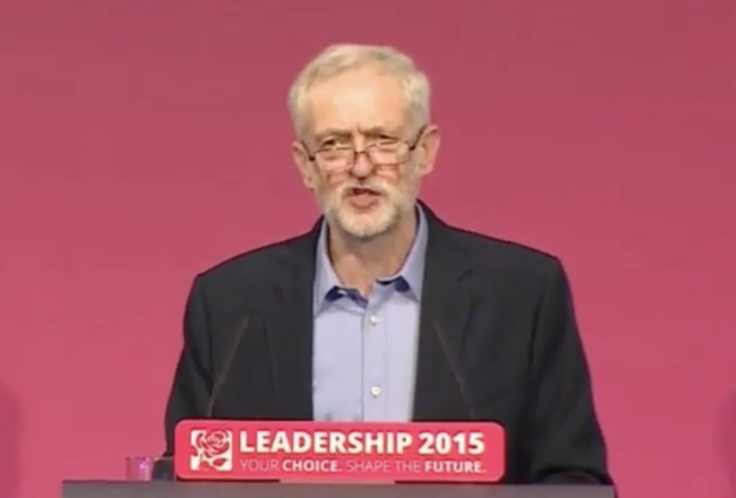
On 12 September 2015, Jeremy Corbyn, the veteran left-wing MP for Islington North, was elected leader of the Labour Party.
Corbyn, a rebellious backbencher for the previous 32 years, won 59.5% of the vote.
The leadership contest was triggered by Ed Miliband’s resignation as Labour leader on 7 May after the 2015 general election resulted in a majority Conservative government.
Corbyn was the chosen representative of the Socialist Campaign Group (SCG) of left-wing Labour MPs. John McDonnell and Diane Abbott, both SCG members, had launched leadership campaigns in 2007 and 2010. Corbyn was the latest candidate of the left to contest the leadership; few expected he would succeed where McDonnell and Abbott failed.
Announcing his candidacy, Corbyn declared: “This decision to stand is in response to an overwhelming call by Labour Party members who want to see a broader range of candidates and a thorough debate about the future of the party.
“I am standing to give Labour Party members a voice in this debate.”
McDonnell’s concurrent announcement that Corbyn had “agreed to stand as Left Candidate” did not convey much enthusiasm on the part of his parliamentary comrade.
Corbyn initially struggled to secure a place on the ballot paper. To stand, prospective candidates needed to win the nominations of 15% of the parliamentary Labour Party (PLP) – 35 MPs at that time.
Corbyn was nominated by 36 fellow MPs (15.52% of the PLP) – but several supported his candidacy because they believed the party’s left wing should be represented in the debate. Around a dozen of Corbyn’s ‘supporters’ in the first round went on to back rival candidates.
He stood against three more mainstream Labour candidates, all of whom possessed frontbench experience. Andy Burnham and Yvette Cooper were both former cabinet ministers. Liz Kendall, seen as the race’s “Blairite” candidate, had held a shadow junior ministerial role from 2011 to 2015.
***
Over the course of the campaign, which ran from 14 August to 12 September, Corbyn’s anti-austerity, anti-war platform won significant support from the Labour grassroots.
The North London MP’s platform included comprehensive renationalisation, “tax justice”, unilateral nuclear disarmament, “people’s quantitative easing” and opposition to university tuition fees. He galvanised support as the most obviously distinct candidate when contrasted with his rivals across debates and media appearances.
Significantly, the campaign coincided with the second reading vote on the Conservative government’s new Welfare Reform and Work Bill. Harriet Harman, the interim Labour leader, argued that while the party opposed many parts of the bill, it could not be seen to oppose measures aimed at getting people into work. The leadership’s stance was therefore to abstain at the bill’s second reading but to table amendments to oppose specific elements, such as the two-child limit, later in the legislative process.
This decision to abstain caused a furious backlash within the party, particularly from its left wing. Corbyn was the only candidate to vote against the bill.
Corbyn described the bill a “rotten and indefensible”.
His frontbench rivals – Yvette Cooper, Andy Burnham and Liz Kendall – all abstained. Overall, 48 Labour MPs voted against the proposed legislation.
In an interview with the Independent on Sunday, Corbyn suggested that he could consider bringing back the original Clause IV as part of a commitment to take some “necessary things” into public ownership.
He said: “I think we should talk about what the objectives of the party are, whether that’s restoring the Clause IV as it was originally written or it’s a different one, but I think we shouldn’t shy away from public participation, public investment in industry and public control of the railways.”
He added: “I’m interested in the idea that we have a more inclusive, clearer set of objectives. I would want us to have a set of objectives which does include public ownership of some necessary things such as rail.”
A spokesperson later sought to play down Corbyn’s remarks.
***
Corbyn began the campaign as a mostly unknown 200-to-1 rank-outsider; he ended it addressing mass rallies on an explicitly, unapologetic socialist platform.
Reforms to the Labour leadership election rules, overseen by Miliband, were crucial in shaping Corbyn’s victory. The changes scrapped the three-way, equally weighted electoral college. Under the new one member, one vote (OMOV) system, the electorate was expanded to include “affiliated supporters” from trade unions as well as “registered supporters” who could pay £3 to vote.
In late August, the Labour Party announced that in excess of 112,000 individuals had joined as registered supporters – over a fifth of the full 552,000 electorate.
However, even without the £3 registered supporters, Corbyn would still have secured the leadership in the first round with 51% of votes.
Corbyn won 83.8% of the registered supporter vote, 57.6% of the affiliated supporters vote and 49.6% of the members vote.
The socialist scourge of the New Labour whips won a majority in the first round of voting, defeating his opponents in one fell swoop. Burnham finished second with 19.0% of the vote; Cooper won 17.0%, and Kendall 4.5%.
In his victory speech, Corbyn said the result showed people are “fed up with the injustice and the inequality”.
He added: “The media and many of us, simply didn’t understand the views of young people in our country. They were turned off by the way politics was being conducted. We have to and must change that. The fightback gathers speed and gathers pace”.
Addressing Labour’s new members, he said: “Welcome to our party, welcome to our movement. And I say to those returning to the party, who were in it before and felt disillusioned and went away: welcome back, welcome home.”
Corbyn also condemned the media, saying its behaviour had been at times “intrusive, abusive and simply wrong”.
He stated: “I say to journalists: attack public political figures. That is ok but please don’t attack people who didn’t ask to be put in the limelight. Leave them alone in all circumstances.”
The result led directly to the formation of ‘Momentum’, a grassroots Corbynite campaign vehicle, to support his political agenda and consolidate his position as leader.
***
Corbyn’s victory set the stage for five years of intense factional conflict within the Labour Party.
His election pitted the PLP against the Labour membership – a routine source of instability throughout the 2015 to 2019 period.
Within hours of the result, senior MPs including Cooper, Kendall, Rachel Reeves and Tristram Hunt declared that they would not serve on Corbyn’s frontbench.
Alongside the leadership race, the contest for the vacant deputy post was won by Tom Watson. Corbyn and Watson would go on to forge a difficult relationship, reflecting their disparate political outlooks.
Over time, several MPs who nominated Corbyn to “broaden the debate”, notably Neil Coyle and Jo Cox, later expressed their regret.
On 28 June 2016, Corbyn suffered an emphatic defeat in a vote of no confidence among his own MPs, with 172 MPs voting against him and only 40 offering their support.
The ballot, while it was not binding, marked the culmination of a full-scale revolt against his leadership in the wake of the UK’s vote to leave the European Union. The rebellion was triggered by widespread anger within the PLP over what was seen as Corbyn’s lukewarm and ineffective support for the ‘Remain’ campaign.
In the subsequent leadership election, held over the summer of 2016, Corbyn defeated rival candidate Owen Smith comfortably.
Nonetheless, Corbyn’s relationship with the PLP remained fundamentally broken. His standing was secured by the 2017 general election, when Labour unexpectedly gained 30 seats. But relations soured markedly over the course of the 2017-2019 parliament.
Corbyn resigned as Labour leader in the wake of the 2019 general election, which saw Labour collapse to 202 seats – the party’s worst result since 1935.
Politics.co.uk Newsletters
DAILY
Politics@Lunch
WEEKLY
Week in Review