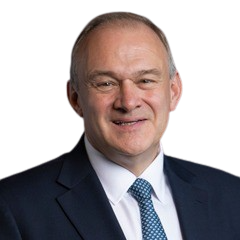
Lucy Powell is the Labour and Co-operative MP for Manchester Central, having first been elected to parliament at a by-election on 15 November 2012.
Powell serves as deputy leader of the Labour Party and education secretary.
In the 2024 general election in the Manchester Central constituency, Powell received 20,184 votes, representing 50.8% of the vote share. The Green Party candidate, Ekua Bayunu, received 6,387 votes (16.1%), while the Reform UK candidate, David Brown, secured 4,760 votes (12%). Powell was duly re-elected with a majority of 13,797 votes.
The Manchester Central constituency covers Manchester city centre and inner city areas including Anscoats, Deansgate and Failsworth. The seat has been held by Labour continuously since its creation in 1974.
Political Career
Lucy Powell currently serves as secretary of state for education. Powell was appointed to this role in July 2026, following the Labour leadership contest and Andy Burnham’s elevation as prime minister.
Powell was elected as deputy leader of the Labour Party in October 2025, succeeding Angela Rayner.
The 2025 Labour deputy leadership election followed Rayner’s resignation; Rayner simultaneously stepped down as deputy prime minister and housing secretary after an investigation into her tax affairs. The contest marked the first time since 2007 that Labour had held a deputy leadership election while in government.
Powell was dismissed as leader of the House of Commons and lord president of the council as part of the reshuffle precipitated by Rayner’s resignation. A Labour source quoted in the New Statesman magazine suggested Powell was sacked from her role as leader of the House of Commons as she had “fundamentally lost the trust of colleagues” as a result of briefing and leaking. Powell vehemently rejected this accusation, describing the claim as “just plain wrong”.
In the 2025 deputy leadership contest, Powell was seen as a candidate representing Labour’s “soft left”, and was supported by leading soft left figures including Ed Miliband and Andy Burnham. She secured 117 nominations from the Parliamentary Labour Party (PLP), above the 80 required, and went on to win the election – defeating Bridget Phillipson with 54.3% of the vote. Phillipson was cast as the No 10 or government candidate – a framing she failed to invalidate as the campaign progressed.
During the campaign, Powell said she would be a voice for “progressive change and hope that Labour has always delivered when we’re at our best.”
She added: “I want this government to succeed, and sometimes that means speaking the truth – not sniping from the sidelines but ensuring we listen, and act on what we hear. When we don’t we make mistakes that overshadow our achievements.”
Powell dismissed suggestions that she would encourage “division and disunity”, describing the accusation (actively encouraged by the Phillipson camp) as “ridiculous”.
On 5 October 2025, Powell told BBC One’s Sunday with Laura Kuenssberg programme that Labour needed to be a “better version of ourselves” and draw in “all the voices from our broad movement that are connected to our communities.”
Powell called for a “course correction”.
Upon her election as deputy leader, Powell emphasised the need for Labour to give a “stronger sense of purpose” to voters.
She stated: “We must give a strong sense of our purpose, whose side we are on, and of our Labour values and beliefs. People feel that this government is not being bold enough in delivering the kind of change we promised.”
Prior to the 2024 general election, which saw Labour returned to power after 14 years in opposition, Powell served in a series of shadow ministerial roles. She served continuously on Labour’s frontbench from April 2020 until the 2024 election. Her roles included shadow leader of the house (September 2023 – July 2024), shadow secretary of state for digital, culture, media and sport (November 2021 – September 2023), shadow secretary of state for housing (May – November 2021) and shadow minister for business and consumers (April 2020 – May 2021).
Previously, during Jeremy Corbyn’s tenure as Labour leader, Powell served as shadow secretary of state for education from September 2015 to June 2016. She was among those to resign from the shadow frontbench in protest at Jeremy Corbyn’s leadership and his approach to the Brexit referendum.
In her resignation letter, Powell described Corbyn’s position as leader of the party as “untenable”.
She wrote: “I didn’t know you before you became leader but I have come to know you and found you to be a decent, principled and kind colleague. However, it is increasingly clear that your position is untenable and that you are unable to command the support of the shadow cabinet, the Parliamentary Labour Party and, most importantly, the country.
“Given the big challenges faced by our country and our party over the coming months, and the possibility of an imminent general election, I do not have the confidence that you can bring the party together, lead us to a general election and be an effective opposition.”
Powell was a close ally of Ed Miliband during his tenure as leader of the Labour Party. Under Miliband’s leadership, she was shadow minister for the Cabinet Office (November 2014 – September 2015) and shadow minister for childcare and early years (October 2013 – November 2014).
Powell served as vice-chair of Labour’s unsuccessful 2015 general election campaign. She was associated with the widely mocked misstep in which Miliband unveiled a large stone monolith engraved with election pledges – the so-called “Ed Stone”. At the time, Powell suggested Miliband might break the promises he had carved into it.
She stated: “I don’t think anyone is suggesting that the fact that he’s carved them into stone means that he is absolutely not going to break them or anything like that.”
Powell was the chair of the House of Commons modernisation committee (2024-2025), and sat as a member of the education committee (2017-2020) and the transport committee (2012-2013).
Powell won the Manchester Central by-election in November 2012 with 11,507 votes (69.1%). This came on a turnout of just 18.2%, the lowest in a parliamentary by-election since the Second World War.
Powell delivered her maiden speech on 28 November 2012 during a debate on jobs and social security.
In it, she said: “A child born in Manchester Central is still likely to live five years less than the UK average; 50% of children in Manchester Central live in poverty; long-term youth unemployment is high and rising; too many families are in underemployment with not enough hours to make ends meet; wages are stagnant and bills getting higher; access to quality, affordable child care is getting harder; the vulnerable and disabled are seeing their services and support cut; and places such as Collyhurst, Clayton, Newton Heath and Openshaw are still in desperate need of regeneration.”
She added: “As the granddaughter of Irish immigrants on one side and a mining family on the other, my family are hugely proud of my achievements here today.
“I was born on the day of the second general election of 1974. My dad would not take my mum to the hospital until after our local polling station in Moss Side had opened, where he duly declared that my mum was in labour and voting Labour.
“Some thought this marked my future destiny, but my beliefs and conviction were actually shaped by the fact that it would be nearly 23 years before Labour would next win a general election.”
Before entering parliament, Powell was chief of staff (acting, then deputy) to Miliband as Labour leader from 2010 to 2012. She managed Miliband’s successful 2010 leadership campaign.
Powell stood unsuccessfully for Parliament in Manchester Withington in the 2010 general election, losing to the Liberal Democrat candidate John Leech.
Political Views
Leadership elections and loyalty
Labour leadership 2015: Powell was one of 68 Labour MPs who nominated Andy Burnham for the party’s leadership in June 2015. The election followed the resignation of Ed Miliband after the party’s defeat in the 2015 general election. It was the first contest held under the “one member, one vote” system, which replaced the previous electoral college.
Burnham, the shadow health secretary, was initially considered the frontrunner. He secured 68 nominations from the Parliamentary Labour Party (PLP), comfortably exceeding the 35 required to reach the final ballot. He ultimately finished second in the contest with 19% of the vote, losing to Jeremy Corbyn in the first round.
Corbyn loyalty list: In March 2016, Powell was labelled as “core group negative” by the Corbyn leadership in a leaked list which categorised Labour MPs by their perceived loyalty. This label suggested the Corbyn leadership viewed Powell as a critic but not openly hostile.
Labour leadership 2016: Powell was one of 162 Labour MPs who nominated Owen Smith for the party’s leadership in July 2016. The election was triggered by a challenge to Jeremy Corbyn following the EU referendum, which led to a wave of shadow cabinet resignations and a vote of no confidence supported by 172 MPs. Smith, the former shadow work and pensions secretary, was ultimately defeated by Corbyn, who won with an increased mandate of 61.8% of the vote.
Factional identity and party tradition
Tribune group (2017): Powell was listed among the supporters of the Tribune parliamentary group – a caucus generally described as representing the party’s “soft left”.
The Tribune group was initially formed in 1964 to support the newspaper of the same name. It served as a prominent forum for those parliamentarians situated on the left of the Labour Party – but it split over Tony Benn’s campaign for the deputy leadership in 1981. Benn’s supporters founded the Campaign group – which evolved into the Socialist Campaign Group (SCG). Today, the Bennite SCG is strongly associated with the Labour left tradition.
During the 1980s, the Tribune group emerged as a more natural home for those on Labour’s “soft left”.
In 2017, Efford officially re-launched the group with a new mission statement calling for “opportunity and aspiration” to be placed at the heart of the party’s programme. Efford said he had reformed the group to ensure that the centre-left of the Parliamentary Labour Party (PLP) “have a space in which to put forward ideas and debate which has not been there under successive leaders”.
He added: “The view of Labour MPs at the moment tends to be that too much are just Blairites who want to stab Jeremy Corbyn in the back. We want to show that is not where we are, and that we want to develop our own ideas that represent the centre-left of the party.”
Brexit and Europe
Brexit referendum: Powell supported Remain in the 2016 Brexit referendum, and therefore agreed with a majority of her constituents, 63.6% of whom also voted to Remain.
Article 50: In February 2017, Powell voted in favour of the European Union (Notification of Withdrawal) Bill. The legislation empowered the prime minister to notify the Council of the European Union of the UK’s intention to withdraw, formally triggering the process set out in Article 50 of the Treaty on European Union. MPs supported the bill by 498 votes to 114 at second reading.
Welfare
Welfare vote (July 2025): Powell voted in favour of the government’s flagship welfare bill at second reading. The vote came after ministers agreed to significant concessions to avoid defeat via a mass rebellion of Labour MPs on 1 July 2025.
Assisted dying
Powell voted in favour of the Terminally Ill Adults (End of Life) Bill, better known as the assisted dying bill, at both second reading (November 2024) and third reading (June 2025).
Social values and conscience issues
Abortion decriminalisation (2025): Powell voted in favour of a backbench amendment to the Crime and Policing Bill that sought to decriminalise abortion in England and Wales in June 2025. The amendment, which was passed by a majority of 242 votes, removed women from the threat of prosecution for ending a pregnancy at any stage. As an issue of conscience, MPs were allowed to vote according to their personal beliefs.
Same-sex marriage (2013): In February 2013, Powell voted in favour of the Marriage (Same Sex Couples) Bill at its second reading. The landmark piece of legislation, which received its second reading by 400 votes to 175, legalised marriage for same-sex couples in England and Wales.
Foreign policy and security
Trident renewal (2016): Powell voted in favour of a government motion calling for the renewal of the Trident nuclear deterrent system in July 2016. The motion, which was passed by 472 votes to 117, committed the UK to constructing a new fleet of submarines to carry the nation’s nuclear weapons. Labour was split over the issue with 140 of its 230 MPs going against leader Jeremy Corbyn and backing the motion.
Syria airstrikes (2015): Powell voted in favour of a government motion to extend UK airstrikes against Isis from Iraq into Syria in December 2015. The motion, which was passed by 397 votes to 223 after a 10-hour debate in the House of Commons, authorised the RAF to conduct strikes against Isis targets in Syria.
Syria airstrikes (2013): Powell voted against the government’s motion on the principle of military intervention in Syria in August 2013. The government motion was defeated by 285 votes to 272, a move which effectively ruled out UK participation in any US-led military strikes.
Before Politics
Born Lucy Maria Powell in Manchester on 10 October 1974, she attended Beaver Road Primary School, Parrs Wood High School in Didsbury and Xaverian College .
She studied chemistry at Somerville College, University of Oxford, and also undertook studies at King’s College London.
Powell worked as a parliamentary assistant for Labour MP Beverley Hughes and in campaigning and public relations roles for the pro-European pressure group Britain in Europe (BiE), eventually becoming its campaign director.
She subsequently worked for NESTA (National Endowment for Science, Technology and the Arts).
Personal Life
Powell is married to James Williamson, an emergency medicine doctor. They have two children.
Trivia
Powell supports Manchester City Football Club.
Lucy Powell has not written for Politics.co.uk.