Kemi Badenoch elected Conservative leader
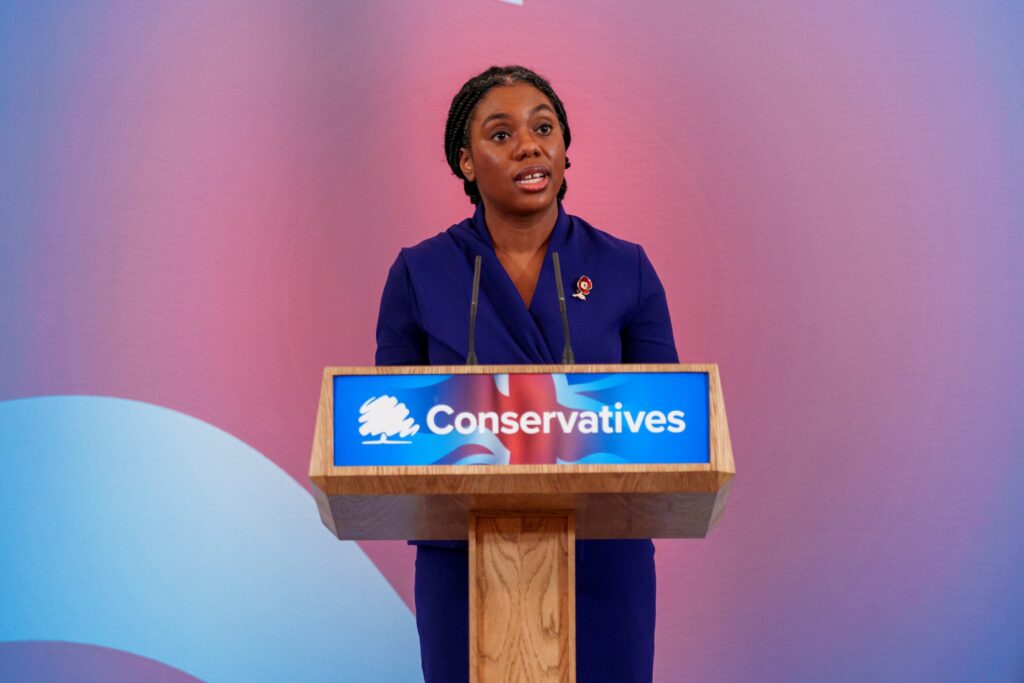
On 2 November 2024, Kemi Badenoch was declared as the new leader of the Conservative Party, succeeding Rishi Sunak.
The leadership election was triggered by Sunak’s resignation after the party suffered a landslide defeat at the 2024 general election. The Conservatives were reduced to just 121 MPs – the worst result in the party’s history.
On 10 July, speaking at the first shadow cabinet meeting since the election, Badenoch accused senior Conservatives of failing to understand the “enormity” of the defeat. She said that Suella Braverman, the former home secretary, appeared to be having a “very public” nervous breakdown, and referred to Craig Williams – the Sunak aide who admitted placing a bet on the election date – as a “buffoon”.
Badenoch argued that the Conservatives saw “too much nodding along in the room and arguments outside it” during its tenure in government.
Braverman, a vocal critic of Sunak’s government, had initially been linked with a second run for the Conservative leadership; like Badenoch, she stood in the July-September 2022 contest that followed Boris Johnson’s resignation as prime minister.
The former home secretary ultimately ruled herself out of the 2024 leadership contest; it came after her supporters, including key allies John Hayes and Danny Kruger, shifted their support to Robert Jenrick. In an article for the Telegraph, published 28 July 2024, Braverman insisted she did have the requisite backers (10 MPs) to qualify for the first ballot.
She wrote: “There is, for good or for ill, no point in someone like me running to lead the Tory party when most of the MPs disagree with my diagnosis and prescription.”
The piece was titled: “I’ve been branded mad, bad and dangerous by my own party – so I will not lead it”.
***
On 29 July, Badenoch declared her candidacy, pledging to return the Conservative Party to “first principles”.
In an article for the Times, she wrote: “My campaign is launching with an explicit focus on renewing our party for 2030 – the first full year we can be back in government and the first year of a new decade.”
Badenoch joined fellow candidates Jenrick, the former immigration secretary; Priti Patel, the former home secretary; Mel Stride, the former work and pensions secretary; Tom Tugendhat, the former security minister; and James Cleverly, the former foreign secretary in the race to replace Sunak.
The leadership race, which officially commenced on 24 July, spanned more than four months. There was some debate among Tory MPs officials over whether to have a long, potentially protracted contest or a shorter race. In the end, the view prevailed that only a longer contest could ensure the emergence of a worthy leader.
The Conservative Party’s leadership election rules, introduced under William Hague (1997–2001), set out a two-stage process: successive ballots of Conservative MPs reduce the field to two candidates, after which the wider membership selects the leader through a one-member-one-vote (OMOV) ballot.
Bob Blackman, the newly elected chair of the 1922 committee of Tory backbenches, announced that he would give out formal warnings – in the form of “yellow cards” – if the candidates briefed against their rivals. This scheme was informed by previous ill-tempered Tory leadership elections, notably the first contest of 2022.
Blackman, however, never distributed his “yellow cards” – despite the relatively wholesale briefing.
***
The first round on 4 September saw Priti Patel eliminated, having only secured the support of 14 Conservatives MPs. Robert Jenrick topped the poll with 28 votes; the former immigration minister campaign championed policies and messaging firmly aligned with the Conservative right.
Jenrick resigned from the Sunak government in December 2023 over his belief that attempts to operationalise the Rwanda deportations scheme were doomed to fail. Throughout the 2024 leadership campaign, he stressed his support for leaving the European Convention on Human Rights (ECHR).
Mel Stride was eliminated in the second round of voting on 10 September, having secured the support of only 16 Tory MPs. This ballot narrowed the field to a final four.
The campaign continued through and beyond the 2024 Conservative conference, which effectively evolved into a Tory ‘beauty contest’ – with each candidate competing for the affections of Tory MPs and members.
On the first day of Tory conference, Badenoch came in for criticism for suggesting that maternity pay was “excessive”.
She told Times Radio: “Maternity pay varies, depending on who you work for – but statutory maternity pay is a function of tax, tax comes from people who are working. We’re taking from one group of people and giving to another. This, in my view, is excessive.
“Businesses are closing, businesses are not starting in the UK, because they say that the burden of regulation is too high.”
Despite her attempts to clarify the remarks, Tugendhat and Cleverly issued thinly veiled criticisms.
Tugendhat said: “I’m afraid I don’t know the context of her comments, but I do know that it is incredibly important that women have the ability to choose how to live their lives.”
Jenrick, meanwhile, was criticised for claiming that UK special forces “kill rather than capture terrorists” because of fears that European laws would free any detained assailants.
https://x.com/RobertJenrick/status/1840659469727916246
Each candidate was given the opportunity to address Conservative activists from the conference main stage for 20 minutes. The format echoed the 2005 Conservative leadership contest’s choreography; David Cameron’s skilful, no-notes contribution in 2005 catapulted him to the Tory leadership.
All of Tugendhat, Jenrick and Badenoch opted to deliver similar no-notes speeches.
Jenrick repeated his call for the UK to leave ECHR to “secure our borders” and promised a freeze in net migration. Badenoch told activists that the “system is broken” and warned governments “run into trouble” without a plan to fix it.
Cleverly, the only candidate to use a podium, urged his party to “sell the benefits of Conservatism with a smile” and to be “more normal”. The speech received the longest standing ovation of the four candidates.
The former foreign secretary entered the third ballot of Tory MPs with clear post-conference momentum. He also secured the endorsement of Mel Stride.
Cleverly won the support of 39 Tory MPs in the third ballot, outperforming both Jenrick (31) and Badenoch (30). Tugendhat (20) was eliminated.
The fourth and final ballot of MPs came the next day on 9 October. It was initially seen as a contest for second, with Cleverly’s place in the final round seen as secure. As the more moderate candidate, he was also expected to pick up a plurality of the 20 MPs who had backed Tugendhat in the third ballot.
But Cleverly was eliminated. His support dropped by two to 37 MPs. Badenoch won 42 votes; Jenrick placed second with 41.
The elimination of Cleverly, despite his momentum after the conference, was widely attributed to tactical voting (or ‘vote lending’) by rival camps.
Cleverly’s campaign subsequently dismissed rumours it told MPs to ‘lend’ their votes to either Jenrick or Badenoch in a bid to stop one or the other. This denial, however, did not rule out the possibility that Cleverly-supporting MPs took matters into their own hands – choosing, either, to back the most vulnerable candidate or to support their second preference.
In the final head-to-head vote, Badenoch won a clear majority of the Tory membership, securing 53,806 votes (56.5%) compared to Jenrick’s 41,388 votes (43.5%).
The margin of victory, however – 12,418 votes – made it the narrowest win of the five contests (2001, 2005, 2019 and summer 2022) held since the party changed its rules to allow members the final say.
Badenoch’s victory made her the fourth woman and first black person to lead the Conservative Party.
***
In her victory speech, Badenoch said it was “the most enormous honour to be elected” to the role leading the “party that has given me so much.”
She paid tribute to Jenrick, who she said had run a “great campaign”.
She added: “You and I know that we don’t actually disagree on very much. And I have no doubt that you have a key role to play in our party for many years to come…
“The time has come to tell the truth. The time has come to tell the truth to stand up for our principles, to plan for our future, to reset our politics and our thinking, and to give our party and our country the new start that they deserve.
“It is time to get down to business. It is time to renew.”
Keir Starmer, the prime minister, welcomed Badenoch to her new position. “The first Black leader of a Westminster party is a proud moment for our country”, he said. “I look forward to working with you and your party in the interests of the British people.”
Badenoch set about appointing her first shadow cabinet.
Mel Stride and Priti Patel were appointed to the posts of shadow chancellor and shadow foreign secretary respectively.
Robert Jenrick was appointed as shadow justice secretary.
Tom Tugendhat and James Cleverly, meanwhile, chose to return to the backbenches.
Badenoch also appointed a series of key allies to prominent roles – including Alex Burghart (shadow chancellor of the Duchy of Lancaster) and Andrew Griffith (shadow business and trade secretary).
Politics.co.uk Newsletters
DAILY
Politics@Lunch
WEEKLY
Week in Review