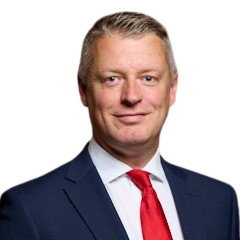
William Hague was a senior figure in the Conservative Party for over two decades. He served as the MP for Richmond (Yorks) from 1989 to 2015, and held prominent roles including leader of the Conservative Party and leader of the opposition (1997-2001), foreign secretary (2010-2014) and first secretary of state (2010-2015).
Hague first gained national attention aged 16 with a speech at the 1977 Conservative Party conference. After leading the party to defeat in the 2001 general election, he resigned as leader but returned to high office under David Cameron.
Hague stood down from the House of Commons in 2015 and accepted a life peerage as Lord Hague of Richmond.
Hague has served as chancellor of Oxford since February 2025.
William Hague: rise to prominence and leadership (1977-2001)
Hague made his political debut speaking at the 1977 Conservative Party conference aged 16. He was elected MP for the safe Conservative seat of Richmond (Yorks) in a 1989 by-election, succeeding Sir Leon Brittan with a majority of 2,634 votes. At the time, he was the youngest Conservative MP.
Hague served as parliamentary private secretary (PPS) to chancellor Norman Lamont (1990-1993), before junior ministerial roles at the Department of Social Security. In 1995, prime minister John Major appointed him secretary of state for Wales, making him the youngest cabinet minister since Harold Wilson.
Hague stood in the 1997 Conservative leadership contest, triggered by John Major’s resignation after the 1997 general election resulted in a Labour landslide. The contest was initially characterised by uncertainty after former defence secretary Michael Portillo’s surprise defenestration cleared the field of the favourite to succeed Major.
It was Kenneth Clarke, the europhile former chancellor, who established himself as the early frontrunner, winning the first two rounds of voting among Conservative MPs. Clarke’s main rivals were from the party’s right wing, primarily the ardent eurosceptic John Redwood and Hague.
Hague originally entered the race as the junior partner on a joint-ticket with Howard, whose campaign steadily melted away.
In the third and final ballot, the party’s right wing largely coalesced around Hague in a bid to thwart Clarke’s candidacy. Redwood’s shock endorsement of Clarke ahead of the final ballot – forming the Clarke-Redwood pact – was variously decried as “unholy”, cynical and unsustainable. By contrast, Hague secured the coveted public endorsement of Lady Thatcher.
Hague, who pitched himself as a fresh face who could truly unite his party’s warring factions, defeated Clarke by 90 votes to 72 – a 22-vote majority. At the age of 36, Hague was the youngest Conservative leader since William Pitt the Younger in 1783.
During his tenure as Tory leader, Hague acquired a series of unflattering nicknames. He was ridiculed as “Hague the vague”, the “Yorkshire strangler” and William “14 Pints” Hague. The Sunday Telegraph, which reportedly coined the “Yorkshire strangler” moniker, said Hague deserved the title because of his prowess at Judo.
In August 2000, Hague told GQ magazine that between the ages of 15 and 21 he drank 14 pints a day during a summer job hauling crates of drinks into pubs across South Yorkshire. The remark was intended to offset the lingering image of Hague as a 16-year-old addressing the Conservative Party conference and as an ardent admirer of Margaret Thatcher.
Meanwhile, Hague’s decision to sport a personalised, navy-blue baseball cap, emblazoned with the word “HAGUE” in bold white text – just four weeks after winning the Conservative leadership in August 1997 – was widely seen as a gaffe. Hague’s choice of headgear was seemingly designed to counter perceptions of the Conservatives as stuffy and out of touch. But it showed a new Conservative leader trying a little too hard to make his mark. More abstractly, the awkward and inauthentic attempt to appear “cool” only shone a light on those aspects of the Conservative Party’s brand that stunt sought to neutralise.
The Tory leader himself later acknowledged his PR blunder, auctioning one of the caps for charity in 1999. Its estimated value was £15.00.
All this contributed to a mixed public perception. An opinion poll in 2001 revealed that while most people (69%) thought Hague was not nasty, two thirds (66%) thought he came over as “a bit of a wally”.
Hague recorded successes at the European parliamentary elections in June 1999, when the Conservatives gained 18 MEPs. Moreover, Hague’s powerful and popular opposition to the UK joining the Euro likely proved a significant factor in the Labour government’s eventual decision not to adopt the single currency, at a time when most of the European Union was moving across to it.
Under Hague’s leadership, the Conservative Party briefly jumped ahead of Labour in the polls following the 2000 fuel protests/blockade. In response, Hague declared: “The Conservative Party is ready for government. We have got a team that’s ready for government.”
But while his talented and confident oratory regularly ruffled Tony Blair at prime minister’s questions, Hague was ultimately no match for the New Labour political juggernaut. As the 1997-2001 parliament progressed, with the polls continuing to show Blair in the ascendancy, Hague retreated more and more into traditional Tory territory to appease his anxious party.
In March 2001, Hague delivered a controversial speech warning that continued integration with the European Union would turn Britain into a “foreign land”. In the speech’s most memorable and controversial passage, Hague invited his audience to imagine the consequences of another Labour victory, declaring: “Let me take you on a journey to a foreign land – to Britain after a second term of Tony Blair.”
Responding to Hague’s speech, former deputy prime minister Lord Heseltine said: “Does anyone seriously think that France is a ‘foreign’ country? Or that Germany is a ‘foreign’ country?”
Heseltine spoke of a “dilemma” over whether to vote Conservative at the next general election.
Hague’s 2001 general election campaign was widely derided as misjudged, resulting in the gain of just one seat. Labour’s 179-seat majority in 1997 was cut to 166 – a second successive landslide.
Hague announced his resignation as Conservative leader on the morning after polling day with results still rolling in. Hague conceded that, “we have not been able to persuade a majority or anything approaching a majority, that we are yet the alternative government that they need.”
Iain Duncan Smith was elected as Hague’s replacement. Duncan Smith was the first Conservative leader elected by a ballot of members – a change Hague had overseen during his tenure. Hague endorsed Duncan Smith in 2001.
William Hague’s late-political career (2001-2015)
In March 2003, Hague voted in favour of the government motion authorising military action against Iraq. The vote, one of the most contentious in recent parliamentary history, gave the prime minister, Tony Blair, the authority to join the US-led invasion.
In the 2005 Conservative leadership contest, Hague supported David Cameron’s candidacy and returned to the frontbench as shadow foreign secretary (2005-2010).
Under Cameron as prime minister, Hague served as foreign secretary from 2010 to 2014 and as first secretary of state from 2010 to 2015. As foreign secretary at a time of international turbulence, Hague oversaw the UK’s response to the 2011 Arab Spring protests, the beginnings of the Syrian civil war and the Iran nuclear crisis. Renowned for his oratory skills, his counterpart in the United States, Hillary Clinton, labelled Hague “the David Beckham of witty toasts”.
Hague helped lead efforts to secure support for a government motion on the principle of military intervention in Syria in August 2013. The government motion was defeated by 285 votes to 272, a move which effectively ruled out UK participation in any US-led military strikes.
In February 2013, Hague was one of the 131 Conservative MPs to vote in favour of the Marriage (Same Sex Couples) Bill at its second reading. The landmark piece of legislation, which received its second reading by 400 votes to 175, legalised marriage for same-sex couples in England and Wales.
In his final year as an MP, Hague served as leader of the House of Commons. He stood down from parliament at the 2015 general election. In his final act as an MP, shortly before the dissolution of parliament ahead of the 2015 contest, Hague caused controversy after he sought to introduce a secret ballot to re-elect John Bercow as speaker in the next parliament. This move, it was said, would have provided political cover for critical Conservative MPs who wished to remove Bercow from his post.
Hague was succeeded as the MP for Richmond by Rishi Sunak.
In November 2023, it was widely speculated that Sunak, the prime minister since October 2022, had asked Hague to serve as foreign secretary. David Cameron, subsequently Lord Cameron, was eventually appointed to the post in a far-reaching cabinet reshuffle.
When asked on Times Radio about his role in events surrounding Lord Cameron’s appointment, Hague said: “I do like the idea of David Cameron coming back into government and was very enthusiastic about it. I knew about it a few days before and spoke to David Cameron to brief him about my views on foreign affairs and the Foreign Office.
He added: “But it wasn’t my idea. You read these things, I set it up in some way, it was my idea – that’s not the case. I know Rishi Sunak and David Cameron very well, but sometimes in politics, things are simpler than they look.
“Sometimes somebody just asked somebody else around for a chat and says, ‘Why don’t you do this?’ And they said, ‘Well, OK, fine.’ And you know, it doesn’t need any intermediary or they just sort it out themselves. So that’s what happened in this case.”
What is William Hague doing now?
Since leaving the commons in 2015, Hague has sat in the House of Lords as Lord Hague of Richmond on the Conservative benches. He was elected as chancellor of the University of Oxford, assuming the role formally in February 2025.
Known for his wit and engaging speaking style, he remains active as a public speaker and writes a weekly column for the Times.
In his column for the Times newspaper in late 2023, ahead of the then-government’s Safety of Rwanda Bill’s second commons reading, Hague warned that if the Conservative Party couldn’t pass the bill “they are going into opposition”.
Hague added: “And if they were mad enough to try to bring down yet another leader, the case for an immediate general election would become unanswerable.”
In 2014, while still foreign secretary, Hague co-founded the United for Wildlife Transport Taskforce with the Prince of Wales (then Duke of Cambridge) to tackle the illegal wildlife trade. He continues to play a leading role in the organisation alongside the Prince.
Before Politics
William Jefferson Hague was born on 26 March 1961, in Rotherham, Yorkshire. He attended Wath-upon-Dearne Comprehensive School and studied philosophy, politics and economics (PPE) at Magdalen College, Oxford. During his time at Oxford, he was president of both the Oxford University Conservative Association and the Oxford Union debating society.
After Oxford, Hague completed a master’s degree at INSEAD in France. He subsequently worked as a management consultant for McKinsey & Company before entering parliament in 1989.
Personal Life
Hague married Ffion Jenkins in December 1997.
Hague practises judo and learned piano after resigning the Conservative leadership. He maintains a strong interest in the history and countryside of Yorkshire.
Trivia
Hague has written a biography of Pitt the Younger (published in 2004.)
William Hague has not written for Politics.co.uk.