Labour wins historic landslide as Conservative Party collapses
The general election held on 4 July 2024 resulted in a spectacular landslide victory for the Labour Party, led by Keir Starmer. The contest, which brought 14 years of Conservative government to a definitive end, represented a political earthquake.
Labour secured 411 seats and a commanding House of Commons majority of 174.
Conversely, it marked the worst defeat in the history of the Conservative Party, which was reduced to just 121 MPs.
***
The 2024 general election was the first to be held after the Dissolution and Calling of Parliament Act 2022 formally repealed the Fixed-term Parliaments Act 2011. This allowed the prime minister, Rishi Sunak, to request the dissolution of parliament from the monarch at a time of his own choosing, within a maximum five-year term.
Despite the technical freedom to wait until January 2025, Sunak defied expectations and called a snap election in a surprise statement in the pouring rain outside 10 Downing Street on 22 May.
This inauspicious start kicked off an omnishambolic Conservative campaign, marred by a series of high-profile gaffes Conservative – including Sunak’s early departure from D-Day commemorations and a betting scandal in which several Conservative candidates and officials were investigated for allegedly betting on the July election date.
By contrast, Labour’s campaign was highly disciplined and cautious, constructed around the single-word slogan: “Change”.
The Labour Party’s manifesto for the 2024 general election, entitled Change, included a vow not to “increase national insurance, the basic, higher, or additional rates of income tax, or VAT.” The party also pledged to cut NHS waiting times, recruit 6,500 new teachers and introduce free breakfast clubs in every primary school.
When the results came in, the scale of the Conservative collapse was unprecedented, with 12 cabinet ministers losing their seats. Among the cabinet casualties were leader of the House of Commons Penny Mordaunt (Portsmouth North) and defence secretary Grant Shapps (Welwyn Hatfield). Liz Truss, who served as prime minister from September-October 2022, was ousted in her constituency of South West Norfolk.
The Liberal Democrats, led by Ed Davey, achieved a record result, winning 72 seats to become the largest third party in the commons in over a century. Following a campaign dominated by water-themed stunts, the party ravaged the Conservative “blue wall” of affluent commuter-belt constituencies in southern England.
The election also saw Nigel Farage’s Reform UK win its first-ever seats. Farage himself was elected in Clacton, and the party secured a total of five MPs. Speaking at his election count, Farage vowed: “We’re coming for Labour – be in no doubt about that.”
Notably, turnout was 59.7%, down from 67.3% in 2019 – and the second lowest since records began in 1885.
***
The 2024 general election was historically significant, in part, due to the performance of third parties.
The Labour and Conservative parties received their lowest combined vote share (57.4%) in the era of universal suffrage. Moreover, they were in the top two in fewer than half of constituencies (306) compared to 432 in 1997.
In the latter stages of the 2019-2024 parliament, Reform UK experienced a marked rise in its stature, establishing it as a significant threat to Sunak’s right flank.
The snap election sparked considerable speculation that Farage, the so-called honorary president of Reform UK, could return to frontline politics. Farage, a declared supporter of Donald Trump, initially stated he would not stand, saying he wanted to be free to campaign in the US presidential election. “Important though the general election is”, he wrote, “the contest in the United States of America on November 5 has huge global significance.”
But Farage soon U-turned, declaring his candidacy for the constituency of Clacton and announcing that he would take over as leader of Reform UK. Farage said that he had changed his mind on the campaign trail and wanted to lead a “political revolt”. Tice, a longstanding ally of Farage, willingly stood aside, assuming the position of party chairman.
Reform benefitted from the omnishambolic Conservative campaign. According to analysis by Ipsos, Reform won 23% of those voters who backed the Conservative Party, then led by Boris Johnson, at the 2019 general election.
The party won five seats and 4,117,610 votes (14.3%). Significantly, Reform UK placed second in 98 constituencies; in 89 of those contests, it finished behind Labour.
Meanwhile, the Liberal Democrat performance in the 2024 general election established Davey as the most electorally successful Liberal since David Lloyd George (prime minister from 1916 to 1922).
Davey’s campaign gained widespread media attention for a series of water-themed stunts. These included repeatedly falling off a paddleboard in Windermere to highlight sewage discharge, going down a large water slide to draw attention to children’s mental health, and undertaking a bungee jump in Eastbourne.
Defending his unconventional campaign, Davey said: “Politicians need to take the concerns and interests of voters seriously but I’m not sure they need to take themselves seriously all the time and I’m quite happy to have some fun”.
A central feature of Davey’s success was the Liberal Democrat capture of traditional Conservative seats. The party made six gains in Surrey, five in Sussex, four in Oxfordshire and 11 in Devon and Somerset.
Notably, the Liberal Democrats won the symbolic seats of Witney, previously represented by David Cameron, and Maidenhead, previously represented by Theresa May. The party also ousted four sitting cabinet ministers, including education secretary Gillian Keegan in Chichester, justice secretary Alex Chalk in Cheltenham, and technology secretary Michelle Donelan in Melksham and Devizes. The Lib Dem capture of ultra-safe Conservative seats extended to areas previously represented by Boris Johnson (Henley), Michael Gove (Bicester and Woodstock), and Stratford-on-Avon (Nadhim Zahawi).
The party also took four seats from the Scottish National Party (SNP) in Scotland.
Tactical voting played a crucial role in the Liberal Democrat resurgence. Of those intending to vote for the party, an estimated 35% cited tactical reasons – typically to oust an incumbent Tory.
***
The Green Party of England and Wales (GPEW) won a historic four seats at the 2024 general election. The result followed years of targeted campaigning, focusing the party’s resources on four specific constituencies: Brighton Pavilion, Bristol Central, Waveney Valley and North Herefordshire.
In Bristol Central, building on the party’s recent success in local government contests, co-leader Carla Denyer defeated the incumbent Labour MP, Thangam Debbonaire, with 24,539 votes (56.6%) and a majority of 10,407. At the time, Debbonaire served on the Labour frontbench as shadow culture secretary.
Siân Berry successfully defended Brighton Pavilion following Lucas’ retirement, winning 28,809 votes (54.8%) and a majority of 14,290.
The party also secured notable breakthroughs in two rural areas. Co-leader Adrian Ramsay won Waveney Valley with 20,467 votes (41.7%) and a majority of 5,593 over the second-placed Conservative candidate. Ellie Chowns won in North Herefordshire with 21,736 votes (43.2%) and a majority of 5,894 over the incumbent Conservative candidate.
Overall, Green parties in the United Kingdom secured 6.8% of the national vote – their highest ever share at a general election. The GPEW and its sister parties finished second place in 40 constituencies; in all but one of these 40 seats, the Greens finished second to Labour.
In Scotland, the SNP suffered a severe setback. John Swinney, the new first minister of Scotland, entered the campaign seeking to steady the ship. The SNP’s manifesto foregrounded independence, with the first page declaring: “VOTE SNP FOR SCOTLAND TO BECOME AN INDEPENDENT COUNTRY.”
The official SNP strategy, carried over from Swinney’s predecessors, stated that winning a majority of the 57 Scottish seats at Westminster would empower the Scottish government to begin immediate negotiations with the UK government on independence. And yet, the SNP’s long-held electoral dominance crumbled as the party’s representation at Westminster was decimated, falling from 48 to just 9 seats.
In a dramatic reversal of fortunes, Labour surged back to prominence in its former heartland, winning 37 seats and becoming the largest Scottish party at Westminster for the first time since 2010. The SNP’s share of the vote fell by 15 points to 30%, while Labour’s rose by over 16 points to 35.3%.
In the wake of this crushing defeat, Swinney conceded that the SNP had “failed to convince people of the urgency of independence” and that the party’s strategy would have to be fundamentally rethought. The “de facto referendum” plan was rendered irrelevant, and the immediate prospect of another independence vote vanished.
***
The 2024 election notable for the successful election of five independent MPs on platforms that emphasised Palestinian solidarity. One of those, former Labour leader Jeremy Corbyn, defeated his ex-party in Islington North – the constituency he has represented since 1983.
However, George Galloway, the Workers Party leader and MP for Rochdale, was defeated by Labour’s Paul Waugh – mere months after winning a by-election in the constituency.
In total, the WPB stood 152 candidates, winning 210,194 votes (0.7%). The party came close to unseating a series of high profile Labour incumbents. Jess Phillips, the incumbent MP for Birmingham Yardley, was reelected with a majority of 693 votes over the WPB candidate, Jody McIntyre. Phillips won a 10,659-vote majority at the 2019 general election. In Birmingham Hodge Hill and Solihull North, the incumbent Labour MP, Liam Byrne, won a 1,566-vote majority over the WPB candidate, James Giles.
Former England cricketer Monty Panesar stood down as the WPB candidate for the Ealing constituency after a series of unfortunate media interviews. Panesar suggested that withdrawing from Nato would reduce “illegal migration”.
Plaid Cymru won four out of the 32 Welsh constituencies (up two) and 194,812 votes (14.8% of the Welsh vote).
In Northern Ireland, the Democratic Unionist Party (DUP) lost three seats – including the historic and symbolic stronghold of North Antrim. Ian Paisley Jr (son of the predecessor MP) lost to Jim Allister of the Traditional Unionist Voice (TUV) party, a hardline unionist and onetime ally of Paisley Sr.
TUV candidates appeared under a joint Reform UK-TUV logo as part of a formal electoral alliance. Farage, however, appeared to distance himself from the alliance by endorsing some DUP MPs, including Paisley.
Overall, the DUP won five of Northern Ireland’s 18 parliamentary constituencies and 22.1% of the vote. The Social Democratic and Labour Party (SDLP) won two seats and 11.1% of the vote. The Alliance Party of Northern Ireland (APNI) won one seat and 117,191 votes (15.0%) The Ulster Unionist Party (UUP) won one seat and 12.2% of the vote. The TUV won one seat and 6.2% of the vote.
***
Labour’s vote was spread widely and thinly throughout the country.
The party’s landslide victory, with a vote share of 33.7%, was referred to as an inherently unstable if “monumental sandcastle”. This 33.7% represented the lowest vote share of any majority government in British history.
Labour’s total vote share only increased by 1.6 points compared to their historic defeat in 2019.
The geographic “efficiency” of Labour’s support allowed the party to almost double their seat count (based on the notional 2019 result, accounting for boundary changes). The party won many constituencies where they improved their standing and/or the vote on the right was split between the Conservative Party and Reform (allowing Labour to come through the middle). Conversely, Labour’s vote share declined in a number of seats it had historically treated as strongholds, particularly urban areas. Under the first past the post electoral system, however, Labour could “afford” to lose votes in such constituencies, while still retaining the seat.
As such, the 2024 general election was highly and historically disproportional.
Labour won 411 seats (63% of those available) with its 33.7% vote share. Reform UK’s five seats (0.8%) came on a vote share of 14.3%.
Overall it took approximately 24,000 votes to elect a Labour MP, 49,000 votes to elect a Liberal Democrat MP, 56,000 votes to elect a Conservative MP, 79,000 votes to elect an SNP MP, 485,000 votes to elect a Green MP, and 823,000 votes to elect a Reform UK MP.
According to research from the Electoral Reform Society (ERS), 554 (85%) of MPs were elected without the winner getting more than 50% support in the constituency.
***
On 5 July, power transferred from the Conservative Party to Labour for the first time since 1997.
Sunak announced his resignation on the steps of Downing Street. The outgoing PM said he had “given this job my all” but voters had sent a “clear message”.
He said: “I would like to say first and foremost, I am sorry, I have given this job my all. But you have sent a clear signal that the government of the United Kingdom must change.
“And yours is the only judgment that matters. I have heard your anger, your disappointment. And I take responsibility for this loss to all the Conservative candidates and campaigners who worked tirelessly, but without success.”
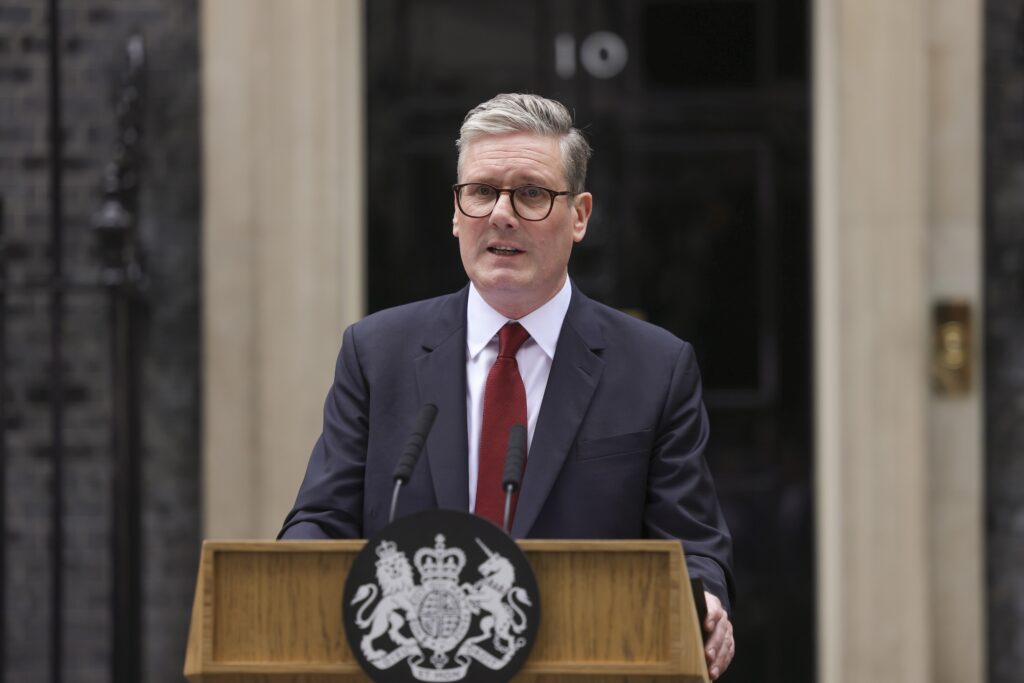
In his first speech as prime minister, Starmer said his government would rebuild hope and opportunity in the UK “brick-by-brick” and would show voters that “politics can be a force for good.”
He said: “Our country has voted decisively for change and a return of politics to public service.”
The new prime minister added: “From now on, you have a government unburdened by doctrine guided only by the determination to serve your interest, to defy, quietly, those who have written our country off. You have given us a clear mandate, and we will use it to deliver change.
“To restore service and respect to politics, end the era of noisy performance, tread more lightly on your lives and unite our country.”

Politics.co.uk Newsletters
DAILY
Politics@Lunch
WEEKLY
Week in Review