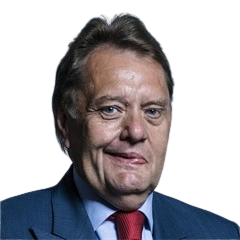
Sir John Hayes CBE is the Conservative MP for South Holland and The Deepings, having first been elected to parliament at the 1997 general election.
In the 2024 general election, Hayes received 17,462 votes (38.0%). The Reform UK candidate received 10,606 votes (23.1%), and the Labour candidate secured 9,086 votes (19.8%).Hayes was duly elected with a majority of 6,856.
The South Holland and The Deepings constituency is located in the south-western corner of Lincolnshire. It is a largely rural and agricultural seat, containing the towns of Spalding, Holbeach, Long Sutton, and Market Deeping.
Created in 1997, the constituency has been held continuously by the Conservative Party and is considered one of the safest Conservative seats in the country, although the majority was significantly reduced in 2024 (from 30,838 to 6,856). Sir John achieved one of the highest Conservative vote shares nationwide (75.9%) in the 2019 general election.
Political Career
Hayes currently serves on the intelligence and security committee of parliament (since July 2020) – the main body responsible for the parliamentary oversight of the UK’s intelligence agencies. It is not a select committee. Instead, it’s a statutory committee created by an act of parliament, which gives it a different legal status and special powers. The committee, established under the Intelligence Services Act 1994, is made up of nine members drawn from both the House of Commons and the House of Lords.
Hayes has sat on the panel of chairs since November 2024. The panel of chairs is made up of MPs chosen by the House of Commons speaker, typically at the beginning of every parliament, to chair public bill committees and other commons general committees. In this capacity, Hayes also chairs debates in Westminster Hall and may also act as temporary chair during a committee of the whole House.
Hayes was appointed a Commander of the Order of the British Empire (CBE) in 2016 (Cameron’s resignation honours list). He was knighted in 2018. The then-prime minister, Theresa May, was accused of bringing the honours system into disrepute in offering Hayes a knighthood. A spokesperson for first minister of Scotland Nicola Sturgeon argued the gong “exposes how broken the whole Westminster system is.”
At the time, Hayes was considered to be wavering over whether to back May’s Brexit withdrawal agreement. He went on to oppose the deal.
Hayes has considerable ministerial experience, encompassing his time as minister of state for transport from July 2014 to May 2015, and again from July 2016 to January 2018; minister of state for security at the Home Office from May 2015 to July 2016; minister without portfolio (senior parliamentary adviser to the prime minister) at the Cabinet Office from March 2013 to July 2014; minister of state for energy from September 2012 to March 2013; and minister of state for further education, skills and lifelong learning, serving jointly in the Department for Business, Innovation and Skills and the Department for Education, from May 2010 to September 2012.
As energy minister from 2012 to 2013, Hayes notably clashed with the Conservative Party’s coalition partners in the Liberal Democrats. “We can no longer have wind turbines imposed on communities”, he told Channel 4 News in October 2012. “I can’t single-handedly build a new Jerusalem but I can protect our green and pleasant land.”
Ed Davey, the Liberal Democrat energy and climate change secretary, dismissed Hayes’ remarks. “Onshore wind is one of the cheapest renewables, which is why we’ve been able to cut the subsidy. It has an important role to play in our energy future”, he responded.
In November 2016, Hayes delivered a memorable speech on the “beauty in transport”. Setting out a “provocative” plan to tackle the “ugliness” of Britain’s transport architecture, Hayes said the government had a “unique opportunity to be the vanguard of a renaissance”.
He told the House: “It is this: the overwhelming majority of public architecture built during my lifetime is aesthetically worthless, simply because it is ugly. This assertion is not so much challenged by defenders of contemporary architecture as dismissed out of hand.”
He added: “On HS2, we have established a design panel almost 50-strong. I will be looking closely at its remit, role and appropriateness.
“I expect to do more and do it better; no more soulless ubiquity; no more demolition of our railway heritage; no more sub-standard, conceptually flawed buildings; no more excuses, in the guise of ergonomics, for an ignorance of aesthetics…
“So be warmed – or warned – when I speak next I will set out when and how. How we will change what is built and what is saved – roads, rail and beyond. Some who did the damage to our country were crass and careless.
“But some wrought monstrous havoc knowingly, wilfully. All of them Philistines. Well now the Philistines have met their David.”
https://x.com/CDP1882/status/793894704500867072
In a February 2024 article for The House magazine, Sir John argued that a “second [Donald] Trump presidency would be great for Britain”. He contended that Trump’s appeal lay in his ability to “energise” working-class voters on issues like immigration, crime, and patriotism – which Hayes said the “political elite” had failed to do.
He wrote: “I do not support everything [Trump] says or does. However, the alternative – plutocratic globalist technocrats clinging to yesterday’s failed consensus – is as unappealing as it is unsustainable in meeting the salient challenges of our age.
“Britain will, of course, remain the closest of allies with the US regardless of who is elected president, but we shouldn’t rule out nor resist the return of Donald Trump. Instead, we should see it as an opportunity to enhance our relations with our American cousins.”
During the 2020 US presidential election, Hayes held a flag bearing the slogan: “Trump 2020 Keep America Great.”
Hayes was considered an ally of David Cameron as prime minister – if not an ideal ideological bedfellow. As senior parliamentary adviser to the prime minister, he was appointed (2013) to build ties between Cameron and the Conservative backbenches.
Hayes, a Brexit supporter, has recalled the time he informed Cameron of his intention to support the Leave campaign in the 2016 referendum on Britain’s membership of the European Union (EU).
Hayes nonetheless stated that he had wanted Cameron to continue as prime minister after the referendum. “I wasn’t able to get to him with that advice”, he told LincsOnline in 2017. “He must have made that decision with a very tight group of people.”
During the Conservative Party’s tenure in opposition from 1997 to 2010, Sir John held a series of frontbench roles. He was shadow education minister from January 2009 to May 2010, shadow minister for reform and apprenticeships from December 2005 to January 2009, shadow transport minister from May 2005 to December 2005, the shadow communities and local government minister from June 2003 to April 2005, the shadow environment, food and rural affairs minister from June 2002 to June 2003, an opposition pairing whip from June 2001 to June 2002, and shadow schools minister from June 2000 to June 2001.
Hayes also served as vice-chair of the Conservative Party from July 1999 to July 2000, during William Hague’s tenure as leader.
Sir John is considered to be a prominent figure on the right wing of the Conservative party. In the 2019 to 2024 parliament, he established himself as convenor of backbench sentiment and discontent.
During the last parliament, Hayes was seen as a close ally and patron of former home secretary Suella Braverman.
Braverman was forced to resign as home secretary during the short-lived Liz Truss government after she emailed proposals from her ministerial account to her personal account and then attempted to send them on to Hayes.
After Braverman left Truss’ government, Hayes told the Guardian that the pair would campaign together on immigration from the backbenches. “She reported herself and accepted responsibility”, Hayes said. “She’s disappointed to leave office but resolved to continue to campaign with me and others to fulfil the party’s manifesto commitments to cut legal immigration and end illegal migration.”
Hayes is listed as a member of the all-party parliamentary groups (APPGs) for acquired brain injury, craft, genetic haemochromatosis, Lebanon, UK Fresh Produce Network, and skills, careers and employment.
Hayes was a member of the House of Commons administration committee from July 2001 to December 2002, the education and employment committee from December 1998 to May 2000, and the agriculture committee from July 1997 to July 1999.
Hayes delivered his maiden speech on 2 June 1997. In it, he said: “[South Holland and The Deepings] is traditional, rural Britain with all the characteristics which one might therefore expect. It has a hard-working, law-abiding, patriotic population – people who respect the soil and its products, who depend upon the elements and who are close to God.
“They are suspicious of pomposity, pretension and political correctness and of all other ephemeral and fashionable ideas.”
He added: “I am a grateful for the traditional indulgence that the House has shown me as a newcomer in making this speech.
“I shall not expect it in the future, and no doubt I shall not get it as I give notice that I intend to fight tooth and nail every Labour measure of this type which I believe restricts opportunity, reduces choice and thwarts initiative.”
Hayes served as a Conservative councillor on Nottinghamshire County Council from 1985 to 1998.
Hayes previously stood unsuccessfully as the Conservative candidate for North East Derbyshire in the 1992 and 1987 general elections, finishing second to Labour candidate Harry Barnes on both occasions. Barnes won the seat with 3,720-vote and 6,270-vote majorities respectively.
Political Views
Leadership elections and loyalty
Tory leadership 2024: Jenrick supported Robert Jenrick’s candidacy in the 2024 Conservative Party leadership election. The contest was triggered by the resignation of Rishi Sunak following the party’s defeat in the 2024 general election.
Jenrick, a former immigration minister, positioned himself on the right wing of the party, advocating for the UK to leave the European Convention on Human Rights (ECHR). He emerged as an early frontrunner, topping the first two parliamentary ballots. After reaching the final two, he was defeated in the membership vote by Kemi Badenoch, receiving 41,388 votes (43.5%) compared to Badenoch’s 53,806 (56.5%).
Hayes was an early and vocal supporter of Jenrick, attending his campaign launch in August 2024.
At the time, Hayes, considered an ally of Suella Braverman, was widely expected to endorse the former home secretary’s candidacy. His effective defection to another candidate of the Conservative right was seen as a boost to Jenrick’s campaign and an all-but fatal blow to Braverman’s prospects.
https://x.com/MrHarryCole/status/1810709659344417046?lang=en-GB
In an article for the Telegraph, published July 2024, Braverman insisted she did have the requisite backers (10 MPs) to ensure a spot in the contest’s first round.
She wrote: “There is, for good or for ill, no point in someone like me running to lead the Tory party when most of the MPs disagree with my diagnosis and prescription.”
In October 2024, Hayes called on his party to avoid electing a leader with an “irascible” style – a comment widely interpreted as a swipe at Badenoch.
Hayes referred to Jenrick as “emollient but principled” and pointed to his preferred candidate’s experience in government.
Tory leadership 2022 (I): Hayes supported Suella Braverman’s candidacy in the Conservative Party’s July-September 2022 leadership election. The contest was triggered by the resignation of Boris Johnson following the mass exodus of more than 60 frontbenchers.
Braverman, the attorney general, announced her candidacy before Johnson had officially resigned. She positioned herself as a staunch Brexiteer on the party’s right wing, calling for the UK’s withdrawal from the European Court of Human Rights (ECHR). She was eliminated in the second parliamentary ballot on 14 July after receiving 27 votes.
Hayes went on to support Kemi Badenoch’s candidacy. Having gained significant momentum among the party’s right wing, Badenoch was nonetheless eliminated in the fourth parliamentary ballot on 19 July after receiving 59 votes.
Finally, Hayes supported Liz Truss’ candidacy. After finishing second in the final parliamentary ballot with 113 votes, Truss won the subsequent vote of the party membership with 81,326 votes (57.4%) and was appointed prime minister on 6 September.
Tory leadership 2019: Hayes supported Michael Gove for the party’s leadership in 2019. The election was triggered by the resignation of Theresa May following her inability to secure a Brexit deal acceptable to parliament.
Gove, then the environment secretary, reached the final three of the parliamentary ballots. He was ultimately eliminated in the fifth ballot on 20 June, receiving 75 votes – just two fewer than Jeremy Hunt.
Tory leadership 2016: Hayes also supported Gove during the party’s leadership election in July 2016. The contest was triggered by the resignation of David Cameron following the UK’s vote to leave the European Union.
Gove, then the justice secretary, had been expected to manage Boris Johnson’s campaign but made the surprise announcement that he would run for the leadership himself. Gove secured 48 votes in the first ballot, placing third, but his support fell to 46 votes in the second ballot on 7 July. As the candidate with the fewest votes in that round, Gove was eliminated from the contest.
Hayes supported Liam Fox in the 2005 contest – before switching to David Cameron in latter rounds.
At the time, Hayes stated: “Cameron has made a big impression on key figures on the Right. He is much more socially Conservative than people think. You should not assume Cameron is instinctively close to people like [Michael] Portillo.
“The modernisers think they are telling him what to do, but they are overplaying their hand. We think he will carry forward the agenda of compassionate Conservatism articulated by IDS [Iain Duncan Smith].”
In 2001, Hayes was said to have been a leading member of Iain Duncan Smith’s successful campaign for the Conservative leadership.
Factional identity and party tradition
Hayes is a prominent figure in Conservative factional politics, having been a member of an array of Tory right caucuses across a series of parliaments.
Cornerstone Group: Alongside Edward Leigh, Hayes founded the Cornerstone Group of Conservative MPs, which sought to promote a “more communitarian, Burkean conservatism”.
The political philosophy of the Cornerstone Group, a highly traditionalist and socially conservative faction, was summarised by its motto: “Faith, Flag, and Family”.
In July 2005, the group published a pamphlet that accused the-leader Michael Howard of running a general election campaign that was too “timid” about tax cuts, public service reform and family values.
“We believe that these values must be stressed: tradition, nation, family, religious ethics, free enterprise”, Leigh wrote. “We want to use the leadership election to argue for principles and policies, not about personalities.”
The Cornerstone Group was critical of “modernising” forces within the party – which came to be associated with Cameron and his leadership.
In the group’s 2005 pamphlet, Leigh wrote of those seeking to “emulate” New Labour’s cultural liberalism: “We must seize the centre ground and pull it kicking and screaming towards us. That is the only way to demolish the foundations of the liberal establishment and demonstrate to the electorate the fundamental flaws on which it is based.
“It is understandable that after three general election defeats, many in our party have lost confidence… But it is unacceptable for people whose electoral success is dependent on carrying the Conservative badge to use it to conceal fundamentally unconservative attitudes.
“Such critics usually have little to offer as a clarion call beyond the shrill cry for evermore unbridled liberty.”
Leigh argued that the “Conservative party has deserted conservative Britain, and so Britons have deserted us.”
Common sense group: In the 2019-2024 parliament, Hayes founded the Common Sense Group (CSG) of socially conservative MPs. The CSG’s principal focus was to combat what it described as “woke” ideology. In 2021, it published a manifesto, Common Sense: Conservative Thinking for a Post-Liberal Age, which took aim at the Equality Act 2010, the supreme court, British broadcasters and environmentalist direct action group Extinction Rebellion.
In a 2020 open letter published in the Daily Telegraph, MPs of the Common Sense Group said the faction had formed to “speak for the silent majority of voters tired of being patronised by elitist bourgeois liberals whenever issues such as immigration or law and order are raised.”
Upon the founding of the CSG (in many senses an ideological successor to the Cornerstone group) Hayes told the Guardian that there is a “different kind of Conservative family emerging.”
“The ERG [European Research Group] has served an important role, but it has very largely done its work. The government has to decide what its defining purpose is beyond Brexit. There’s a thirst in the party to have an open debate about what the direction should be now. There’s a different kind of Conservative family emerging.”
The CSG’s primary focus was to combat what it described as “woke” ideology, frequently campaigning on issues central to the UK’s so-called “culture wars”.
New Conservatives: Hayes was a member of the New Conservatives, a faction within the Conservative Party that emerged in the aftermath of the 2019 general election. The group was originally made up of 24 Conservative MPs elected primarily after the Brexit referendum. However, Hayes was one of only three members to retain their seats at the 2024 general election (alongside Danny Kruger and Gareth Bacon).
Upon the group’s launch in July 2023, it published a “10-point plan” to reduce net immigration to the UK to below 226,000 a year – which was seen as a challenge to the authority of then-prime minister Rishi Sunak. Danny Kruger, who co-chaired the group, defected to Reform UK in September 2025. Speaking at the launch event, co-chair Miriam Cates warned that “addiction” to mass migration for the economy is like “turning on the hot tap to warm up your bath when it’s already overflowing and flooding your home.”
Blue Collar Conservatives: Hayes was previously listed as a member of the Blue Collar Conservatives group. This faction within the Conservative party was founded in 2012 by the former cabinet minister Esther McVey, but came to greater prominence following the 2019 general election. The group aimed to “champion working people and develop a conservative agenda to benefit the voters and communities most neglected by Labour”. In October 2022, McVey was succeeded by Lee Anderson as the group’s chair.
Rwanda rebellion (amendments): In January 2024, Hayes was one of around 60 Conservative MPs who supported amendments to the government’s Safety of Rwanda (Asylum and Immigration) Bill. The amendments, proposed by Conservative MPs Sir Bill Cash and Robert Jenrick, sought to strengthen the proposed legislation by limiting the ability of individual asylum seekers to prevent their deportation to Rwanda, under the terms of the government’s flagship removals scheme. The rebellion was composed of Tory MPs on the right of the party.
In March 2023, Hayes referred to ex-professional footballer and broadcaster Gary Lineker as “self-indulgent, out of touch, insensitive, avaricious [and] smug”.
https://x.com/ITVNewsPolitics/status/1635647110941929472
In November 2023, Hayes called on Rishi Sunak as prime minister to ignore the “guilt-ridden bourgeois liberals and greed-driven globalists” when it came to debates over migration.
During the July 2022 heatwave, Hayes said that people taking precautions are “snowflakes” and “cowards”.
He told the Telegraph: “This is not a brave new world but a cowardly new world where we live in a country where we are frightened of the heat.
“It is not surprising that in snowflake Britain, the snowflakes are melting. Thankfully, most of us are not snowflakes.
“The idea that we clamour for hot weather for most of the year and then shut down when it does heat up is indicative of the state in which we now live.”
Mass deportation: In May 2025, Hayes signed an early day motion (EDM) concerning the mass deportation of illegal migrants. The motion, tabled by the independent MP Rupert Lowe, expressed “grave concern at the continued presence of over one million illegal migrants in the United Kingdom”.
The EDM urged the government to “implement a comprehensive national strategy to identify, detain, and deport all individuals found to be residing in the United Kingdom illegally, and to ensure that such policies are backed by the necessary legislative, diplomatic, logistical and financial resources to restore confidence in the rule of law and the security of our borders.”
Brexit and Europe
Brexit referendum: Sir John Hayes supported the Leave campaign in the 2016 EU referendum, and therefore agreed with a majority of constituents, 71.1% of whom also voted to Leave.
In a June 2016 Album for ConservativeHome, Hayes argued that a Leave vote would “bring down the curtain on the [Tony] Blair Era.
He wrote: “One great Conservative reformer from a previous era, Rab Butler, once said that politics is ‘the art of the possible.’ What we are seeing now is nothing less than a shift in what is possible, in what politics can achieve.
“The British people now have a chance, probably for the last time, to take back control, to restore to their proper place the democratic institutions that have served our nation so well over hundreds of years.”
Leave Means Leave: Hayes was a supporter of Leave Means Leave, a cross-party eurosceptic pressure group established in the aftermath of the 2016 EU referendum. The group, which described itself as “the campaign for a clean Brexit”, set out its opposition to any withdrawal agreement that it believed would keep the UK tied to EU rules and institutions – a position often referred to as a “hard Brexit”.
Article 50: In February 2017, Hayes voted in favour of the European Union (Notification of Withdrawal) Bill. The legislation empowered the prime minister to notify the Council of the European Union of the UK’s intention to withdraw, formally triggering the process set out in Article 50 of the Treaty on European Union. MPs supported the bill by 498 votes to 114 at second reading.
In a December 2018 article for The House magazine, written during the intense parliamentary debates over May’s Brexit deal, Hayes argued that MPs must “rise to the challenge presented to us by the British people.”
He wrote: “That few seem to know where we go from here is the product of an absence of defining ideas. The majority of the political class have no religious conviction, no driving philosophy and no real mission to lead. How can we blame people for being bored with politics when so much of our politics is characterised by technocratic terminology spluttered out in scripted television interviews?”
He added: “It suits the liberal establishment that the Brexit debate has been transformed into an arch polemic of reductive polarisations. Rather than a simple vote against immigration, Brexit represents an opportunity to take back control of our borders and forge an immigration policy that is in our nation’s long-term interests.
“Diktats from Brussels has infantilised political debate. One of the welcome impacts of the 2016 vote is that we are at last slowly moving towards a grown-up discussion about migration and its economic, social and cultural impacts.”
Customs union vote (2025): In December 2025, Hayes voted against the UK-EU Customs Union (Duty to Negotiate) Bill. The bill, introduced under the ten-minute rule procedure by Liberal Democrat Europe spokesperson Al Pinkerton, sought to mandate the government to enter into negotiations with the European Union to establish a bespoke customs union.
Assisted dying
Hayes voted against the Terminally Ill Adults (End of Life) Bill, better known as the assisted dying bill, at both second reading (November 2024) and third reading (June 2025).
In a statement setting out his position, issued December 2024, Hayes argued that assisted dying would “harm not help”.
He stated: “Doubtless, many believe that the House of Commons debate last Friday on the Terminally Ill Adults (End of Life) Bill was about death. In fact, the decision MPs made was about life – its value and who does the valuing.
“In the biggest social change to our country for years, by voting to introduce assisted suicide MPs chose to change the role of the NHS forever – no longer missioned only to protect life, but to end lives too.
“I opposed this change, largely on the basis that it would be incompatible with my lifelong mission to defend the vulnerable, the disabled and those who have little voice and no power. For despite all the assurances from its advocates, the proposed legislation’s ‘safeguards’ will, in practice, prove ineffective.”
Social values and conscience issues
Abortion decriminalisation (2025): Hayes voted against a backbench amendment to the Crime and Policing Bill that sought to decriminalise abortion in England and Wales in June 2025. The amendment, which was passed by a majority of 242 votes, removed women from the threat of prosecution for ending a pregnancy at any stage. As an issue of conscience, MPs were allowed to vote according to their personal beliefs.
Same-sex marriage (2013): In February 2013, Hayes was one of the 139 Conservative MPs to vote against the Marriage (Same Sex Couples) Bill at its second reading. The landmark piece of legislation, which received its second reading by 400 votes to 175, legalised marriage for same-sex couples in England and Wales.
In November 2018, Hayes called on the government to reintroduce hanging for people who commit violent crimes.
In a written parliamentary question, Hayes asked David Gauke, the then-justice secretary, to “make an assessment of the potential merits of bringing forward legislative proposals to reintroduce the death penalty to tackle violent crime”.
Foreign policy and security
Trident renewal (2016): Hayes voted in favour of a government motion calling for the renewal of the Trident nuclear deterrent system in July 2016. The motion, which was passed by 472 votes to 117, committed the UK to constructing a new fleet of submarines to carry the nation’s nuclear weapons.
Syria airstrikes (2015): Hayes voted in favour of a government motion to extend UK airstrikes against Isis from Iraq into Syria in December 2015. The motion, which was passed by 397 votes to 223 after a ten-hour debate in the House of Commons, authorised the RAF to conduct strikes against Isis targets in Syria.
Syria airstrikes (2013): Hayes voted in favour of the government’s motion on the principle of military intervention in Syria in August 2013. The government motion was defeated by 285 votes to 272, a move which effectively ruled out UK participation in any US-led military strikes.
Iraq War authorisation vote (2003): In March 2003, Hayes voted in favour of the government motion authorising military action against Iraq. The vote, one of the most contentious in recent parliamentary history, gave the prime minister, Tony Blair, the authority to join the US-led invasion.
Sanctioned (Russia): In April 2022, Hayes was among the group of MPs placed on a sanctions list by the Russian government. The measure barred them from entering Russia and was presented by Moscow as a retaliatory response to the UK’s stance on the invasion of Ukraine.
Civil liberties
Covid passes vote (2021): Hayes was one of 99 Conservative MPs to vote against Covid passes in England in December 2021.
Before Politics
Born in Woolwich, South East London on 23 June 1958, Hayes grew up on a council estate. He attended Colfe’s Grammar School (then a voluntary aided school, now independent) in Lewisham. He studied politics (BA Hons) at the University of Nottingham, where he also obtained a Postgraduate Certificate in Education (PGCE) in History and English. While at university, he chaired the Conservative Association.
Before entering parliament, he worked as the sales director for an IT company, The Data Base Ltd.
Personal Life
Hayes married Susan Hopewell in 1997. They have two children
Susan Hayes is employed as Sir Johns’ administrative manager, paid from parliamentary expenses, as declared in the Register of Members’ Financial Interests (June 2025).
He suffered a serious head injury in his early twenties, leading him to be an advocate for research into acquired brain injury and support for those affected.
Trivia
Hayes is a part-time professor of politics at the University of Bolton.
John Hayes has not written for Politics.co.uk.