Twelve months ago, Andy Burnham landed in Liverpool possessed by palpable ambition and a plan to place himself at the top of the conference agenda. The unsubtle criticisms he levelled at Keir Starmer from the conference fringe were the opening salvo in a clumsy leadership coup. Starmer broke the siege with a well-received keynote speech targeting Nigel Farage and Reform UK. With a series of precise swipes at Burnham, Starmer left Liverpool with his authority enhanced.
One year and several electoral setbacks later, Burnham returned to Liverpool in the honeymoon phase of his premiership. The prime minister spent the period that followed Starmer’s defenestration trying to win his party a hearing. At conference, after months of positive-sounding signals, the stage was set for Burnham to tell the country what he actually had to say.
Starmer spent the early part of his premiership educating voters on what the government – and he as prime minister – could not do. The excuses for inaction, expressed most infamously in his first major address to the nation in August 2024, drained Labour’s first months in office of “hope” and probably empowered anti-establishment sentiment.
Burnham’s “hope again” slogan was a nod to what Starmer did not deliver as prime minister – and how he planned to be different.
Starmer governed in a narrow frame defined by external and self-imposed constraints. Burnham, by contrast, is betting that successful politicians can use persuasion and argument to expand the boundaries of what is politically possible – building space to shift the dial.
The most successful pieces of political oratory reorder the terms of political debate. Burnham chose issues and causes that, announced in isolation, would have been seized on by his opponents as opportunities to assail the government. But Labour’s stance on issues previously considered politically off limits – the triple lock, social care, electoral reform, public ownership and Brexit – will unsettle his opponents. Taken together, the intervention amounted to the most robust political challenge Nigel Farage and Kemi Badenoch have faced since the 2024 general election.
Burnham did not mention his opponents by name once in his conference address. He did not need to. The prime minister escaped the defensive crouch that characterised Starmer’s tenure in office and confronted his rivals with a choice: develop a credible alternative or defend the status quo.
Political pain for me – but also for thee
Take Burnham’s proposal to adjust the triple lock. The Conservative, Reform, Liberal Democrat and Green leaderships have all reiterated their support for the pensions mechanism since Burnham delivered his speech. So far, however, those commitments have served mainly to expose divisions and vulnerabilities within each party.
The triple lock is testing for the main parties of the right because they are competing largely for the same voters on the same territory. Reform’s surge in 2024 and 2025 came, in significant part, at the Conservatives’ expense – as it eroded support among the older voters who have traditionally formed the central pillar of the Tory base. For the Conservatives therefore, shifting on the triple lock would risk alienating the party’s core supporters at precisely the moment when those voters have an alternative. Meanwhile, Reform’s recent troubles have coincided with a renewed effort to reconnect with its core supporters. A strident defence of the triple lock will form a natural part of Farage’s core-vote strategy.
Labour says Badenoch should back care service as it points to Tory triple lock doubts
The result is a bind for both parties. The Conservatives have little room to challenge the triple lock without risking conflict with their traditional base, while Reform has almost no incentive to do so when it is trying to win those voters over. As such, while neither is ideologically committed to the continuance of the triple lock (Farage and Badenoch have questioned the sustainability of the triple lock since 2024), both fear the electoral consequences of pulling their support – and especially fear the risks of moving first.
The Conservatives and Reform will therefore have to live with the contradictions in their positions on the triple lock – and with the internal divisions and questions those positions invite – until something breaks.
As Labour has been quick to point out, senior Conservatives have questioned the triple lock in recent years. These include shadow foreign secretary Tom Tugendhat; shadow justice secretary Nick Timothy as co-author of the 2017 Conservative manifesto; Badenoch aides John Glen and Jack Rankin; former chancellor Jeremy Hunt; former shadow chancellor and work and pensions secretary Mel Stride; and former cabinet ministers Andrew Mitchell and Michael Gove.
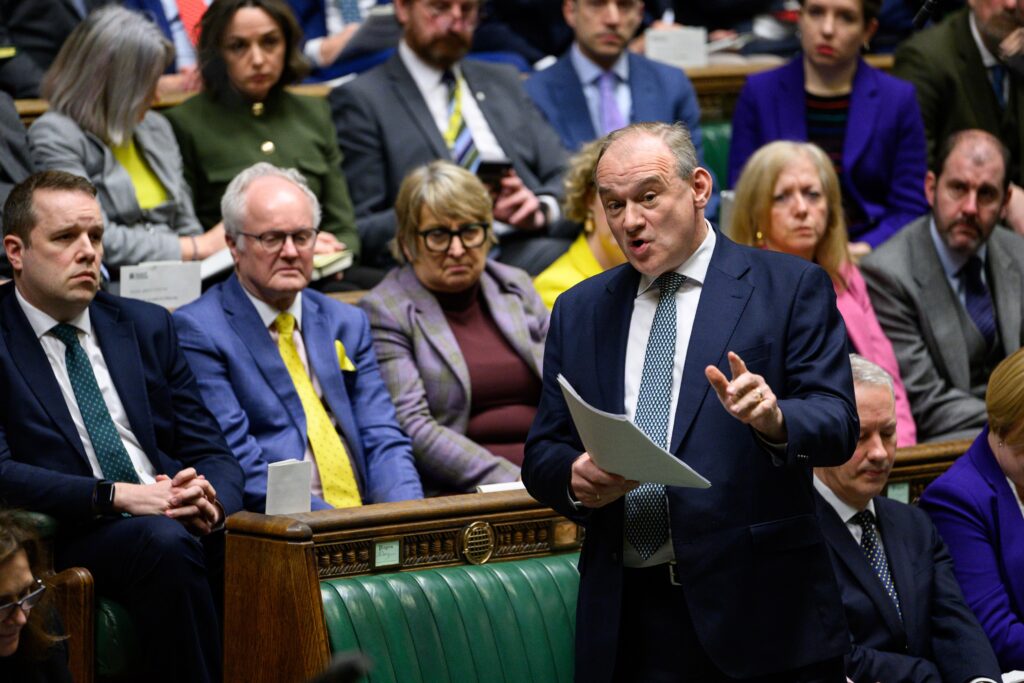
Badenoch will also fear a pensioner pincer movement if the Liberal Democrats continue to defend the policy. Ed Davey, of course, has problems of his own; his response to Burnham’s speech caused considerable ructions within the Lib Dem parliamentary party. Two MPs, Tom Gordon and Vikki Slade, broke cover to criticise his stance.
‘For the birds’: Lib Dem MP tells Ed Davey to ‘think again’ on triple lock defence
A similar story can be told on social care, public ownership, Brexit and to a lesser extent electoral reform.
Once more, Burnham’s offer on social care challenges the opposition parties to get on board, defend the status quo or produce alternative proposals. By linking proposed reforms to changes to the triple lock, he also forces his opponents to confront the question of how their own alternatives would be funded.
On Brexit, a move by either the Conservatives or Reform to reassert their historic positions would risk placing both parties on the wrong side of public opinion; polling suggests voters are increasingly open to changes to the current Brexit settlement. Again, competition on the right is crucial. Farage and Badenoch will both fear being outflanked, as each has an incentive to appeal to the more uncompromising elements of the electorate to shore up their vulnerable bases.
Farage has moved back and forth on electoral reform since July 2024. Reform UK’s position has broadly tracked its position in the polls; first past the post (FPTP) offers Farage the possibility of winning a parliamentary majority on a plurality of the vote – a prospect that seemed genuinely plausible when the party’s support was at its peak in 2025. Yet Farage founded Reform UK, in part, to campaign for political reform. The prospect of a cross-party commission would present another opportunity for Labour strategists to chastise Reform as opportunistic.
Andy Burnham announces national commission on electoral reform
Reform has also spoken a good game on nationalisation and public ownership. Burnham’s commitments on energy and water will force Farage into taking a fully formed stand. Moreover, the prime minister’s criticism of Thatcherism since assuming power, while no doubt keenly felt, also challenges Farage to either defend or distance himself from a politician he has repeatedly cited as a key influence. Thatcher’s legacy, which Burnham denigrated on Tuesday, sits uneasily with many of Reform’s target voters.
Burnham’s dividing lines are politically shrewd because they clarify his own vision. Certainly, if he delivers on the terms set out in his speech, Burnham will be considered a highly consequential prime minister. But the address also forced his opponents onto territory where competing interests, incentives and instincts are likely to expose divisions. Burnham accepted his decisions would cause some pain for his own party; he was less open, but surely no less calculated, about the pain they would inflict on his opponents.
The power of politics
Burnham’s speech drew a series of disconnected policy areas and issues into a single narrative thread. It also succeeded in narrower terms: Burnham defined the terrain on which British politics will be contested in the months ahead.
Starmer’s lack of a coherent political vision had a chilling effect on his party. Ministers and MPs were wary of speaking out of turn, while others felt unable to contribute because they could not discern the direction of travel. Burnham has restored Labour’s voice by delivering a platform that could, in theory, be used to fight an election campaign. In fact, the platform is uniquely designed to bring into being the conditions in which Labour is best placed to win the next election: a broad progressive coalition facing a divided right.
More importantly however, the speech provides the political ammunition needed to fight the everyday battles through which a government maintains control of the political narrative. This is how Labour can succeed in the current crowded political landscape: with the courage of its convictions, understanding the power of persuasion, and spoiling for a fight.
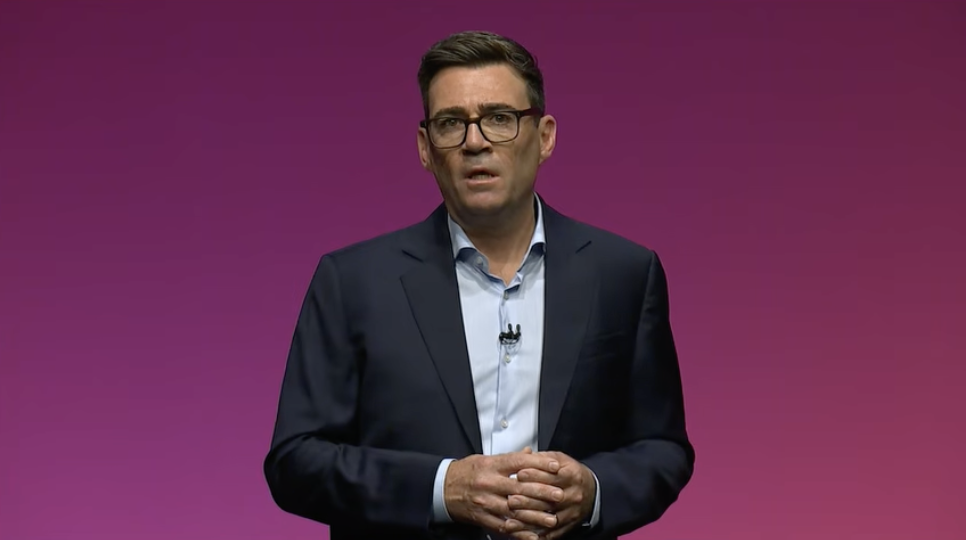
The speech’s execution is also worth examining, because its form reinforced its central argument. Addressing Labour delegates on Tuesday, Burnham explored an emotional register that prime ministers have rarely shown the courage or ability to reach. His most powerful passage came when Burnham channelled his grief into a rallying cry for patriotism. He used first minister of Scotland John Swinney’s recent attack – that he would be the “last prime minister of the United Kingdom” – as a springboard for a savage and moving piece of oratory.
He declared: “On the day my dad died, the Scottish first minister said I would be the last prime minister of the United Kingdom. I quote that not to seek sympathy…
“I relay it because I want you to know how it made me feel. Utterly determined to prove him wrong. Whatever its flaws, this country gave my dad a good life. And it has given his sons opportunities he didn’t get for himself…
“The United Kingdom my dad represented is the one I believe in… Britain is not perfect. It can be better, and we will make it so. But it still stands for something worth saving, worth fighting for.”
Burnham connected his personal story to that of the country, and his determination to change it.
This part of Burnham’s speech was both politically brutal and highly emotional
Probably the speech’s best written and delivered passage pic.twitter.com/Xilw7MMaX5
— Josh Self (@Josh_Self_) September 29, 2026
The mandate question won’t go away
But the success of Burnham’s speech also sharpens the central tension that looks set to define the remainder of this parliament – however long that proves to be.
Burnham understands that he must distance himself from Starmer’s approach if he is to succeed. The further he moves from his predecessor’s politics, however, the more pressing the question of his own mandate becomes.
There are no obvious ways to resolve this tension – other than an election of course. But a snap poll is undesirable for a whole host of reasons, including but not limited to the state of play in Scotland and Wales, as well as the prospect of a hung parliament – which could end up imposing further constraints by virtue of a pact with the Liberal Democrats.
For the time being, Burnham could govern as a de facto opposition force, making decisions within the broadest possible interpretation of the 2024 manifesto while using commissions, consultations and committees to prepare the ground for a new political settlement, to be put to the electorate when the time comes.
Naturally, there are risks to this approach. It would give Burnham’s rivals several years to develop alternative plans and arguments, leaving them better placed to challenge his unimplemented programme at a future election. Meanwhile, the longer voters wait for delivery, the greater the danger that Burnham becomes associated with the status quo that he rejected on Tuesday. He should fear suffering the same fate as Starmer, who became the personification of a discredited state.
These tensions will rumble on, potentially for some time. The extent to which they become politically damaging will shape No 10’s calculus as to whether an early election is necessary.
For the time being, however, Burnham should be pleased to have this problem. It is the natural consequence of having successfully shifted the political argument beyond the terms set by Starmer. He has changed the game. The road to the next election will now be shaped by the tension between the strength of Burnham’s convictions, and the constraints he confronts.