Gordon Brown rules out snap election
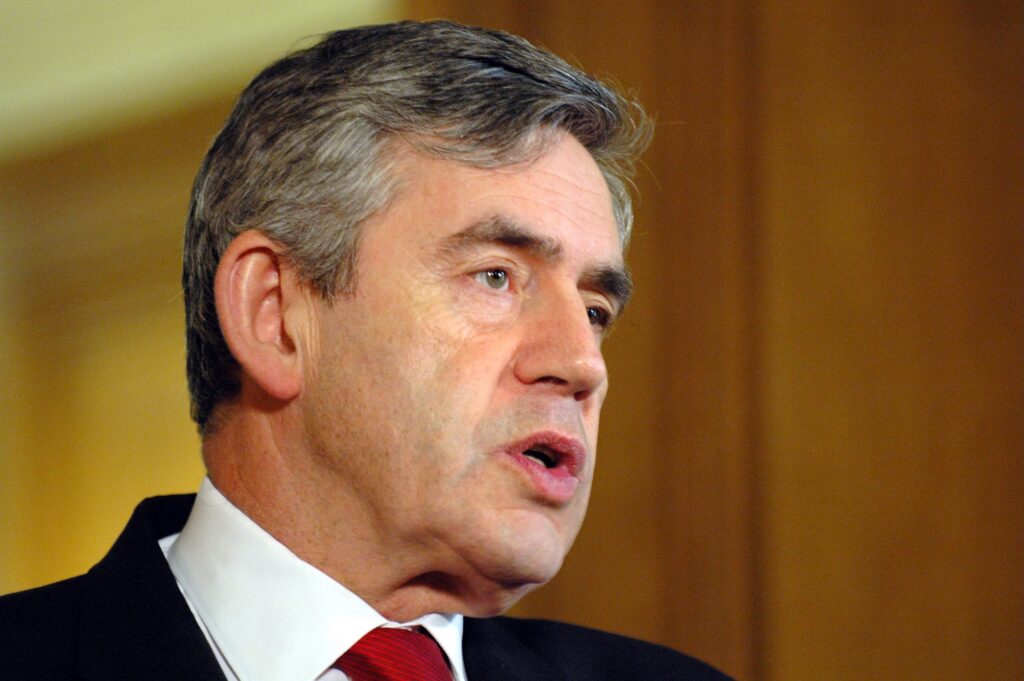
On 6 October 2007, the prime minister, Gordon Brown, ended weeks of overwhelming speculation by announcing in an interview with the BBC’s Andrew Marr that he would not be calling a snap general election. The decision abruptly ended Brown’s political honeymoon and badly damaged his fledgling premiership.
The prime minister had cultivated a reputation for strength and strategic skill during his 10-year stint as chancellor. In this light, the election that never was – as the saga became known – was politically ruinous for the prime minister. It marked a watershed in public perceptions of Brown; he arguably never recovered from the accusations of weakness and indecisiveness that followed.
***
Brown succeeded Tony Blair as prime minister on 27 June, just over three months previously.
Gordon Brown becomes prime minister after decade in waiting
Almost immediately, the new prime minister won praise for his handling of a series of crises, including terrorist attacks in London and Glasgow, an outbreak of foot-and-mouth disease and severe national flooding. Brown’s poll ratings soared, fuelling intense speculation in the autumn of 2007 that he would call a snap general election to secure his own mandate.
When Brown assumed office as PM, Labour trailed the Tories by two points, 34% to 32%, according to a Guardian/ICM poll. By 16 September, Labour was ahead by eight points – 40% to 32%. It was the party’s largest poll lead since September 2005.
Speculation regarding an early election began on 24/25 June – shortly before Brown’s appointment as prime minister. With Blair having passed the baton to his impatient chancellor, Brown’s aides reportedly briefed journalists that the new prime minister could capitalise on his unopposed succession by calling a national poll.
In July, Brown appointed Cabinet Office minister Ed Miliband to lead on Labour’s manifesto ahead of the next general election.
Spencer Livermore, Brown’s director of strategy, emerged as a prominent advocate for calling an early general election.
***
The election speculation reached a fever pitch during the 2007 party conference season.
Slogans and posters for Labour’s conference in Bournemouth were prepared by Saatchi & Saatchi, Margaret Thatcher’s favourite advertising agency. The agency styled Gordon Brown as “Not flash, just Gordon.”
The advertising campaign sought to establish distance between Brown and his predecessor, while emphasising his serious, steady presentational style. This was contrasted with Cameron’s sleeker (or more slippery and superficial) demeanour.
On 23 September, in the traditional pre-conference interview with the BBC, Brown conspicuously refused to rule out an early election, declining to give a “running commentary” on his thought process.
On 26 September, Ed Balls, the schools secretary and Brown’s closest political ally, was asked whether the bigger political gamble would be to call a snap election, or wait until the end of the parliament.
He responded: “It’s a very interesting question as to where the gamble really lies.”
On the same day, universities secretary John Denham told the BBC an early election looks “more likely than not”.
Conservative leader David Cameron, speaking at his party’s conference in Blackpool, dared Brown to call an election despite the prevailing polling picture.
He declared: “So, Mr Brown, what’s it going to be? You go ahead and call that election. Let the people pass judgment on 10 years of broken promises, let people decide who’s really making the arguments about the future of our country…
“Call that election. We will fight, Britain will win.”
George Osborne’s conference address as shadow chancellor was seen as a political masterstroke. He unexpectedly pledged to raise the inheritance tax threshold to £1 million. Subsequent polling suggested the policy announcement had cut through, allowing the Conservatives to close the gap on Labour.
During the Conservative Party conference, Brown travelled to Iraq. During his visit, the prime minister said that UK forces in Iraq would be cut by 1,000 by 2008.
The trip was criticised as a political stunt, with Conservative spokespeople accusing the prime minister of breaching the convention that party leaders should avoid upstaging opponents’ conferences.
Liam Fox, the shadow defence secretary, said “many people will see this as cynical politics, playing political football with our armed forces.”
He added: “And a lot of people, given Gordon Brown’s lack of interest previously, will find this pretty cynical and unacceptable.”
John Major, the former prime minister, was also critical of Brown’s actions – with regard to his Iraq visit and election speculation more broadly.
He said: “What is pretty unattractive is the nods, the winks, the hints, the cynicism, the belief that every decision is being taken because it is marching to the drum beat of an election rather than to the drumbeat of solid proper government.”
At around this time, Ed Balls left London for his Yorkshire constituency fully convinced that an election campaign was imminent.
But the revelation of a News of the World poll, which showed a Conservative lead of six points in 83 key marginal constituencies, is said to have unnerved No 10.
On 6 October, under mounting pressure to clarify his intentions, Brown abruptly pulled the plug.
In a sit-down interview with Andrew Marr of the BBC, Brown said he would not be calling an election.
The prime minister told Marr: “I’ll not be calling an election. I have a vision for change in Britain and I want to show people how in government we’re implementing it.
“Over the summer months we’ve had to deal with crises, we’ve had to deal with foot-and-mouth, with terrorism, with floods, we had financial crises.
“Yes, we could have had an election on competence and I hope people would have understood we have acted competently, but what I want to do is show people the vision we have for the future of this country in housing, health and education.
“And I want the chance in the next phase of my premiership to develop and show people the policies that are going to make a huge difference and make a change in the whole country itself”.
The interview was scheduled, per an agreement with Downing Street, to be broadcast on Sunday morning. But Marr, fearing he would be scooped by a rival lobby journalist, revealed Brown’s intentions live on-air at 17:11 on Saturday.
Marr said: “To be absolutely clear, there is not going to be an election this year”.
***
With speculation having reached a fever pitch in the preceding days, the announcement was widely seen as a U-turn. The episode – which became known as the election that never was – was seen as a victory for Cameron.
Responding to Brown’s interview, Cameron said the PM had conducted a “humiliating retreat”.
He stated: “The reason the prime minister has cancelled this election is that the Conservative Party is making the arguments about the changes this country needs. People are responding very positively to our proposals.
“The prime minister has shown great weakness and indecision. It’s quite clear he’s not been focussed on running the country these last few months, he’s been trying to spin his way into a general election campaign and now he’s had to make a humiliating retreat.”
In the session of prime minister’s questions that followed on 10 October, Cameron accused Brown of treating the public like fools.
Cameron told the House: “The prime minister was asked, ‘Hand on heart, if the polls showed a 100-seat majority, would you still have called off the election?’ and he said yes.
“Does he expect anyone to believe that?”
He added: “He is the first prime minister in history to flunk an election because he thought that he was going to win it.
“Does he remember writing this? It is in his best-selling book about courage: ‘As far back as I can remember, I have been fascinated by men and women of courage. Stories of people who took brave decisions in the service of great causes… especially when more comfortable and far less dangerous alternatives were open to them’
“Does he realise what a phoney he now looks? Has he found a single person who believes his excuses for cancelling the election?”
On 1 November, Cameron marked what he termed “non-election day”. The Conservatives released a poster apologising “for the delay to the change Britain needs.”
In a speech, Cameron claimed “the tide of history” had turned against Brown and “soon there will be a new team in charge”.
***
James Purnell resigns from cabinet, calling on Brown to quit
The election that never was emerged as an enduring and bitter source of regret for Labour politicians.
In December 2009, Jack Straw, the justice secretary, said Brown should have called an early election.
Asked if Brown should have gone for an autumn election, Straw told the New Statesman: “Yes, entirely, in hindsight, but I was not saying that [then].”
Brown’s premiership was subsequently dogged by accusations of indecision.
He remained in office until the 2010 general election, which resulted in a hung parliament and the end of 13 years of New Labour government.
After days of wrangling, Brown handed over to Cameron, who entered office at the head of a Conservative-Liberal Democrat coalition.

Politics.co.uk Newsletters
DAILY
Politics@Lunch
WEEKLY
Week in Review
