Andy Burnham becomes prime minister in Labour coronation
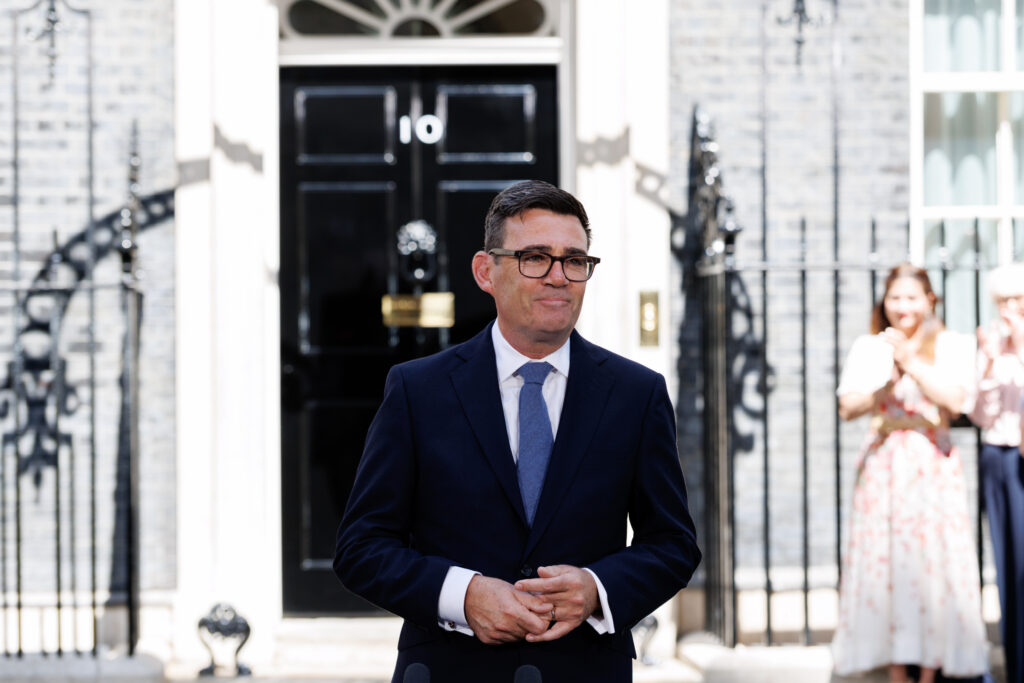
On 20 July 2026, Andy Burnham entered Downing Street as prime minister, becoming the sixth person to hold the office in a decade. Burnham’s appointment followed an uncontested Labour leadership process that concluded without a membership ballot.
No rival candidate stepped forward to challenge Burnham’s elevation. It marked the first time since 2007 that a Labour prime minister transferred power to a successor mid-term.
Burnham’s path to No 10 followed months of manoeuvring on the part of the former Greater Manchester mayor and the sensational June 2026 Makerfield by-election, which secured his return to parliament.
***
During his first stint in parliament representing Leigh (2001-2017), Burnham held several ministerial positions under Tony Blair and Gordon Brown. He served in cabinet as secretary of state for health (2009-2010), secretary of state for culture, media and sport (2008-2009) and chief secretary to the Treasury (2007-2008).
Burnham twice stood unsuccessfully for the Labour leadership, in 2010 and 2015. In 2015, he finished second to Jeremy Corbyn with 19% of the membership vote, having secured nominations from 68 MPs – more than any other candidate. In 2010, he won 8.7% of the electoral college vote (under Labour’s old leadership rules) and was eliminated in the first round, having been nominated by 33 MPs – the minimum required to enter the contest.
Burnham left Westminster in 2017 to run for the Greater Manchester mayoralty. He was elected mayor in 2017, 2021 and 2024, each time securing over 60% of the vote. In 2024, he achieved a majority of 351,803 over the Conservative candidate, who received 68,946 votes (10.4%).
During Starmer’s leadership of the Labour Party and his premiership, Burnham became an increasingly vocal critic. In a remarkable intervention at Labour’s annual conference in 2025, Burnham pointed to a “climate of fear” in the party.
In 2025 and 2026, the Starmer government’s woes over the winter fuel payment cut, welfare bill rebellion and Peter Mandelson vetting debacle sparked speculation that Burnham could mount a parliamentary comeback.
In early 2026, Burnham sought the Labour selection for the Gorton and Denton by-election, which was triggered by the resignation of former minister Andrew Gwynne. However, Labour’s national executive committee (NEC) voted 8-1 to block Burnham’s candidacy; only the deputy Labour leader and Burnham ally, Lucy Powell, voted in his favour. Burnham’s application had been publicly supported by senior Labour figures including Powell, Angela Rayner, Ed Miliband and Sadiq Khan.
The decision to block Burnham was a boost for the Green campaign, spearheaded by Zack Polanski, resulting in the party’s first-ever victory in a parliamentary by-election.
***
The May 2026 local elections and devolved parliament elections to the Scottish Parliament and Senedd Cymru inflicted more pain on the Labour Party. These results, which were confirmed from 8 to 9 May, sparked an intense political crisis as Labour MPs lined up to call on Starmer to step down/set out a timetable for his departure. In total, over 90 MPs called for Starmer to step down as prime minister. Several serving frontbenchers, including ministers Jess Phillips and Miatta Fahnbulleh, resigned in order to do so.
On 14 May 2026, Wes Streeting resigned as health secretary. In his letter of resignation, the outgoing health secretary described the 2026 local and devolved parliament elections as “unprecedented”. He said that the rise of nationalism in all corners of Britain represented “an existential threat to the future integrity of the United Kingdom”. Streeting later vowed to stand in a future Labour leadership election.
Mere hours after Streeting’s resignation, Josh Simons, a former junior minister, announced that he would resign his Makerfield seat to enable Burnham to stand as a candidate and return to parliament.
In a statement setting out his decision to resign as an MP, Simons said: “It is my unwavering belief that nothing short of urgent, radical, courageous reform will make a difference. That must start with a change in leadership.
“Today, I am putting the people I represent and the country I love first and will be resigning as MP for Makerfield. I am standing aside so that Andy Burnham can return to his home, fight to re-enter parliament, and if elected, drive the change our country is crying out for.”
This time, ahead of the Makerfield by-election, the NEC put up no resistance and Burnham was confirmed as Labour’s candidate.
On 4 June, during a BBC Question Time special, Burnham confirmed that he would seek to enter any future Labour leadership contest should he win the Makerfield by-election. He argued that “Wes Streeting seems to have launched a leadership contest, so if that is running I would seek to join it.”
Burnham stated: “I can’t do anything unless I’m lucky enough to get the support of people here.
“But if I get your support, I would seek to represent you at the highest possible level and give this constituency maximum power and influence.”
In the early hours of Friday 19 June, Burnham was declared as the winner of the Makerfield by-election. Burnham secured 24,927 votes (54.8%) and a significant majority of 9,231 over the Reform UK candidate in second place.
The Makerfield by-election moved Labour’s leadership crisis into a new phase. It ensured that Burnham was now eligible to stand in a leadership contest to succeed Starmer. Events moved quickly. Starmer spent the weekend of 20-21 June at Chequers, the prime minister’s country retreat, to mull his political future.
In a statement on the morning of 22 June, Starmer confirmed his intention to resign. Speaking on the steps of Downing Street, Starmer said it had been an honour to serve the “country I love”. His voice cracked as he paid tribute to his wife, Victoria, and his sons.
In the hours that followed Starmer’s address, Burnham confirmed that he would be standing for the Labour leadership.
He said: “His decision marks the beginning of a transition and it is important that this process is conducted in an orderly and responsible way. I will put myself forward as part of this process…
“The Labour movement has always been at its strongest when it looks forward with confidence and purpose. This is what we will do from here and we will make sure this transition is a positive process of renewal for our party and our country.”
Almost immediately, Streeting endorsed Burnham and abandoned his own leadership bid. The former health secretary said he had spoken to Burnham “at length” in recent days.
In a post to social media, he stated: “We could spend the summer exaggerating small differences, or we can roll up our sleeves and help him to deliver the change our party and country needs. That is the choice I am making and I hope that everyone else will back Andy, too.”
***
On 25 June, the Labour NEC set out the leadership election timetable. Members of the parliamentary Labour Party (PLP) were told they could nominate a fellow Labour MP to stand for leader from 9 July to 15 July. Under the party’s rule book, any candidate would need to receive the support of 20% of the PLP (81 MPs) to stand in the contest.
The NEC announced that, in the event that more than one candidate was nominated, a membership ballot would take place between 6 August and 27 August – with the result being announced on August 29.
On 29 June, in his first speech since Starmer announced his decision to resign as prime minister, Burnham promised a “new direction” for Britain. Speaking at the People’s History Museum in Manchester, Burnham vowed to establish a “No 10 of the North”, which he claimed would be “the nerve centre of a rewired Britain”.
Dressed in his trademark dark T-shirt, the former Greater Manchester mayor stated: “Ours is a 10-year mission to raise people’s living standards.
“I know people can’t wait forever for change. I heard on doorsteps in Makerfield how people need a bit extra now to help with rising costs. I will do my very best to deliver it, and whilst not taking risks with the public finances, will seek to give Britain some breathing space as soon as I can.
“People need to be able to look forward to a night out or a holiday with the kids. People need hope.”
On 2 July, Starmer delivered a landmark apology in the House of Commons on behalf of the state to victims of historic forced adoption practices. Speaking directly to campaigners watching from the House gallery, Starmer, said: “The shame is not yours. The shame was never yours. The shame is ours.
“And I say that on behalf of the whole country, I say it to every single person impacted, we are deeply and profoundly sorry.”
On 7 July, Nigel Farage, the leader of Reform UK, sought to upstage Labour’s leadership transition by announcing he would resign as an MP and contest the resulting Clacton by-election. He delivered the live statement about his “future in public life” after facing questions over a series of donations. In the wake of Farage’s announcement, the major parties confirmed they would not field candidates in Clacton, leaving him to face a slate of novelty challengers, including perennial candidate Count Binface.
Burnham later quipped that Binface, who secured 95 votes in the Makerfield by-election, was “carrying the hopes of the nation”. Speaking at the Silver Clef music awards at the Royal Albert Hall on 9 July, Burnham declared: “Now, the legends that we’re here to honour have not shied away from politics in their career, but I promise you, I am not going to talk politics to you tonight, except to say, except to say this, Count Binface. You are carrying the hopes of the nation.”
On 8 July, Al Carns, the former defence minister, ruled out a leadership bid after weeks of speculation that he could stand. Carns told Sky News that a leadership contest was “not the best use of Labour’s time” and that in his view “we need to get on board” with Burnham. This intervention meant that Burnham was the only Labour MP to have declared his candidacy at the time nominations opened on 9 July.
On the evening of 9 July, it was announced that 322 MPs had officially endorsed Burnham – comfortably surpassing the 81-MP threshold. The Labour heir apparent was just one nomination shy of the 323 mark; once reached, no other candidate would be able to muster the 81 backers required to enter the race to replace Starmer.
On 13 July, the second day of nominations, a further 27 MPs backed Burnham – taking his total to 349.
In a PLP hustings on 13 July, Burnham underlined his aim to create “a team and culture where everyone is valued, seen and listened to.” He warned that “this is a significant moment for the country, and our constituents are counting on all of us to come together.”
Burnham reportedly emphasised that “the Labour movement is, and always has been, a broad church. Cabinet and appointments will reflect that, alongside contribution, experience and commitment”.
Burnham delivered his first commons speech since returning to parliament on 14 July. It came during a debate on the Public Office (Accountability) Bill, also known as the “Hillsborough law”.
Burnham had introduced the same legislation as an unsuccessful private member’s bill in 2017, calling for a legally enforceable duty of candour on public officials and authorities during investigations and inquiries. The bill, promised in the 2024 Labour manifesto, had been stalled since January 2026 after a proposed carve-out for intelligence officers provoked a backlash from the Hillsborough families.
In his address, Burnham praised the outgoing prime minister, hailing Starmer’s commitment to building “a country based on justice”.
Burnham stated: “Tonight, it feels like life is coming full circle. In passing this momentous piece of legislation, which will change the way this country thinks about and works towards justice, we are truly rewiring the state and passing power from the authorities to the hands of ordinary people.
“It is happening because of the prime minister’s commitment to a country based on justice and fairness, and we thank him for that. He has honoured his commitment to the Hillsborough families, and what this House will do in passing this bill tonight is rebalance the scales of justice so that we have justice for ordinary people going forward.
“That is some legacy indeed.”
In his own contribution, Starmer paid tribute to the Hillsborough families and campaigners.
He declared: “I still remember the first time I met the Hillsborough families with Bishop James Jones. That was nearly 15 years ago, as the director of public prosecutions.
“It was a humbling experience, and I was taken aback by their courage. To be able to campaign after such unimaginable loss – it floored me… To then keep going and going, as the state deployed all its power to obstruct justice and truth – that is a stain on our history.”
The prime minister added: “This bill has been too long coming, but now, as we reach third reading, we stand on the precipice of change. This is a moment of real significance for our country. We arrive here with a bill that is stronger and, above all, worthy of those who fought for it.
“It is a law that will always carry their name: the Hillsborough law.”
***
On 15 July, Starmer returned to the House of Commons for his final session of prime minister’s questions (PMQs).
In a short statement, the speaker of the House of Commons, Lindsay Hoyle, thanked the “prime minister for his public service and his international leadership, particularly in his steadfast support for Ukraine.”
Hoyle added: “I am sure that members will want to join me in wishing him and his family well in the future. Let us hope that this prime minister will be bringing home an England world cup win.”
On the evening of 15 July, England faced Argentina in the World Cup semi-final.
Starmer referenced the match in his opening contribution. In response to the engagements question, the prime minister referred to an “important appointment with the television at 8 o’clock this evening.”
Kemi Badenoch, the Conservative leader of the opposition, mostly refrained from attacking Starmer’s record and praised his work on Ukraine. But Badenoch also warned Labour MPs that a change of prime minister was not a “silver bullet” and that “their troubles are only just beginning.”
Starmer paid tribute to Badenoch, noting that the two had taken part in “robust exchanges across this dispatch box.”
He added: “But she has extended kindness to me privately at very difficult times, including when there was an attempt to burn down our family home, which deeply affected my family.”
In his final contribution to the commons as prime minister, Starmer reflected on the “end of my political journey”.
He told the House: “Every prime minister knows when they take up the torch that the day will come when they have to pass it on. That day has come for me…
“In six years, we went from historic defeat in 2019 to historic victory in 2024, and after two years in government, I leave the country in better shape than I found it in. I am proud of everything that we have achieved.”
As he left the chamber, with his family watching on from the gallery, Starmer received a standing ovation from his own benches and from several opposition MPs.
Starmer’s final session of PMQs came after cabinet members presented the outgoing prime minister with a vintage silver carriage clock made in the 1920s by the company responsible for building Big Ben. The gift was coordinated by David Lammy, the deputy prime minister, and presented to Starmer on the morning of 15 July.
The plaque on the clock read: “Change promised, change fought for, change delivered. Thank you Keir – The cabinet.”
***
On 15 July, Labour MP Neil Coyle – a supporter of Starmer and Burnham critic – nominated Catherine West to lead the party. During the May 2026 Labour leadership crisis, triggered by the local and devolved parliament elections, West had threatened to topple Starmer as a “stalking horse” candidate unless a more realistic rival emerged.
Responding to a Sky News report pointing to frustrations within Labour that the party had never been led by a woman, Coyle responded: “Well, I nominated one today.”
West, however, declined to pursue a leadership bid, replying: “I’m flattered… but I’m backing Andy.”
The episode ensured that Burnham’s elevation would not be wholly unanimous.
In the end, Burnham secured a total 379 nominations out of a total 403 Labour MPs. He was formally introduced as the leader of the Labour Party in a special conference on 17 July 2026.
In his first speech as Labour leader, Burnham pledged to serve “people and places who have been waiting too long for politics to let them hope again.”
Addressing an audience of MPs, activists, trade union leaders and party grandees, Burnham further vowed to end Labour’s factional disputes, saying “we won’t beat Britain’s new right if we are consumed by infighting and pulling in different directions.” He referred to a “generation of politicians” who had failed to challenge “an economic model that simply doesn’t work well enough for ordinary people.”
Burnham declared: “Four decades of the neoliberalism that began in the 1980s have not been kind to the places that built our party, nor to the communities across the UK in rural and coastal areas. So we pledge today to them to be better.”
He added: “Political power was centralised and economic power was privatised. The country surrendered control of the essentials – housing, water, energy, transport – and left people exposed to higher costs…
“The right used the phrase ‘take back control’ – but they are the ones who gave it away in the first place.
“If we want an economy and a country that works for all people and places – which to me should always be at the very core of Labourism – then it requires a new path to the one we’ve been on for the last 40 years.”
***
On the morning of 20 July, Burnham began the day with a visit to The Passage, a homelessness charity in Victoria, central London.
He stated: “It’s a big day, but I’m starting it here at The Passage in Victoria, an amazing organisation that supports people who are street homeless, people who are recovering from homelessness.
“It just felt to me the right place to start a day like this, to get myself on the ground, just to see what life is like, what the team here are dealing with and what more we can do to support them.”
In a broadcast interview conducted as part of the visit, Burnham insisted he was ready for the premiership. “I am ready. I’ve had a long journey to this point but I am ready to lead, I know what I want to do”, he said.
Asked whether he was nervous, Burnham responded: “It’s obviously a big thing, isn’t it, to step up in this way? But you’ve got to have a degree of that… I’ve been in politics a long time, I do bring a lot of experience to this, particularly from the ground up as mayor of Greater Manchester.
“Of course, the nerves are there, but I’m also confident in what I’m doing, what I’m about, and as I said, I’m ready.”
In the same interviews, Burnham condemned “appalling” anonymous briefings against Ed Miliband, the energy secretary, who had been touted as a potential chancellor. Burnham also rejected calls – led by Nigel Farage – to hold an immediate general election.
He said: “We’re in a parliamentary democracy and as we’ve seen through time if somebody can command a majority of the MPs in the House of Commons, they obviously then have the legitimacy to lead things forward.
“And I will lead forward consistently with the manifesto, which also talked about change. And I now want to work on the platform that Keir Starmer has left to deliver that change, and a massive change in our politics. That’s what No 10 North is about, taking the power out of Westminster and Whitehall and into every postcode in the land.”
At around 11:15am, Starmer delivered his final speech as prime minister outside 10 Downing Street, declaring: “My work is done.”
Starmer warned that Britain’s enemies would “stop at nothing to divide us because of our values, our freedom, our decency, and frankly, because of our unflinching resolve towards the brave people of Ukraine.”
He concluded: “So, as I now pass the baton to Andy Burnham, I wish him every success. He has my full support…
“I thank the British people for the opportunity to serve. I go with good grace, I go with a smile, and I go proud of everything that we have achieved.”
Starmer then travelled to Buckingham Palace to formally tender his resignation to King Charles III. Shortly afterwards, Burnham arrived at the palace for an audience with the monarch, who invited him to form a government.
In a statement, Buckingham Palace said: “His Majesty received in audience the Rt Hon Andrew Burnham MP and requested him to form a new administration.
“The Rt Hon Andrew Burnham MP accepted The King’s offer and kissed hands upon his appointment as Prime Minister and First Lord of the Treasury.
“Ms Marie-France van Heel [Burnham’s wife] was also received by His Majesty.”
Burnham delivered his first speech as prime minister outside No 10 shortly before 2:00pm. In a break with tradition, he spoke without notes or the customary lectern, opting instead for a double microphone.
The address lasted around 5 minutes.
Burnham told the nation: “I know people at home are fed up with politics. I hear you and I want to be honest with you, we have not been good enough and we need to be better. We will be.
“We will make this moment a circuit-breaker for Britain, bringing forward the biggest changes in the last 40 years.”
Reprising his critique of the post-1980s economic consensus, the new prime minister declared: “We will take power out of here, and carry it into every postcode in the land so that they can do more. And in doing more, build a new economy, where we put life’s essentials back under stronger public control to make them affordable to you again.”
Burnham confirmed that he would announce measures on the cost of living the following day and a fuller “10-year plan” for Britain later in the year, “laying out a path from where we are now to where I believe we all want Britain to be”.
In his concluding remarks, Burnham pledged to “give this my all, and I ask you all to pull with me”, calling for a “new national sense of unity, of common purpose, and positivity.”
He added: “Let us make this the moment when Britain starts to believe again; the moment we bring back hope.”
Burnham’s inaugural act in office was to announce a national drive to end rough sleeping, declaring it would be his “first instruction” as prime minister. The commitment was backed “from day one” by an extra £340 million in funding, taking total investment in tackling rough sleeping to record levels. Officials said the initial funding would provide 1,200 homes and intensive support for at least 3,000 people, as the opening phase of a five-year programme.
The policy echoed the “A Bed Every Night” scheme Burnham had spearheaded as Greater Manchester mayor, and was styled as central to his promise to build a “more preventative state” that invests “in people’s success, rather than paying for people’s failure.”
***
The cabinet reshuffle, conducted through the afternoon and evening of 20 July, amounted to a sweeping clear-out of ministers closely associated with the Starmer government.
Steve Reed, the housing secretary, was first out of the door. In his resignation letter, posted to social media, the Starmer loyalist delivered a parting shot at “disloyal” MPs.
Reed wrote: “Keir Starmer showed loyalty to me by appointing me to his cabinet. I make no apology for returning that loyalty. It’s what is expected of functioning teams, and I hope those who did not show loyalty to Keir will now show it to you.
“I’m proud I acted with integrity at every step over the turbulent past few months.”
Rachel Reeves left as chancellor, reportedly having been offered another senior role, which she declined.
David Lammy was dismissed as deputy prime minister and justice secretary.
In a statement making clear he had been forced out, Lammy said: “I would have been proud to continue serving in cabinet. But a new prime minister is entitled to build his own team, and I wish Andy Burnham and the new cabinet every success.”
The departures continued through the evening: Peter Kyle (business and trade), Liz Kendall (science, innovation and technology), Darren Jones (chief secretary to the prime minister), Jo Stevens (Wales), Hilary Benn (Northern Ireland), Jenny Chapman (international development), Nick Thomas-Symonds (paymaster general) and Richard Hermer (attorney general) all left government.
The appointment of John Healey as the new chancellor of the exchequer, succeeding Reeves, was a genuine surprise. It came after weeks of speculation framing the chancellorship as a binary choice between Ed Miliband and Shabana Mahmood – and a totemic battle between the soft left and Blue Labour wings of the party. Healey’s resignation as defence secretary in June 2026 over a defence funding row had pushed Starmer’s premiership to the brink.
Miliband was appointed as foreign secretary, while Mahmood remained at the Home Office, vowing to “finish the job” on her asylum and migration reforms.
Wes Streeting, whose abandoned leadership bid had cleared Burnham’s path, was made defence secretary.
Burnham’s closest allies were given top roles.
Louise Haigh, who ran his Makerfield by-election campaign, was appointed first secretary of state, chancellor of the Duchy of Lancaster and Cabinet Office minister – formally ranking her above other secretaries of state.
Anneliese Midgley, another loyal Burnham lieutenant, became chief whip.
Elsewhere, Angela Rayner was appointed housing secretary, Yvette Cooper moved from the Foreign Office to health, Lucy Powell became education secretary, Alex Norris lord chancellor and justice secretary, Miatta Fahnbulleh energy secretary, and Ellie Reeves – sister of the outgoing chancellor – attorney general.
Angela Eagle took environment, while Stephen Kinnock and Chris Bryant were appointed as Wales secretary and Northern Ireland secretary respectively.
Burnham’s cabinet, notwithstanding the sweeping dismissal of Starmerite ministers, did display significant continuity. Pat McFadden was retained as work and pensions secretary, Heidi Alexander as transport secretary, Douglas Alexander as Scotland secretary, Lisa Nandy as culture secretary, and Alan Campbell as leader of the House of Commons.
Bridget Phillipson was replaced as education secretary (by Lucy Powell, her former deputy leadership rival), but retained in cabinet as women and equalities minister.
The reshuffle also produced some historical curiosities.
Ed Miliband’s appointment as foreign secretary meant that he and his brother, David Miliband – who served in the role under Gordon Brown from 2007 to 2010 – became the first brothers to have held the post since the Wellesley family in the 19th century. Richard Wellesley, 1st Marquess Wellesley, served as foreign secretary from 1809 to 1812; his younger brother Arthur Wellesley, 1st Duke of Wellington, held the office from 1834 to 1835.
Meanwhile, Hilary Benn’s departure as Northern Ireland secretary meant that Burnham became the first Labour prime minister not to have a Benn serve in his cabinet (so far, at least). Members of the Benn family had served in the cabinets of every previous Labour prime minister. William Wedgwood Benn served as secretary of state for India (1929-1931) under Ramsay MacDonald and secretary of state for air (1945-1946) under Clement Attlee. His son, Tony Benn, served as secretary of state for industry (1974-1975) and energy (1975-1979) under Harold Wilson and Jim Callaghan. Hilary Benn, Tony’s son, served as secretary of state for international development (2003-2007) and environment (2007-2010) under Tony Blair and Gordon Brown, before returning as Northern Ireland secretary (2024-2026) under Keir Starmer.
***
Burnham’s first calls with world leaders came on the afternoon of 20 July.
According to a Downing Street readout, the new prime minister opened his conversation with Donald Trump by congratulating the president on a “successful World Cup” – the tournament, co-hosted by the United States, had concluded in New York the previous day. England ultimately finished third at the tournament, their best World Cup result in 60 years, beating France 6-4 in the bronze final after their semi-final defeat to Argentina.
A No 10 spokesperson said: “The prime minister began by congratulating the president on a successful World Cup and agreed that England had an excellent tournament…
“The prime minister also hoped that he would be able to show the president what Manchester had to offer during a visit in the future.”
The readout added that Burnham had set out his vision of “reindustrialisation up and down the country to ensure good growth in every postcode”, while Trump updated the prime minister on the situation in the Middle East.
In his call with Volodymyr Zelenskyy, Burnham reiterated the British government’s support for Ukraine.
In post to social media following the conversation, Zelenskyy stated: “Ukraine and the United Kingdom have built the strongest partnership in the history of relations between our two countries, and we will certainly continue working to expand it even further…
“Thank you, Andy. Thank you, Britain!”
Ursula von der Leyen, the European Commission president, reported a “very good first discussion” with Burnham, posting that the pair were “both committed to bringing the EU and the UK closer and closer”.
***
On 21 July, his second day in office, Burnham moved to make good on his cost of living pledge – announcing that VAT would be removed from domestic electricity bills from 1 October, taking an estimated £45 off the annual Ofgem price cap.
Healey said: “Today’s energy tax cut will give families some breathing room on bills, and provide some reassurance this winter.
“This will be funded from the cancelled digital ID scheme this year, helping to bring down inflation while supporting households in every postcode.”
The announcement, however, immediately descended into a funding row. Darren Jones, the former minister who had overseen the digital ID policy, declared it “unfunded”.
Jones stated: “Good news that VAT will be cut on electricity bills. It’s a simple way for families to save a few quid, and to mechanically help to keep inflation that little bit lower.
“But the DigitalID program was unfunded. The government will have to set out how it will pay for its new policies at the budget.”
Kemi Badenoch said: “It’s only one day into Burnham’s government and already the explanations are falling apart. You can’t use the funding from an unfunded programme to pay for cheaper bills.”
Burnham chaired the first meeting of his cabinet at 12.30pm on 21 July.

Politics.co.uk Newsletters
DAILY
Politics@Lunch
WEEKLY
Week in Review
