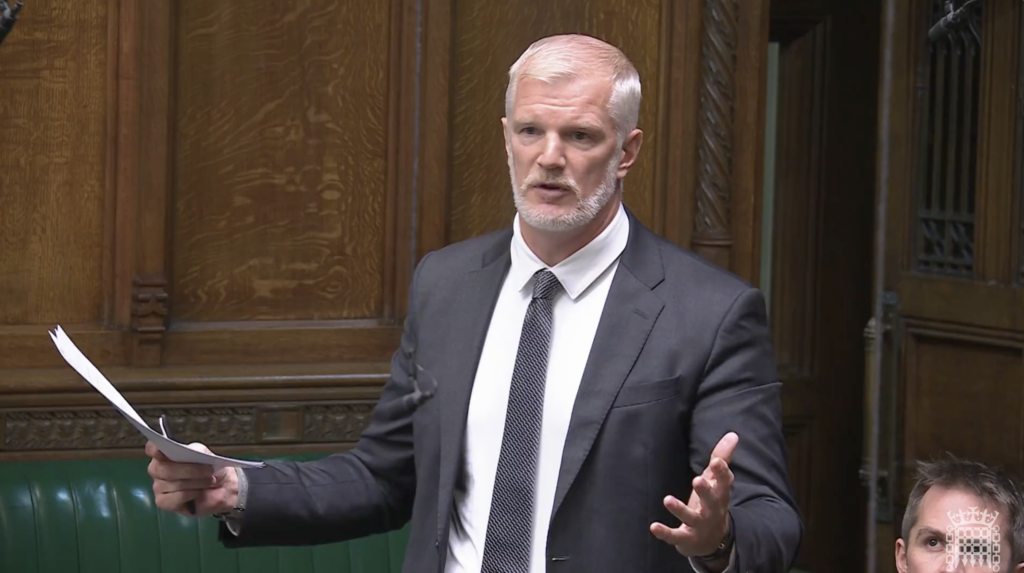
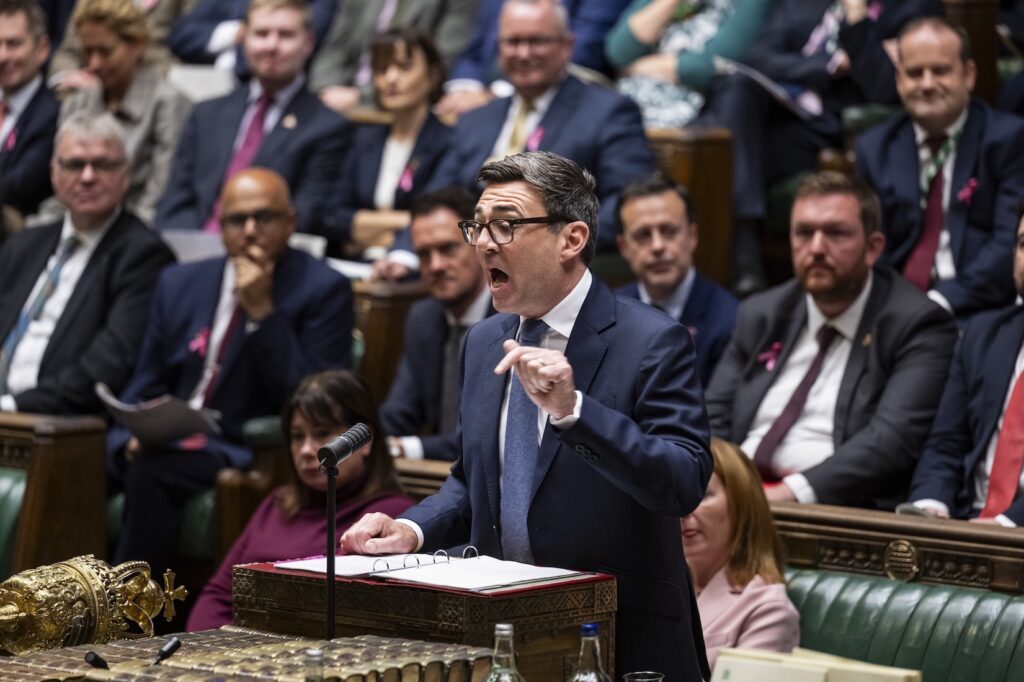
Andy Burnham has delivered his most assured performance at PMQs since becoming prime minister. Having spent the opening months of his premiership seeking to establish the government’s priorities, he turned his fire on the record of the previous Conservative administration.
The prime minister seized the opportunity provided by the session – and the openings offered by Kemi Badenoch – to take the Conservatives to task over energy policy, social care and Liz Truss.
It was Badenoch, whose certain and acerbic despatch box demeanour is celebrated by her Conservative colleagues, that struggled to land a blow. She began on a confused note, sardonically thanking the prime minister for approving the Jackdaw gas field, while mocking the time taken to reach the decision.
“The Conservatives first approved Jackdaw in 2022”, she said. “Rather than fighting the lefty activists that tried to block it, Labour appointed one of them as energy secretary. So many jobs lost, so much time and money wasted.”
Burnham responded that the government had “made a decision that her government messed up. That’s why there was the delay because they didn’t do the process properly.”
The prime minister defended the decision as “pragmatic”, arguing that it would “build a bridge to a renewable future”. He also reached for common ground with his Conservative opponent, agreeing with Badenoch in response to her second question that the move “does strengthen our energy security”.
Burnham was less conciliatory when drawn on the process behind the decision. He defended the approval while casting the delay as a consequence of Conservative failings.
After Badenoch suggested that the government’s reliance on “process” echoed Keir Starmer’s approach, Burnham argued that the Conservatives were displaying why “they got those decisions wrong”. He said the government had spent the intervening period assessing whether the decision complied with statutory climate obligations, before concluding that it did.
Badenoch, accustomed to berating Burnham’s predecessor into submission, failed to exploit latent Labour divisions over the Jackdaw project. A more disciplined approach might have served her better on this occasion.
The Conservative leader pivoted to the forthcoming budget, noting the government was “spending more on interest payments than we do on schools, the army, and the police combined.”
She added: “Meanwhile, the prime minister is worrying about loud music on trains. This is not serious. The only solution to the challenges facing our country is to cut spending and cut borrowing.”
Badenoch should be wary of dismissing Burnham’s focus on “everyday fixes” as trivial. Such policies may seem small, but they can have an outsized political impact.
Burnham hit back that he was “not going to apologise for doing the small things that help people have better lives. I’m not going to apologise for that.” He further pointed to the government’s “big decisions” on issues like social care.
He declared: “On social care, I grasped the nettle in a way that nobody on their side ever has, and I made a difficult spending decision to lay a path towards a national care service.”
Burnham’s tone sharpened as he castigated the Conservative Party’s record on social care.
He told the House: “Have they had the time to read the Covid inquiry report yesterday about the appalling state of social care as it went into the pandemic, the hundreds of 1000s of British people who suffered as a result of that, the lives that were lost.
“I need no lectures from the other side about taking tough decisions on social care. I suggest they go away from this PMQs, read that report, and have a period of reflection.”
Towards the end of the session, Burnham shifted his focus to the Conservative Party’s economic record, pointing to that perennial Labour punching bag: the September 2022 mini-budget.
He told the House that, shortly before the budget next week, Liz Truss will publish a new book about her historically brief tenure in office. The account is billed as “a short book on how the Bank of England broke the bond market and brought down the government”.
As with almost any pronouncement from the former prime minister of 49 days, her new book is a gift to Labour. And with the budget next week, it could hardly be better timed.
Burnham did not miss the opportunity to strike.
He stated: “They’ve gone quiet, because the authors of that mini-budget are sitting across these benches, including the shadow chancellor [Andrew Griffith].
“Does anybody on this side or anybody around the country believe that [the Conservative Party] of all parties has the audacity to come to this House and lecture us about how to do a budget?
“People in this country, British households, are still paying the price of that disastrous budget.”
The line capped a confident performance at the despatch box.