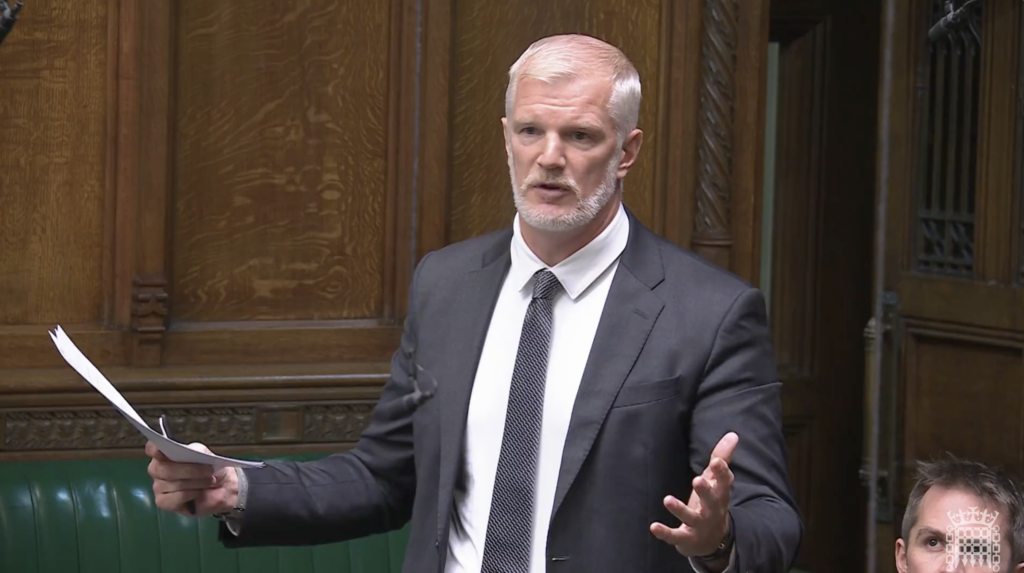
Labour MP Al Carns has said he remains “deeply concerned” about the Northern Ireland Troubles Bill, and that the government’s approach “deals the best possible hand to our adversaries”.
The former veterans minister told MPs during Monday’s committee stage debate that he supported many of the government’s amendments, but feared the bill “opens the floodgates for hundreds of lawyers to pursue what can only be described as a strategic effort to rewrite history.”
Carns, who served in Northern Ireland in 2003, said the bill could be used to “paint the state as the aggressor” and as a “punishment to hit back at our brave servicemen and servicewomen who served in Northern Ireland”.
The bill was considered by a committee of the whole House on Monday evening – a procedure in the commons where the detailed, clause-by-clause scrutiny of a bill takes place in the main chamber rather than in a separate committee room. This allows every MP to participate in the debate and propose and vote on amendments.
The Northern Ireland Troubles Bill was first introduced to parliament in 2025 following agreement on a joint framework with the Irish government. It aims to overhaul the previous Conservative government’s 2023 Legacy Act, which prohibited criminal investigations into Troubles-related offences, and find an alternative way to deal with the legacy of the Troubles. The bill involves a reformed legacy commission to investigate Troubles-related killings.
The government has said the bill “delivers on the spirit and promise of the Good Friday Agreement.”
Last week, the government proposed 156 amendments to the bill, raising concerns about scrutiny of the proposed legislation.
Carns said he would not push his own amendment to a vote, which would have moved all inquests into the legacy commission, “creating one simple body for truth and reconciliation, with an acceptance that the likelihood of justice and ‘prosecutions’ is vanishingly small”.
Carns now faces a decision on whether to defy the Labour whip and oppose the bill at its third reading – the final stage of its journey in the House of Commons – when MPs vote on Tuesday evening.
Carns, who served as parliamentary under-secretary of state for the armed forces from September 2025 to June 2026, said that without his proposal the bill would leave “a twin-track approach”, with the legacy commission on one side and inquests on the other.
“We will waste a huge amount of money through that process, because I genuinely believe that that illusionary justice is very unlikely to come about”, the MP for Birmingham Selly Oak said. “We will allow the process to drift on, potentially for up to 15 years.”
Carns argued that the bill would be of little use in recovering information. “As for information recovery, there is no new information unless it comes from Ireland”, he said.
SDLP MP Colum Eastwood interrupted to say: “This is nonsense.”
Social Democratic and Labour Party founded in Northern Ireland
Carns replied that it was “highly unlikely that there will be new evidence”.
He stated: “We can say, ‘This is nonsense’, but the reality is that it is not going to happen. It has not happened for the last 10 years; it is unlikely to happen now, except in one or two cases.”
Eastwood responded that “over the last week and a half, there have been two former paramilitaries in court on the basis of things that happened long ago”.
Carns concluded that the process would allow “those in Northern Ireland who were defeated in a military campaign to now engage in a political one – one that uses every operation to rewrite history, paint the state as the aggressor, and convince the good people of Northern Ireland that reunification is the answer to all of their problems.”
He said: “Morally and ethically, this approach does not support our veterans as it should, and strategically, it deals the best possible hand to our adversaries.”
Northern Ireland secretary Chris Bryant said he was “grateful” for the way Carns had conducted and his campaign and how he had “informed many of the amendments that we have tabled today”.
Conservative MP Andrew Murrison, a former defence and Northern Ireland minister, said he “agreed with every single word” of Carns’ remarks.
The Conservatives have consistently opposed the bill. Speaking in the debate, shadow defence minister Mark Francois claimed “the veteran community fear that they have now become pawns in a wider game to appease Dublin; they are not fooled in any way.”
Carns resigned as a minister in June 2026 over a dispute regarding military spending and the defence investment plan specifically. He joined John Healey, then the defence secretary, in stepping down.
In his resignation letter, Carns also raised the Troubles bill, describing it as “unfit for purpose”.
He wrote: “It risks failing the very veterans it claims to protect. Men and women I served with, those I buried friends alongside, people who did their duty under conditions most individuals in Westminster will never have to imagine.”
Carns considered running in the 2026 Labour leadership contest but ultimately backed down and endorsed Andy Burnham.
In a June 2026 interview with LBC Radio, he was asked about how he would respond if there was a leadership election and “the ball comes out from the back of the scrum.”
Carns responded: “I’m good at rugby and football, but we’ll see what happens… I’m always up for playing.”