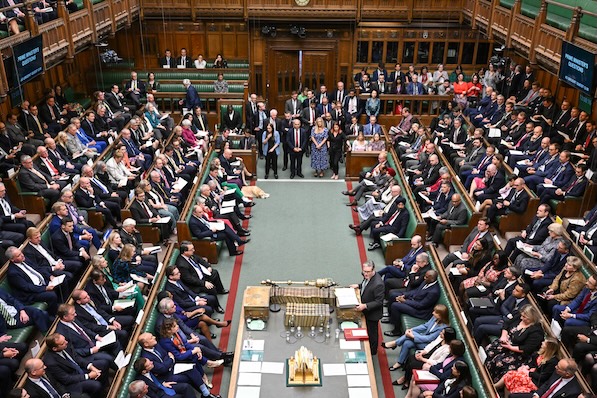
Prime minister’s questions (PMQs) is the main event of the parliamentary week. It is a 30-minute session held in the House of Commons every Wednesday at 12 noon, where the prime minister answers questions from MPs from all sides of the House.
PMQs is the most regular and high-profile opportunity for parliament to hold the head of the government directly to account. It is a unique combination of constitutional scrutiny and high-stakes political theatre. The performance of the prime minister and the leader of the official opposition can shape the political news agenda.
The format of PMQs
The session follows a well-established format, which is presided over by the speaker of the House of Commons.
The ‘engagements’ question
To ensure the prime minister can be questioned on any aspect of government policy, MPs who wish to ask a question table the same generic, open question on the commons order paper. The prime minister is always asked to list their “official engagements for the day.”
In response, the prime minister gives a prepared answer briefly updating the House on government business. The response always ends with the standard sign-off, which follows: “This morning I had meetings with ministerial colleagues and others. In addition to my duties in this House I shall have further such meetings later today”.
From that point on, all subsequent MPs called by the speaker technically ask a supplementary question on any topic they choose, for which the prime minister has no advance notice.
The order of questioners
The order in which MPs are called to ask questions is primarily determined by a random ballot, known as the “shuffle”. There are 15 numbered questions listed on the commons order paper, and because demand invariably exceeds this number, a computer programme randomly selects which MPs will be included and determines the sequence in which they are called.
The House of Commons speaker then calls MPs in that order during the session.
In addition to those selected through the shuffle, the speaker retains discretion to call MPs who “bob” – standing repeatedly in the chamber in the hope of “catching the speaker’s eye.” This allows the speaker to include MPs who were not drawn in the ballot; they may select those who are particularly relevant to a prominent issue.
Critically, in addition to those selected through the shuffle, the leader of the opposition is entitled to ask six questions.
The leader of the third-largest party in the commons is also entitled to ask two questions.
Evaluation question
To what extent does this format balance adversarial debate with detailed policy scrutiny, particularly when compared to the standard set by select committees – and liaison committee sessions specifically?
The role of the speaker
Besides calling MPs, the speaker plays a crucial role in managing the flow and timing of PMQs.
The speaker must maintain order during what is often the loudest and most raucous part of the parliamentary week. Since taking the chair, Lindsay Hoyle, the current speaker of the commons, has ejected several MPs from the chamber for disorderly behaviour, including shadow transport secretary Richard Holden in January 2026.
The speaker is also responsible for time-management. Sessions are nominally meant to last 30 minutes, but there is some leeway.
Hoyle’s first PMQs after replacing John Bercow as speaker lasted 33 minutes. By contrast, Bercow’s final session on 30 October 2019 lasted 71 minutes. Under Bercow’s tenure, the length of PMQs steadily increased, from an average of just over 30 minutes in 2009 to 35 minutes by 2015 and 49 minutes by 2019.
The speaker must try to ensure a fair balance of questions from MPs across all parties. But due to the random nature of the ballot and one party’s position in the majority means this is not always possible.
Pros of PMQs: why is it important?
Accountability
It is the most direct and regular way that the head of the government is held to account by the elected legislature. The prime minister can be asked questions on any aspect of government policy.
In his resignation speech as prime minister, Harold Wilson said that “the wide open nature of prime minister’s questions – entirely different from that of any departmental minister – required familiarity with, and understanding of, the problems of every department and every part of the country.”
Political performance
It is a key test of leadership, requiring the prime minister and the leader of the opposition to be masters of their briefs and to perform under intense pressure. A strong or weak performance can have a significant impact on party morale.
In particular, PMQs is a test for the prime minister who must answer for the policies and actions of the entire government. While they have a large team in 10 Downing Street to prepare them with briefings on a vast range of current issues, they have no formal notice of the specific supplementary questions that will be asked.
In this way, PMQs can be a nerve-wracking experience for prime ministers. In 2010, Tony Blair admitted that he still felt a “chill” on the back of his neck at midday every Wednesday.
He said: “Wherever I’m in the world, every Wednesday at three minutes to twelve, I get a chill feeling on the back of my neck.”
During his tenure as prime minister, Blair replaced the previous system of two 15-minute prime minister’s questions sessions each week with the single 30-minute weekly session that operates today.
As leader of the opposition and prime minister, Blair was a skilled performer at PMQs. On 25 April 1995, Blair famously dismissed John Major with the riposte: “I lead my party, he follows his.”
Public engagement
PMQs is the most-watched part of parliamentary proceedings, providing a weekly window for the public to see the leaders debating the major issues of the day.
Cons of PMQs: common criticisms
‘Punch and Judy’ politics
PMQs is known internationally for its highly adversarial and theatrical style. Critics argue that this confrontational atmosphere is unproductive, not conducive to effective scrutiny and presents the British political system in a poor light.
Upon winning the Conservative leadership contest in 2005, David Cameron said he was “fed up with the Punch and Judy politics of Westminster, the name calling, backbiting, point scoring, finger pointing.” However, during his tenure as prime minister, Cameron was a combative and sometimes unruly commons performer. In May 2012, he called the then shadow chancellor, Ed Balls, a “muttering idiot” at PMQs.
On 24 February 2016, during a session of prime minister’s questions, Cameron launched a personal attack on the then leader of the opposition, Jeremy Corbyn, over his appearance. Responding to questions from the Labour leader, Cameron delivered what appeared to be a scripted remark about Corbyn’s attire and patriotism, telling him to “do up his tie and sing the national anthem”.
Lack of substance
Critics argue that it rarely involves detailed policy scrutiny. Questions are often political attacks designed to create a soundbite for social media; meanwhile, answers are frequently evasive and consist of pre-prepared party lines.
‘Planted’ questions
It is a common practice for government backbenchers to be given favourable questions to ask by the party whips. This allows the prime minister to deliver a pre-prepared statement about government achievements. While within the rules of the commons, the practice arguably makes for ineffective scrutiny. For an ambitious and loyal backbencher, asking “planted questions” can help build favour with the Whips’ Office, which may assist their chances of future promotion.
Evaluation question
To what extent does the use of ‘planted’ questions by government whips undermine the effectiveness of PMQs as a mechanism for executive scrutiny?
PMQs and Boris Johnson’s downfall
Prime minister’s questions played a central role in the political unraveling of Boris Johnson.
On 1 December 2021, following reports in the Daily Mirror of festive gatherings during the 2020 lockdown, Johnson used a session of PMQs to tell MPs that “all guidance was followed completely in No 10.”
However, on 7 December, a 47-second clip was broadcast showing his press secretary, Allegra Stratton, joking about a Christmas party during a mock press conference. The following day at PMQs, Johnson told the Commons he was “furious” to see the clip but maintained that “the guidance was followed and the rules were followed at all times.”
He subsequently confirmed that the cabinet secretary, Simon Case, would lead an investigation into the matter.
The pressure intensified in January 2022 following revelations regarding a “bring-your-own-booze” event held in the Downing Street garden on 20 May 2020. At PMQs on 12 January, Johnson apologised to the House, admitting he had attended the gathering for 25 minutes.
He stated that he “believed implicitly that this was a work event”, adding that “with hindsight, I should have sent everyone back inside.”
On 19 January 2022, minutes after the Conservative MP Christian Wakeford defected to the Labour Party, the senior Tory David Davis used PMQs to call for Johnson’s resignation.
Deploying a historically-charged quotation, Davis told Johnson: “In the name of God, go.”
The statements made by Johnson at the dispatch box during these sessions ultimately became the basis for a formal inquiry. On 19 April 2022, Lindsay Hoyle, the commons speaker, granted approval to a motion referring the prime minister to the privileges committee.
The inquiry focused on whether Johnson’s repeated assurances at PMQs had knowingly misled parliament.
Evaluation question
To what extent does this demonstrate that PMQs remains a powerful mechanism for ensuring accountability, notwithstanding its theatrical flaws?
The privileges committee’s final report was published on 15 June 2023, sometime after Johnson’s resignation as prime minister. It found that Johnson had committed “repeated contempts of parliament”. The former prime minister, who had recently resigned as an MP, stood accused of deliberately misleading the House.
The report stated that had Johnson remained an MP, the committee would have recommended a 90-day suspension.
On 19 June 2023, the House of Commons voted 354 to 7 to support the report’s findings.