Kwarteng’s ‘mini-budget’ triggers market meltdown and government collapse
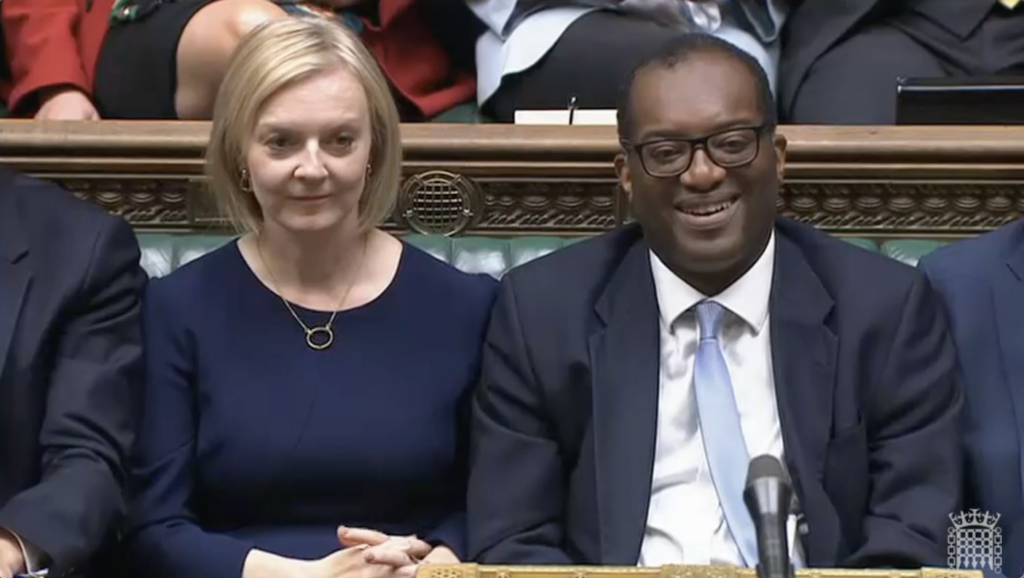
On 23 September 2022, the chancellor, Kwasi Kwarteng, unveiled his ‘Growth Plan’ to parliament. The fiscal package, dubbed the ‘mini-budget’, represented the flagship economic policy of the new prime minister, Liz Truss.
The mini-budget triggered immediate financial turmoil, a collapse in the pound and, ultimately, the fall of the Truss government.
***
Truss had assumed office 17 days earlier after winning the Conservative leadership contest on a platform of radical tax cuts. Truss secured 81,326 votes (57.4%) from the party membership, defeating her rival, Rishi Sunak, who won 60,399 votes (42.6%).
On 23 September, Kwarteng announced the largest package of unfunded tax cuts in 50 years, estimated at £45 billion. The measures included the abolition of the 45p top rate of income tax, a reversal of the April 2022 national insurance rise, bringing forward a 1p cut in the basic rate of income tax to 19%, the cancellation of the plan to increase corporation tax from 19% to 25%, and cuts to stamp duty.
The ‘mini-budget’ followed the announcement of a new “energy price guarantee”. Under the plan, the government would pay a subsidy to energy and gas suppliers in order to limit typical household energy costs to £2,500 per year. The Institute for Fiscal Studies (IFS) estimated its cost at over £100 billion per year.
Critically, the government bypassed the fiscal watchdog, the Office for Budget Responsibility (OBR). Kwarteng presented his statement without the customary independent forecast of its impact on public finances; a formal budget statement – which ‘The Growth Plan’ deliberately was not – would have required an independent forecast.
Kwarteng told the House of Commons that the Treasury’s growth plan was “built around three central priorities: reforming the supply-side of the economy; maintaining responsible approach to public finance; and cutting taxes to boost growth.”
Unveiling his package’s headline measure, the chancellor continued: “Take the additional rate of income tax. At 45%, it is currently higher than the headline top rate in G7 countries such as the US and Italy, and it is even higher than in social democracies such as Norway.
“But I am not going to cut the additional rate of tax today; I am going to abolish it altogether.”
Kwarteng promised a “medium-term fiscal plan” in “due course” – when the Treasury would set out “a clear commitment to fiscal responsibility and reducing debt as a proportion of GDP over the medium term”. But the chancellor did not commit to a date.
Investors were spooked by the scale of the unfunded borrowing. On the day of Kwarteng’s statement, sterling fell by around 4% against the US dollar.
Kwarteng made matters worse – likely much worse – when he committed to more tax cuts during an interview on 25 September. “There’s more to come”, the chancellor vowed during an appearance on the BBC’s flagship Sunday politics programme.
On 26 September, sterling reached an all-time low against the dollar, plunging to $1.0327 (a fall of nearly 5%). The cost of government borrowing (gilt yields) spiked.
Analysts did point to challenging international factors. However, the existence of a “UK-specific component” or moron premium was widely accepted.
Also on 26 September, the Treasury announced that Kwarteng’s “medium-term fiscal plan” would be published on 23 November.
***
The market meltdown forced the Bank of England (BoE) to intervene on 28 September with an emergency £65 billion bond-buying programme. The BoE said its decision to buy government bonds was driven by concern over “a material risk to UK financial stability.”
The International Monetary Fund (IMF) also issued a rare rebuke, warning that “the nature of the UK measures will likely increase inequality”.
The IMF said that “given elevated inflation pressures in many countries, including the UK, we do not recommend large and untargeted fiscal packages at this juncture, as it is important that fiscal policy does not work at cross purposes to monetary policy.”
It added: “The November 23 budget will present an early opportunity for the UK government to consider ways to provide support that is more targeted and re-evaluate the tax measures, especially those that benefit high income earners.”
The political and financial backlash sparked a series of tortured U-turns. On 3 October, at the height of a funereal Conservative Party conference, Kwarteng announced the abolition of the 45p tax rate would be scrapped.
Kwarteng said the cut had “become a distraction from our overriding mission to tackle the challenges facing our country”.
He added: “As a result, I’m announcing we are not proceeding with the abolition of the 45p tax rate. We get it, and we have listened.”
Then, on 14 October, Truss sacked Kwarteng as chancellor. In a subsequent press conference, Truss announced that the government would “keep the increase in corporation tax that was planned by the previous government.”
Kwarteng was replaced with Jeremy Hunt, seen as a significantly more moderate figure. Hunt, with Truss sat to his left, proceeded to dismantle “almost all” of the mini-budget’s measures in a commons statement.
Despite the U-turns, around £25 billion of tax cuts remained prior to Hunt’s statement.
Hunt told MPs on 17 October: “We are a country that funds our promises and pays our debts. When that is questioned, as it has been, the government will take the difficult decisions necessary to ensure that there is trust and confidence in our national finances.
“That means decisions of eye-watering difficulty”.
Truss’ political authority collapsed in tandem with the Conservative Party’s economic credibility. After a further farce – a botched whipping operation over an ‘opposition day’ fracking vote – Truss announced her resignation on 20 October 2022.
Truss became the shortest-serving prime minister in British history, lasting just 49 days in office (excluding the brief caretaker period before her successor took over). The previous record was held by George Canning, who died in office after 119 days in 1827.
The Truss premiership was widely ridiculed, most notably by a Daily Star livestream which charted whether she would outlast a bewigged leaf vegetable. The lettuce, famously, prevailed.
The mini-budget had severe political consequences for the Conservative Party.
Truss’ downfall was quickly followed by a second, significantly expedited Conservative leadership contest. Rishi Sunak was appointed prime minister on 25 October.
At the 2024 general election, Truss was one of many high-profile Conservative MPs who lost their seats.
Politics.co.uk Newsletters
DAILY
Politics@Lunch
WEEKLY
Week in Review