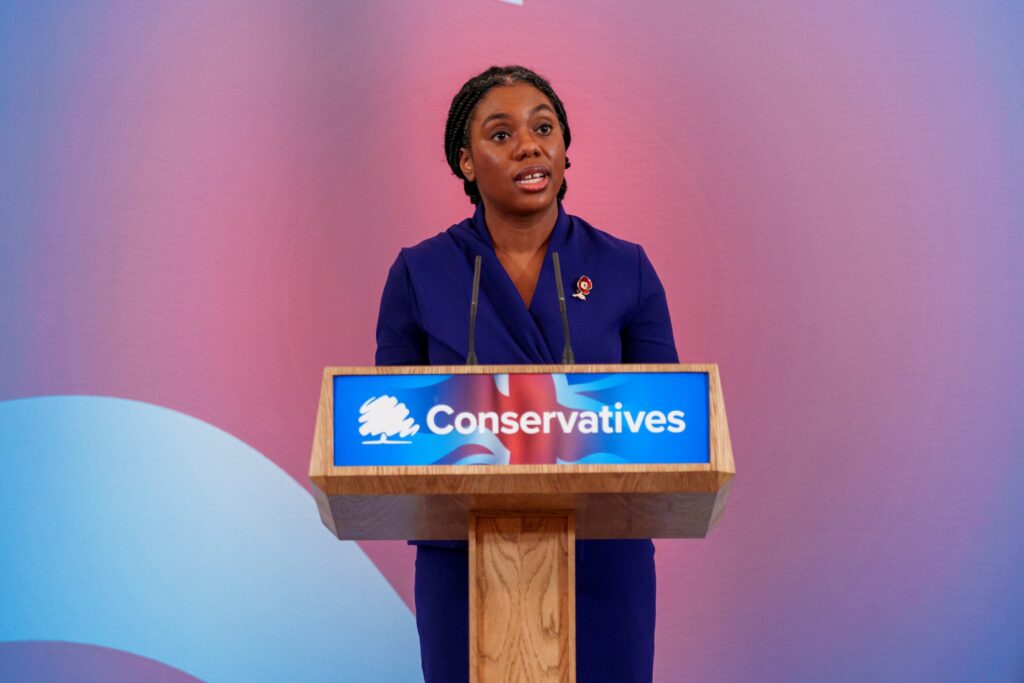
Kemi Badenoch has published The Right Way, a 95-page statement of Conservative principles modelled on the party’s 1976 document The Right Approach.
Launched at Conservative conference in Birmingham, the booklet is billed as the intellectual foundation for the party’s next programme for government. Like Margaret Thatcher’s Right Approach, published three years before the 1979 general election, it sets out the argument which will be expanded upon in a future manifesto.
Margaret Thatcher leads Conservative Party to election victory
In the foreword, Badenoch wrote that the earlier documents “came before the 1979 manifesto, because the argument had to come before the programme”.
She added: “They set out a diagnosis of what had gone wrong and an approach to governing from which policy could follow. We need to do the same again.”
The booklet is divided into chapters on the “Right Way for” the economy, energy, government, the country, defence, and borders and immigration.
It sets out five principles to guide a future Conservative government:
- Wealth must be created before it can be distributed.
- Freedom requires responsibility.
- Rules need consequences or they will be flouted.
- A government should be judged on what it achieves, not what it intended.
- It should be strong where only the state can act, and restrained where people are better placed to decide for themselves.
Badenoch stressed that policy comes last. “Policy is critical but it comes last, not first: principle comes first, then a way of governing, then diagnosis, and then policy”, she wrote.
The foreword and booklet more broadly features a relatively wide-ranging critique of the Conservative Party’s performance when it was last in government from 2010 to 2024.
“Labour goes wrong when it follows its principles; we go wrong when we fail to follow ours”, she wrote.
She added: “We promised lower immigration without a strategy for delivering it. Net Zero was legislated for before we had an economically feasible route to get there. We left the European Union without the economic plan that should have gone with it.”
Britain leaves the European Union after 47 years of membership
The booklet further argues that the Conservatives “did little to reverse” New Labour‘s changes, delivered under prime ministers Tony Blair and Gordon Brown.
It states: “Labour naturally believes more readily in spending, direction and regulation. Conservatives too often opposed that approach in rhetoric, while preserving or extending it when in office between 2010 and 2024. This is the root of the often-heard criticism ‘You had 14 years’.
“Conservatives were seen as the best option by the electorate for 14 years, which is why we were in office during that period, but the charge which we must accept is that we did little to reverse the structural changes Labour had made which took the country in the wrong direction.
“The result was that the state grew by stealth. A new priority rarely displaced an old one.”
The booklet issues a criticism of the 2022 mini-budget, delivered by Kwasi Kwarteng as chancellor during Liz Truss’ tenure as prime minister.
It says: “Here lies a warning for many Conservatives: intentions are not enough. The 2022 mini-budget demonstrated the danger of treating the intention of growth as enough to announce major tax changes without a credible plan to cut spending and borrowing.
“The truth is not every tax cut pays for itself. We should be candid about the record of previous Conservative governments in allowing the tax burden to become too high in the first place, such as by freezing tax thresholds while wages and prices rose.”
The document is similarly candid when it comes to the Conservative Party’s attempts to control migration. “The previous Conservative administration promised to bring numbers down but did not deliver that promise”, it states.
The booklet states: “This failure to control free movement was a trigger for the 2016 referendum, directly resulting in Britain’s eventual exit from the European Union.
“Brexit gave Britain the chance to design a different immigration system. Instead, the 2021 changes widened eligibility.”
Badenoch’s foreword also turns on Andy Burnham, whom the Conservative leader accuses of becoming prime minister “with no serious diagnosis of what had gone wrong with the country”.
She describes his calls for “public control” as “a euphemism for more state control”, and writes: “Government doesn’t create growth. People do. Business does.”
The booklet dismisses Manchesterism, the supposed school of thought associated with Burnham, as a “mythical concept”.
The booklet restates a number of existing policy commitments. On borders, it repeats the plan to leave the European Convention on Human Rights, double the qualifying period for indefinite leave to remain from five to ten years, and legislate for a binding annual cap on immigration.
On defence, it commits to spending 3% of GDP by 2030, with “a critical path to 3.5 per cent”.
On energy, the booklet says the Conservatives would repeal and replace the Climate Change Act, restore domestic North Sea production, scrap the Energy Profits Levy and abolish VAT on household electricity for three years.
On foreign policy, the booklet says the United Kingdom should “aspire to be a great power.”
On identity, the booklet says citizenship must “mean more than legal status”.
It states: “People who make Britain their permanent home should embrace our culture. This is not an ethnicity test, and the right way is not, as we have seen in certain quarters, debating endlessly who ethnically counts as British…
“A successful multi-racial country needs confidence in the culture into which people are being asked to integrate.”
The party further calls for the rejection of “identity politics from the right as well as the left.”
The booklet suggests Conservative candidates will need to sign up to the party’s programme before they can be approved.
The document states: “Candidates should argue their case while policy is being decided. Once the party has agreed its core programme, those standing under its banner will be expected to campaign for it and support it in parliament.
“Our candidates will all be required to agree to this transparently before they can stand as Conservatives.”
Labour wins historic landslide as Conservative Party collapses