1979 general election: Margaret Thatcher leads Conservative Party to victory
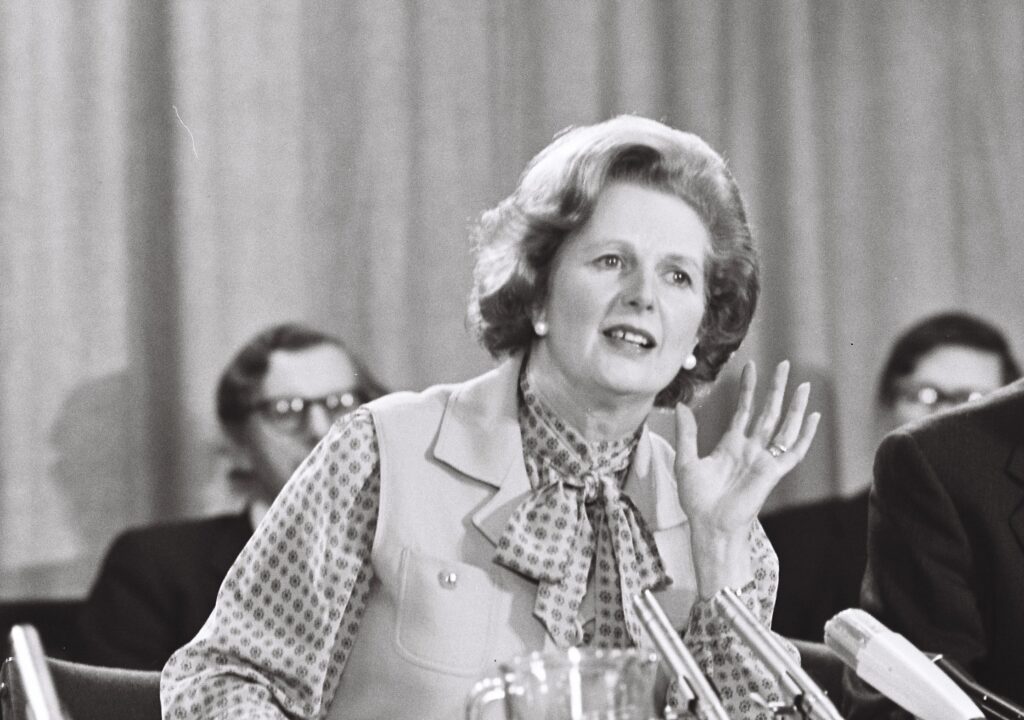
The Conservative Party under Margaret Thatcher’s leadership won a decisive victory in the general election held on 3 May 1979. The result saw Thatcher become the first female prime minister in British and European history.
The Conservatives won 339 seats (up 62), securing a comfortable working majority of 43, while the Labour Party, the incumbent government, slumped to 269 seats (down 50). The swing of 5.2 points from Labour to the Conservatives was the largest since 1945.
The Liberals, under the leadership of David Steel, secured 11 seats (down two). The Scottish National Party (SNP) was reduced from 11 seats to just two.
***
The contest was triggered by a vote of “no-confidence” in Jim Callaghan’s government, which passed by a majority of just one on a night of immense parliamentary drama. Callaghan’s administration had been clinging to power since losing its majority in 1977, relying on a pact with the Liberal Party, the support of smaller parties and an often innovative whipping operation.
Both Liberal and Scottish National Party (SNP) MPs voted against Callaghan’s government in the historic vote, following the botched 1979 Scottish devolution referendum.
Callaghan, who became prime minister in 1976 after Harold Wilson’s resignation, inherited a precarious political and economic situation. But in the autumn of 1978, having experienced something of a honeymoon period, Labour edged ahead of the Conservatives in the polls. Callaghan nonetheless passed up the opportunity to call an election – a decision that is now regarded as a major strategic miscalculation.
Within weeks, the country began its slow descent into the “Winter of Discontent” – a period of widespread industrial unrest and economic disruption. The government was seen as flat-footed in responding to the turmoil, symbolised by the infamous Sun headline: “Crisis? What Crisis”. Upon returning from an international economic conference in Guadeloupe, Callaghan had told the press: “I don’t think other people in the world would share the view [that] there is mounting chaos.”
On 17 January 1979, a week after Callaghan’s infamous comments, Thatcher addressed the nation in a party-political broadcast.
The Conservative leader, delivering her lines from a sitting room, said that she did not want to use her broadcast to “make party political points”. Thatcher argued that the “crisis that our country faces is too serious for that.” She questioned what happened to Britain’s “sense of common nationhood and even of common humanity.”
***
Thatcher was elected leader of the Conservative Party in February 1975, defeating Edward Heath and William Whitelaw consecutively. There were only seven female Conservative MPs at the time of Thatcher’s election.
At the time of parliament’s dissolution, Callaghan remained the more popular of the two main party leaders, but the Conservative campaign relentlessly exploited public misgivings about the direction of the country. Thatcher campaigned on a platform of controlling inflation, curbing trade union power, and reducing the role of the state in the economy.
A Conservative Party broadcast began with the Sun‘s “Crisis? What Crisis?” headline. The phrase was then repeated by an increasingly desperate-sounding voice actor. The broadcast was interspersed with film footage of piles of rubbish, closed factories, picketed hospitals and locked graveyards.
On top of this, the famous “Labour Isn’t Working” poster – curated by advertising agency Saatchi & Saatchi – probably captured the public mood.
During the campaign, Harold Wilson conceded that his wife, Mary, might vote for the Conservatives because their leader was a woman.
***
On the steps of 10 Downing Street following her victory, Thatcher famously quoted St Francis of Assisi.
Asked how she felt about becoming prime minister, she responded: “Very excited, very aware of the responsibilities. Her Majesty The Queen has asked me to form a new administration and I have accepted.
“It is, of course, the greatest honour that can come to any citizen in a democracy. I know full well the responsibilities that await me as I enter the door of No. 10 and I’ll strive unceasingly to try to fulfil the trust and confidence that the British people have placed in me and the things in which I believe.
“And I would just like to remember some words of St Francis of Assisi which I think are really just particularly apt at the moment. ‘Where there is discord, may we bring harmony. Where there is error, may we bring truth. Where there is doubt, may we bring faith. And where there is despair, may we bring hope’…
“And to all the British people – howsoever they voted – may I say this. Now that the election is over, may we get together and strive to serve and strengthen the country of which we’re so proud to be a part.”
She added: “And finally, one last thing: in the words of Airey Neave, whom we had hoped to bring here with us, ‘There is now work to be done’.”
Neave, the shadow Northern Ireland secretary, was assassinated on 30 March 1979 just days after the vote of no confidence in Callaghan’s premiership. Neave had been a key architect of Thatcher’s rise to the Tory leadership and was set to become Northern Ireland secretary in her first government.
The 1979 general election was by all accounts a political watershed.
Thatcher’s victory ushered in 18 years of Conservative rule and a period of radical free-market reforms that would fundamentally reshape the British economy and society.
Callaghan resigned as Labour leader in 1980.
Michael Foot was elected leader of the Labour Party in November, securing a narrow victory over his main rival, Denis Healey, in the final ballot of Labour MPs. Foot, first elected alongside Callaghan as part of Labour’s post-war landslide in 1945, was firmly identified with the party left.
Callaghan stepped down from the commons at the 1987 general election, and was elevated to the House of Lords as Baron Callaghan of Cardiff shortly thereafter.

Politics.co.uk Newsletters
DAILY
Politics@Lunch
WEEKLY
Week in Review