Foreign secretary hints at leadership bid in Tory succession crisis
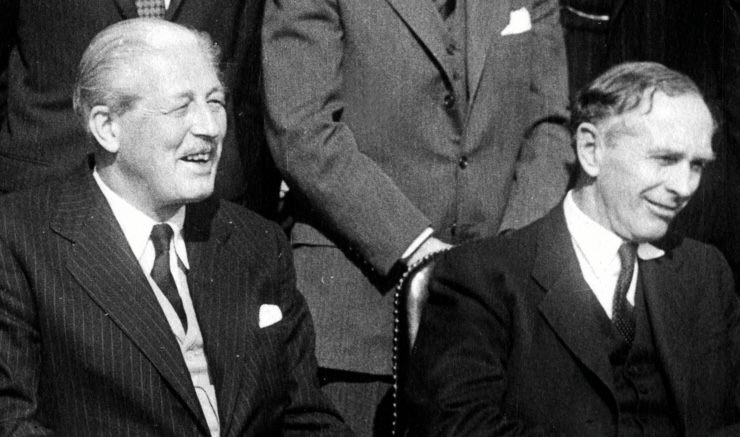
On 11 October 1963, with the Conservative Party conference in Blackpool gripped by a succession crisis after the shock resignation of Harold Macmillan, the 14th Earl of Home (Alec Douglas-Home) delivered a crucial intervention.
Macmillan, who was in hospital recovering from prostate surgery, had sent a resignation letter that Home read out to conference delegates on 10 October. The outgoing prime minister had been looking increasingly embattled after the Profumo affair and French president Charles de Gaulle’s veto of Britain’s accession into the European Economic Community (EEC).
Profumo resigns after admitting lying to parliament
‘Non’: Charles De Gaulle vetoes Britain’s entry to EEC
In his letter, ‘Supermac’ wrote that it was “now clear that whatever might have been my previous feelings, it will not be possible for me to carry the physical burden of leading the party at the next general election.”
He added: “Nor could I hope to fulfil the tasks of prime minister for any extended period, and I have so informed the queen.”
The statement referred vaguely to the “customary processes of consultation” by which his successor would emerge. At the time, the Conservative Party had no formal mechanism for choosing a leader – only a series of secretive soundings to assess a candidates’ suitability. On the eve of Macmillan’s resignation, Home – the foreign secretary – said the Conservative Party did not “believe in choosing a leader” by democratic methods. “We have our means of ascertaining feeling in the country”, he said.
But Macmillan left office without an obvious, settled heir. His call for the “customary processes” to begin “at the earliest opportunity”, therefore, triggered an unprecedented scramble for power.
***
The initial frontrunners were the deputy prime minister, R.A. ‘Rab’ Butler, who had strategically occupied the leader’s suite at the Imperial Hotel; Reginald Maudling, appointed chancellor in Macmillan’s “night of the long knives” reshuffle; and the 2nd Viscount Hailsham (Quintin Hogg), who in a speech on the evening of 10 October announced his intention to renounce his peerage.
Hailsham declared: “I shall continue to try to serve my country honourably but I wish to say tonight that it is my intention to disclaim my peerage. If I can find anyone to receive me as a candidate to stand for parliament I shall do so.”
Over the course of the 20th century, a convention had emerged that the prime minister should sit in the House of Commons. In the first half of the 20th century, the sovereign – exercising their prerogative power to pick the prime minister – passed over two well-qualified peers: Lord Curzon (in 1923) and the Earl of Halifax (1940). In both instances, the monarch selected a prime minister from the commons. It was now considered constitutionally inappropriate for the PM to reside in the unelected House of Lords. The Marquess of Salisbury, prime minister from 1895 to 1902, was the last peer to occupy Downing Street.
Fortunately for Lord Hailsham and other ambitious earls, the Peerage Act 1963 provided a means by which inherited hereditary titles could be disclaimed. The legislation was provoked by the indefatigable campaigning of Tony Benn, who was for a brief period the 2nd Viscount Stansgate.
Tony Benn reclaims commons seat after renouncing peerage
Then, on the morning of 11 October, Home placed himself into contention with a dignified intervention.
Addressing delegates, Home began: “I am offering a prize to any newspaperman this morning who can find a clue in my speech that this is Lord Home’s bid to take over the leadership of the Conservative Party.”
The remark was interpreted as Home gingerly throwing his hat into the ring; it was received with applause.
Home reportedly added: “In a Conservative society, we mean to see that incentives are maintained and improved, that initiative and skill are rewarded, that there are a variety of ladders to the top and that positions of responsibility are not reserved for any coterie or class, or brand of education.”
On the evening of 10 October, Home had been asked by the BBC whether he was discouraging his supporters. “I’m neither encouraging nor discouraging them”, he replied. The foreign secretary was asked moreover whether was he intended to “remain the 14th Earl of Home as long as you live”.
Home responded: “That’s the same question in a different form. And I’m not going to comment on myself or anybody else with regard to the leadership of the Conservative Party, but we’re quite sure we shall find the leader alright by the customary processes which the party wants.”
Finally, questioned as to whether a “reluctant” individual could be drafted to serve as leader, Home added: “It would depend on the individual and on how reluctant he was. I don’t know who you have in mind – this might be the third way of asking the first question which you asked.
“I’m not going to be trapped or induced to answer any questions on the leadership, except to say that it will be settled by the normal customary processes”.
Collectively, Home’s comments seemed well calibrated to the unusual circumstances of this informal leadership contest. They contrasted positively with Hailsham’s overt efforts to seduce delegates – which some critics believed to be beneath the dignity of a prospective prime minister.
In the Conservative Party at this time, the very act of ‘campaigning’ was frowned upon.
Supporters of Hailsham toured the conference distributing “Q” (for Quintin) badges to delegates. Hailsham was also photographed feeding his infant daughter in public. These alleged antics – to which the ebullient, bell-ringing Viscount was no stranger – helped court the Conservative rank and file. But they alienated the party’s all-important traditionalists.
This was the dramatic tension that defined the Conservative Party’s 1963 conference. Those seeking the premiership could only inch towards the power vacuum opened by Macmillan’s sudden resignation – lest they be accused of ambition.
Home, who navigated this dynamic as a good aristocrat, secured support as a compromise candidate.
Butler’s candidacy, meanwhile, was undermined by a lacklustre keynote speech. The de facto deputy minister had previously been passed over after Anthony Eden’s 1957 resignation – and looked set to suffer the same fate six years later. Maudling also failed to ignite the conference.
In a private memo, dated 15 October 1963, Macmillan outlined his view of developments from his hospital bed. The outgoing prime minister referred to the resignation of Gladstone in 1894 and the acrimonious elevation of the Earl of Rosebery. “Then there were many contestants”, he wrote, “but none outstanding”.
He added: “In the end the choice of Lord Rosebery proved fatal both to the recipient of the honour and to the party which did not recover for more than 10 years.”
Conservatives win landslide victory as Rosebery’s Liberals collapse
Macmillan said that those who think most of the “orderly conduct of government would tend to be for Mr Butler as he is likely to carry on the present policies”. By contrast, he suggested that members of the cabinet “are afraid that Lord Hailsham would be impulsive, even arrogant, in his handling of their business.”
He referred to the “mass of feeling in favour of Lord Hailsham” as the candidate best-placed to take on Labour leader Harold Wilson. But he noted that his “recent exhibitions will have caused some dismay and may even cause people to withdraw their support.”
Macmillan then considered Home’s candidacy, characterising the 14th Earl as “a man who represents the old, governing class at its best”. He said that Home was “not ambitious in the sense of wanting to scheme for power although not foolish enough to resist honour when it comes to him.”
The outgoing prime minister claimed the crucial fact was “that Lord Home’s candidature has not been set forward on his own merits but has been thought of as a last-minute method of keeping out Mr Butler now that Lord Hailsham has (according to the pundits) put himself out of court by his stupid behaviour in the foyer of the Imperial Hotel at Blackpool.”
On 18 October, Macmillan – still confined to his hospital bed – advised a 37-year-old Queen Elizabeth II to send for Home.
***
In a speech to the House of Commons on 24 October, Wilson addressed the Conservative succession crisis. He said outsiders had witnessed “democracy at work in the Conservative Party – Nature in the raw, Nature, red in tooth and claw”.
The Labour leader added: “We have been privileged to see the working of those mysterious processes of consultation as a result of which – and this is all that concerns us today – it was decided by the Conservative and Unionist and National Liberal high command that there was no member of this House on whom the party could agree as leader and that they had to look elsewhere.”
Wilson’s speech came as the government sought the prorogation of parliament, providing time for Douglas-Home to find a commons seat and win election to the lower chamber.
Jo Grimond, the Liberal Party leader, responded: “[The new PM] has many admirable qualities, but they do not seem to have counted as much as the fact that he did not want the job.”
George Brown, the deputy Labour leader, stated: “No party can ever have portrayed such a total lack of confidence in each other as to have to resort to such a drama in order to find the lowest common denominator.”
By the time parliament returned on 12 November, Douglas-Home, the new prime minister, had secured a seat as the Conservative MP for Kinross and Western Perthshire.
In his first speech to the commons as prime minister, Douglas-Home thanked Wilson and his “supporters for the good-humoured tolerance with which they received one whom they could hardly have expected to find among them.”
He added: “I rather fear that the Peerage Bill has worked out in a way which they could not have envisaged, and I am sorry if I have put them in a jam; they have all my sympathy. But I quite see that it is almost impossible for them to argue that what is right for the former Lord Stansgate [Tony Benn] is wrong for the former Lord Home, to say nothing of the future portent, Mr. Hogg.”
Quintin Hogg (Hailsham) was returned to the commons after winning the December 1963 St Marylebone by-election.
***
In January 1964, Iain Macleod, the former party chairman and commons leader, penned a damning article for Spectator in which he suggested the leadership race had been fixed by “the magic circle” – a clandestine cabal of Conservative kingmakers.
In an article ostensibly reviewing Randolph Churchill’s book, The Fight for the Tory Leadership, Macleod wrote that once one accepts Macmillan’s prejudice against Butler, his “actions become at least explicable”.
He stated: “It is some measure of the tightness of the magic circle on this occasion that neither the chancellor of the exchequer [Maudling] nor the leader of the House of Commons [himself] had any inkling of what was happening.”
According to Macleod, Macmillan had initially hoped that one of the younger generation – identified as Maudling, Edward Heath, or himself – would emerge to challenge Butler. When this failed to materialise, Macmillan turned first to Hailsham, and finally to Home.
He also commented on the role of the chief whip, Martin Redmayne, suggesting that while Redmayne acted with sincerity, he had concluded that Home was the right man and did “all in his power to achieve that result.”
Interestingly, Macleod lamented that the party had “gravely weakened the House of Lords” by using the Peerage Act to extract “outstanding” ministers from it. He also regretted that the Conservatives had, in effect, “confessed” that there were no suitable candidates for prime minister in the commons.
Both Macleod and Enoch Powell refused to serve in Douglas-Home’s government. Powell later condemned Macmillan for having “deprived the queen of the exercise of her principal prerogative”.
Douglas-Home ultimately led the Conservative Party to a narrow defeat at the 1964 general election.
Labour wins narrow majority after 13 years of Tory rule
Douglas-Home’s subsequent resignation paved the way for the party’s first ever leadership election. His emergence two years previously had delegitimised the “customary processes of consultation” in the eyes of influential contemporaries.
Three candidates contested the 1965 Conservative leadership election: Edward Heath, the shadow chancellor, seen as representing a new generation; Maudling, the shadow foreign secretary, viewed as the more established figure; and Powell, the firebrand orator representing the party’s right wing.
Heath secured victory in the first round on 27 July 1965.
Edward Heath elected Conservative leader in party’s first formal ballot
Douglas-Home returned as foreign secretary in June 1970, serving for the duration of Heath’s government. He stood down from the commons at the October 1974 general election, and was re-elevated to the Lords shortly thereafter as Lord Dunglass.
Lord Dunglass died on 9 October 1995, aged 92.

Politics.co.uk Newsletters
DAILY
Politics@Lunch
WEEKLY
Week in Review
