Labour wins narrow majority after 13 years of Tory rule
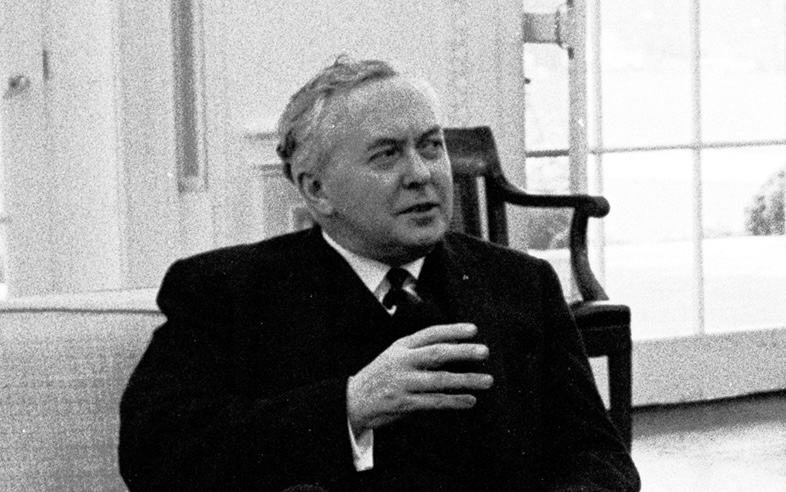
The general election held on 10 October 1964 resulted in a win for Harold Wilson’s Labour Party, ending 13 years of Conservative government.
Labour won 317 seats on 44.1% of the popular vote, narrowly defeating the Conservative Party, led by Sir Alec Douglas-Home, which secured 304 seats on 43.4%. Wilson’s working parliamentary majority of just four seats was the smallest since 1847.
The Conservative government in its latter years, plagued by a series of damaging scandals, was seen as politically exhausted and out of touch. Harold Macmillan, who had led the Conservatives to victory in 1959, suddenly resigned in October 1963, following a period of ill-health. His premiership had been looking increasingly embattled after the Profumo affair, a ruthless reshuffle – dubbed the “night of the long knives”, and the French veto of Britain’s accession into the European Economic Community (EEC).
Economically, the mood had shifted markedly since Macmillan’s famous declaration that Britons “have never had it so good”. By the early 1960s, that confidence no longer rang true.
Macmillan’s resignation precipitated a Tory succession crisis and Sir Alec Douglas-Home’s “emergence” as prime minister. Douglas-Home, the Conservative Party’s fourth premier in eight years, renounced his 14th Earldom in order to take up his post in the commons. Macmillan and a cabal of Conservative kingmakers (the “magic circle”) were accused of manipulating the outcome. As a result, Tory MPs Enoch Powell and Iain Macleod elected not to serve in Douglas-Home’s cabinet.
Douglas-Home, a distant and aristocratic figure, found an unforgiving contrast in Harold Wilson – whose political talents were first spotted by Clement Attlee as prime minister. Upon joining the cabinet as president of the Board of Trade in 1947, aged 31, Wilson became the youngest person to serve as a minister since Pitt the Younger.
Wilson himself had only recently been elected Labour leader, replacing Hugh Gaitskell, who died at the age of 56 in January 1963.
***
Shortly before Douglas-Home’s accession, Wilson famously cast the next general election as a battle for modernity. Addressing Labour’s Scarborough conference in 1963, Wilson spoke of the “white heat” of a technological and scientific revolution “greater than in the whole Industrial Revolution of the last 250 years”.
The speech framed the forthcoming general election as a choice between a dynamic future under Labour, and a stagnant, “nostalgic” Conservative Party. He cast aspersions over conservatism’s ability to oversee and hone such rapid societal change.
The patrician profile of Douglas-Home provided ample material for Wilson’s political narrative.
Douglas-Home, asked in 1962 whether he would ever become prime minister, responded: “No, because I do my sums with matchsticks”.
Shortly after Douglas-Home’s emergence as Tory leader in October 1963, Wilson referred to his new opponent as an “elegant anachronism”.
He added: “After half a century of democratic advance, the whole process has ground to a halt with a 14th earl.”
The Conservative leader replied: “I suppose Mr Wilson, when you come to think of it, is the 14th Mr. Wilson. If all men are equal, well, that’s a very good doctrine. But are we to say that all men are equal except peers?”
***
During the campaign, the Conservative leader – who had spent most of his career in the House of Lords – demonstrated his inexperience with modern political debate. The Conservative leader struggled to connect effectively via television, the emerging key medium of political communication.
One Daily Mail front page pictured Sir Alec having his nose powdered before a TV appearance.
Douglas-Home later recalled an encounter in a broadcast studio: “I remember being made up for a broadcast and my conversation with the young lady who was applying the powder and tan went like this: ‘Can you not make me look better than I do on television? I look rather scraggy – like a ghost.”
The individual attending to the Tory leader responded: “No… because you have a head like a skull.”
Douglas-Home asked: “Doesn’t everyone have a head like a skull?”
To which she replied simply: “No.”
Douglas-Home’s chosen style of campaigning involved speaking from a soapbox. He struggled, however, with the hecklers this strategy attracted. Campaigning in Lancashire, Douglas-Home was hit by an egg and confronted with placards, including one that read: “Who exhumed you?”.
Douglas-Home hit back: “If that young man ever decided to do a day’s work, he will know what full employment means.”
In London, the Conservative leader snapped: “I don’t mind opposition, but I’m not prepared for people who won’t listen.”
***
Quintin Hogg, the ebullient Conservative education minister, proved a prominent figure in the 1964 election campaign. He made headlines after responding to a heckler who raised the Profumo scandal.
Hogg declared: “Profumo! I would say just one thing. If you can tell me there are no adulterers on the frontbench of the Labour party you can talk about Profumo. If you can’t tell me that, you had better keep your mouths shut.”
He added: “If not, you had better keep your finders out of filth and not dabble in it. That sort of filth should be kept out of public life. Let us have no more filth of that kind.”
Wilson responded to the allegation by urging Douglas-Home to issue a statement.
On another occasion, speaking at a Conservative press conference, Hogg said that the election was “quite plainly [a choice] between sanity on our side and madness on the other side.”
Hogg, once seen as a successor to Macmillan, declared: “What is [Labour’s] defence policy? To drop our most powerful weapon altogether. Their foreign policy? To opt out of the conference table at the highest level.
“Their policy on finance? To stop inflation by spending another £1,000 million a year.”
He added: “If the British public falls for this, I say it will be stark, staring bonkers, and that is all I have got to say.”
Hogg was asked whether he thought the editor of the Economist was bonkers for backing Labour. “I have not examined him lately”, he responded.
Wilson, meanwhile, condemned the government for “13 wasted years” and its “stop-go policies”.
The Labour manifesto read: “We do not delude ourselves that the tasks ahead will be easy to accomplish. Even now we do not know the full extent of the damage we shall have to repair after 13 wasted years of Conservative government.”
Wilson’s campaign suffered a misstep when he implied that strikes were being strategically promoted to advantage the Conservative Party. The Labour leader spoke of a “Tory plot”.
Douglas-Home famously referred to Labour’s manifesto as a “menu without prices”.
The Conservative campaign centred on two core themes: economic prosperity and the nuclear deterrent.
In the Conservative manifesto, Prosperity With A Purpose, Douglas-Home stated his party’s philosophy was to “use what is good from the past to create a future which is better.”
He argued that the “future will be assured only if our people recognise the simple economic rules which must be kept by a country dependent on earning its living in a competitive world.”
Douglas-Home added: “In a world as dangerous as that in which we live it can make no sense whatever for Britain unilaterally to discard her strength. We therefore reject the idea of giving up our nuclear arm.”
In mid-October 1964, two major international developments occurred that could have altered the dynamics of the campaign and influenced the result. On 14 October, Nikita Khrushchev was deposed as premier of the Soviet Union; then, two days later, the People’s Republic of China tested its first atomic bomb.
Soon after the election, it was put to Douglas-Home that such developments, had they unfolded sooner, might have strengthened the Conservative Party’s platform.
Commenting specifically on the latter development, Douglas-Home responded: “Well, we expected this, of course, and I think it was very public that we expected this… But I think that perhaps the impact of an actual explosion of a bomb would have made people think a bit more.”
Douglas-Home, who served as foreign secretary from 1960 to 1963, was seen as an expert when it came to international affairs.
***
Despite Labour’s significant presentational and structural advantages, the election was a tight, producing a slim majority of just four.
The Liberal Party under Jo Grimond’s leadership doubled its vote share for the second successive election. The Liberals, positioned as a “radical, non-socialist alternative”, won 11.2% of the vote but only nine seats.
Wilson was appointed as the youngest prime minister since the Earl of Rosebery in 1894.
Douglas-Home’s subsequent resignation as Conservative leader paved the way for the party’s first-ever leadership election, which was won by Edward Heath.
With only a four-seat majority, Wilson struggled to pass substantial legislation through parliament. He called a snap election to break the parliamentary deadlock.
The 1966 general election resulted in a landslide Labour majority of 98 seats.

Politics.co.uk Newsletters
DAILY
Politics@Lunch
WEEKLY
Week in Review