Conservatives win landslide victory as Rosebery’s Liberals collapse
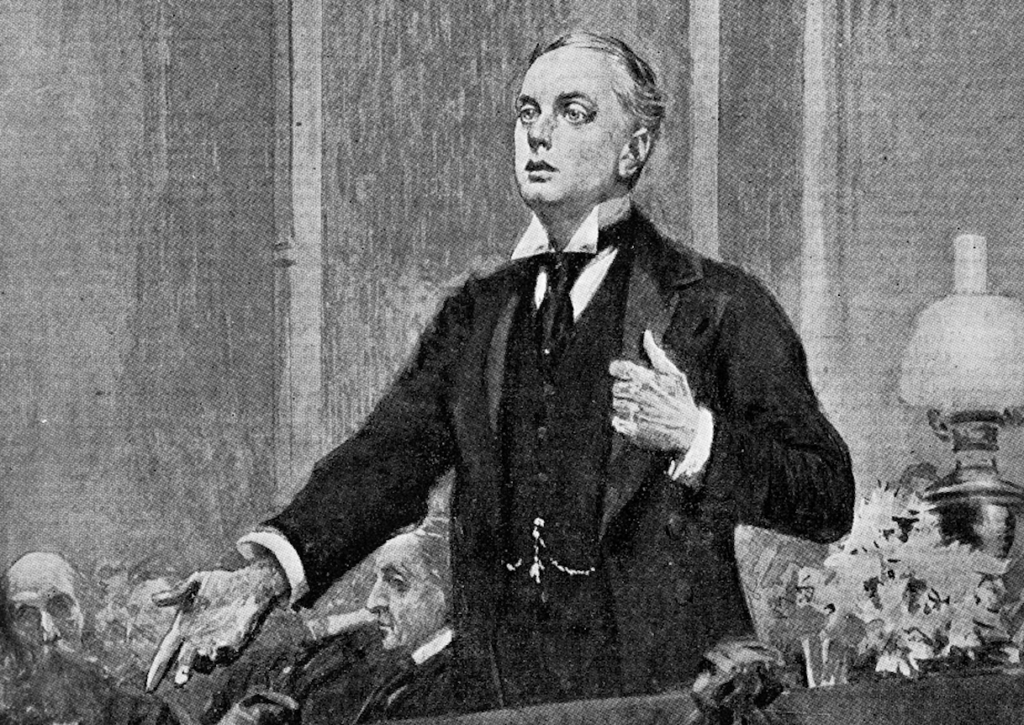
The general election held between 13 July and 7 August 1895 resulted in a decisive victory for the Conservative Party, led by the Marquess of Salisbury (Robert Gascoyne-Cecil), ushering in a decade of Conservative and Unionist dominance.
The election followed the collapse of the short-lived Liberal government under the Earl of Rosebery (Archibald Philip Primrose), which had been plagued by internal divisions and leadership struggles.
***
William Gladstone, the long-standing Liberal statesman, left office in March 1894. The Grand Old Man’s second attempt to legislate in favour of a devolved parliament in Dublin, Irish home rule, had been scuppered in the House of Lords. Having successfully beseeched MPs to support the measure, peers rejected the bill by 419 votes to 41.
The First Home Rule Bill, introduced in 1886, precipitated a split in the Liberal Party between those who supported Gladstone’s designs for limited Irish self-government and the ‘Liberal Unionists’ – a powerful new faction led by Joseph Chamberlain. The grouping feared home rule would destabilise the British Empire by injecting the possibility of self-determination. The split, in time, would prove permanent.
Gladstone had his last audience with Queen Victoria on 28 February 1894. The palace sent for Rosebery, the foreign secretary, who assumed office on 5 March.
Rosebery’s appointment was a poisoned chalice.
The 1892 general election had resulted in a hung parliament, but with the Conservative/Unionist alliance as the largest party. The Liberals returned to government relying on support from the Irish nationalist bloc.
The nationalists had also ceased to act as a unified entity. Charles Stewart Parnell, the leader of the Irish Parliamentary Party (IPP) from 1882 to 1891, was a powerful advocate for Irish home rule – and a skilled politician. But scandal – the revelation of affair – had shattered his reputation and authority. The IPP split between the loyal Parnellite Irish National League (INL), led by John Redmond, and the anti-Parnellite Irish National Federation (INF), led by John Dillon.
Rosebery’s succession, meanwhile, was resented by his rivals in the Liberal Party.
William Harcourt, the chancellor of the exchequer and commons leader, was furious to have been denied the premiership. Harcourt was 20 years Rosebery’s senior, and believed his length of service gave him precedence in the Liberal line of succession. Rosebery’s first step on the ministerial ladder came in the form of a junior post at the Home Office, during Harcourt’s tenure as home secretary.
Rosebery had his allies, and Harcourt his critics. But the prime minister’s status as a peer of the realm meant his authority over Liberal MPs was always in doubt. Rosebery inherited his earldom in 1851 at a young age, and therefore had no experience of the commons.
Moreover, Rosebery was not Gladstone’s chosen successor. The outgoing prime minister’s advice was not sought by Queen Victoria, with whom he shared a mutually adversarial relationship; had it been, he would have recommended Lord Spencer.
Conspicuously, Gladstone’s final speech in the commons offered little in the way of a careful or courteous transfer of political authority.
Addressing the House for the final time, the Grand Old Man warned of “tremendous contrariety and incessant conflict” with the Lords, arguing the upper chamber’s treatment of recent bills – notably the Second Home Rule Bill – raised “a question of the gravest character.”
He told the House: “The question is whether the work of the House of Lords is not merely to modify, but to annihilate the whole work of the House of Common?”
Gladstone declared that the “differences of conviction, differences of prepossession, differences of mental habit, and differences of fundamental tendency, between the House of Lords and the House of Commons, appear to have reached a development in the present year such as to create a state of things of which we are compelled to say that, in our judgment, it cannot continue.”
The Gladstonian gauntlet had been hurled at the feet of the Lords. And then, the 84-year-old statesman departed – never again to address parliament. His closing moral crusade, which owed as much to frustration as it did political calculation, hardly facilitated a smooth transition to a “peer premier.”
Rosebery, who managed Gladstone’s famous Midlothian campaign at the 1880 general election, was not altogether at odds with his predecessor’s stance. In a speech to Liberal MPs upon assuming the office of prime minister, Rosebery referred to Gladstone’s final address. “I venture to say”, he said, “that with his declaration on that point Her Majesty’s present advisers entirely identify themselves.”
He added: “I myself have for a long time past studied that question without much success, and in the course of that study I have used language, I am afraid, much stronger about the House of Lords, to the House of Lords itself, than even Mr Gladstone employed on that occasion.”
***
In the 1880s and 90s, the Liberal Party was profoundly divided over how to respond to the growing popular enthusiasm for empire.
One section of the Liberal parliamentary party believed the government should pursue a foreign policy that eschewed jingoism, true to the historic slogan: “peace, retrenchment and reform”. This tendency, represented by ‘radical’ Liberals such as Harcourt, Rosebery’s rival claimant, and David Lloyd George, was inherently sceptical of overseas expansion, military entanglements and imperial domination. Critics derided these figures as “Little Englanders.”
An opposing faction believed the Liberals should positively embrace empire – fearful, in part, of the electoral consequences of an ‘unpatriotic’ stance. ‘Liberal imperialists’ bemoaned ‘faddism”, the embrace of so-called sectional interests (Welsh and Irish policy) – alleged cul de sacs associated with Gladstone’s premiership. The faction, a minority tendency in the parliamentary party, was associated with senior figures such as Rosebery and H. H. Asquith. Critics accused Liberal imperialists of belligerent nationalism and jingoism.
Indeed, for Rosebery – the former president of the Imperial Federation League – empire was central to his politics. In 1892, he referred to the British Empire as the “greatest secular agency for good now known to mankind.”
On 1 March 1893, Rosebery delivered a speech to the Royal Colonial Institute in his capacity as foreign secretary, protesting against the anti-imperialist position. Britain, he said, was engaged in “pegging out claims for the future”.
He said: “Since 1868 the Empire has been growing by leaps and bounds. That is, perhaps, not a process which everybody witnesses with unmixed satisfaction… It is said that our Empire is already large enough, and does not need extension…
“We have to look forward beyond the chatter of platforms, and the passions of party, to the future of the race of which we are at present the trustees”.
The jingo-Little Englander divide would become more pronounced over the coming years. But during Rosebery’s tenure as foreign secretary, it was brought into sharp relief over the question of British withdrawal from Uganda.
In a commons debate on 20 March 1893, concerning the government’s policy in Uganda, Radical MP Henry Labouchère seized on Rosebery’s recent speech to the Royal Colonial Institute as proof of a policy of limitless, costly imperial expansion.
Labouchère could not help thinking that if “Lord Salisbury had sent such instructions… what indignation there would have been… from the Liberal benches!”. The Liberal MP referred to Rosebery as the “high priest of Jingoism”.
Robert Reid, also a Liberal MP, said Rosebery’s language “seemed to be more or less repudiated by other” ministers. As such, he accused the foreign secretary of “putting pressure on reluctant colleagues to fall in with his scheme, which meant a first step towards the premature establishment of a great empire in the Valley of the Nile, and up towards Uganda and the Lake District.”
Arthur Balfour, the Conservative leader in the commons, and Joseph Chamberlain, the leading Liberal Unionist both stated their fulsome support for Rosebery’s “pegging out claims” speech.
Gladstone, in his place as prime minister, defended his foreign secretary as “patriotic”. But it would soon emerge that they were not entirely at one when it came to empire.
The debate came as Gerald Portal, the British Special Commissioner to East Africa, had been directed to visit Uganda and inquire as to the desirability of setting up a British Protectorate to replace the Imperial British East Africa Company (IBEAC). He would “consider and report on the best means of dealing with the country”.
During Rosebery’s tenure as prime minister, Portal’s ‘inquiry’ resulted in the imposition of a protectorate under direct British rule – as Liberal radicals like Labouchère and Reid had suspected. In the 1893 commons debate, Gladstone said there were no plans to establish a protectorate.
As prime minister, Rosebery embraced the “continuity of the moral policy of England” – placing imperialism on a cross-party footing.
***
The Liberal Party’s divisions over imperialism were closely bound up with the related question of the government’s Irish policy.
In his first speech as prime minister on 12 March 1894, Rosebery summarily announced that home rule for Ireland would be delayed until England, the “predominant member of the partnership of the three kingdoms”, could be convinced of its merits.
The comments, in response to Salisbury’s criticism of the queen’s speech – the first of the Rosebery ministry – sparked fury among Gladstonian Liberals and the Irish nationalist bloc. It represented a marked shift in position. Gladstone’s approach to home rule required simple majorities in the ‘imperial parliament’ – which of course included Irish MPs and peers. Rosebery, rather, referred to the consent of England as the dominant component of the union state.
Moreover, under Gladstone, the Liberal Party had adopted the position that the ‘Irish question’ needed to be settled before any separate reforms could be achieved. Rosebery now planned to push ahead in lieu of home rule.
Rosebery himself seemed to be taken aback by the significance of his “considerable admission”.
He told peers: “I did not mean to dilate so much on the question of home rule. The noble Marquess [Salisbury] has, at any rate, the satisfaction of eliciting that declaration.”
Addressing the commons the following day, on 13 March, the leading Irish nationalist John Redmond expressed “dissatisfaction, the distrust, and… alarm” at Rosebery’s “ambiguous and halting phrases”.
Redmond furiously repudiated the “predominant partnership” doctrine as “preposterous”, “insulting”, “extraordinary” and “humiliating”. An effective English veto, he remarked, “changes the whole aspect of the home rule question”.
John Morley, the chief secretary for Ireland and committed home ruler, argued Rosebery’s remarks were not tantamount to a new constitutional doctrine, but a recognition of the practical reality that “it could be of no avail to submit home rule bill after home rule bill to the House of Lords… until we had made further progress in the conversion of the minds of the people” of England.
The effective deferment of home rule sparked a fresh debate as to the Liberal Party’s new set of priorities – thus revealing policy dissensions the Irish “obstruction” had once subordinated. The ‘home rule party’ suddenly needed a new raison d’être. Rosebery therefore opened up another front for political contention and ill-discipline.
***
These conditions produced political paralysis – in the Liberal Party and parliament.
Rosebery explained the precariousness of his position to Queen Victoria. The Liberal government, he said, was “kept in existence by a narrow majority, which may at any moment break away.” The prime minister said that he was “only able to guide this tumultuous party through a leader [Harcourt] bitterly hostile to himself and ostentatiously indifferent to the fate of the government. Lord Rosebery in the meantime is shut up in a House almost unanimously opposed to his Ministry, and, for political purposes, might as well be in the Tower of London.”
These remarks accurately described the first material debacle of Rosebery’s ministry: the defeat of its first address from the throne (queen’s speech).
On 13 March 1894, once Redmond had dissected Rosebery’s new home rule policy, Labouchère moved an amendment calling for an end to the “Lords’ veto”. He urged the government to appoint 500 new peers to overcome the upper chamber’s hostile majority – and “cook them in their own juice.”
The queen’s speech contained no measures to take on the Lords; Rosebery, having noted the daunting number of “enemies” in the House, merely maintained his confidence that “we have a large measure of support from the people of the three kingdoms.”
In his address, Labouchère cited the precedent of 1832, when the mere threat of creating peers forced the Lords into passing the Great Reform Act. He said he “was sick of seeing popular measures destroyed in the House of Lords – sick of pouring good radical liquor into a Tory vat.”
Labouchère rejected the House of Lords as composed of “hereditary Peers, Bishops”, “brewers”, “bankers”, “rich nonentities” and “failures from the House of Commons.”
Speaking for the government, Harcourt opposed the amendment, mocking its “impracticable” method. Referring to Labouchère’s proposal to pack the Lords with Liberal supporters, he asked: “I suppose my honourable friend has his list ready?”
Labouchère responded: “I have a list of stalwarts, who will sacrifice themselves for a short time, in order to destroy themselves as peers and their brother peers.”
Nonetheless, Harcourt said that the government would proceed with caution when it came to the Lords, “as my right honourable friend the member for Midlothian [Gladstone] has impressed upon us”.
Labouchère’s amendment was passed by 147 votes to 145.
Balfour responded that the vote marked “the first time… in the memory of most of us that an amendment to the address has been carried in the face of a government which is supposed to have a majority in the House, and I think we ought to have, before the evening closes, and even before the debate is continued, some declaration from the government.”
The Conservative leader in the commons asked for some clarification. Would the government reverse the amendment, he asked, “or resign?”
Balfour did not receive an immediate response; the debate continued for some time with further amendments considered.
Chamberlain, in the end, forced the government’s hand by moving a motion to adjourn; he pointed to the time, past midnight, and regretted that the House was considering further amendments without an understanding of whether the government would proceed. “It is perfectly clear that some step must be taken… in order to extricate the government from the position in which they are placed”, he told MPs.
Harcourt acquiesced. He returned to the commons chamber the next day to deliver a statement disowning the queen’s speech as amended. The government, he said, “cannot present to the Sovereign… a document of which they are not prepared to accept the entire and immediate responsibility.”
“The course which we intend to pursue is this”, Harcourt said, “when the address in its present form is put from the chair we shall vote against that address. It will then be possible for the government to move a new address to the crown.”
Balfour responded by ridiculing the government’s “prophetic obscurity” on its actual policy for the Lords. Labouchère described the treatment of his amendment as a “sham”.
***
From the outset therefore, Rosebery was destined to lead a short-lived, unhappy administration. His domestic agenda was lost in the Tory/Unionist-dominated House of Lords; his foreign policy was criticised in the commons; the fracturing Liberal hierarchy was represented in a riven cabinet. Throughout, Rosebery neither won over his party’s radicals, nor won back the Liberal unionists.
To use the modern terminology: Rosebery was in office but not in power.
A debate in the House of Commons over Rosebery’s proposal to erect a statue of Oliver Cromwell culminated in a symbolic defeat.
On 17 June 1895, MPs voted by 220 to 83 not to grant any public money towards the project. The source of the Liberal Party’s majority, the Irish nationalist bloc, unsurprisingly voted against the statue. Justin McCarthy, the Irish nationalist MP for North Longford, described the proposal as an “insult upon the Irish people”.
The government, having decided the division would be lost, ultimately abstained.
The measure did not make it to Rosebery’s chamber – which Cromwell had abolished. The statue, however, was later erected with an anonymous donor – widely believed to be Rosebery – providing the funds. It stands outside Westminster Hall to this day.
On 20 June, the government lost a vote in committee on army supply – specifically regarding the adequacy of cordite reserves – by 132 votes to 125.
Rosebery chose to interpret the result, a familiar defeat, as a vote of censure in his entire administration. Aged 48, just 15 months after taking office, he resigned.
“There are two supreme pleasures in life”, Rosebery said later of the fall of his ministry. “One is ideal, the other real. The ideal is when a man receives the seals of office from the hands of his Sovereign. The real pleasure comes when he hands them back.”
Salisbury was invited to form a minority administration. He accepted and promptly called a general election.
The 1892-1895 parliament, dominated by Irish home rule and Liberal division, meant the Liberals boasted little amounting to a legislative record. At the 1892 general election, the party under Gladstone promised a great deal – and then fatally underdelivered. The radical Newcastle programme (1891) remained unimplemented; that was no accident under Rosebery’s leadership.
Rosebery regarded the Newcastle programme as emblematic of Liberal “faddism”, dismissing it as the “flyblown phylacteries of obsolete policies”.
***
Rosebery resolved to make the House of Lords the “prominent and the primary question” of the election, embracing a crusade against his colleagues in the “other place”.
Rosebery’s pivot against his fellow peers began in a speech at Bradford, delivered October 1894. There, he argued that the Lords’ veto was the reason Liberal governments “come back to the country… with many promises unfulfilled”. He denigrated the Lords as “not a second chamber at all” but rather “a permanent party organisation”.
He urged Liberal canvassers to “fight as they fought in Yorkshire, as [Cromwell’s] old Ironsides fought in Yorkshire, never knowing when they were beaten, and determined not to be beaten.”
He added: “We fling down the gauntlet. It is for you to take it up.”
On 5 July 1895, Rosebery attacked the “indefensible, the one-sided, the anomalous, the mediaeval control that [the Lords] exercise over your legislative work” in an address at the Albert Hall. His position on the upper chamber now appeared strikingly similar, in its aggression and ambiguity, to Labouchère’s.
As with the so-called ‘Irish obstruction’, Rosebery styled the Lords as the unreformed restriction on the progress of further reforms.
On 6 July, Salisbury led a Lords debate on Rosebery’s Albert Hall speech, and his attempt to define the election as a battle against the upper chamber. He described the Liberal leader’s position as an “absurd and flagrant fallacy”.
Salisbury contrasted his own “positive policy” of social reform with Rosebery’s “long vista” of “revolutionary changes”. The new prime minister defined his election platform as the “restoration of prosperity and the decrease of suffering among the poorer classes”.
Rosebery welcomed those “measures designed to raise the social life of the people”. He offered “cordial co-operation” from his “six gentlemen who sit behind me” – a joke about his party’s slight stature in the Lords.
He added: “It will be – I say it face to face with your Lordships – the essential policy of the Liberal Party that in the promotion of those measures they shall no longer meet with an insurmountable, an hereditary, and an unremoved opposition in the person of this House.”
The voters, in the end, did not much respond to Rosebery’s ‘Lords question’. The upper chamber was by no means unpopular in the country; its rejection of Irish home rule in 1892 may have even strengthened its standing in the country.
The Conservative and Liberal Unionist alliance won a landslide victory in the 1895 general election. They secured 411 seats (341 Conservatives; 70 Liberal Unionists) – a net gain of 97. It amounted to a commanding commons majority of 153.
The Liberal Party suffered its worst result since its formation, reduced to just 177 seats, a net loss of 94. Harcourt was unseated in Derby and John Morley was defeated at Newcastle.
The Anti-Parnellite Irish National Federation won 70 seats, while the smaller Parnellite Irish National League secured 12.
***
The collapse of the Liberal Party was predicted – but the margin of victory took contemporaries by surprise. Harcourt had “expected a deluge but had not calculated on an earthquake”.
The election also marked the first challenge from the Independent Labour Party (ILP), founded in 1893 and led by Keir Hardie. It fielded 28 candidates but failed to win any seats. Ramsay MacDonald, the future Labour prime minister, fought his first parliamentary election in Southampton. He won just 867 votes (4%) and finished fifth – in last place. Hardie, meanwhile, lost his seat after three years as MP for West Ham.
Moreover, this election was notable as the last occasion when neither the incumbent prime minister (Salisbury) nor the leader of the main opposition party (Rosebery) sat in the House of Commons. Both peers left Balfour and Harcourt to act as their respective leaders in the elected chamber.
Rosebery was himself the last non-Conservative prime minister to sit in the Lords.
In his first speech in the Lords after the election, Rosebery admitted that he was “not so depressed as perhaps I ought to be”, because history showed that “action and reaction” are normal in electoral politics. He cited the Tory party’s “pulverisation” in 1833, only for them to be back in office by 1834.
Rosebery came armed with explanations for his party’s electoral collapse. Referring to the Newcastle programme, he argued it was a “strategical mistake to attempt to condense the creed of a lifetime into the manifesto of the moment”, and that it was an error “the Liberal Party is not likely to repeat.”
Rosebery also addressed the “predominant partner” controversy which so overshadowed his appointment as prime minister. Utterly unapologetic, he said that the words, “spoken on the spur of the moment”, nonetheless “embodied the result of my deepest and most conscientious convictions.”
The former prime minister declared: “I have never withdrawn from them, and I never will withdraw from them, because they represent the common sense of the Irish question.”
***
The 1895 election is remembered as marking the beginning of a period of Conservative/Unionist hegemony. Salisbury led the country from the Lords, the last to do so, until July 1902. He then passed the baton to Balfour, who served for a further three years.
The Liberals retained their divisions into the 1895-1900 parliament. Rosebery, a wealthy man with passions stretching far beyond politics, resigned as Liberal leader on 6 October 1896.
At the time, Rosebery wrote to Gladstone: “I wish you to know from myself that I have resigned the leadership of the Liberal Party – that is, if I ever held it, of which I am not quite sure!
“I will not disguise that you have, by again coming forward and advocating a policy which I cannot support, innocently and unconsciously dealt the coup de grâce by enabling discontented Liberals to pelt me with your authority.
“But, as you well know, the situation has long been almost impossible, and I for one am glad that it should cease.”
In 1898, on the death of Gladstone, Rosebery paid tribute in the House of Lords “to the pure, the splendid, the dauntless figure” of the G.O.M. Despite their later political differences, which included some backseat driving on Gladstone’s part – especially when it came to foreign policy – theirs remained a cordial relationship.
But Rosebery grew disillusioned with the new direction of his party.
The results of the 1895 election conspired to shift the party on from Rosebery’s mode of liberalism. Salisbury had won the election on a platform of social reforms, adding weight to Liberal arguments in favour of adopting progressive policy, responsive to inequality and the demands of the new industrial age. In this regard, the election has been seen as contributing to the development of ‘New liberalism’.
Rosebery was initially succeeded by Harcourt, who had returned to parliament following his defeat in 1895. But the tensions between the two and their allies would result in Harcourt’s resignation in December 1898.
Henry Campbell-Bannerman replaced Harcourt as Liberal leader – the party’s third leader since the 1895 election.
Rosebery remained a prominent proponent of Liberal imperialism and was even accused of attempting to reclaim the Liberal leadership on these terms. In a sweeping address to the Chesterfield Liberal Association in December 1901, he urged his colleagues not to dissociate themselves from “the new sentiment of the empire which occupies the nation.”
In February 1902, the Liberal League was established to promote Rosebery’s ‘Chesterfield policy’ with the former prime minister himself serving as president. The group, with Asquith and Edward Grey among its vice-presidents, was intended to act as a counterbalance to Campbell-Bannerman’s leadership.
Rosebery refused office when the Liberals took power again after 1905; then, in the 1906 general election, a mostly re-united Liberal Party gained 214 seats.
Rosebery was reduced to a detached and aloof presence.
The Liberal League split over Rosebery’s condemnation of the 1909 People’s Budget – introduced to the commons by David Lloyd George, the chancellor of the exchequer, serving under Asquith as prime minister. Rosebery rejected the seminal budget as “pure socialism… and the end of all, the negation of faith, of family, of property, of monarchy, of empire”.

Politics.co.uk Newsletters
DAILY
Politics@Lunch
WEEKLY
Week in Review